

Parts of speech are categories of words based on the jobs they perform in sentences. Learning them helps students understand how English sentences are built, how words relate to one another, and why the same word can sometimes perform different grammatical functions.
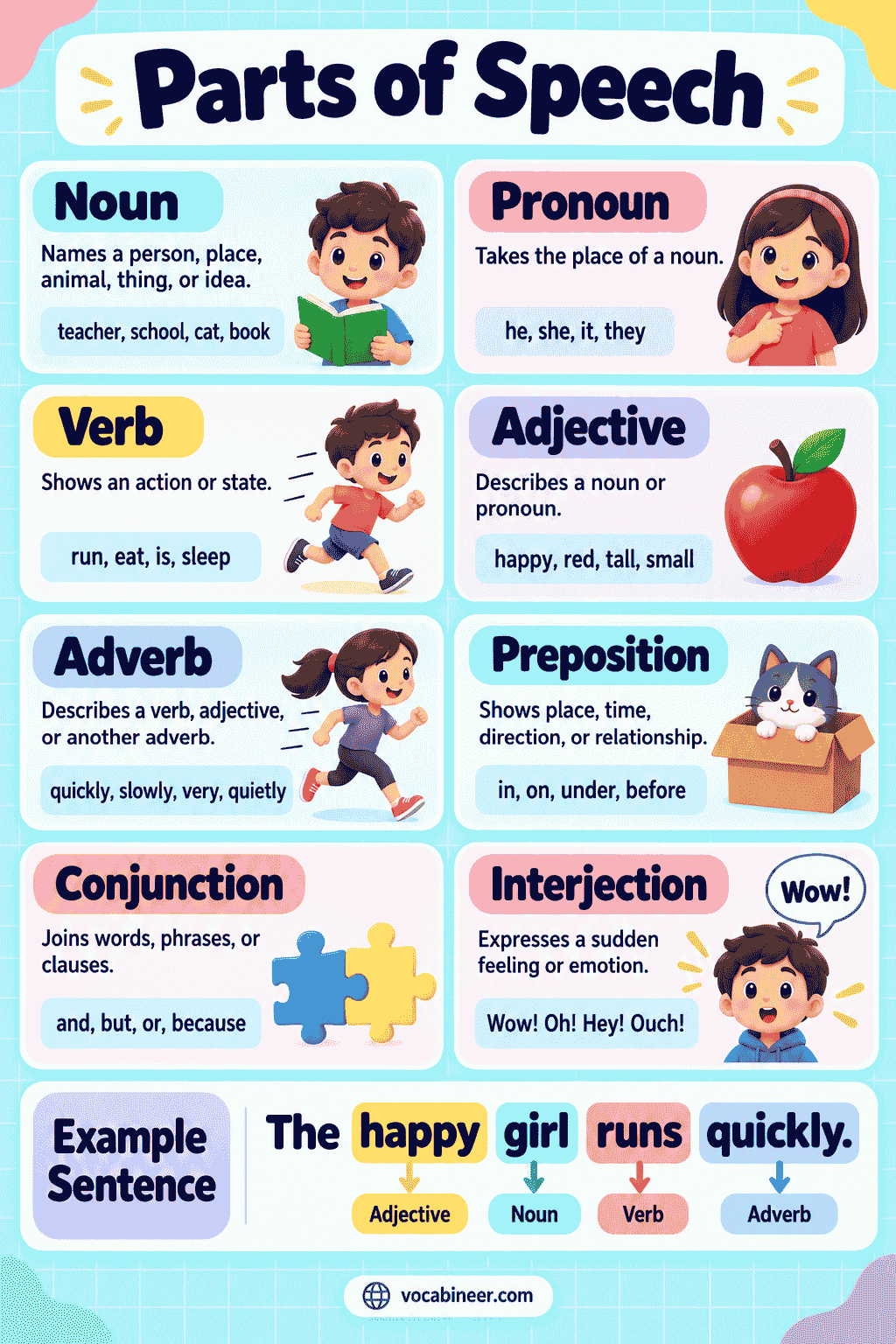
The traditional 8 parts of speech are noun, pronoun, verb, adjective, adverb, preposition, conjunction, and interjection. This article explains each one with clear definitions, examples, sentence use, comparison tables, and practical ways to identify them in context.
In This Page
What Are Parts of Speech?
Parts of speech classify words according to their grammatical function in a sentence.
For example:
- I work every day. → verb
- My work is difficult. → noun
Although the word work is the same in both sentences, its function changes. Therefore, identifying a part of speech depends on how the word is used in context.
8 Parts of Speech at a Glance
| Part of Speech | Main Function | Examples |
|---|---|---|
| Noun | names a person, place, thing, or idea | teacher, city, book, happiness |
| Pronoun | replaces a noun or noun phrase | he, she, it, they |
| Verb | expresses action, occurrence, or state | run, write, seem, be |
| Adjective | describes a noun or pronoun | red, tall, kind |
| Adverb | modifies a verb, adjective, or another adverb | quickly, very, often |
| Preposition | shows a relationship | in, on, under, before |
| Conjunction | joins words, phrases, or clauses | and, but, because |
| Interjection | expresses emotion or reaction | wow!, oh!, ouch! |
Nouns
A noun names a person, place, thing, animal, quality, concept, or idea.
Examples:
- teacher
- London
- book
- dog
- water
- happiness
- honesty
Sentence examples:
- The teacher entered the classroom.
- Sara bought a book.
- The dog is sleeping.
- Honesty is important.
Common noun groups include:
- common nouns
- proper nouns
- concrete nouns
- abstract nouns
- countable nouns
- uncountable nouns
- collective nouns
- compound nouns
- possessive nouns
A noun can perform several sentence roles, such as subject, object, or complement.
Pronouns
A pronoun replaces a noun or noun phrase, usually to avoid unnecessary repetition.
Examples:
- I
- you
- he
- she
- it
- we
- they
- this
- someone
- mine
Compare:
- Maria is my friend. Maria lives nearby.
- Maria is my friend. She lives nearby.
The pronoun she replaces Maria in the second sentence.
Common pronoun types include:
- personal pronouns
- possessive pronouns
- demonstrative pronouns
- reflexive pronouns
- relative pronouns
- interrogative pronouns
- indefinite pronouns
Verbs
A verb expresses an action, event, process, occurrence, or state.
Examples:
- run
- eat
- write
- think
- become
- seem
- know
- be
Sentence examples:
- They play football.
- She writes every morning.
- He became a doctor.
- I know the answer.
- The soup is hot.
Verbs are not only action words. Words such as know, seem, belong, and be describe states rather than physical actions.
Common verb groups include:
- action verbs
- linking verbs
- helping verbs
- transitive verbs
- intransitive verbs
- regular verbs
- irregular verbs
Adjectives
An adjective describes or gives more information about a noun or pronoun.
Examples:
- red
- tall
- kind
- expensive
- happy
- small
Sentence examples:
- She has a red bag.
- The boy is happy.
- We saw a large building.
- It was a cold morning.
Adjectives can appear before nouns:
- a beautiful flower
They can also follow linking verbs:
- The flower is beautiful.
Useful adjective groups include descriptive, quantitative, comparative, and superlative adjectives.
Adverbs
An adverb commonly modifies a verb, adjective, or another adverb.
Examples:
- quickly
- slowly
- very
- often
- yesterday
- outside
Adverb Modifying a Verb
- She ran quickly.
- He spoke softly.
Adverb Modifying an Adjective
- The water is very cold.
- The test was quite difficult.
Adverb Modifying Another Adverb
- She ran very quickly.
- He spoke extremely softly.
Common adverb groups include:
- manner
- time
- place
- frequency
- degree
Prepositions
A preposition shows a relationship between words, often involving place, time, direction, position, or movement.
Examples:
- in
- on
- at
- under
- behind
- before
- after
- toward
- between
Sentence examples:
- The keys are on the table.
- We met after lunch.
- The cat is under the chair.
- She walked toward the gate.
- He arrived before noon.
A preposition is usually followed by a noun, pronoun, or noun phrase.
Conjunctions
A conjunction connects words, phrases, or clauses.
There are three major groups.
Coordinating Conjunctions
Common examples include:
- and
- but
- or
- nor
- for
- so
- yet
Examples:
- I wanted tea but she ordered coffee.
- Sara and Ali arrived early.
Subordinating Conjunctions
These connect a dependent clause to a main clause.
Examples:
- because
- although
- if
- when
- while
- since
Sentence:
- We stayed home because it was raining.
Correlative Conjunctions
These work in pairs.
Examples:
- either…or
- neither…nor
- both…and
- not only…but also
Sentence:
- Either call me or send a message.
Interjections
An interjection expresses emotion, reaction, surprise, pain, excitement, or another sudden feeling.
Examples:
- Wow!
- Oh!
- Ouch!
- Hooray!
- Hey!
- Alas!
Sentence examples:
- Wow! That is beautiful.
- Ouch! My hand hurts.
- Oh, I understand now.
- Hooray! We won the game.
Interjections often stand apart from the grammatical structure of the main sentence.
What About Articles and Determiners?
Traditional school grammar usually teaches 8 parts of speech. However, modern grammar commonly treats determiners as a separate word class.
Determiners include words such as:
- a
- an
- the
- this
- that
- these
- those
- some
- my
- your
- both
They commonly appear before nouns and help identify, limit, or specify them.
Examples:
- The book is new.
- My bag is on the chair.
- Those students are waiting.
- Some people arrived early.
This article follows the traditional 8-part framework while recognizing determiners as a separate category in many modern grammar systems.
Articles as Determiners
The three English articles are:
- a
- an
- the
Examples:
- A boy entered the room.
- She ate an apple.
- The book is on the desk.
In modern grammar, articles are generally classified as determiners rather than treated as a separate traditional part of speech.
How to Identify Parts of Speech
Instead of memorizing only word lists, identify a word by asking what job it performs in its sentence.
Does the word name something?
It may be a noun.
Does it replace a noun?
It may be a pronoun.
Does it express an action, event, or state?
It may be a verb.
Does it describe a noun or pronoun?
It may be an adjective.
Does it modify a verb, adjective, or adverb?
It may be an adverb.
Does it show a relationship?
It may be a preposition.
Does it connect words, phrases, or clauses?
It may be a conjunction.
Does it express a sudden feeling or reaction?
It may be an interjection.
Context is especially important because some words can belong to several categories.
One Word Can Be Different Parts of Speech
A word does not always belong to one fixed category.
Work
- I work every day. → verb
- My work is difficult. → noun
Light
- Turn on the light. → noun
- This bag is light. → adjective
- Please light the candle. → verb
Well
- She sings well. → adverb
- She is well now. → adjective
- They found a well near the farm. → noun
Clean
- This is a clean room. → adjective
- Please clean the room. → verb
Therefore, the sentence context determines the part of speech.
Parts of Speech in a Sentence
Consider this sentence:
Wow, she quickly carried the heavy bag into the room, but I stayed outside.
| Word | Part of Speech |
|---|---|
| Wow | interjection |
| she | pronoun |
| quickly | adverb |
| carried | verb |
| the | determiner |
| heavy | adjective |
| bag | noun |
| into | preposition |
| the | determiner |
| room | noun |
| but | conjunction |
| I | pronoun |
| stayed | verb |
| outside | adverb |
This analysis shows how several word classes work together inside one natural sentence.
Parts of Speech vs Sentence Parts
Parts of speech and sentence parts describe different things.
| Parts of Speech | Sentence Parts |
|---|---|
| classify words | describe grammatical roles |
| noun | subject |
| verb | predicate |
| adjective | object |
| adverb | complement |
Consider:
The young boy kicked the ball.
- boy → noun and subject
- young → adjective
- kicked → verb and part of the predicate
- ball → noun and object
A noun is a word class, while subject or object describes the noun’s role in a particular sentence.
Parts of Speech vs Word Classes
The terms parts of speech and word classes are closely related.
Parts of speech is the traditional classroom term.
Word classes is common in modern grammar.
Modern word-class systems often include:
- nouns
- verbs
- adjectives
- adverbs
- pronouns
- prepositions
- conjunctions
- determiners
- interjections
This explains why some grammar books list more than eight categories.
Open and Closed Word Classes
Word classes can also be grouped according to how easily they gain new members.
Open Word Classes
These regularly gain new words:
- nouns
- verbs
- adjectives
- adverbs
For example, new technology regularly creates new nouns and verbs.
Closed Word Classes
These contain a more limited set of words:
- pronouns
- prepositions
- conjunctions
- determiners
Their membership changes much less frequently.
Content Words and Function Words
Another useful distinction separates words by how much lexical meaning they carry.
Content Words
These carry substantial meaning:
- nouns
- main verbs
- adjectives
- many adverbs
Function Words
These mainly help organize grammatical relationships:
- pronouns
- determiners
- prepositions
- conjunctions
- auxiliary verbs
This distinction adds depth, although beginners should learn the eight basic categories first.
Adjective vs Adverb
These two categories are often confused.
| Adjective | Adverb |
|---|---|
| commonly describes a noun or pronoun | commonly modifies a verb, adjective, or adverb |
| She is quick. | She runs quickly. |
| It is extremely cold. | Extremely modifies the adjective cold. |
| He is a careful driver. | He drives carefully. |
Not every adverb ends in -ly, and not every -ly word is an adverb.
For example:
- friendly → adjective
- lovely → adjective
Noun vs Verb
Some words can function as either nouns or verbs.
| Noun | Verb |
|---|---|
| I need some help. | Please help me. |
| Her work is difficult. | She works here. |
| We went for a walk. | We walk every morning. |
| That was a good answer. | Please answer the question. |
The sentence function determines the category.
Pronoun vs Determiner
Some forms can function differently depending on what follows them.
| Pronoun | Determiner |
|---|---|
| This is mine. | This book is mine. |
| Some arrived early. | Some students arrived early. |
| Those are expensive. | Those shoes are expensive. |
When the word stands in place of a noun, it can function as a pronoun. When it directly introduces a noun, modern grammar commonly classifies it as a determiner.
Preposition vs Adverb
Some words can function as either prepositions or adverbs.
| Preposition | Adverb |
|---|---|
| She went inside the house. | She went inside. |
| He walked up the hill. | He looked up. |
| They stayed outside the building. | They stayed outside. |
A preposition normally has a complement after it, while the corresponding adverb can stand without one.
Common Mistakes When Identifying Parts of Speech
Calling Every Verb an Action Word
Some verbs express states rather than actions.
Example:
- She knows the answer.
Assuming Every -ly Word Is an Adverb
Words such as friendly and lovely are commonly adjectives.
Assuming Adjectives Always Come Before Nouns
Adjectives can follow linking verbs.
Example:
- The sky is blue.
Classifying a Word Without Looking at Context
The same word can perform different functions.
Example:
- I work here. → verb
- My work is finished. → noun
Confusing Parts of Speech with Sentence Roles
A noun is not automatically a subject. It may also function as an object or complement.
Treating Articles as a Ninth Traditional Part Without Explanation
Modern grammar usually treats a, an, and the as determiners.
Parts of Speech for Kids
Children and beginners can remember the eight categories through simple meanings.
Noun
Names a person, place, thing, or idea.
Pronoun
Replaces a noun.
Verb
Expresses an action or state.
Adjective
Describes a noun or pronoun.
Adverb
Tells more about a verb, adjective, or adverb.
Preposition
Shows a relationship.
Conjunction
Joins words or ideas.
Interjection
Shows a feeling or reaction.
Consider this sentence:
Wow! The small dog ran quickly into the garden, but it came back.
- Wow → interjection
- small → adjective
- dog → noun
- ran → verb
- quickly → adverb
- into → preposition
- but → conjunction
- it → pronoun
This makes the categories easier to recognize in context.
FAQs
The traditional 8 parts of speech are noun, pronoun, verb, adjective, adverb, preposition, conjunction, and interjection.
Look at the function of each word. Ask whether it names something, replaces a noun, expresses an action or state, describes another word, shows a relationship, connects ideas, or expresses a reaction.
Yes. A word can belong to different categories depending on its function. For example, work is a verb in I work every day but a noun in My work is difficult.
Traditional school grammar often teaches eight main parts of speech. In modern grammar, a, an, and the are generally classified as determiners.
Parts of speech classify words, such as noun or verb. Sentence parts describe grammatical roles, such as subject, object, predicate, or complement.
Read More
- 12 English Tenses Chart
- All Tenses Rules and Formula
- English Tenses with Examples
- Present Tenses in English
- Past Tenses in English
- Future Tenses in English
- Be Going To in English