Collective nouns are words that name groups of people, animals, or things as a single unit. Common examples include team, family, committee, crowd, flock, herd, pack, swarm, bunch, and set.
Learning collective nouns helps students describe groups more naturally and understand how group words work in sentences. These nouns can also affect verb agreement, especially when a group is treated as one unit or when its individual members are emphasized.
In This Page
What Is a Collective Noun?
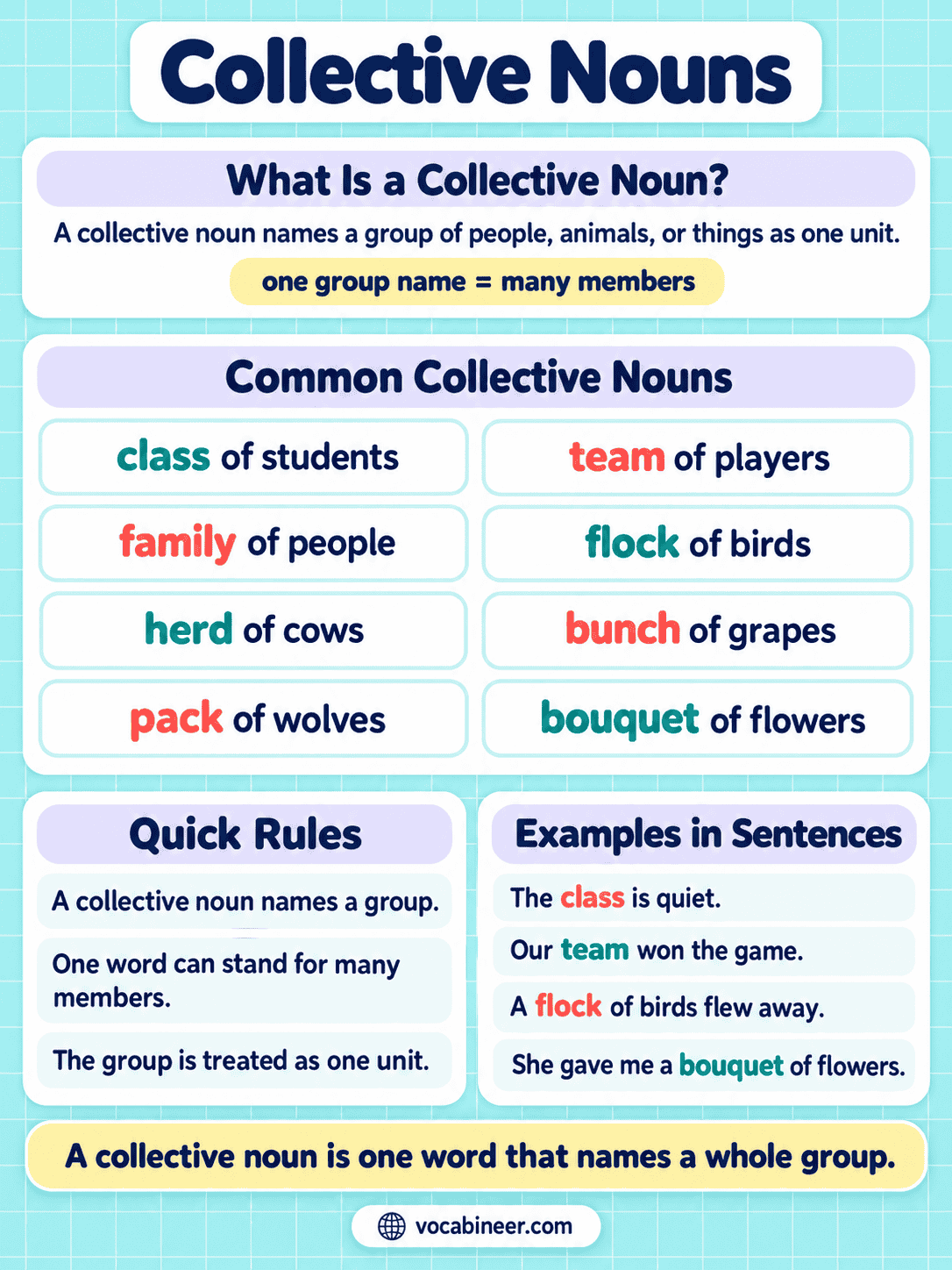
A collective noun is a noun that names a group of people, animals, or things.
Examples:
- team
- family
- committee
- audience
- flock
- herd
- swarm
- bunch
Sentence examples:
- The team won the match.
- A flock of birds flew overhead.
- The committee met this morning.
- She carried a bunch of flowers.
Although a collective noun refers to several members, the word itself names the group as a whole.
Collective Nouns at a Glance
| Category | Collective Noun | Example |
|---|---|---|
| people | team | a team of players |
| people | crowd | a crowd of people |
| people | committee | a committee of members |
| animals | flock | a flock of birds |
| animals | herd | a herd of cattle |
| animals | pack | a pack of wolves |
| insects | swarm | a swarm of bees |
| fish | shoal | a shoal of fish |
| things | bunch | a bunch of keys |
| things | set | a set of tools |
Collective Nouns for People
Collective nouns for people name groups formed by several individuals.
Common examples include:
- team
- family
- class
- committee
- audience
- crew
- crowd
- staff
- jury
- choir
Sentence examples:
- The team practiced early.
- Our family lives nearby.
- The audience applauded.
- The committee approved the plan.
- The crew prepared the aircraft.
- The class started at nine.
Each noun represents several people together as one group.
Collective Nouns for Animals
Different collective nouns describe groups of animals.
Common examples include:
- flock of birds
- herd of cattle
- pack of wolves
- swarm of bees
- shoal of fish
- pride of lions
- litter of puppies
- colony of ants
- troop of monkeys
Sentence examples:
- A flock of birds crossed the sky.
- A herd of cattle moved through the field.
- A pack of wolves travelled together.
- A swarm of bees surrounded the hive.
- A pride of lions rested in the shade.
For everyday English, familiar group words are usually more useful than rare or highly unusual animal terms.
Collective Nouns for Things
Collective nouns can also name groups or collections of objects.
Examples:
- bunch of keys
- bunch of flowers
- set of tools
- pack of cards
- stack of books
- pile of clothes
- collection of stamps
- fleet of ships
Sentence examples:
- She carried a bunch of flowers.
- He bought a set of tools.
- A stack of books stood on the desk.
- I found a pack of cards in the drawer.
- The navy sent a fleet of ships.
Collective Noun + Of + Plural Noun
A common collective-noun pattern is:
collective noun + of + plural noun
Examples:
- a team of players
- a flock of birds
- a herd of cattle
- a bunch of flowers
- a pack of wolves
- a swarm of bees
- a class of students
- a collection of stamps
The collective noun names the group, while the plural noun identifies its members.
Singular Verbs with Collective Nouns
When a group is treated as one unit, a singular verb is common.
Examples:
- The team is ready.
- The committee has made a decision.
- The audience was quiet.
- The family lives nearby.
- The crew is prepared.
Here, the group is viewed as a single whole.
Plural Verbs with Collective Nouns
A plural verb may be used when the individual members of the group are emphasized, especially in British English.
Examples:
- The team are wearing different shirts.
- The committee are arguing among themselves.
- The audience were taking their seats.
- The family are discussing their different plans.
Here, attention shifts from the whole group to the individual members.
Singular vs Plural Agreement with Collective Nouns
| Meaning | Verb Choice | Example |
|---|---|---|
| group as one unit | singular | The team is ready. |
| members individually | plural | The team are arguing. |
| audience as one group | singular | The audience was large. |
| audience members individually | plural | The audience were cheering. |
The choice depends partly on meaning and variety of English.
British vs American Usage
British English more readily allows plural agreement when individual group members are emphasized.
British-style example:
- The team are playing well.
American English generally prefers singular agreement with a singular collective noun:
- The team is playing well.
These are broad usage tendencies rather than absolute rules.
Collective Nouns Can Be Plural
Collective nouns can themselves take plural forms when more than one group is involved.
Examples:
- team → teams
- family → families
- committee → committees
- flock → flocks
- crowd → crowds
Sentence examples:
- Several teams are competing.
- The families have arrived.
- Two flocks were flying south.
- The committees are meeting separately.
Once the collective noun itself becomes plural, it takes ordinary plural agreement.
Collective Noun vs Plural Noun
A collective noun names the group itself, while a plural noun names multiple members.
| Collective Noun | Plural Noun |
|---|---|
| team | players |
| class | students |
| flock | birds |
| herd | cows |
| crew | workers |
Compare:
- The team is practicing.
- The players are practicing.
- The class is quiet.
- The students are quiet.
The meaning is related, but the noun being named is different.
Collective Noun vs Common Noun
Collective and common nouns are not opposite categories. A collective noun is often also a common noun.
For example:
Team
Team can be:
- a common noun
- a collective noun
- a countable noun
Family
Family can be:
- a common noun
- a collective noun
- a countable noun
Therefore, one noun can belong to more than one noun category.
Collective Noun vs Proper Noun
A collective noun gives a general group name, while a proper noun may name a particular group.
Compare:
- team → collective common noun
- Manchester United → proper noun naming a specific team
- company → common noun
- Microsoft → proper noun naming a specific company
This distinction helps separate group meaning from specific naming.
Common Collective Nouns for People
| Collective Noun | Group |
|---|---|
| team | players or workers |
| family | relatives |
| class | students |
| audience | spectators or listeners |
| committee | members |
| crew | workers |
| crowd | people |
| choir | singers |
| jury | jurors |
| staff | employees |
These are among the most useful collective nouns in everyday English.
Common Collective Nouns for Animals
| Collective Noun | Animals |
|---|---|
| flock | birds, sheep |
| herd | cattle, goats |
| pack | wolves, dogs |
| swarm | bees, insects |
| shoal | fish |
| pride | lions |
| litter | puppies, kittens |
| colony | ants |
| troop | monkeys |
Some animals have several possible group terms, but beginners should learn the common forms first.
Common Collective Nouns for Things
| Collective Noun | Things |
|---|---|
| bunch | keys, flowers, grapes |
| set | tools, rules, dishes |
| pack | cards |
| stack | books, papers |
| pile | clothes, stones |
| collection | stamps, coins |
| fleet | ships, vehicles |
These words help describe collections of objects clearly.
How to Identify a Collective Noun
A word may be a collective noun if it:
- names a group
- refers to several members together
- identifies the whole group rather than one member
- can often appear before of + plural noun
Examples:
- a team of players
- a flock of birds
- a bunch of keys
- a committee of members
A useful question is:
Does this noun name the whole group rather than an individual member?
If yes, it may be a collective noun.
Collective Nouns in Sentences
The following examples show collective nouns in natural contexts:
- The team won the match.
- A flock of birds flew across the sky.
- The committee approved the proposal.
- A herd of cattle crossed the road.
- She carried a bunch of flowers.
- The audience was silent.
- The crew prepared the equipment.
- A swarm of bees flew around the hive.
- The family lives in a small town.
- He bought a set of tools.
These examples show people, animals, and things in the same grammatical category.
Not Every Group Needs a Special Collective Noun
English does not require a special group word for every possible group.
Natural examples include:
- a group of students
- a group of tourists
- a group of dolphins
- a group of friends
Using group of is often clearer and more natural than forcing a rare collective expression.
Common Mistakes with Collective Nouns
Confusing the Group with Its Members
A team is the group, while players are its individual members.
Assuming Every Collective Noun Always Takes a Singular Verb
Singular agreement is common when the group acts as one unit, but plural agreement may occur when individual members are emphasized.
Forgetting Agreement with Plural Collective Nouns
Incorrect: The teams is ready.
Correct: The teams are ready.
Using Rare Group Terms Unnaturally
A simple phrase such as a group of dolphins may be clearer than an unfamiliar specialist collective noun.
Thinking Collective Nouns Cannot Belong to Other Noun Types
Words such as team and family are also common and countable nouns.
Collective Nouns for Kids
A simple definition for children is:
A collective noun is a word that names a group of people, animals, or things.
Examples:
- team → group of players
- class → group of students
- flock → group of birds
- herd → group of cows
- bunch → group of flowers
Sentence examples:
- A flock of birds flew across the sky.
- Our class visited the museum.
- The team won the game.
- She picked a bunch of flowers.
These examples make the group idea easy to recognize.
FAQs
A collective noun is a noun that names a group of people, animals, or things as a unit, such as team, family, flock, or bunch.
Common examples include team, family, class, committee, audience, flock, herd, pack, swarm, bunch, and set.
A singular verb is common when the group is viewed as one unit. A plural verb may be used when the individual members are emphasized, especially in British English.
A collective noun names one group, such as team, while a plural noun names several individual members, such as players.
Yes. Words such as team, family, and class are both common nouns and collective nouns.
Read More
- 12 English Tenses Chart
- Parts of Speech in English
- Nouns in English with Examples
- Common and Proper Nouns
- Countable and uncountable nouns
- Be Going To in English