

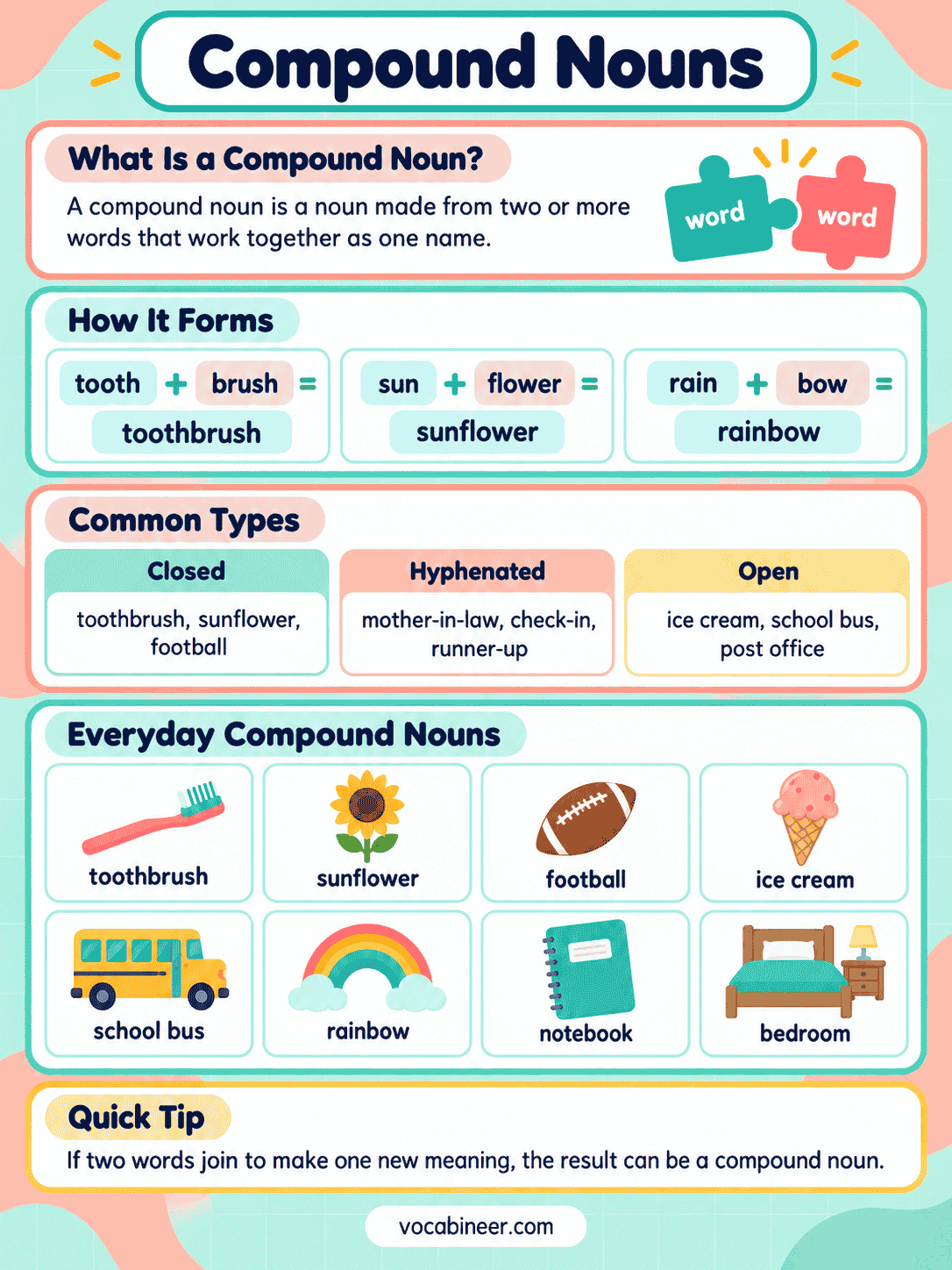
Compound nouns are formed when two or more words work together as one noun. They can name people, places, objects, events, activities, or ideas. Common examples include toothbrush, bedroom, school bus, coffee shop, washing machine, and mother-in-law.
Learning compound nouns helps students understand how English combines familiar words to create new meanings. It also helps with spelling, plural forms, pronunciation, sentence use, and the difference between compounds and ordinary descriptive phrases.
In This Page
What Are Compound Nouns?
A compound noun is a noun made from two or more words that function together as one unit of meaning.
Examples:
- tooth + brush → toothbrush
- bed + room → bedroom
- school + bus → school bus
- coffee + shop → coffee shop
- mother + in + law → mother-in-law
Although the parts have their own meanings, the complete compound functions as one noun.
For example:
- toothbrush names one object
- bus stop names one place
- mother-in-law names one family relationship
How Compound Nouns Are Formed
English forms compound nouns through several word combinations. Some patterns are very common, while others appear in a smaller number of words.
Noun + Noun
This is one of the most common compound noun patterns.
Examples:
- toothbrush
- bedroom
- classroom
- football
- school bus
- coffee shop
- raincoat
- website
- doorbell
- notebook
In many noun + noun compounds, the first noun gives more information about the second.
For example:
- a school bus is a type of bus
- a coffee shop is a type of shop
- a toothbrush is a type of brush
Adjective + Noun
Some compound nouns combine an adjective with a noun.
Examples:
- greenhouse
- blackboard
- blackberry
- highway
These combinations develop established meanings and function as nouns.
For example, a greenhouse is not simply any house that is green. It is a structure used for growing plants.
-ing Form + Noun
Many common compounds begin with an -ing form.
Examples:
- washing machine
- swimming pool
- parking ticket
- dining room
- walking stick
The first part usually describes the activity connected with the second noun.
Nouns for People and Roles
Many compounds name people according to their occupation, role, or relationship.
Examples:
- bus driver
- shopkeeper
- firefighter
- babysitter
- hairdresser
- police officer
- schoolteacher
- mother-in-law
Other Common Compound Patterns
Some compounds follow less regular patterns.
Examples:
- rainfall
- sunrise
- haircut
- check-in
- passer-by
- breakthrough
These forms are best learned as complete vocabulary items rather than forced into one simple rule.
Closed, Open, and Hyphenated Compound Nouns
Compound nouns can be written in three main ways.
| Form | How It Is Written | Examples |
|---|---|---|
| Closed | one word | toothbrush, bedroom, notebook |
| Open | separate words | school bus, coffee shop, post office |
| Hyphenated | joined with hyphens | mother-in-law, runner-up, check-in |
The spelling does not determine whether something is a compound noun. In all three forms, the words work together as one noun.
Closed Compound Nouns
A closed compound noun is written as one word.
Examples:
- bedroom
- bathroom
- toothbrush
- notebook
- playground
- football
- rainfall
- website
- doorbell
- airport
Sentence examples:
- My bedroom is upstairs.
- She bought a new toothbrush.
- The children played on the playground.
- Heavy rainfall caused flooding.
Open Compound Nouns
An open compound noun is written as two or more separate words but still expresses one noun meaning.
Examples:
- school bus
- coffee shop
- car park
- post office
- swimming pool
- washing machine
- bus stop
- dining room
- mobile phone
- police officer
Sentence examples:
- The children waited for the school bus.
- She works in a coffee shop.
- The washing machine needs repair.
- We met at the bus stop.
Separate spelling does not make these ordinary phrases. They still function as established compound nouns.
Hyphenated Compound Nouns
A hyphenated compound noun joins its parts with one or more hyphens.
Examples:
- mother-in-law
- sister-in-law
- runner-up
- passer-by
- check-in
Sentence examples:
- My mother-in-law visited yesterday.
- The runner-up received a medal.
- A passer-by called for help.
- Hotel check-in begins at two.
Hyphen use is not always predictable, so learners should check a reliable dictionary when unsure.
Compound Spelling Can Vary
There is no single rule that tells learners whether every compound should be written as one word, separate words, or with a hyphen.
Compare:
- bedroom
- bus stop
- mother-in-law
All three are compound nouns, even though their spelling differs.
In addition, compound spellings can change over time as usage develops. Therefore, dictionary checking is useful when a form looks uncertain.
How Compound Nouns Develop Meaning
Compound nouns often create meanings that are more specific than the separate words suggest.
Compare:
| Compound Noun | Ordinary Phrase |
|---|---|
| greenhouse | green house |
| blackbird | black bird |
| blackboard | black board |
A greenhouse is a structure used for growing plants.
A green house is simply a house that is green.
Likewise, a blackbird refers to a particular kind of bird, while a black bird may describe any bird that happens to be black.
This meaning difference is one of the clearest ways to understand compound nouns.
Compound Noun vs Noun Phrase
A compound noun and an ordinary noun phrase may look similar, but they do not always function in the same way.
| Compound Noun | Ordinary Noun Phrase |
|---|---|
| greenhouse | green house |
| blackbird | black bird |
| school bus | large bus |
| coffee shop | busy shop |
A compound noun usually has an established meaning. By contrast, an ordinary noun phrase describes something more freely in context.
For example:
- greenhouse → a structure for growing plants
- green house → a house whose color is green
How to Form Plurals of Compound Nouns
Most compound nouns form the plural by changing the main noun.
Examples:
| Singular | Plural |
|---|---|
| toothbrush | toothbrushes |
| school bus | school buses |
| coffee shop | coffee shops |
| bedroom | bedrooms |
| washing machine | washing machines |
In many compounds, the main noun appears at the end, so the plural ending is added there.
Plurals When the Main Noun Comes First
Some compounds place the main noun before another element. In these cases, pluralize the main noun rather than simply adding -s to the last word.
| Singular | Plural |
|---|---|
| mother-in-law | mothers-in-law |
| sister-in-law | sisters-in-law |
| passer-by | passers-by |
Incorrect:
- mother-in-laws
- sister-in-laws
Correct:
- mothers-in-law
- sisters-in-law
The safest rule is:
Pluralize the main noun in the compound.
Stress in Compound Nouns
Compound nouns often place stronger spoken stress on the first element.
Examples:
- TOOTHbrush
- GREENhouse
- BLACKbird
- BUS stop
- DOORbell
Stress can sometimes help distinguish a compound from an ordinary phrase.
Compare:
- GREENhouse → structure for growing plants
- green HOUSE → a house that is green
However, stress patterns vary, so this should be treated as a useful clue rather than an absolute rule.
Compound Nouns for People
Many compound nouns refer to people, occupations, roles, and relationships.
Examples:
- schoolteacher
- shopkeeper
- firefighter
- bus driver
- babysitter
- hairdresser
- police officer
- mother-in-law
- sister-in-law
Sentence examples:
- The bus driver stopped the vehicle.
- A firefighter entered the building.
- The shopkeeper opened the store.
- My mother-in-law lives nearby.
Compound Nouns for Places
Compound nouns commonly name familiar places.
Examples:
- bedroom
- bathroom
- classroom
- playground
- airport
- bus stop
- car park
- coffee shop
- post office
- swimming pool
Sentence examples:
- The children are in the classroom.
- We waited at the bus stop.
- They parked in the car park.
- She went to the post office.
Compound Nouns for Objects
Many everyday objects have compound names.
Examples:
- toothbrush
- notebook
- football
- raincoat
- doorbell
- washing machine
- coffee cup
- mobile phone
- keyboard
- saucepan
Sentence examples:
- My toothbrush is blue.
- The doorbell rang twice.
- Her mobile phone is charging.
- The washing machine is running.
Compound Nouns for Events, Actions, and Ideas
Compound nouns can also name events, activities, conditions, or ideas.
Examples:
- sunrise
- rainfall
- homework
- teamwork
- birthday
- check-in
- breakthrough
- feedback
Sentence examples:
- We watched the sunrise.
- Heavy rainfall damaged the road.
- Good teamwork improved the result.
- The scientist made a major breakthrough.
Compound nouns are therefore not limited to physical objects.
Compound Nouns in Sentences
These examples show different types of compound nouns in natural use:
- I bought a new toothbrush.
- Her bedroom is very tidy.
- The children waited for the school bus.
- We met at the coffee shop.
- The washing machine stopped working.
- My mother-in-law visited yesterday.
- Heavy rainfall caused flooding.
- The children played on the playground.
- His homework is complete.
- The bus driver opened the door.
Compound Noun vs Compound Adjective
Compound nouns and compound adjectives have different grammatical jobs.
| Compound Noun | Compound Adjective |
|---|---|
| functions as a noun | describes another noun |
| coffee shop | full-time job |
| bus stop | well-known actor |
| toothbrush | high-speed train |
Examples:
- She works at a coffee shop. → compound noun
- She has a full-time job. → compound adjective
A compound noun names something, while a compound adjective describes something.
Compound Noun vs Compound Word
A compound word is a broader term.
Compound words can function as:
- nouns
- adjectives
- verbs
- other word classes
A compound noun is specifically a compound that functions as a noun.
For example:
- toothbrush → compound noun
- well-known → compound adjective
Therefore, every compound noun is a compound word, but not every compound word is a noun.
Compound Nouns and Other Noun Types
“Compound” describes how a noun is formed. The same noun can also belong to other noun categories.
For example:
Toothbrush
- compound noun
- common noun
- concrete noun
- countable noun
Homework
- compound noun
- common noun
- normally uncountable noun
Mother-in-law
- compound noun
- common noun
- countable noun
- person noun
Noun classifications can therefore overlap.
How to Identify a Compound Noun
A word or expression may be a compound noun if:
- it contains two or more meaningful parts
- the parts work together as one noun
- the complete expression names one person, place, thing, event, or idea
- it often has an established meaning
- it may be closed, open, or hyphenated
A useful question is:
Do these words work together as one noun rather than as separate descriptive words?
If yes, the expression may be a compound noun.
Common Mistakes with Compound Nouns
Thinking Every Compound Noun Is One Word
Incorrect idea: all compounds must be closed.
Correct: toothbrush, school bus, and mother-in-law are all compound nouns.
Pluralizing the Wrong Part
Incorrect: mother-in-laws
Correct: mothers-in-law
Adding Hyphens to Every Compound
Compound spelling varies. Some compounds are closed, some are open, and others are hyphenated.
Confusing a Compound with a Descriptive Phrase
Compare:
- greenhouse → compound noun
- green house → adjective + noun phrase
Confusing Compound Nouns with Compound Adjectives
A compound noun names something, while a compound adjective describes a noun.
Assuming Spelling Is Always Predictable
When unsure whether a compound is open, closed, or hyphenated, check a reliable dictionary.
Compound Nouns for Kids
A simple way to understand compound nouns is:
A compound noun is made when two or more words work together to name one person, place, thing, or idea.
Examples:
- tooth + brush = toothbrush
- bed + room = bedroom
- school + bus = school bus
- rain + coat = raincoat
- play + ground = playground
Sentence examples:
- My toothbrush is blue.
- The children are on the playground.
- We waited for the school bus.
- I put on my raincoat.
These examples make it easy to see how smaller words combine to create one noun.
FAQs
A compound noun is a noun formed from two or more words that work together as one unit of meaning, such as toothbrush, school bus, or mother-in-law.
Compound nouns can be closed as in bedroom, open as in coffee shop, or hyphenated as in mother-in-law.
They can form through patterns such as noun + noun, adjective + noun, -ing form + noun, and other established word combinations.
Pluralize the main noun. For example, school bus becomes school buses, while mother-in-law becomes mothers-in-law.
A compound noun has an established combined meaning, while an ordinary noun phrase describes a noun more freely. For example, greenhouse is a compound noun, while green house describes a house that is green.
Read More
- 12 English Tenses Chart
- Parts of Speech in English
- Nouns in English with Examples
- Common and Proper Nouns
- Countable and uncountable nouns
- Be Going To in English