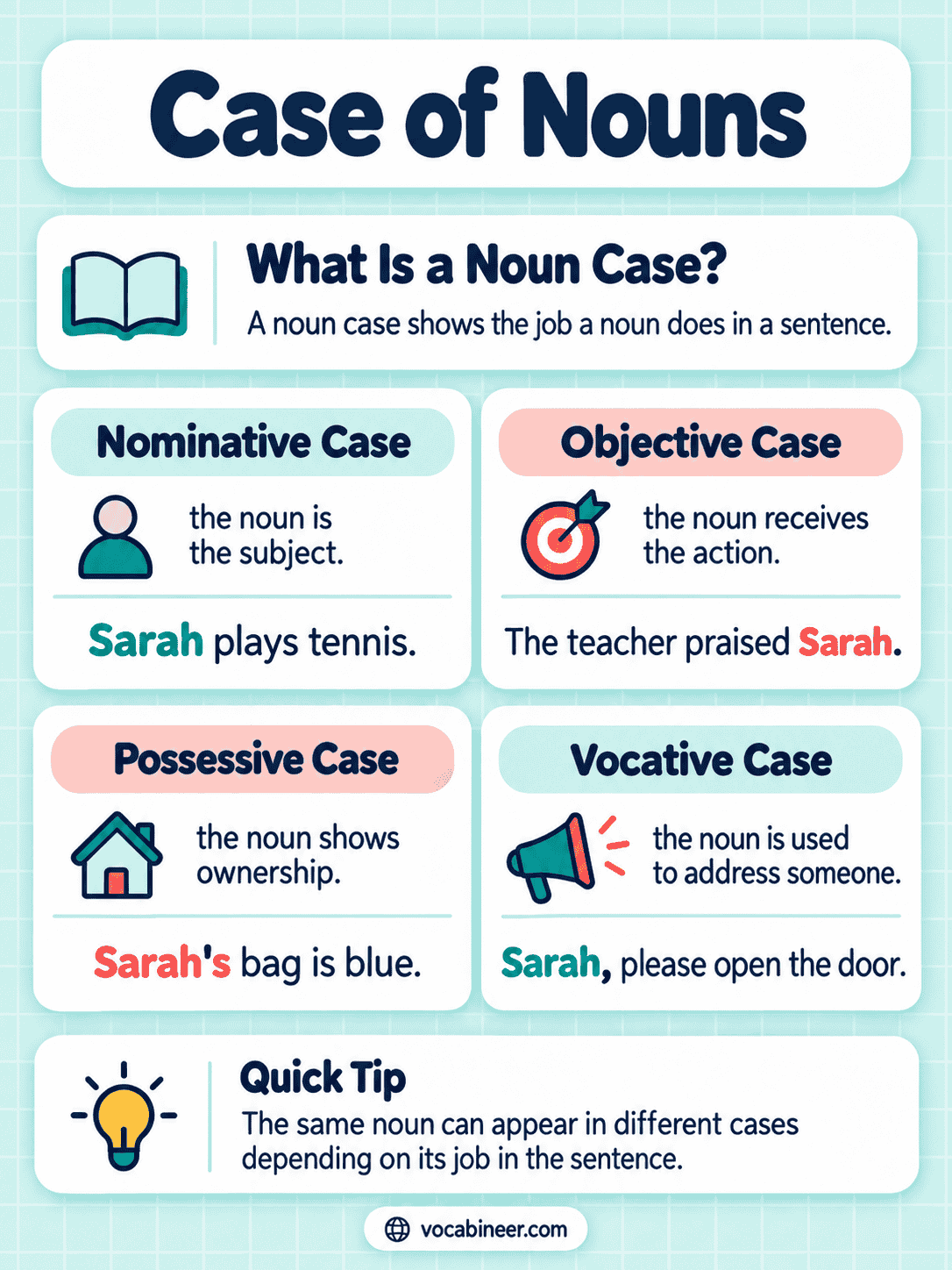
The case of a noun shows the grammatical role that noun performs in a sentence. A noun may act as a subject, object, possessor, indirect object, or word of direct address. Traditional grammar describes these roles through cases such as nominative, objective, possessive, dative, and vocative.
Learning noun cases helps students understand sentence structure, identify how nouns relate to verbs and other words, and use possessive forms correctly. In modern English, most nouns do not change their form for each case, so word order, prepositions, and possessive marking are especially important.
In This Page
What Does Case Mean in English Grammar?
In grammar, case describes the relationship of a noun or pronoun to other words in a sentence.
Compare:
- Ali opened the door.
- Sara called Ali.
- This is Ali’s bag.
- She gave Ali a book.
- Ali, come here.
The same noun appears in several different grammatical roles.
In these examples:
- Ali is the subject
- Ali is the object
- Ali’s shows possession
- Ali is the indirect object
- Ali is directly addressed
The basic idea is:
The case of a noun tells us what grammatical job the noun is doing in the sentence.
Main Cases of Nouns
Traditional English grammar commonly recognizes five main noun cases:
- Nominative Case
- Objective Case
- Possessive or Genitive Case
- Dative Case
- Vocative Case
These cases are best understood through sentence function rather than through endings alone.
| Case | Main Function | Example |
|---|---|---|
| Nominative | subject | Ali opened the door. |
| Objective | object | Sara called Ali. |
| Possessive | ownership or connection | Ali’s bag |
| Dative | indirect object | She gave Ali a book. |
| Vocative | direct address | Ali, come here. |
Nominative Case
A noun is in the nominative case when it functions as the subject of a sentence.
The subject usually performs the action or is the main noun connected with the verb.
Examples:
- Ali opened the window.
- The teacher explained the lesson.
- The dog barked loudly.
- Maria arrived early.
- The children played outside.
In:
Ali opened the window.
Ali performs the action of opening, so it is in the nominative case.
The simple rule is:
Nominative case = subject
Objective Case
A noun is in the objective case when it functions as the object of a verb or follows a preposition in traditional grammar.
Examples:
- Sara called Ali.
- The boy kicked the ball.
- We visited the museum.
- She opened the door.
- The cat slept under the table.
In:
Sara called Ali.
Ali receives the action of the verb called, so it functions as the object.
The simple rule is:
Objective case = object
Unlike pronouns, ordinary English nouns usually keep the same form whether they are subjects or objects.
Compare:
- Ali called Sara.
- Sara called Ali.
The noun does not change, but its role does.
Possessive or Genitive Case
The possessive case, also called the genitive case, shows ownership, relationship, association, time, or another close connection.
Examples:
- Ali’s book
- the teacher’s desk
- the dog’s collar
- the company’s policy
- today’s meeting
- the students’ books
This is the noun case that most clearly changes the visible form of an English noun.
The simple rule is:
Possessive case = ownership or connection
How the Possessive Case Is Formed
The possessive ending depends on whether the noun is singular, plural, or irregular.
Singular Nouns
Add ’s.
Examples:
- boy → boy’s
- teacher → teacher’s
- Ali → Ali’s
- dog → dog’s
In sentences:
- The boy’s bicycle is outside.
- The teacher’s desk is near the window.
- Ali’s bag is on the chair.
Regular Plural Nouns Ending in S
Add only an apostrophe after the final s.
Examples:
- students → students’
- teachers → teachers’
- girls → girls’
In sentences:
- The students’ books are on the desks.
- The teachers’ room is upstairs.
Irregular Plural Nouns
If the plural does not end in s, add ’s.
Examples:
- children → children’s
- men → men’s
- women → women’s
In sentences:
- The children’s toys are outside.
- The women’s team won the match.
Dative Case
The dative case traditionally refers to the indirect object.
An indirect object usually tells us to whom, for whom, or for what something is given, sent, shown, or done.
Examples:
- She gave Ali a book.
- The teacher told the students a story.
- I sent Sara a message.
- My mother bought me a gift.
In:
She gave Ali a book.
Ali receives the book indirectly, so traditional grammar describes it as dative.
The simple rule is:
Dative case = indirect object
Modern English nouns do not have a special dative ending.
Compare:
- She gave Ali a book.
- She gave a book to Ali.
The noun form stays the same.
Objective vs Dative Case
The objective and dative functions are easy to confuse because both can appear after a verb.
| Direct Object | Indirect Object |
|---|---|
| receives the action directly | receives or benefits from something |
| She gave Ali a book. | She gave Ali a book. |
| He sent Sara a message. | He sent Sara a message. |
| I bought my brother a gift. | I bought my brother a gift. |
A useful test is:
What was given or sent? → direct object
To whom was it given or sent? → indirect object
Vocative Case
A noun is in the vocative case when it is used to address someone directly.
Examples:
- Ali, come here.
- Children, listen carefully.
- Doctor, can you help me?
- Thank you, John.
- Please sit down, students.
The vocative noun does not act as the subject or object of the sentence. It identifies the person or group being addressed.
The simple rule is:
Vocative case = direct address
Vocative Case and Commas
Vocative nouns are usually separated by commas.
Examples:
- Sara, please close the door.
- Please listen, children.
- Thank you, teacher.
- John, can you help me?
- Come here, Ali.
The comma helps separate the person being addressed from the rest of the sentence.
Same Noun in Different Case Functions
Using the same noun makes case differences easier to understand.
Ali
| Sentence | Case |
|---|---|
| Ali opened the door. | Nominative |
| I called Ali. | Objective |
| I gave Ali the book. | Dative |
| This is Ali’s bag. | Possessive |
| Ali, come here. | Vocative |
Teacher
| Sentence | Case |
|---|---|
| The teacher entered. | Nominative |
| I called the teacher. | Objective |
| I gave the teacher the book. | Dative |
| The teacher’s desk is new. | Possessive |
| Teacher, please help me. | Vocative |
The noun often keeps the same spelling, but its grammatical function changes.
Nominative vs Objective Case
The nominative case identifies the subject, while the objective case identifies the object.
| Nominative Case | Objective Case |
|---|---|
| noun is the subject | noun is the object |
| performs or controls the action | receives or is affected by the action |
| Ali called Sara. | Sara called Ali. |
| The dog chased the cat. | The cat saw the dog. |
Compare:
- Ali called Sara. → Ali = nominative
- Sara called Ali. → Ali = objective
In both sentences, the noun Ali keeps the same form.
Possessive Case vs Other Cases
The possessive case is different because it usually changes the noun form.
Compare:
| Case | Example |
|---|---|
| Nominative | John arrived. |
| Objective | I saw John. |
| Dative | I gave John a book. |
| Vocative | John, come here. |
| Possessive | John’s book |
Only the possessive form visibly changes from John to John’s.
This is one of the most important facts about noun case in modern English.
Noun Case vs Pronoun Case
Pronouns show case differences much more clearly than ordinary nouns.
| Subjective | Objective | Possessive |
|---|---|---|
| I | me | my / mine |
| he | him | his |
| she | her | her / hers |
| we | us | our / ours |
| they | them | their / theirs |
Compare:
- I called him.
- He called me.
- This is my book.
- This book is mine.
Now compare an ordinary noun:
- John called Sarah.
- Sarah called John.
- This is John’s book.
The noun changes clearly only in the possessive form.
Nominative vs Subjective Case
The terms nominative and subjective usually describe the same basic role: the subject.
Examples:
- She works here.
- They arrived early.
- Ali opened the door.
In learner grammar:
- nominative is the traditional term
- subjective is often used when discussing pronouns
They should not be treated as two completely different cases.
Objective vs Accusative Case
The terms objective and accusative can also overlap.
The objective case is the common learner term for nouns or pronouns used as objects.
The term accusative is more traditional and often refers specifically to the direct object.
For beginner English, objective case is usually clearer.
Possessive vs Genitive Case
The terms possessive case and genitive case usually refer to the same basic English relationship.
Examples:
- Sarah’s bag
- the students’ books
- children’s toys
- today’s meeting
Possessive is the simpler learner term, while genitive is the more technical grammatical term.
How Modern English Shows Case
Modern English does not have a large system of noun endings for case.
Compare:
- John called Sarah.
- Sarah called John.
- I gave John a book.
- John, come here.
The form John stays the same.
Only the possessive clearly changes:
- John → John’s
Therefore:
Modern English shows noun case mainly through sentence role, word order, prepositions, and possessive marking.
Traditional case labels remain useful for describing function, but most ordinary nouns do not change form for each case.
Case and Word Order
Word order is especially important because English nouns do not usually show subject and object roles through endings.
Compare:
- The dog chased the cat.
- The cat chased the dog.
The same nouns appear in both sentences, but changing their positions changes the meaning.
In the first sentence:
- dog = subject
- cat = object
In the second:
- cat = subject
- dog = object
This shows why word order is central to modern English grammar.
Case and Prepositions
Prepositions also help express grammatical relationships.
Examples:
- to the teacher
- for Sara
- with John
- under the table
- beside the house
- near the school
In traditional grammar, nouns after prepositions are often described as being in the objective case.
Examples:
- She spoke to the teacher.
- He sat beside Ali.
- The bag is under the table.
The noun itself still does not change form.
Possession with ’s and Of
English can express possession or close relationships in more than one way.
Compare:
- John’s car
- the roof of the house
Possessive ’s is especially common with:
- people
- animals
- organizations
- time expressions
Examples:
- Maria’s bag
- the dog’s collar
- the company’s policy
- today’s meeting
The of construction is often natural with things and longer phrases:
- the roof of the house
- the end of the road
- the door of the building
Both structures can express relationships between nouns.
Case of Nouns in Sentences
These examples show the traditional cases in natural sentences.
Nominative
- The boy opened the gate.
- Maria sings well.
- The dog is sleeping.
Objective
- I saw the boy.
- We called Maria.
- She fed the dog.
Possessive
- The boy’s bag is blue.
- Maria’s voice is beautiful.
- The dog’s bowl is empty.
Dative
- I gave the boy a book.
- She sent Maria a message.
- He gave the dog some food.
Vocative
- Boy, come here.
- Maria, please listen.
- Dog, stay there.
The same noun can perform different roles depending on the sentence.
Common Errors with Noun Cases
Thinking Every Case Changes the Noun Ending
In modern English, nominative, objective, dative, and vocative nouns usually keep the same form.
Confusing Objective and Dative Functions
The direct object receives the action directly, while the indirect object receives or benefits from something.
Treating the Dative as a Special English Ending
English nouns do not normally have a separate dative form.
Confusing Noun Case with Pronoun Case
Pronouns change more clearly, such as I/me, while ordinary nouns usually do not.
Ignoring Vocative Commas
Direct address usually needs commas.
Incorrect:
- Sara please sit down.
Better:
- Sara, please sit down.
Treating Possessive and Genitive as Completely Different Cases
In English, the two terms usually describe the same basic relationship.
Relying Only on Word Form
A noun’s position and function often show its case more clearly than its spelling.
Case of Nouns for Kids
A simple way to understand noun case is:
The case of a noun tells us what job the noun is doing in a sentence.
Using Ali:
- Ali runs. → subject
- I saw Ali. → object
- This is Ali’s book. → possession
- I gave Ali a pen. → receiver
- Ali, come here. → direct address
Children can learn the sentence role first and add the technical labels later:
- subject → nominative
- object → objective
- possession → possessive
- receiver → dative
- direct address → vocative
FAQs
The case of a noun describes its grammatical role or relationship in a sentence, such as subject, object, possession, indirect object, or direct address.
The five commonly taught cases are nominative, objective, possessive or genitive, dative, and vocative.
A noun is in the nominative case when it functions as the subject, as in Ali opened the door.
The objective case usually refers to a direct object, while the dative case traditionally refers to an indirect object. In She gave Ali a book, book is the direct object and Ali is the indirect object.
The possessive case shows ownership or another close relationship, as in Ali’s book, the students’ room, and children’s toys.
Usually not. Modern English nouns generally keep the same form in nominative, objective, dative, and vocative functions. The possessive or genitive is the main visibly marked noun case.
Because nouns usually do not change endings, their position often shows whether they are subjects or objects. Compare The dog chased the cat with The cat chased the dog.
Read More
- Parts of Speech in English
- Nouns in English with Examples
- Common and Proper Nouns
- Countable and uncountable nouns
- Collective nouns
- Abstract and concrete nouns
- Gender nouns
- Compound nouns
- Possessive nouns
- Singular and plural nouns
- Plural noun rules