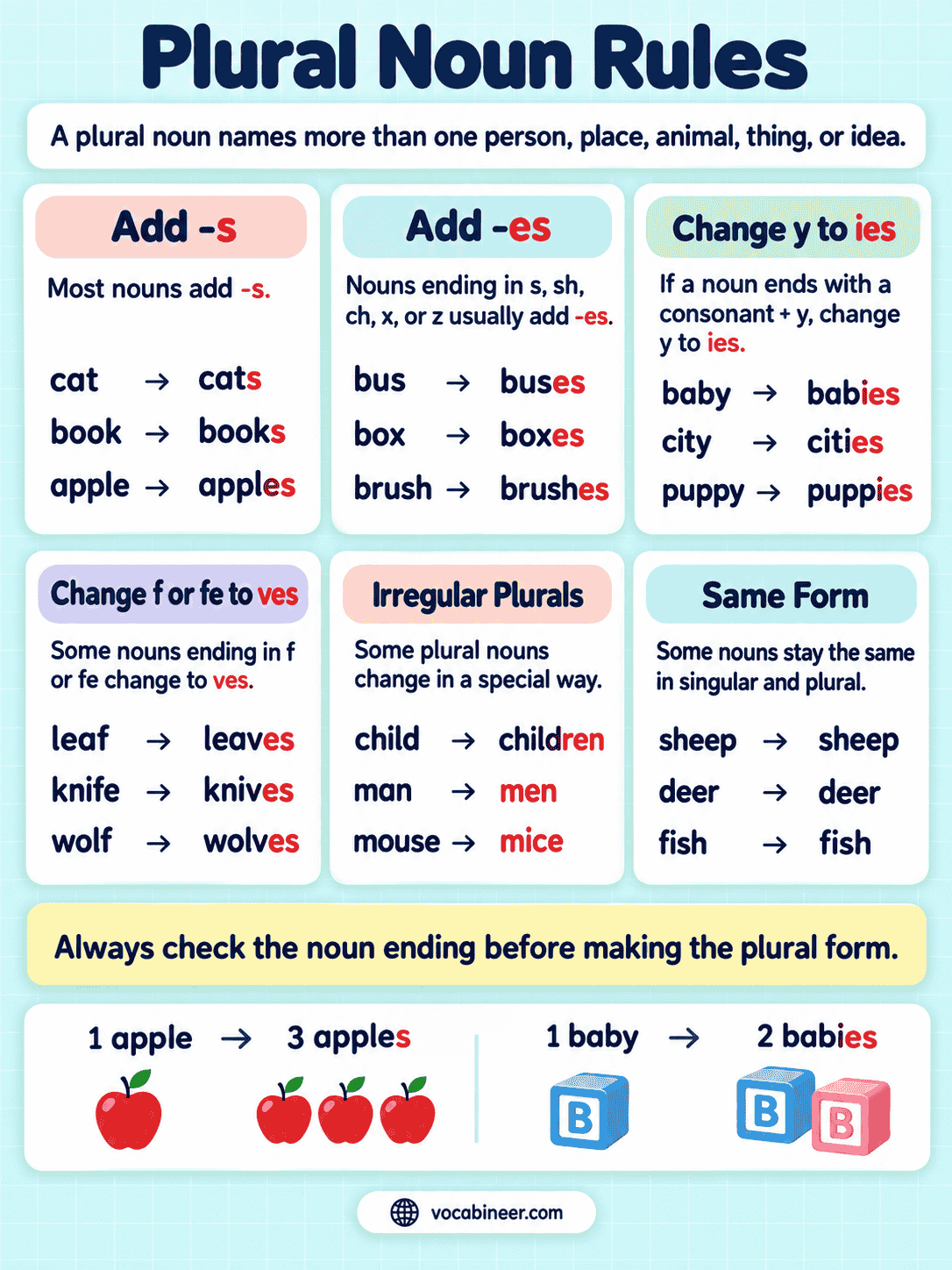
Plural noun rules explain how English nouns change when they refer to more than one person, animal, place, thing, or idea. Most nouns simply add -s or -es, but nouns ending in y, f, fe, or o may follow different spelling patterns.
Some plurals are irregular, some stay unchanged, and others belong to special groups such as compound nouns or borrowed Greek and Latin forms. Learning the main rules and their exceptions helps learners form plural nouns accurately and avoid common spelling mistakes.
In This Page
How English Plural Noun Rules Work
Most English nouns follow regular plural patterns, but not every noun changes in the same way.
The main rules include:
- adding -s
- adding -es
- changing y to -ies
- changing some f/fe endings to -ves
- adding -es to some nouns ending in o
- using an irregular plural form
- making no spelling change
Some rules are highly reliable, while others have exceptions that must be learned individually.
Add -s to Most Nouns
The most common plural rule is to add -s to the singular noun.
Examples:
- book → books
- car → cars
- apple → apples
- teacher → teachers
- chair → chairs
- flower → flowers
- school → schools
- table → tables
- student → students
- computer → computers
This rule covers a large number of English nouns.
Examples in sentences:
- One book is on the table.
- Several books are on the table.
- The teacher entered the room.
- The teachers entered the room.
Add -es After S, SH, CH, X, and Z
Nouns ending in s, sh, ch, x, or z usually take -es.
Examples:
- bus → buses
- class → classes
- dish → dishes
- brush → brushes
- watch → watches
- church → churches
- box → boxes
- fox → foxes
- quiz → quizzes
These endings usually need an extra syllable in pronunciation, which is why -es is added.
Examples:
- one box → two boxes
- one dish → several dishes
- one watch → three watches
Plurals of Nouns Ending in Y
The plural rule depends on whether y comes after a consonant or a vowel.
Consonant + Y
If a noun ends in a consonant followed by y, change y to i and add -es.
Examples:
- baby → babies
- city → cities
- story → stories
- family → families
- country → countries
- party → parties
- lady → ladies
- puppy → puppies
The pattern is:
consonant + y → ies
Vowel + Y
If y comes after a vowel, keep the y and add -s.
Examples:
- boy → boys
- key → keys
- toy → toys
- day → days
- monkey → monkeys
- journey → journeys
Compare:
| Consonant + Y | Vowel + Y |
|---|---|
| baby → babies | boy → boys |
| city → cities | key → keys |
| story → stories | toy → toys |
| family → families | day → days |
The y → ies rule does not apply to every noun ending in y.
Plurals of Nouns Ending in F or FE
Some nouns ending in f or fe change to -ves.
Examples:
- wife → wives
- knife → knives
- life → lives
- leaf → leaves
- loaf → loaves
- thief → thieves
- wolf → wolves
- shelf → shelves
However, many other nouns ending in f simply add -s.
Examples:
- roof → roofs
- belief → beliefs
- cliff → cliffs
- chief → chiefs
- proof → proofs
Therefore, this is not an absolute rule.
Compare:
| Change to -ves | Add -s |
|---|---|
| knife → knives | roof → roofs |
| leaf → leaves | belief → beliefs |
| wife → wives | chief → chiefs |
| loaf → loaves | cliff → cliffs |
Common exceptions are best learned as complete word pairs.
Plurals of Nouns Ending in O
Some nouns ending in o add -es.
Examples:
- tomato → tomatoes
- potato → potatoes
- hero → heroes
- echo → echoes
However, many other nouns ending in o add only -s.
Examples:
- piano → pianos
- photo → photos
- radio → radios
- video → videos
- studio → studios
- zoo → zoos
Compare:
| Add -es | Add -s |
|---|---|
| tomato → tomatoes | piano → pianos |
| potato → potatoes | photo → photos |
| hero → heroes | radio → radios |
| echo → echoes | video → videos |
Because this group contains several exceptions, uncertain forms should be checked in a reliable dictionary.
Irregular Plural Nouns
Irregular plural nouns do not follow the normal -s or -es rules.
| Singular | Plural |
|---|---|
| child | children |
| man | men |
| woman | women |
| tooth | teeth |
| foot | feet |
| mouse | mice |
| goose | geese |
| person | people |
| ox | oxen |
Examples in sentences:
- One child is playing.
- Three children are playing.
- The man is waiting.
- The men are waiting.
- My tooth hurts.
- My teeth are clean.
These forms need to be learned as vocabulary pairs.
Nouns That Stay the Same in the Plural
Some nouns have the same singular and plural form.
Examples:
- sheep → sheep
- deer → deer
- fish → fish
- species → species
- series → series
- bison → bison
Examples:
- one sheep
- five sheep
- one deer
- several deer
The surrounding words usually show whether the noun is singular or plural.
Compare:
- The sheep is in the field.
- The sheep are in the field.
Compound Noun Plurals
Compound nouns usually form the plural on the main noun.
Examples:
- toothbrush → toothbrushes
- school bus → school buses
- bedroom → bedrooms
- coffee shop → coffee shops
When the main noun comes before another element, the plural may appear in the middle.
Examples:
- mother-in-law → mothers-in-law
- sister-in-law → sisters-in-law
- passer-by → passers-by
Compare:
| Singular | Plural |
|---|---|
| toothbrush | toothbrushes |
| school bus | school buses |
| mother-in-law | mothers-in-law |
| passer-by | passers-by |
Incorrect:
- mother-in-laws
Correct:
- mothers-in-law
The key rule is:
Pluralize the main noun in the compound.
Greek and Latin Plural Forms
Some English nouns borrowed from Greek or Latin retain traditional plural forms.
Examples:
| Singular | Plural |
|---|---|
| criterion | criteria |
| phenomenon | phenomena |
| analysis | analyses |
| crisis | crises |
| stimulus | stimuli |
| nucleus | nuclei |
Some borrowed nouns also allow a more regular English plural.
For example:
- formula → formulas / formulae
These forms are less common in beginner vocabulary, so they should be learned as needed.
Nouns Used Only in the Plural
Some nouns normally appear only in plural form.
Examples:
- scissors
- trousers
- jeans
- glasses
- binoculars
- tweezers
- shorts
These nouns usually take plural verbs:
- These scissors are sharp.
- My jeans are new.
- Those binoculars are expensive.
For one item, English often uses a pair of:
- a pair of scissors
- a pair of trousers
- a pair of glasses
Then the verb agrees with pair:
- This pair of scissors is new.
Nouns That Look Plural but Are Singular
Some nouns end in -s but normally take singular verbs.
Examples:
- news
- mathematics
- physics
- economics
In sentences:
- The news is surprising.
- Mathematics is important.
- Physics is difficult for some students.
- Economics is taught at the university.
Their spelling looks plural, but their grammatical use is normally singular.
When a Noun Does Not Take a Plural
Not every English noun has a normal plural form.
Uncountable nouns usually do not take ordinary plural endings.
Common examples include:
- information
- furniture
- advice
- equipment
- luggage
- rice
- water
- knowledge
Correct:
- some information
- some furniture
- some advice
- some equipment
Usually incorrect:
- informations
- furnitures
- advices
- equipments
When a quantity must be counted, use a suitable unit or expression:
- a piece of advice
- two pieces of information
- three items of furniture
This is an important part of plural grammar because learners need to know both how to pluralize and when not to pluralize.
How Plural Endings Are Pronounced
The plural endings -s and -es have three common pronunciations.
/s/
The plural ending sounds like /s/ after certain voiceless sounds.
Examples:
- cat → cats
- book → books
- cup → cups
- map → maps
/z/
The plural ending sounds like /z/ after many voiced sounds.
Examples:
- dog → dogs
- car → cars
- bag → bags
- chair → chairs
/ɪz/
The plural ending sounds like /ɪz/ after sibilant sounds.
Examples:
- bus → buses
- box → boxes
- watch → watches
- dish → dishes
These pronunciation patterns help learners use plural nouns more naturally in speech.
Plural Nouns vs Possessive Nouns
Plural nouns and possessive nouns are different.
| Plural Noun | Possessive Form |
|---|---|
| dogs | dog’s |
| teachers | teacher’s |
| students | student’s |
| girls | girl’s |
Compare:
- The dogs are outside. → more than one dog
- The dog’s bowl is outside. → the bowl belongs to one dog
An apostrophe does not normally make a noun plural.
Correct plural forms:
- apples
- books
- cars
- teachers
Not:
- apple’s
- book’s
- car’s
- teacher’s
when simply referring to more than one.
Plural Nouns and Verb Agreement
Plural nouns used as subjects usually take plural verbs.
Examples:
- The dogs are outside.
- The children play in the garden.
- The books belong to me.
- Those students work hard.
By contrast:
- The dog is outside.
- The child plays in the garden.
This connection is useful, but full subject-verb agreement rules belong to a separate grammar topic.
Common Plural Rule Errors
Adding -s to Irregular Nouns
Incorrect: childs, foots, mouses
Correct: children, feet, mice
Changing Every Y to -ies
Incorrect: boies, keies
Correct: boys, keys
Only consonant + y normally changes to -ies.
Changing Every F or FE to -ves
Incorrect: rooves, beliefves
Correct: roofs, beliefs
Adding -es to Every Noun Ending in O
Incorrect: pianoes, photoes
Correct: pianos, photos
Adding Apostrophes to Ordinary Plurals
Incorrect: apple’s, car’s, book’s
Correct: apples, cars, books
Pluralizing Uncountable Nouns
Incorrect: informations, furnitures, advices
Correct: information, furniture, advice
Pluralizing the Wrong Part of a Compound
Incorrect: mother-in-laws
Correct: mothers-in-law
FAQs
Most nouns add -s. Nouns ending in s, sh, ch, x, or z usually add -es. Other nouns may change y to -ies, change f/fe to -ves, use an irregular form, or stay unchanged.
Add -s to most nouns. Add -es to many nouns ending in s, sh, ch, x, or z, such as bus → buses and box → boxes.
When a noun ends in a consonant followed by y, change y to i and add -es, as in baby → babies. If a vowel comes before y, simply add -s, as in boy → boys.
Irregular plural nouns do not follow normal -s/-es rules. Examples include child → children, foot → feet, tooth → teeth, and mouse → mice.
Common examples include sheep, deer, fish, species, series, and bison.
Read More
- Parts of Speech in English
- Nouns in English with Examples
- Common and Proper Nouns
- Countable and uncountable nouns
- Be Going To in English