

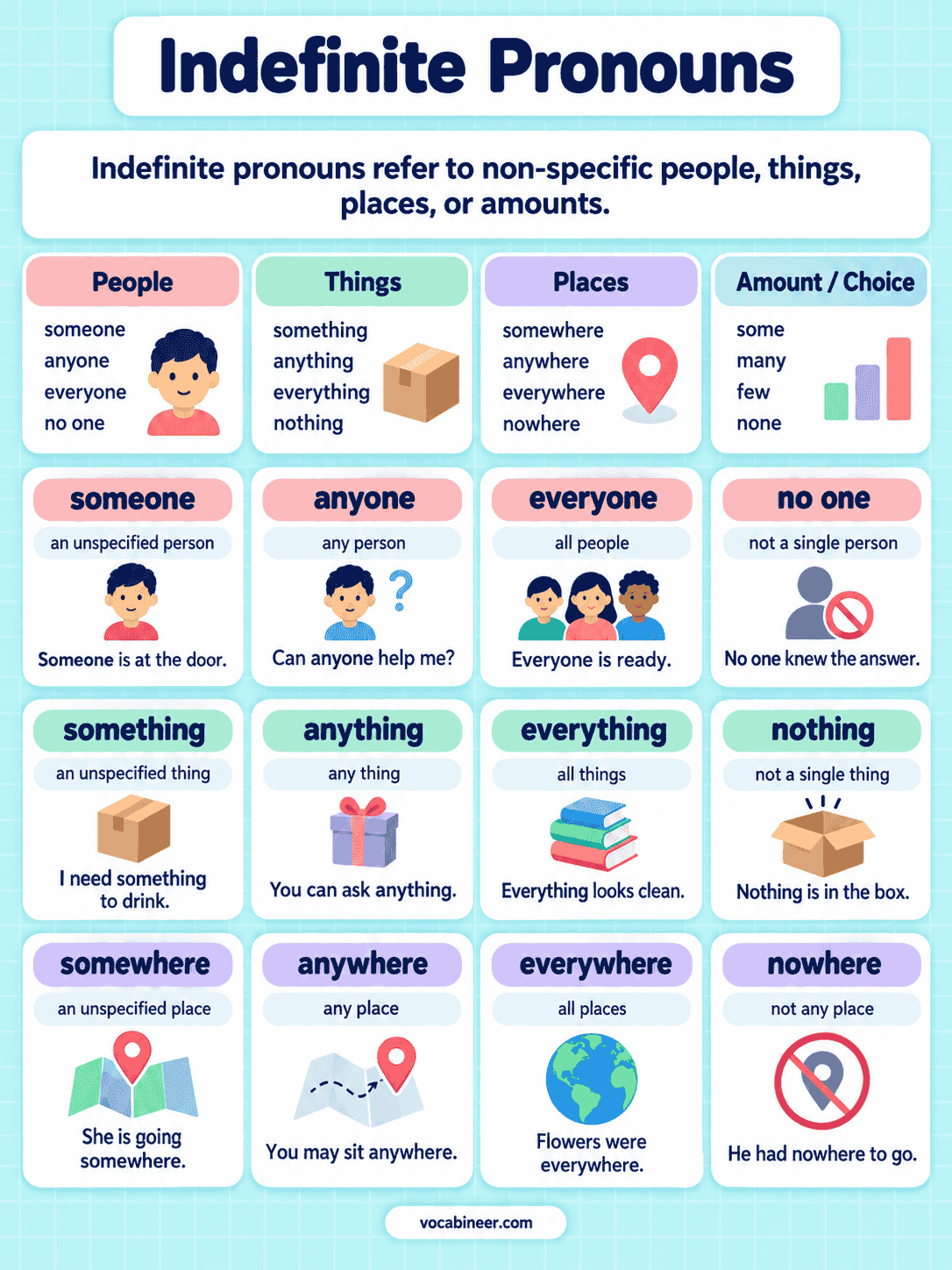
Indefinite pronouns refer to people, things, amounts, or groups without identifying exactly who or what they are. Common examples include someone, anyone, everyone, no one, somebody, anybody, everybody, nobody, something, anything, everything, and nothing.
Learning indefinite pronouns helps students talk about unknown or non-specific people and things, choose the correct singular or plural verb, use singular they naturally, and understand forms such as each, either, neither, both, many, few, several, some, any, and none.
In This Page
What Are Indefinite Pronouns?
An indefinite pronoun refers to a person, thing, amount, or group in a general or non-specific way.
Examples:
- Someone is at the door.
- Nobody answered.
- I heard something.
- Everyone is ready.
- Several were absent.
The key idea is:
Indefinite pronouns refer to people or things without identifying them exactly.
Main Indefinite Pronoun Groups
Many common indefinite pronouns are formed with some-, any-, no-, and every-.
| Some- | Any- | No- | Every- |
|---|---|---|---|
| someone | anyone | no one | everyone |
| somebody | anybody | nobody | everybody |
| something | anything | nothing | everything |
These groups make it easier to understand both meaning and sentence use.
Indefinite Pronouns for People
Forms ending in -one and -body usually refer to people.
Common examples include:
- someone
- somebody
- anyone
- anybody
- everyone
- everybody
- no one
- nobody
Examples:
- Someone called you.
- Anybody can apply.
- Everyone enjoyed the lesson.
- Nobody answered.
- Somebody left a message.
Indefinite Pronouns for Things
Forms ending in -thing refer to things, ideas, situations, or events.
Common examples include:
- something
- anything
- everything
- nothing
Examples:
- I need something to eat.
- Did you hear anything?
- Everything is ready.
- Nothing happened.
A simple rule is:
-one / -body → people
-thing → things
Someone vs Somebody
Someone and somebody have almost the same meaning.
Examples:
- Someone is waiting outside.
- Somebody called earlier.
The difference is mainly style. Somebody can sound slightly more informal, but both are common.
Anyone vs Anybody
Anyone and anybody also have the same basic meaning.
Examples:
- Did anyone call?
- I don’t know anybody here.
- Anyone can join.
Do not assume anyone is used only in questions and negatives.
Example:
- Anyone can learn this.
Here, it means any person at all.
Everyone vs Everybody
Everyone and everybody mean the same thing.
Examples:
- Everyone is ready.
- Everybody knows the answer.
Both normally take a singular verb.
No One vs Nobody
No one and nobody have the same basic meaning.
Examples:
- No one replied.
- Nobody came.
A useful spelling point is:
- no one ✅
- no-one ✅
- noone ❌
Some-, Any-, No-, and Every- Forms
These groups express different meanings.
| Group | Typical Meaning | Example |
|---|---|---|
| some- | an unspecified person or thing | Someone called. |
| any- | any person or thing | Did anyone call? |
| no- | absence of a person or thing | No one called. |
| every- | all members considered generally | Everyone called. |
This is one of the simplest ways to understand the main indefinite-pronoun families.
Some vs Any
A useful learner pattern is:
- some- forms are common in affirmative statements
- any- forms are common in questions and negatives
Examples:
- Someone is outside.
- Is anyone outside?
- I didn’t see anyone.
However, anyone can also appear in affirmative sentences when it means any person at all.
Example:
- Anyone can enter the competition.
So the rule is a tendency, not an absolute restriction.
No- Forms and Negative Meaning
Forms such as nobody, no one, and nothing already carry negative meaning.
Correct:
- Nobody came.
- Nothing happened.
- No one answered.
Incorrect in standard English:
- Nobody didn’t come.
- Nothing didn’t happen.
- No one didn’t answer.
The key rule is:
Do not add another negative when the indefinite pronoun is already negative.
Nobody vs Not Anybody
These structures can express similar meanings.
Examples:
- Nobody came.
- I didn’t see anybody.
But do not say:
- Anybody didn’t come. ❌
Use:
- Nobody came.
- No one came.
- I didn’t see anybody.
Singular Verb Agreement
The common forms ending in -one, -body, and -thing normally take singular verbs.
Examples:
- Everyone is ready.
- Someone has called.
- Nothing was damaged.
- Everything looks fine.
- Anybody is welcome.
This is one of the most important rules for indefinite pronouns.
Singular They with Indefinite Pronouns
Although forms such as someone, anyone, everyone, and no one take singular verbs, English commonly uses they, them, their, and theirs to refer back to them.
Examples:
- If someone calls, tell them I’m busy.
- Everyone should bring their notebook.
- No one said they were leaving.
- If anyone needs help, ask them to speak to me.
This is standard modern English.
Singular Verb with Singular They
This combination can look unusual at first.
Example:
Everyone is ready, and they have their tickets.
The grammar works because:
- everyone takes a singular verb
- they can refer back to one non-specific person
This is an important modern usage point.
Other Indefinite Pronouns
English also has broader indefinite pronouns such as:
- each
- either
- neither
- one
- another
- both
- few
- many
- several
- all
- some
- any
- none
- much
- little
These forms refer to people, things, amounts, or groups without naming them specifically.
Singular Indefinite Pronouns
Common singular indefinite pronouns include:
- each
- either
- neither
- anyone
- anybody
- someone
- somebody
- everyone
- everybody
- no one
- nobody
- something
- anything
- everything
- nothing
Examples:
- Each is important.
- Either is acceptable.
- Neither is available.
- Someone has arrived.
These normally take singular verbs.
Plural Indefinite Pronouns
Some indefinite pronouns are plural.
Common examples include:
- both
- few
- many
- several
Examples:
- Both are correct.
- Few were available.
- Many have applied.
- Several are missing.
These take plural verbs.
Indefinite Pronouns That Can Be Singular or Plural
Some indefinite pronouns depend on what they refer to.
Common examples include:
- all
- any
- more
- most
- none
- some
Compare:
- All is ready. → a whole situation or amount
- All are ready. → people
- Some is missing. → uncountable amount
- Some are missing. → plural items
The verb depends on meaning.
Singular, Plural, and Variable Indefinite Pronouns
| Singular | Plural | Singular or Plural |
|---|---|---|
| each | both | all |
| either | few | any |
| neither | many | more |
| everyone | several | most |
| someone | none | |
| anyone | some | |
| nobody | ||
| something |
This table gives a practical overview of agreement.
Each
Each refers to individual members of a group one at a time.
Examples:
- Each is important.
- Each has a different role.
- The students received a book each.
When used as a pronoun, each normally takes a singular verb.
Either and Neither
Either means one or the other of two.
Example:
- Either is acceptable.
Neither means not one and not the other.
Example:
- Neither is available.
Both normally take singular verbs in standard learner grammar.
Both
Both refers to two people or things together.
Examples:
- Both are correct.
- Both were invited.
- Both have arrived.
Unlike either and neither, both takes a plural verb.
Few, Many, and Several
These forms refer to plural countable people or things.
Examples:
- Few were interested.
- Many have applied.
- Several were absent.
They take plural verbs.
Much and Little
When used independently, much and little can refer to uncountable quantities.
Examples:
- Much remains unknown.
- Little has changed.
These usually take singular agreement because they refer to uncountable amounts.
All as an Indefinite Pronoun
All can stand alone as a pronoun.
Examples:
- All were happy.
- All is well.
Its verb agreement depends on what all refers to.
Some, Any, and None as Pronouns
These words can function as pronouns when no noun follows.
Examples:
- I bought some apples. Would you like some?
- I don’t have any.
- None were available.
They can also function as determiners when a noun follows.
Indefinite Pronouns vs Determiners
Some indefinite words can act as either pronouns or determiners.
| Pronoun | Determiner |
|---|---|
| Some arrived late. | Some students arrived late. |
| Many were absent. | Many students were absent. |
| All were ready. | All students were ready. |
| Few remained. | Few people remained. |
A pronoun stands alone.
A determiner comes before a noun.
Adjectives After Indefinite Pronouns
Adjectives normally come after indefinite pronouns such as something, anything, nothing, someone, and anyone.
Correct:
- something interesting
- nothing serious
- someone helpful
- anyone suitable
- everything important
Incorrect:
- interesting something
- serious nothing
- helpful someone
The pattern is:
indefinite pronoun + adjective
Indefinite Pronouns with Else
Use else after an indefinite pronoun to mean another or additional person or thing.
Examples:
- someone else
- anything else
- nobody else
- everyone else
In sentences:
- Is there anything else?
- Someone else called.
- Nobody else knew.
- Everyone else had left.
The normal word order is:
indefinite pronoun + else
Possessive Forms of Indefinite Pronouns
Indefinite pronouns referring to people can take possessive ’s.
Examples:
- someone’s bag
- anybody’s coat
- nobody’s fault
- everyone’s responsibility
In sentences:
- Someone’s phone is ringing.
- It is nobody’s fault.
- Everyone’s work has been checked.
Everyone vs Every One
These forms have different meanings.
Everyone means every person.
Example:
- Everyone is ready.
Every one means each individual member of a specific group.
Example:
- Every one of the books was damaged.
- I checked every one carefully.
The space changes the meaning.
Indefinite Pronouns in Sentences
These examples show the main patterns:
- Someone is at the door.
- Did anyone call?
- Everyone is ready.
- Nobody answered.
- I heard something.
- I didn’t see anything.
- Everything looks fine.
- Nothing happened.
- Each is important.
- Either is acceptable.
- Neither is available.
- Both are correct.
- Many have applied.
- Several were missing.
- Some are ready.
- If anyone calls, tell them I’m busy.
- Something interesting happened.
- Is there anything else?
Common Mistakes with Indefinite Pronouns
Using a Plural Verb with Everyone or Someone
Incorrect: Everyone are ready.
Correct: Everyone is ready.
Assuming Every Indefinite Pronoun Is Singular
Incorrect idea: all indefinite pronouns take singular verbs.
Correct: forms such as both, few, many, and several are plural.
Avoiding Singular They Unnecessarily
Awkward: Everyone should bring his or her notebook.
Natural: Everyone should bring their notebook.
Using Double Negatives
Incorrect: Nobody didn’t come.
Correct: Nobody came.
Using Anybody as a Negative Subject
Incorrect: Anybody didn’t answer.
Correct: Nobody answered.
Putting an Adjective Before the Pronoun
Incorrect: interesting something
Correct: something interesting
Writing No One Incorrectly
Incorrect: noone
Correct: no one
Confusing Everyone and Every One
Everyone = every person
Every one = each individual member of a group
Confusing Pronoun and Determiner Use
Some students arrived. → determiner
Some arrived. → pronoun
Indefinite Pronouns for Kids
A simple explanation is:
An indefinite pronoun talks about a person or thing without saying exactly who or what it is.
Examples:
- Someone is outside.
- Nobody answered.
- I saw something.
- Everyone is ready.
- Did anyone call?
Useful beginner forms include:
- someone
- anyone
- everyone
- no one
- somebody
- anybody
- everybody
- nobody
- something
- anything
- everything
- nothing
After learning these, students can move to forms such as each, both, many, few, several, some, and none.
FAQs
Indefinite pronouns refer to people, things, amounts, or groups without identifying them exactly. Examples include someone, anyone, everyone, nobody, something, and nothing.
Common indefinite pronouns include someone, anyone, everyone, no one, somebody, anybody, everybody, nobody, something, anything, everything, and nothing. Other forms include each, either, neither, both, many, few, several, some, and none.
It depends on the pronoun. Forms such as everyone, someone, and each normally take singular verbs. Forms such as both, many, and several take plural verbs, while words such as all, some, and none can depend on context.
Yes. Singular they/them/their commonly refers back to singular indefinite pronouns, as in Everyone should bring their notebook.
Someone is common in affirmative statements, while anyone is common in questions and negatives. However, anyone can also mean any person at all, as in Anyone can apply.
Read More
- Parts of Speech in English
- Nouns in English with Examples
- Common and Proper Nouns
- Countable and uncountable nouns
- Collective nouns
- Abstract and concrete nouns
- Gender nouns
- Compound nouns
- Possessive nouns
- Singular and plural nouns
- Plural noun rules