

You hear three knocks at the classroom door. “Is somebody there?” you ask. Later, you return to a quiet classroom and call, “Is anybody there?” Both questions sound natural. The knock gives you a reason to expect an answer the first time.
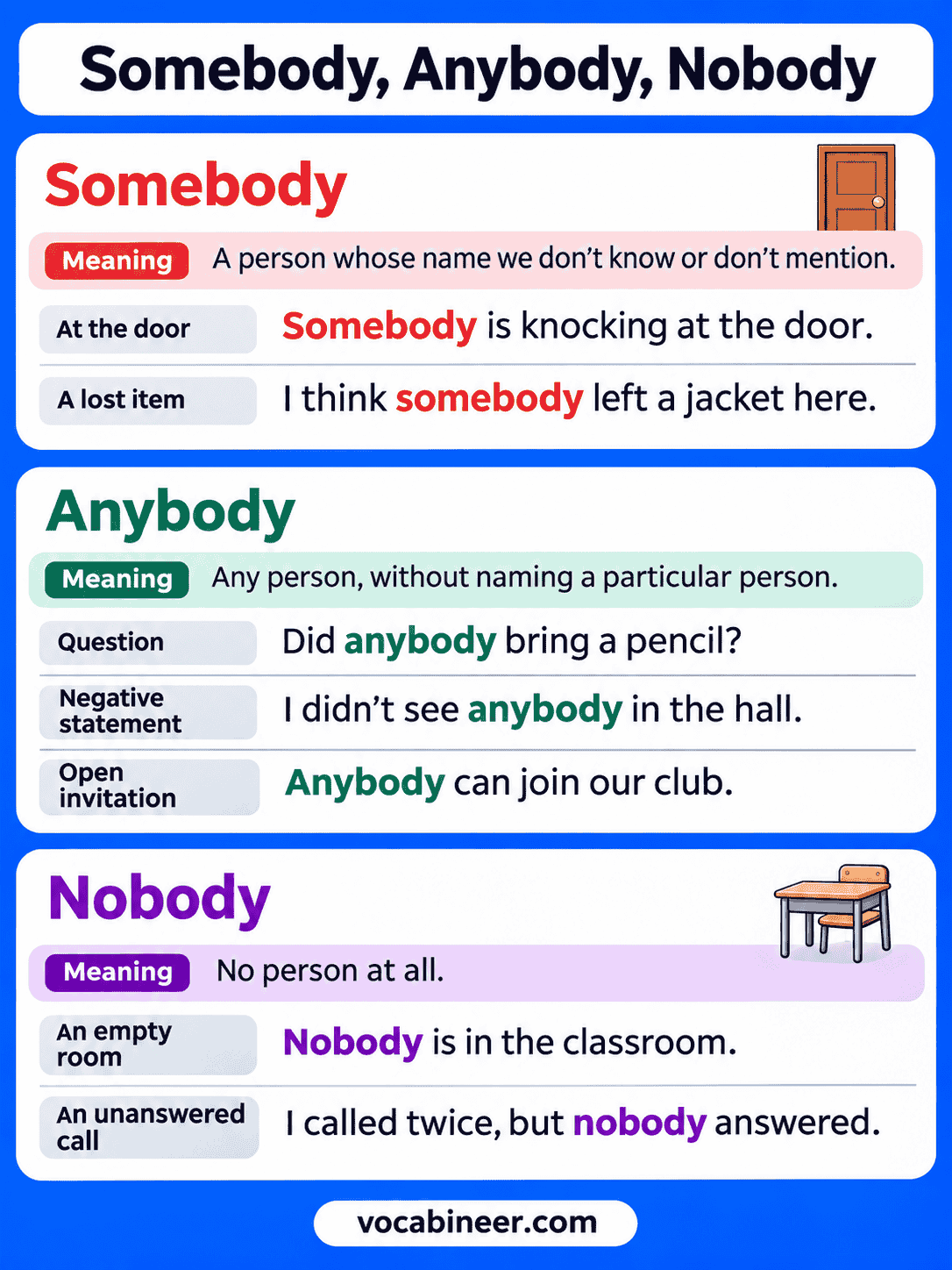
Somebody, anybody, and nobody all refer to people without naming them. The word you choose tells the listener whether you have a person in mind, whether the choice is open, or whether you mean no one at all.
In This Page
What Do Somebody, Anybody, and Nobody Mean?
These words are indefinite pronouns. Each can stand in place of a person’s name. Imagine a class getting ready for the school play. The same sign-up sheet can give you a reason to use all three words.
| Word | Example | What it means |
|---|---|---|
| Somebody | Somebody signed up for the play. | At least one person signed up. The speaker leaves the person unnamed. |
| Anybody in a question | Did anybody sign up for the play? | The speaker wants to know whether even one person signed up. |
| Anybody in a statement | Anybody in our class can sign up. | Every class member has the option to join. |
| Nobody | Nobody signed up for the play. | The sign-up sheet has no names on it. |
Somebody works whether you know the person’s identity or are still trying to find out. For example, if you find a scarf on the bus, you might say, “Somebody left a scarf on this seat.” But you can also say, “I know somebody who can knit a scarf like that.” In the second sentence, you know exactly who you mean. You simply haven’t given their name.
The group you are talking about matters, too. If your teacher asks who brought a pencil sharpener and you answer “Nobody,” you mean nobody in the group she asked. A student in the next classroom might have one.
Choosing Between Somebody and Anybody in Questions
Use somebody in a question when you have a reason to think a person is involved. Use anybody when you want to leave the possibilities open. The difference is easiest to hear when the rest of the question stays the same.
| Situation | Natural question | What the listener hears |
|---|---|---|
| You return to find a phone message on your desk. | Did somebody call while I was out? | The message gives you a reason to think a call came in. |
| You return and check whether you missed any calls. | Did anybody call while I was out? | You are asking for information. Either answer would fit. |
The choice expresses an expectation, not certainty. Even with a message on your desk, you could ask “Did anybody call?” if you simply wanted a report. Likewise, a friend who asks “Did somebody call?” might have heard a phone ring and guessed wrong.
Both words also work when you ask a group for help.
| Request | Likely emphasis |
|---|---|
| Can somebody hold the door? | You need a volunteer to do a particular job. |
| Can anybody reach the top shelf? | You want to find out whether anyone in the group can reach it. |
When Anybody Means “Any Person”
In a positive statement, anybody can mean any person, regardless of who they are. A club announcement might say, “Anybody in fifth grade can enter the spelling bee.” A fifth grader reading the notice knows that entry is open to them. The notice tells them who may enter. It says nothing about who has already entered.
| Sentence | Meaning |
|---|---|
| Somebody in our class can play the piano. | At least one class member has that skill. |
| Anybody in our class can use the piano at lunch. | Each class member has permission to use it. |
You will also hear anybody after if: “If anybody finds a blue mitten, please bring it to the front desk.” The request applies to whichever person finds the mitten. It still makes sense if the mitten stays missing all day.
Nobody vs. Not … Anybody
Nobody carries a negative meaning on its own. Another way to express the same idea is to make the verb negative and use anybody. In a contraction such as didn’t, the n’t supplies the negative meaning.
| Using nobody | Using not … anybody |
|---|---|
| I told nobody the secret. | I didn’t tell anybody the secret. |
| We saw nobody on the trail. | We didn’t see anybody on the trail. |
| The coach thanked nobody after the game. | The coach didn’t thank anybody after the game. |
To express zero people in standard written English, choose one of these patterns. If you write “I didn’t see nobody,” keep didn’t and change nobody to anybody, or keep nobody and write “I saw nobody.”
Sometimes the clearest choice puts nobody first. In “Nobody answered the phone,” nobody is the subject of answered. This wording is especially natural when the important detail is that the phone rang and no person answered.
Singular Verbs with Somebody, Anybody, and Nobody
Use a singular verb when one of these pronouns is the subject. This rule applies even when you are asking about a whole classroom. In “Does anybody have a ruler?” the subject is anybody, so the question begins with does.
| Sentence | Subject | Why the verb fits |
|---|---|---|
| Somebody has the spare key. | somebody | The singular form is has. |
| Nobody knows the answer yet. | nobody | In the simple present, know becomes knows. |
| Does anybody need more paper? | anybody | The singular helping verb does goes with anybody. |
| Do you know anybody here? | you | You takes do. Here, anybody is the object of know. |
You can use they or their to refer back to an unnamed person. For example, “Somebody has left their lunchbox on the bus.” The verb has agrees with somebody, and their tells us the lunchbox belongs to that person.
Can You Use Someone, Anyone, and No One Instead?
Yes. Each -body word has a matching form with the same basic meaning. Both versions work in ordinary American English.
| Original sentence | Same meaning |
|---|---|
| Somebody drew a map. | Someone drew a map. |
| Can anybody read it? | Can anyone read it? |
| Nobody took the wrong path. | No one took the wrong path. |
Pay attention to the spelling of no one. In American English, write it as two words. The other five forms in the table are single words.
FAQs
“Somebody solved the puzzle” tells you that at least one person solved it. Other people may have solved it, too. To say exactly one person did, write “Only one person solved the puzzle.”
Yes. “Anybody with a library card can borrow a book” is a complete sentence. Here, anybody is the subject, and the phrase with a library card tells you who qualifies.
Yes. If a friend asks “Who won the race?” and all the runners tied, “Nobody” is a natural short answer if you mean there was no single winner. In other situations, a few more words can make the reason clear: “Nobody finished before the rain started.”
Put else immediately after the pronoun. “Ask somebody else” means ask a different person. In “Does anybody else want a turn?” the speaker invites additional people to join.
Add an apostrophe and s. For example, “Somebody’s jacket is on the bench” means the jacket belongs to an unnamed person. “Is this anybody’s jacket?” is a natural way to ask a group who owns it.
Read More
- Parts of Speech in English
- Nouns in English with Examples
- Common and Proper Nouns
- Countable and uncountable nouns
- Collective nouns
- Abstract and concrete nouns
- Gender nouns
- Compound nouns
- Possessive nouns
- Singular and plural nouns
- Plural noun rules