

At the school gate, Ava spots you first. You wave and say, “She saw me!” Both she and me refer to people, but each has a different job. She tells who saw someone, and me tells whom she saw.
Choose a subject or object pronoun by finding its job in the sentence. This rule works even when a question changes the word order or a friend’s name appears beside the pronoun.
In This Page
What Are Subject and Object Pronouns?
A subject pronoun serves as the subject of a verb. In “We laughed,” we tells who laughed. A subject can also be someone or something the sentence describes. In “We are ready,” the words are ready describe we.
An object pronoun serves as the object of a verb or a preposition. In “Dad called us,” us tells whom Dad called. In “Dad sat beside us,” the same pronoun completes the phrase beside us.
A single sentence can contain both kinds of pronouns. Consider “She thanked him.”
| Word | Grammatical role | What it tells us |
|---|---|---|
| She | Subject pronoun | Who gave thanks |
| thanked | Verb | What happened |
| him | Object pronoun | Whom she thanked |
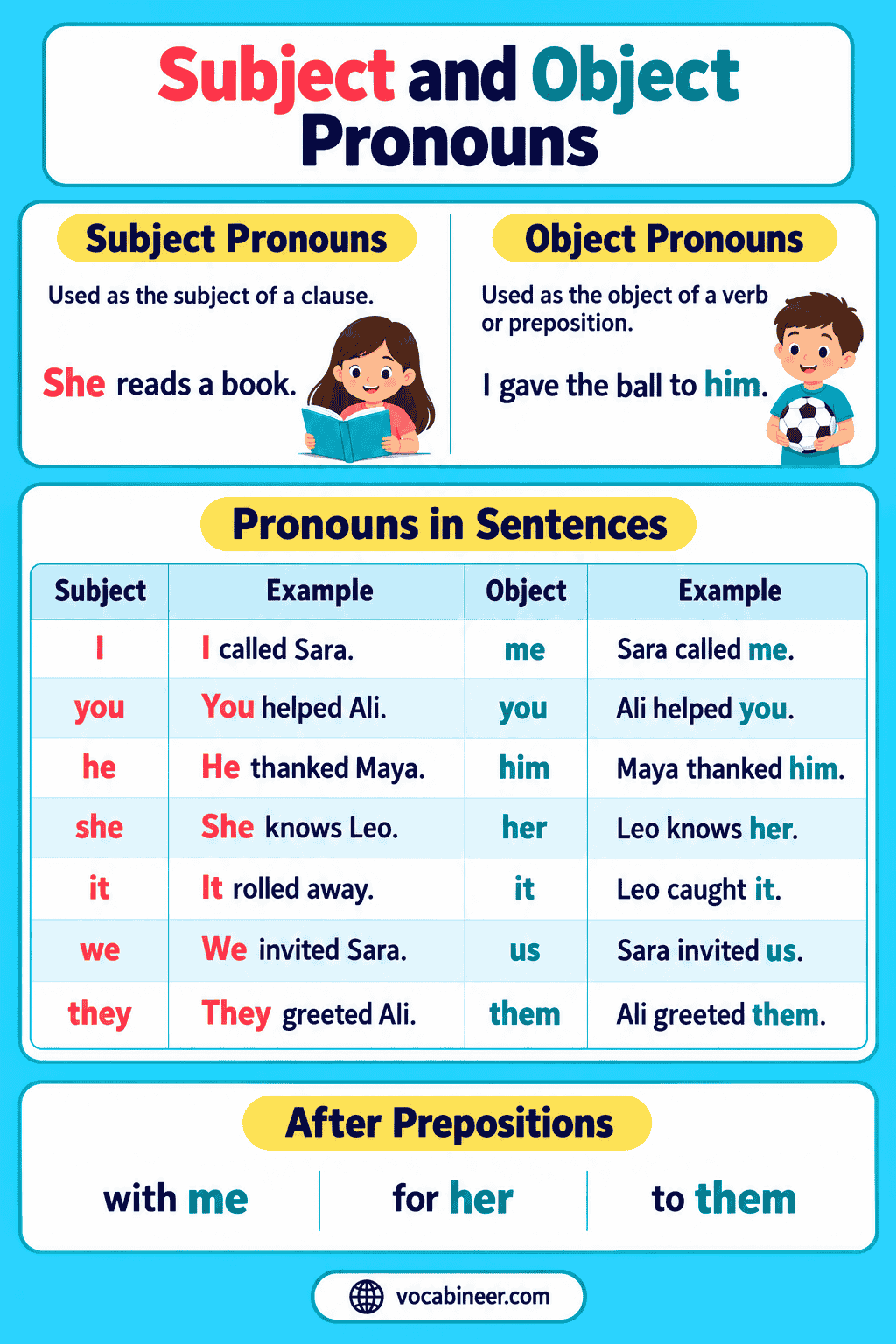
Subject and Object Pronouns Chart
The chart shows seven common pairs of personal pronouns. Read across each row to see how the same person or thing can have a different role in another sentence.
| Subject form | Object form | Subject example | Object example |
|---|---|---|---|
| I | me | I spotted the owl. | The owl spotted me. |
| you | you | You found the puppy. | The puppy followed you. |
| he | him | He called the coach. | The coach called him. |
| she | her | She invited Nora. | Nora invited her. |
| it | it | It rolled under the desk. | Ben picked it up. |
| we | us | We greeted the visitors. | The visitors greeted us. |
| they | them | They waved to Rosa. | Rosa waved to them. |
You and it keep the same form in both columns. For these words, the surrounding sentence shows the role. In the puppy example, you first identifies the finder. In the next sentence, you identifies the person the puppy followed.
They and them can refer to one person as well as several people. For example, “Someone left a scarf. If they come back, please give it to them.” Both words refer to the person who left the scarf. Their roles explain why the forms differ.
How to Use Subject Pronouns
Use I, you, he, she, it, we, or they when the pronoun is the subject. In a statement, the subject usually appears before its verb. In a question, a helping verb can come first.
Subject Pronouns in Statements
To find the subject, look at the verb and ask who or what the sentence tells you something about.
| Statement | Subject and verb | What the sentence tells us |
|---|---|---|
| They carried the canoe. | they carried | What the campers did |
| She likes the quiet. | she likes | What someone enjoys |
| It is heavy. | it is | What an object is like |
The last example matters because looking for an action alone can lead you astray. A backpack can be heavy while it sits on the floor. If it refers to that backpack, it is the subject of is.
Subject Pronouns in Questions
Helping verbs such as did, can, and will often come before the subject in a question. If you are unsure which pronoun to use, try saying the sentence as a statement.
| Question | As a statement | Subject |
|---|---|---|
| Did she find the trail? | She found the trail. | she |
| Can we join the game? | We can join the game. | we |
| Will they need a map? | They will need a map. | they |
A question can contain an object pronoun, too. In “Can he hear us?” the helping verb can comes first. He is still the subject, and us identifies the people he can hear.
How to Use Object Pronouns
The common object forms are me, you, him, her, it, us, and them. To see why one belongs in a sentence, find the verb or preposition it goes with.
Direct and Indirect Objects
A direct object answers whom? or what? after a verb such as greet, carry, or show. An indirect object often identifies the person who receives something or the person to whom someone shows or tells something.
| Sentence | Role of the bold word | How to tell |
|---|---|---|
| The librarian greeted us. | Direct object | Whom did the librarian greet? Us. |
| The librarian showed us a map. | Indirect object | The map is what the librarian showed. Us identifies the people the librarian showed it to. |
| The librarian unfolded it. | Direct object | What did the librarian unfold? It, meaning the map. |
Sometimes the same event can be described in two ways. Notice what happens to the recipient’s role when the sentence includes to.
| Sentence | Role of me | Reason |
|---|---|---|
| Dad handed me the key. | Indirect object | The key is the direct object. Me identifies the recipient. |
| Dad handed the key to me. | Object of a preposition | Me completes the phrase to me. The recipient stays the same. |
Object Pronouns After Prepositions
A preposition is a word such as beside, with, for, from, or between. It introduces a phrase that helps show a relationship. When a personal pronoun is the object of that preposition, choose its object form.
| Preposition | Sentence | Phrase to notice |
|---|---|---|
| beside | A seat opened up beside her. | beside her |
| with | The new student sat with us. | with us |
| for | Grandma saved a peach for him. | for him |
| from | I borrowed a paintbrush from them. | from them |
Finding the whole phrase helps when the verb is farther away. In “The last two seats in the front row are for us,” the short phrase for us gives you everything you need to choose us.
How to Choose the Correct Pronoun
In a longer sentence, start with the few words around the pronoun. Consider “After the bell rang, the teacher waved to us.” The sentence mentions a bell, a teacher, and a group of people. Each has its own role.
- Find the relevant verb or preposition. The word directly connected to us is to.
- Identify the pronoun’s job. The teacher did the waving. The phrase to us identifies the people the teacher waved to.
- Choose the form for that job. For a group that includes the speaker, the object form is us.
Choosing I or Me in Compound Phrases
A compound subject or compound object has two or more parts, often joined by and. For standard written English, a simple check works well when one part is a name and the other is I or me. Temporarily leave out the name and and, then read what remains.
| Full sentence | Check without the name | Why the pronoun fits |
|---|---|---|
| Maya and I painted the sign. | I painted the sign. | I is part of the subject. |
| The principal thanked Maya and me. | The principal thanked me. | Me is part of the direct object. |
| These brushes are for Maya and me. | These brushes are for me. | Me is part of the object of for. |
This also works in questions. Suppose you are unsure how to finish “Did the coach pick Leo and ___?” Set Leo and aside. You would ask “Did the coach pick me?” Put the name back, and you have “Did the coach pick Leo and me?”
Common Subject and Object Pronoun Mistakes
When you edit a sentence, find the verb or preposition that goes with the pronoun. Then check whether the form fits its job.
| Common mistake | Standard written form | Reason |
|---|---|---|
| Him caught the ball. | He caught the ball. | He is the subject of caught. |
| The guide led we home. | The guide led us home. | Us identifies the people the guide led. |
| The kitten ran toward she. | The kitten ran toward her. | Her completes the phrase beginning with toward. |
| Did them finish the mural? | Did they finish the mural? | They is the subject of finish. |
| Please email the photo to Leo and I. | Please email the photo to Leo and me. | Leo and me together form the object of to. |
| Please call myself after lunch. | Please call me after lunch. | Me identifies the person the listener should call. |
The word her deserves a closer look. It can serve two different jobs even when it follows the same verb.
| Sentence | Job of her | Who received the call? |
|---|---|---|
| I called her. | Object pronoun | The person her refers to |
| I called her brother. | Possessive word describing brother | The brother |
FAQs
Yes. In “We surprised them,” we is the subject of surprised, and them is the direct object. Each pronoun identifies a different group.
Yes. “She smiled” is a complete sentence. She is the subject, and the verb smiled makes sense here without an object.
Yes. Between is a preposition, so the standard written phrase is between you and me. Both you and me belong to its object.
“It’s me” is natural everyday English. Here, me identifies the person meant by it. Grammarians call me a complement because it completes the meaning of the linking verb is.
The phrase of him tells us whom someone feels proud of. Because of is a preposition, it takes the object form him. The same pattern appears in proud of her, happy for them, and kind to us.
Read More
- Parts of Speech in English
- Nouns in English with Examples
- Common and Proper Nouns
- Countable and uncountable nouns
- Collective nouns
- Abstract and concrete nouns
- Gender nouns
- Compound nouns
- Possessive nouns
- Singular and plural nouns
- Plural noun rules