

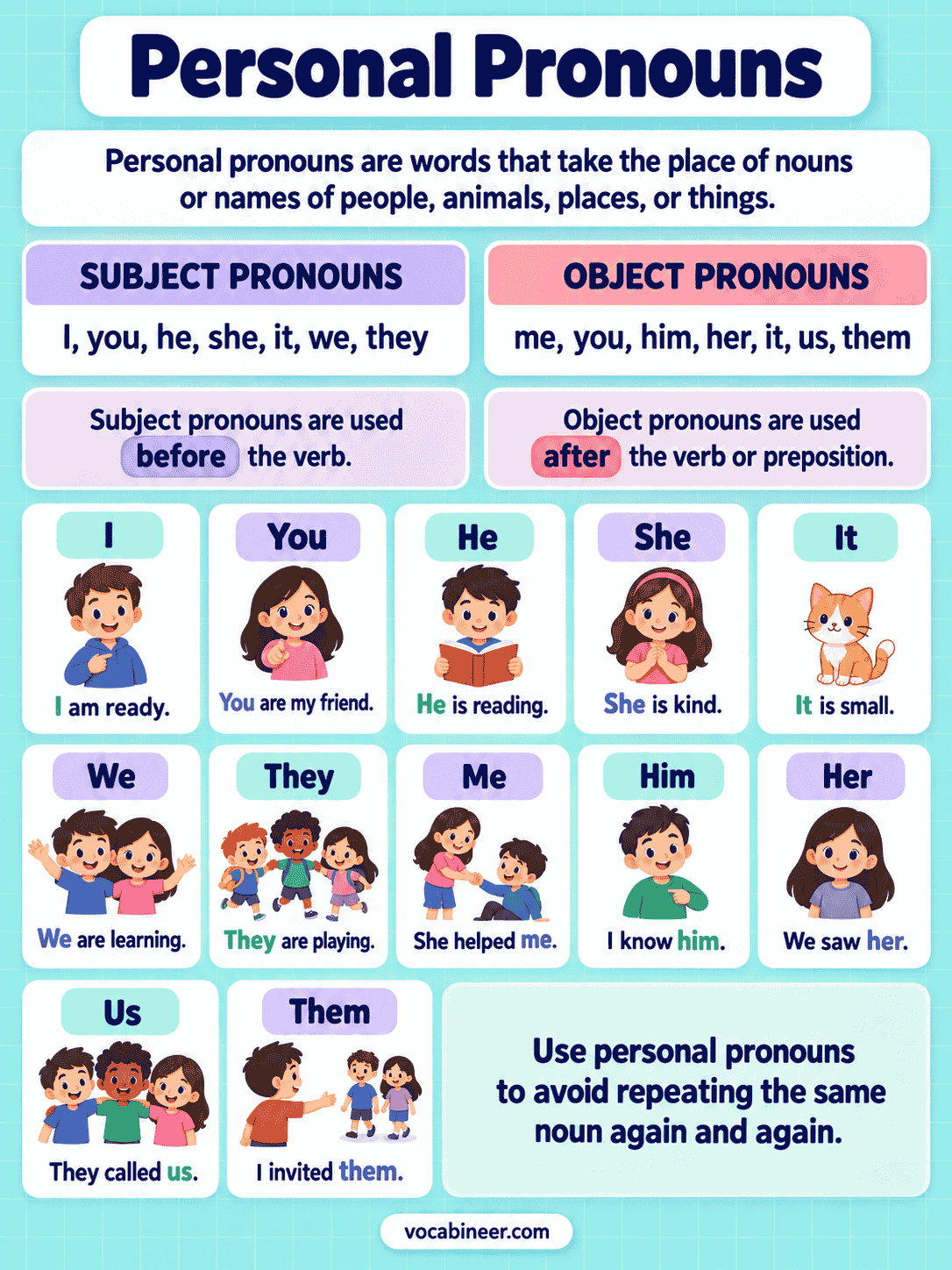
Personal pronouns are words used to refer to the speaker, the listener, or other people, animals, things, and groups without repeating their names. Common personal pronouns include I, you, he, she, it, we, they, me, him, her, us, and them.
Learning personal pronouns helps students choose the correct subject and object forms, understand first, second, and third person, and use pronouns naturally in sentences. English personal pronouns also show number and, in some third-person forms, gender.
In This Page
What Are Personal Pronouns?
A personal pronoun refers to a person, animal, thing, or group that is already known or understood from context.
Compare:
Maria is tired. Maria is going home.
With a personal pronoun:
Maria is tired. She is going home.
Another example:
I saw John. I spoke to him.
The key idea is:
Personal pronouns refer to the speaker, the listener, or another person, animal, thing, or group.
Personal Pronouns Chart
Personal pronouns change according to their grammatical role.
| Person | Subject Pronoun | Object Pronoun | Number |
|---|---|---|---|
| First | I | me | Singular |
| Second | you | you | Singular or plural |
| Third | he | him | Singular |
| Third | she | her | Singular |
| Third | it | it | Singular |
| First | we | us | Plural |
| Third | they | them | Plural or singular in some uses |
This chart shows the main subject and object forms used in English.
Subject Personal Pronouns
Subject personal pronouns act as the subject of a clause.
They are:
- I
- you
- he
- she
- it
- we
- they
Examples:
- I work here.
- You are ready.
- He plays football.
- She sings well.
- It is broken.
- We live nearby.
- They are waiting.
The basic rule is:
Use a subject pronoun when the pronoun is the subject of the verb.
Object Personal Pronouns
Object personal pronouns usually receive the action of a verb or follow a preposition.
They are:
- me
- you
- him
- her
- it
- us
- them
Examples:
- She called me.
- I saw him.
- We invited her.
- They helped us.
- I found it.
- The teacher spoke to them.
The basic rule is:
Use an object pronoun when the pronoun functions as the object of a verb or preposition.
Subject vs Object Personal Pronouns
Subject and object forms are one of the most important parts of personal-pronoun grammar.
| Subject | Object |
|---|---|
| I | me |
| you | you |
| he | him |
| she | her |
| it | it |
| we | us |
| they | them |
Compare:
- I called him.
- He called me.
- She saw them.
- They saw her.
- We invited him.
- He invited us.
The pronoun form changes according to its grammatical role.
First Person Personal Pronouns
First person refers to the speaker or writer.
First Person Singular
The forms are:
- I → subject
- me → object
Examples:
- I am ready.
- She called me.
- I opened the door.
- The teacher spoke to me.
First Person Plural
The forms are:
- we → subject
- us → object
Examples:
- We are ready.
- They invited us.
- We finished early.
- She spoke to us.
The key point is:
First person includes the speaker.
Second Person Personal Pronouns
Second person refers to the listener or reader.
The main form is you.
It works as both a subject and an object.
Examples:
- You are welcome.
- I called you.
- You look tired.
- We spoke to you.
The important point is:
You can refer to one person or more than one person.
English does not normally use separate standard forms for singular and plural you.
Third Person Personal Pronouns
Third person refers to people or things other than the speaker and listener.
The main forms are:
- he / him
- she / her
- it / it
- they / them
Examples:
- He called me.
- I called him.
- She arrived early.
- I spoke to her.
- It is broken.
- I repaired it.
- They are outside.
- We invited them.
Singular and Plural Personal Pronouns
Personal pronouns can also be grouped by number.
| Singular | Plural |
|---|---|
| I | we |
| you | you |
| he | they |
| she | they |
| it | they |
| me | us |
| him / her / it | them |
Two points are especially important:
- you can be singular or plural
- they/them can also refer to one person in modern English
I vs Me
Use I when the pronoun is the subject.
Examples:
- I called Sara.
- I finished the work.
- Ali and I went home.
Use me when the pronoun is the object.
Examples:
- Sara called me.
- The teacher helped me.
- She spoke to Ali and me.
The simple rule is:
I = subject, me = object
He vs Him
Use he as the subject.
Examples:
- He works here.
- He called yesterday.
Use him as the object.
Examples:
- I called him.
- I spoke to him.
- We invited him.
The simple rule is:
he = subject, him = object
She vs Her
Use she as the subject.
Examples:
- She is my teacher.
- She arrived early.
Use her as the object.
Examples:
- I saw her.
- I spoke to her.
- We invited her.
The word her can also come before a noun as a possessive determiner:
- her bag
- her book
However, that is a possessive use rather than an object-pronoun use.
We vs Us
Use we as the subject.
Examples:
- We finished early.
- We live nearby.
Use us as the object.
Examples:
- They invited us.
- She spoke to us.
- The teacher helped us.
The simple rule is:
we = subject, us = object
They vs Them
Use they as the subject.
Examples:
- They are waiting.
- They work here.
Use them as the object.
Examples:
- I called them.
- I spoke to them.
- We invited them.
These forms can be plural or, in suitable contexts, singular.
You as Singular and Plural
The pronoun you can refer to one person or several people.
Singular:
- You are my friend.
- I called you yesterday.
Plural:
- You are all welcome.
- I will see you after class.
The form stays the same, so context usually shows whether you is singular or plural.
He, She, and They
He/him traditionally refers to a male person.
Examples:
- He is my brother.
- I called him.
She/her traditionally refers to a female person.
Examples:
- She is my sister.
- I spoke to her.
When gender is unknown, irrelevant, or unspecified, they/them is commonly used.
Examples:
- Talk to a doctor. They may be able to help.
- If someone calls, ask them to leave a message.
This use is standard in modern English.
Singular They
They, them, their, and theirs can refer to one person.
This commonly happens after expressions such as:
- someone
- anyone
- everyone
- a person
- a customer
- a student
Examples:
- Someone left their phone.
- If anyone calls, tell them I am busy.
- A student should bring their notebook.
- Every customer should keep their receipt.
The key rule is:
They/them can refer to one person when gender is unknown, irrelevant, or unspecified.
How We Use It
The pronoun it commonly refers to things.
Examples:
- The computer is broken. It will not start.
- I found the key. It was under the table.
- The book is new. It looks interesting.
It can also refer to animals when their sex is unknown or not relevant.
Example:
- The bird flew away because it was frightened.
Dummy It
Sometimes it does not refer to a specific noun.
Examples:
- It is raining.
- It is cold today.
- It is ten o’clock.
- It is difficult to explain.
- It is a long way from here.
In these sentences, it acts as a grammatical subject.
The key point is:
Not every use of it replaces a specific noun.
Personal Pronouns After Prepositions
Use object personal pronouns after prepositions.
Examples:
- for me
- with him
- to her
- from us
- about them
- between you and me
In sentences:
- She waited for me.
- I spoke with him.
- Give the book to her.
- They heard from us.
- We talked about them.
Incorrect:
between you and I
Standard:
between you and me
Personal Pronouns After Be
In everyday English, object pronouns are common after forms of be.
Examples:
- It’s me.
- That’s him.
- It was us.
- Was that her?
Very formal constructions such as It is I exist, but they are uncommon in ordinary conversation.
Personal Pronouns and Grammatical Person
The term person in grammar describes whether the pronoun refers to the speaker, the listener, or someone or something else.
| Person | Meaning | Examples |
|---|---|---|
| First Person | speaker | I, me, we, us |
| Second Person | listener | you |
| Third Person | other people or things | he, him, she, her, it, they, them |
This classification helps explain why these words are called personal pronouns.
Personal Pronouns and Number
Personal pronouns can show singular or plural number.
Singular Forms
- I
- you
- he
- she
- it
Plural Forms
- we
- you
- they
However, number is not completely fixed in two cases:
- you can be singular or plural
- they can refer to one or more people
Personal Pronouns and Gender
Gender is most visible in third-person singular personal pronouns.
Examples:
- he / him
- she / her
Other personal pronouns do not inherently show male or female gender:
- I
- you
- we
- they
Singular they also allows English to refer to one person without specifying gender.
Personal Pronoun Reference
A personal pronoun should clearly refer to the intended person, animal, or thing.
Clear:
Maria called because she needed help.
Here, she clearly refers to Maria.
Unclear:
Maria spoke to Sara after she arrived.
Who arrived: Maria or Sara?
When a pronoun could refer to more than one noun, repeat the intended noun or rewrite the sentence.
For example:
Maria spoke to Sara after Sara arrived.
This removes the ambiguity.
Personal Pronoun Agreement
Personal pronouns should match their referents appropriately in meaning and number.
Examples:
- The boys finished their work.
- The computer stopped because it overheated.
- The girls said they were ready.
- Someone forgot their coat.
Agreement and clear reference work together to make sentences easy to understand.
Personal Pronouns vs Possessive Forms
Personal pronouns are related to possessive forms, but they do not have the same function.
| Personal Form | Possessive Form |
|---|---|
| I / me | my / mine |
| you | your / yours |
| he / him | his |
| she / her | her / hers |
| it | its |
| we / us | our / ours |
| they / them | their / theirs |
Compare:
- She called me. → personal pronoun
- This is her book. → possessive determiner
- This book is hers. → possessive pronoun
Keep these categories separate when identifying pronoun forms.
Personal Pronouns vs Reflexive Pronouns
Reflexive pronouns refer back to the subject.
Compare:
- John saw him. → another male person
- John saw himself. → John
- Maria blamed her. → another female person
- Maria blamed herself. → Maria
The ordinary personal object pronoun and the reflexive pronoun do not mean the same thing.
Personal Pronouns in Sentences
These examples show the full subject-object system:
- I am ready.
- She called me.
- You look tired.
- I spoke to you.
- He works here.
- We invited him.
- She arrived early.
- I saw her.
- It is broken.
- I repaired it.
- We live nearby.
- They helped us.
- They are waiting.
- I called them.
- Someone called, but I did not speak to them.
Common Mistakes with Personal Pronouns
Using Me as the Subject
Incorrect: Me went home.
Correct: I went home.
Using I as the Object
Incorrect: She called I.
Correct: She called me.
Using Subject Forms After Prepositions
Incorrect: between you and I
Correct: between you and me
Confusing He and Him
Incorrect: Him works here.
Correct: He works here.
Confusing She and Her
Incorrect: Her is my teacher.
Correct: She is my teacher.
Confusing We and Us
Incorrect: Us went home.
Correct: We went home.
Omitting a Required Subject Pronoun
Incorrect in ordinary English: Is tired.
Correct: She is tired.
Treating You as Singular Only
You can refer to one person or several people.
Treating They as Plural Only
They/them can also refer to one person.
Using a Reflexive Instead of an Object Pronoun
Incorrect: Please contact myself.
Correct: Please contact me.
Using an Unclear Pronoun Reference
If two people could match the same pronoun, repeat the intended noun or rewrite the sentence.
Personal Pronouns for Kids
A simple explanation is:
Personal pronouns are words we use instead of repeating the names of people or things.
Examples:
- Ali is my friend. He is kind.
- Sara is reading. She is quiet.
- The book is new. It is interesting.
- Ali and Sara are here. They are ready.
Useful beginner personal pronouns include:
- I
- you
- he
- she
- it
- we
- they
- me
- him
- her
- us
- them
Children can first learn the subject forms and then connect each one with its object form.
FAQs
Personal pronouns refer to the speaker, the listener, or other people, animals, things, and groups. Examples include I, you, he, she, it, we, and they.
Subject pronouns include I, you, he, she, it, we, and they. Object pronouns include me, you, him, her, it, us, and them.
Use I as the subject and me as the object. For example, I called Sara and Sara called me.
Yes. Standard English uses you for both one person and more than one person.
Yes. Singular they/them is standard when gender is unknown, irrelevant, or unspecified, as in Someone left their phone.
Use an object pronoun after a preposition, such as for me, with him, to her, from us, or about them.
Dummy it is used as a grammatical subject without referring to a specific noun, as in It is raining or It is late.
Read More
- Parts of Speech in English
- Nouns in English with Examples
- Common and Proper Nouns
- Countable and uncountable nouns
- Collective nouns
- Abstract and concrete nouns
- Gender nouns
- Compound nouns
- Possessive nouns
- Singular and plural nouns
- Plural noun rules