

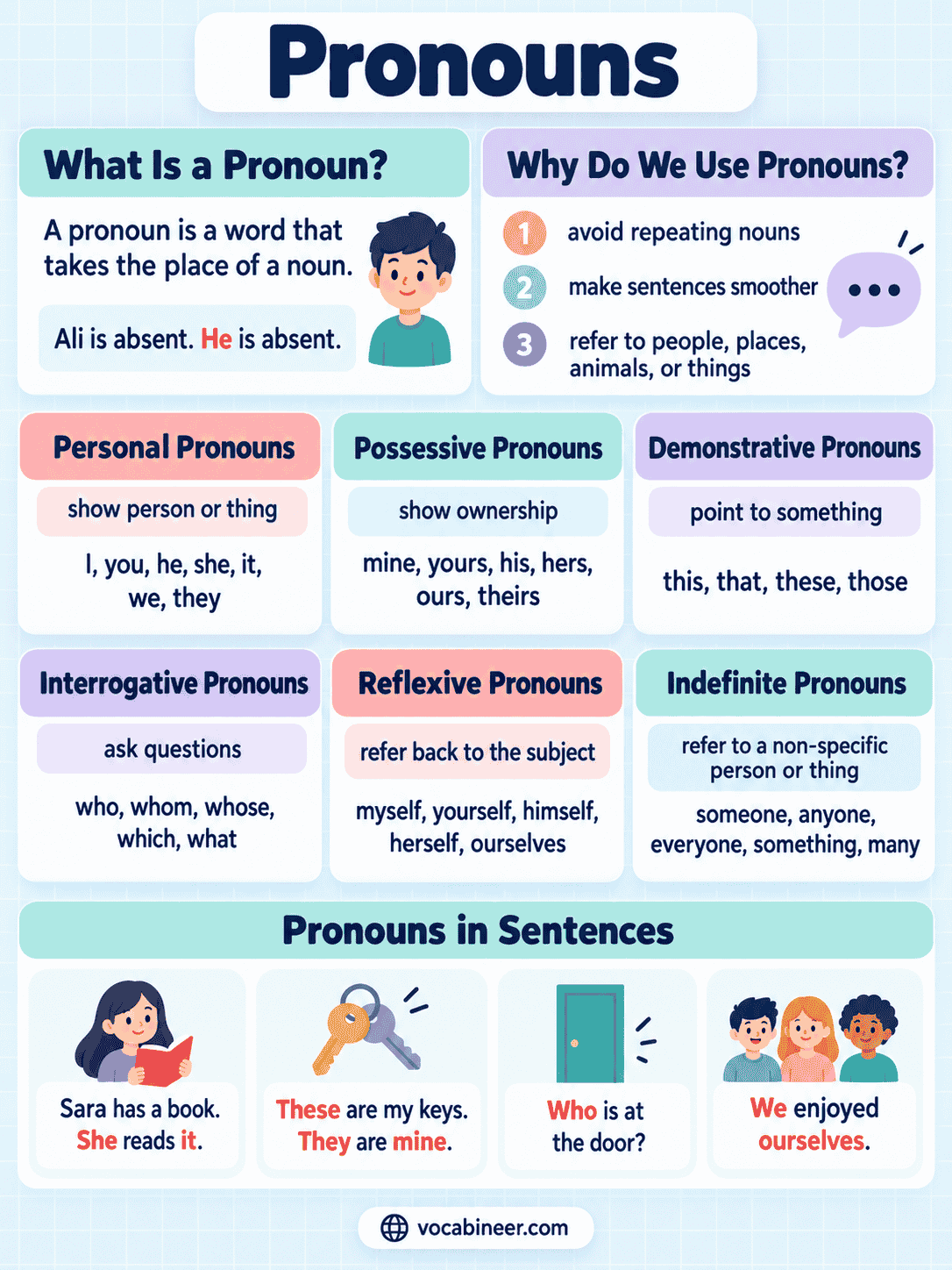
Pronouns are words that refer to or stand in for nouns and noun phrases. They help avoid unnecessary repetition and make sentences clearer and more natural. Common pronouns include I, you, he, she, it, we, they, me, him, her, mine, ours, this, who, someone, and themselves.
Learning pronouns helps students choose the correct subject and object forms, show possession, refer back to people and things clearly, and connect ideas across sentences. English has several main types of pronouns, and each type performs a different grammatical job.
In This Page
What Are Pronouns?
A pronoun is a word used to refer to a noun or noun phrase without repeating the full name or expression every time.
Compare:
Maria is tired. Maria is going home.
With a pronoun:
Maria is tired. She is going home.
Another example:
I found the keys. They were on the table.
The key idea is:
A pronoun refers to or stands in for a noun or noun phrase.
Why We Use Pronouns
Pronouns make language less repetitive and easier to follow.
Without pronouns:
Sara saw Sara’s teacher, and Sara asked Sara’s teacher a question.
With pronouns:
Sara saw her teacher, and she asked her a question.
Pronouns help make writing and speech:
- more natural
- less repetitive
- more concise
- easier to connect across sentences
However, pronouns should always have a clear reference.
Main Types of Pronouns
The main types of pronouns in English include:
- Personal Pronouns
- Possessive Pronouns
- Reflexive Pronouns
- Demonstrative Pronouns
- Interrogative Pronouns
- Relative Pronouns
- Indefinite Pronouns
- Reciprocal Pronouns
Each type has a different purpose.
Personal Pronouns
Personal pronouns refer to people, animals, things, or groups already understood from context.
| Subject Pronoun | Object Pronoun |
|---|---|
| I | me |
| you | you |
| he | him |
| she | her |
| it | it |
| we | us |
| they | them |
Examples:
- She called me.
- I saw him.
- They invited us.
- We found it.
- I spoke to her.
Personal pronouns change according to their role in the sentence.
Subject Pronouns
Subject pronouns act as the subject of a clause.
Examples:
- I work here.
- You look tired.
- He plays football.
- She sings well.
- It is raining.
- We finished early.
- They are waiting.
The subject pronoun normally performs or experiences the action.
Object Pronouns
Object pronouns usually receive the action of a verb or follow a preposition.
Examples:
- She called me.
- We invited him.
- I spoke to her.
- The teacher helped us.
- I found them.
- She looked at it.
Object pronouns commonly appear after verbs and prepositions.
Subject vs Object Pronouns
This distinction is essential because English uses different forms.
| Subject | Object |
|---|---|
| I | me |
| he | him |
| she | her |
| we | us |
| they | them |
Compare:
- She called him.
- They invited us.
- I saw her.
- He helped me.
Incorrect:
Me went home.
Correct:
I went home.
Incorrect:
She called I.
Correct:
She called me.
Possessive Pronouns
Possessive pronouns show ownership or belonging and can stand alone without a following noun.
Common possessive pronouns include:
- mine
- yours
- his
- hers
- ours
- theirs
Examples:
- This book is mine.
- That bag is hers.
- The seats are ours.
- The house is theirs.
- Is this pen yours?
Possessive pronouns replace a full possessive noun phrase.
Possessive Pronouns vs Possessive Determiners
Possessive pronouns and possessive determiners are related, but they do not work in the same way.
| Possessive Determiner | Possessive Pronoun |
|---|---|
| my | mine |
| your | yours |
| his | his |
| her | hers |
| our | ours |
| their | theirs |
Compare:
- This is my book.
- This book is mine.
- That is their house.
- That house is theirs.
A possessive determiner comes before a noun.
A possessive pronoun stands alone.
Correct:
- yours
- hers
- ours
- theirs
Incorrect:
- your’s
- her’s
- our’s
- their’s
Possessive pronouns do not take apostrophes.
Reflexive Pronouns
Reflexive pronouns refer back to the subject of the sentence.
Common reflexive pronouns include:
- myself
- yourself
- himself
- herself
- itself
- ourselves
- yourselves
- themselves
Examples:
- I hurt myself.
- She introduced herself.
- He blamed himself.
- We prepared ourselves.
- They enjoyed themselves.
The key rule is:
Use a reflexive pronoun when the subject and object refer to the same person or thing.
Reflexive Pronouns vs Object Pronouns
Compare:
- Anna saw her. → another female person
- Anna saw herself. → Anna
- John blamed him. → another male person
- John blamed himself. → John
The reflexive form shows that the action returns to the subject.
Demonstrative Pronouns
Demonstrative pronouns point to specific people, objects, or ideas.
The main demonstrative pronouns are:
- this
- that
- these
- those
Examples:
- This is mine.
- That looks expensive.
- These are fresh.
- Those belong to us.
The singular forms are:
- this
- that
The plural forms are:
- these
- those
Demonstrative Pronouns vs Demonstrative Determiners
The same words can work as either pronouns or determiners.
Compare:
- This is interesting. → pronoun
- This book is interesting. → determiner
- Those are expensive. → pronoun
- Those shoes are expensive. → determiner
A pronoun stands alone, while a determiner comes before a noun.
Interrogative Pronouns
Interrogative pronouns are used to ask questions.
Common interrogative pronouns include:
- who
- whom
- whose
- what
- which
Examples:
- Who called?
- Whom did you invite?
- Whose is this?
- What happened?
- Which do you prefer?
Whom is more formal and is less common in everyday conversation than who.
Relative Pronouns
Relative pronouns introduce relative clauses and connect additional information to a noun.
Common relative pronouns include:
- who
- whom
- whose
- which
- that
Examples:
- The woman who called is my aunt.
- The man whom we met was friendly.
- The student whose bag was missing returned later.
- The car which broke down is mine.
- The book that I bought is useful.
Relative pronouns help combine ideas into one sentence.
Interrogative vs Relative Pronouns
Some pronouns can belong to different types depending on their function.
Compare:
- Who called? → interrogative
- The person who called left a message. → relative
- Which do you want? → interrogative
- The book which I bought is new. → relative
The pronoun’s job in the sentence determines its type.
Indefinite Pronouns
Indefinite pronouns refer to people or things without naming them specifically.
Common examples include:
- someone
- anyone
- everyone
- nobody
- somebody
- something
- anything
- nothing
- each
- none
In sentences:
- Someone is at the door.
- Everyone is ready.
- Nobody answered.
- I heard something.
- Is there anything I can do?
- None were available.
Indefinite pronouns are useful when the exact person or thing is unknown, unimportant, or not specified.
Singular They
They, them, their, and theirs can refer to one person when the person’s gender is unknown, irrelevant, or intentionally unspecified.
Examples:
- If someone calls, tell them I’ll return later.
- Every student should bring their notebook.
- A customer left their phone.
- Someone forgot their umbrella.
This use of singular they is standard in modern English and often sounds more natural than repeatedly using he or she.
Reciprocal Pronouns
Reciprocal pronouns show a mutual relationship.
The main forms are:
- each other
- one another
Examples:
- They helped each other.
- The teams respected one another.
- The friends borrowed each other’s books.
- The neighbors often visit one another.
These forms show that two or more people or groups perform the same action toward one another.
Generic Pronouns
Some pronouns can refer to people in general rather than one specific person.
Examples include:
- you
- one
- we
- they
Examples:
- You never know what will happen.
- One should be careful.
- We often learn from experience.
- They say the road is closed.
These are called generic uses because the pronoun refers broadly to people in general.
Pronouns and Gender
Some English personal pronouns can show gender.
Examples:
- he / him / his
- she / her / hers
Other pronouns do not mark gender:
- I
- you
- we
- they
They can also refer to one person when gender is unknown or not relevant.
Pronouns vs Nouns
Nouns and pronouns perform related roles, but they are not the same.
| Noun | Pronoun |
|---|---|
| Maria | she |
| the students | they |
| the book | it |
| Ali and Sara | they |
A noun names or identifies a person, animal, place, thing, or idea.
A pronoun refers to or stands in for a noun or noun phrase.
Compare:
- Maria is tired.
- She is tired.
- The books are new.
- They are new.
Pronouns vs Determiners
Some words can act either as pronouns or determiners.
Compare:
| Pronoun | Determiner |
|---|---|
| This is mine. | This book is mine. |
| Those are expensive. | Those shoes are expensive. |
| Some arrived late. | Some students arrived late. |
| Which do you prefer? | Which book do you prefer? |
A pronoun can stand without a following noun.
A determiner comes before a noun.
Pronoun Case
Personal pronouns change according to their grammatical role.
Compare:
- I called him.
- He called me.
- This book is mine.
These forms show three important roles:
- subject
- object
- possession
Pronouns show these differences much more clearly than ordinary nouns.
Pronoun Reference
A pronoun should clearly refer to the intended person, animal, thing, or noun phrase.
Clear:
Maria dropped the glass because she was tired.
Here, she clearly refers to Maria.
Unclear:
Sara told Ayesha that she was late.
The sentence does not clearly tell us whether she means Sara or Ayesha.
Clear pronoun reference is just as important as choosing the correct pronoun type.
Clear vs Unclear Pronoun Reference
| Clear | Unclear |
|---|---|
| Maria dropped the cup because she was tired. | Sara told Ayesha that she was late. |
| The dog found its ball and carried it home. | Ali spoke to Omar after he arrived. |
When two nouns could match the pronoun, repeating the noun may improve clarity.
For example:
Sara told Ayesha that Ayesha was late.
This removes the ambiguity.
Pronoun Agreement
Pronouns should match their referents appropriately in number, person, and meaning.
Examples:
- The boy lost his bag.
- The girls finished their work.
- The dog wagged its tail.
- The students brought their books.
- Someone left their phone.
Pronoun agreement helps readers understand exactly who or what the pronoun refers to.
Pronouns in Sentences
These examples show the major pronoun types together:
- She called me. → personal pronoun
- This book is mine. → possessive pronoun
- He hurt himself. → reflexive pronoun
- Those are expensive. → demonstrative pronoun
- Who called? → interrogative pronoun
- The man who called is my uncle. → relative pronoun
- Someone is waiting. → indefinite pronoun
- They helped each other. → reciprocal pronoun
- If anyone calls, tell them I am busy. → singular they
Common Mistakes with Pronouns
Using an Object Pronoun as a Subject
Incorrect: Me and Ali went home.
Better: Ali and I went home.
Using a Subject Pronoun as an Object
Incorrect: She called I.
Correct: She called me.
Confusing Possessive Pronouns and Possessive Determiners
Incorrect: This is mine book.
Correct: This is my book.
Correct: This book is mine.
Adding Apostrophes to Possessive Pronouns
Incorrect: her’s, their’s
Correct: hers, theirs
Using Reflexive Pronouns Unnecessarily
Incorrect: Please contact myself.
Better: Please contact me.
Using an Unclear Pronoun Reference
If a pronoun could refer to two different nouns, repeat the intended noun or rewrite the sentence.
Forcing He or She in Every Singular Reference
Singular they is natural when gender is unknown or irrelevant.
Confusing Demonstrative Pronouns with Determiners
This is mine. → pronoun
This book is mine. → determiner
Pronouns for Kids
A simple explanation is:
A pronoun is a word we use instead of repeating a noun.
Example:
Sara has a book. She is reading it.
Here:
- she refers to Sara
- it refers to the book
Useful beginner pronouns include:
- I
- you
- he
- she
- it
- we
- they
- me
- him
- her
- us
- them
Children should learn these common personal pronouns first before moving to more advanced pronoun types.
Frequently Asked Questions
What is a pronoun?
A pronoun is a word that refers to or stands in for a noun or noun phrase. Examples include I, you, he, she, it, we, and they.
What are the main types of pronouns?
The main types are personal, possessive, reflexive, demonstrative, interrogative, relative, indefinite, and reciprocal pronouns.
What is the difference between subject and object pronouns?
Subject pronouns act as subjects, while object pronouns receive the action or follow prepositions. Compare I/me, he/him, she/her, and they/them.
What is the difference between possessive pronouns and possessive determiners?
Possessive determiners come before nouns, as in my book. Possessive pronouns stand alone, as in The book is mine.
What are reflexive pronouns?
Reflexive pronouns refer back to the subject. Examples include myself, yourself, himself, herself, ourselves, and themselves.
Can they refer to one person?
Yes. Singular they is commonly used when a person’s gender is unknown, irrelevant, or unspecified, as in Someone left their phone.
How do you make pronoun reference clear?
Make sure the reader can easily identify which noun or noun phrase the pronoun refers to. If the reference could be ambiguous, repeat the noun or rewrite the sentence.
Read More
- Parts of Speech in English
- Nouns in English with Examples
- Common and Proper Nouns
- Countable and uncountable nouns
- Collective nouns
- Abstract and concrete nouns
- Gender nouns
- Compound nouns
- Possessive nouns
- Singular and plural nouns
- Plural noun rules