

Verbal nouns are nouns that come from verbs or are closely related to verbs. Many verbal nouns use the -ing form, such as reading, writing, singing, painting, and building, but they function as nouns rather than as ordinary verbs.
Learning verbal nouns helps students understand how an action word can behave like a noun in a sentence. It also makes it easier to distinguish noun-like -ing forms from gerunds, present participles, infinitives, and ordinary nouns.
In This Page
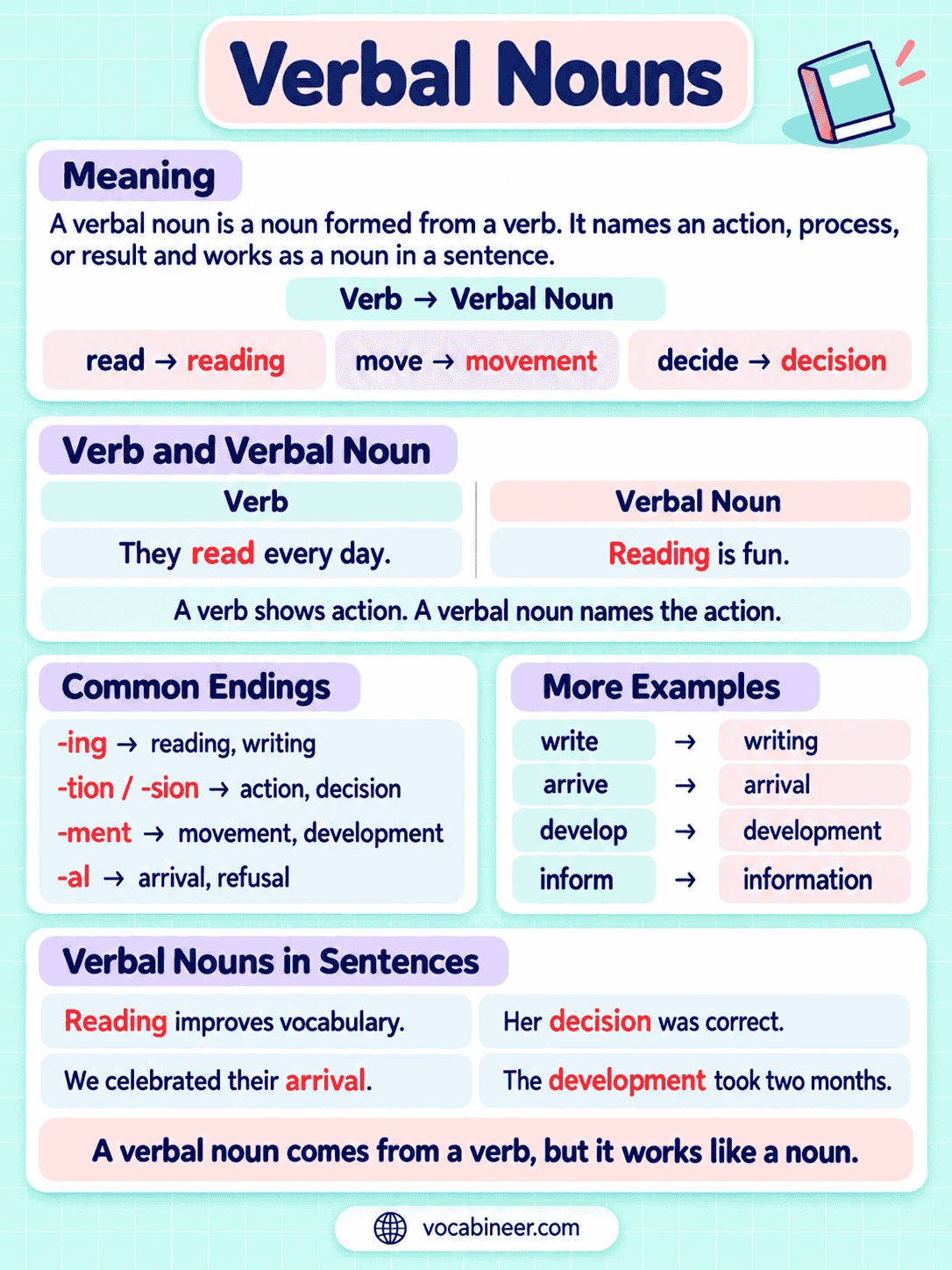
Verbal Nouns: Meaning and Basic Idea
A verbal noun is a noun derived from a verb or closely connected with a verb.
Examples:
- read → reading
- write → writing
- sing → singing
- paint → painting
- build → building
In sentences:
- Reading improves vocabulary.
- Her singing impressed everyone.
- The building of the bridge took years.
The key idea is:
A verbal noun comes from a verb but performs the job of a noun.
The grammatical function matters more than the -ing ending itself.
How Verbal Nouns Are Formed
Many verbal nouns are formed by adding -ing to a verb.
Examples:
- read → reading
- write → writing
- sing → singing
- swim → swimming
- paint → painting
- build → building
- plan → planning
- record → recording
However, English also forms nouns from verbs through other endings.
Examples:
- decide → decision
- develop → development
- arrive → arrival
- perform → performance
- refuse → refusal
- destroy → destruction
These are also nouns derived from verbs, although -ing forms deserve the most attention because they are often confused with gerunds and participles.
How Verbal Nouns Behave Like Nouns
Verbal nouns can perform the same grammatical jobs as other nouns.
They can act as:
- subjects
- objects
- complements
- objects of prepositions
As a Subject
- Reading improves concentration.
- Swimming strengthens the body.
- Writing takes practice.
As an Object
- She enjoys painting.
- He likes reading.
- They discussed planning.
As a Complement
- Her favorite activity is drawing.
- His main hobby is swimming.
After a Preposition
- She is interested in writing.
- He is good at painting.
- They talked about building.
In broad learner grammar, many of these -ing forms are also described as gerunds.
Verbal Nouns Can Take Determiners
Fully noun-like verbal nouns can appear with determiners.
Examples:
- the reading of the report
- his singing
- that painting
- the building of the bridge
- this recording
A determiner is a strong sign that the form is functioning as a noun.
Verbal Nouns Can Take Adjectives
A noun-like verbal form can be modified by an adjective.
Examples:
- careful planning
- beautiful singing
- detailed reporting
- rapid building
- clear writing
Compare:
- careful planning → adjective + noun-like form
- planning carefully → verb-like form + adverb
This difference helps separate more noun-like verbal forms from more verb-like ones.
Verbal Nouns Can Take Of-Phrases
Fully nominal verbal nouns often use of before the noun connected with the action.
Examples:
- the building of the bridge
- the painting of the wall
- the reading of the report
- the destruction of the city
- the opening of the door
Compare:
- the reading of the report → strongly noun-like
- reading the report → more verb-like
This is one of the clearest ways to see the difference between a fully nominal verbal noun and a gerund-like construction.
Verbal Noun vs Gerund
The terms verbal noun and gerund are sometimes used differently across grammar traditions.
In broad learner grammar, a gerund is an -ing form used as a noun, so it may be described as a type of verbal noun.
In more detailed grammar, a useful distinction can be made between a fully noun-like verbal noun and a more verb-like gerund.
| Verbal Noun | Gerund |
|---|---|
| behaves more fully like a noun | keeps more verb-like properties |
| the building of the bridge | building the bridge |
| may take an article | usually no article in verb-like use |
| may take an adjective | may take an adverb |
| often takes an of-phrase | can take a direct object |
Compare:
- The careful building of the bridge took years. → verbal noun
- Building the bridge carefully took years. → gerund / verb-like -ing form
The distinction depends on grammatical behavior, not just spelling.
Verbal Noun vs Present Participle
A present participle also ends in -ing, but it performs a different job.
| Example | Function |
|---|---|
| Swimming is healthy. | noun-like / gerund |
| She is swimming. | part of a continuous verb |
| The swimming child waved. | participial modifier |
Compare:
- Swimming is healthy. → noun-like
- She is swimming. → part of the verb
- The swimming child waved. → describes the child
The key rule is:
Do not classify an -ing form by its ending alone; identify what job it performs in the sentence.
Verbal Noun vs Infinitive
A verbal noun and an infinitive can sometimes fill similar positions in a sentence.
Compare:
- Reading is useful.
- To read is useful.
The first uses an -ing form, while the second uses to + base verb.
Another example:
- She likes reading.
- She likes to read.
The meanings can be similar, but the grammatical forms are different.
Verbal Noun vs Ordinary Noun
A verbal noun has a clear connection with a verb or action.
Examples:
- read → reading
- sing → singing
- build → building
- paint → painting
Ordinary nouns may not have a direct verbal source.
Examples:
- table
- river
- mountain
- chair
However, some verbal nouns eventually develop ordinary noun meanings, which creates another important distinction.
Countable and Uncountable Verbal Nouns
Verbal nouns can be countable or uncountable depending on meaning.
Action-Like Uses
These are often uncountable.
Examples:
- reading
- writing
- swimming
- singing
- planning
In sentences:
- Reading is useful.
- Swimming is good exercise.
- Her writing has improved.
- Careful planning saves time.
Countable Uses
Some verbal nouns become countable when they refer to an object, event, result, or individual instance.
Examples:
- painting → paintings
- building → buildings
- meeting → meetings
- recording → recordings
- drawing → drawings
In sentences:
- Several paintings were displayed.
- The city has many tall buildings.
- We attended two meetings.
- The recordings sound clear.
Countability depends on meaning and context.
When -ing Forms Become Ordinary Nouns
Some -ing forms develop established noun meanings that go beyond the original action.
Building
- Building the house took months. → action / gerund-like use
- The building is tall. → physical structure
Painting
- Painting the wall took hours. → action
- The painting is beautiful. → artwork
Meeting
- Meeting new people can be useful. → action
- The meeting starts at ten. → organized event
Recording
- Recording the song took all day. → action
- The recording sounds clear. → audio or video product
Drawing
- Drawing animals takes practice. → action
- The drawing is on the wall. → picture
This shift shows why context matters when classifying -ing forms.
Articles with Verbal Nouns
Fully noun-like verbal nouns can take articles.
Examples:
- the reading of the document
- the building of the bridge
- a painting
- a meeting
- the recording
By contrast, action-like gerund uses commonly appear without an article:
- Reading improves vocabulary.
- Swimming is healthy.
- Writing takes practice.
This contrast is another useful clue to noun-like behavior.
Possessives with Verbal Nouns
Verbal nouns can also appear with possessive forms.
Examples:
- his singing
- her writing
- their planning
- John’s painting
In more formal constructions, possessives may also appear before gerund-like forms:
- I appreciated John’s helping me.
- We discussed their leaving early.
This area can become technical, so the main point is simply that noun-like forms can combine with possessives.
Plural Forms of Verbal Nouns
Fully countable verbal nouns can take plural endings.
Examples:
- painting → paintings
- building → buildings
- meeting → meetings
- recording → recordings
- drawing → drawings
By contrast, action-like uses often remain nonplural:
- Reading is useful.
- Swimming is healthy.
- Writing takes practice.
This difference again depends on meaning.
Verbal Nouns in Sentences
These examples show several kinds of verbal noun use:
- Reading improves vocabulary.
- Her singing impressed the audience.
- Careful planning saved time.
- The building of the bridge took years.
- The painting of the room started early.
- His writing has improved.
- The meeting lasted two hours.
- Several paintings were displayed.
- The recording sounds clear.
- The opening of the new library attracted visitors.
The examples show action-like, fully nominal, and lexicalized noun uses.
Common Errors with -ing Forms
Treating Every -ing Form as a Verbal Noun
Not every -ing word functions as a noun.
Compare:
- Running is healthy. → noun-like
- She is running. → part of a verb phrase
- The running water is cold. → participial modifier
Confusing a Verbal Noun with a Gerund
The terms overlap in broad learner grammar, but more detailed analysis may distinguish fully nominal verbal nouns from more verb-like gerunds.
Ignoring Noun Features
A fully noun-like verbal noun may take an article, adjective, possessive, plural ending, or of-phrase.
Assuming All Verbal Nouns Are Uncountable
Words such as painting, building, meeting, recording, and drawing can become countable nouns.
Classifying by Form Instead of Function
The -ing ending alone does not determine whether a word is a noun, participle, or part of a verb phrase.
FAQs
A verbal noun is a noun derived from or closely related to a verb. It names an action, activity, event, process, or result while functioning grammatically as a noun.
In broad learner grammar, gerunds are often described as verbal nouns because they are -ing forms used as nouns. More detailed grammar may distinguish fully noun-like verbal nouns from more verb-like gerunds.
Look at its function. A verbal noun performs a noun role and may take noun features such as articles, adjectives, possessives, plural endings, or of-phrases.
A verbal noun functions as a noun, while a participle forms part of a verb phrase or modifies another word. Compare Swimming is healthy with She is swimming.
Yes, when they behave as fully countable nouns. Examples include a painting, the meeting, several buildings, and two recordings.
Read More
- Parts of Speech in English
- Nouns in English with Examples
- Common and Proper Nouns
- Countable and uncountable nouns
- Collective nouns
- Abstract and concrete nouns
- Gender nouns
- Compound nouns
- Possessive nouns
- Singular and plural nouns
- Plural noun rules