Possessive nouns show ownership, relationship, association, time, or another close connection. They usually use an apostrophe with s, as in the girl’s bag, the dog’s collar, the company’s policy, and today’s meeting.
The main challenge is knowing where the apostrophe goes. Singular nouns, regular plurals, irregular plurals, compound nouns, and shared possession follow different patterns, so learning the rules by noun type makes possessive forms much easier to use correctly.
In This Page
How Possessive Nouns Show Ownership and Connection
A possessive noun connects one noun with another.
Examples:
- the girl’s bag
- the teacher’s desk
- the dog’s collar
- the school’s rules
- yesterday’s newspaper
- an hour’s work
Possessive nouns can show several kinds of relationships.
Ownership
The boy’s bicycle is outside.
Relationship
My sister’s friend lives nearby.
Body Part
The cat’s tail is wet.
Association
The company’s policy changed.
Time
Today’s meeting starts at ten.
Duration
We completed two days’ work.
So, possession in grammar does not mean ownership only.
Where the Apostrophe Goes
The position of the apostrophe depends on the form of the noun.
| Noun Type | Possessive Rule | Example |
|---|---|---|
| singular noun | add ’s | girl → girl’s |
| singular noun ending in s | usually add ’s | boss → boss’s |
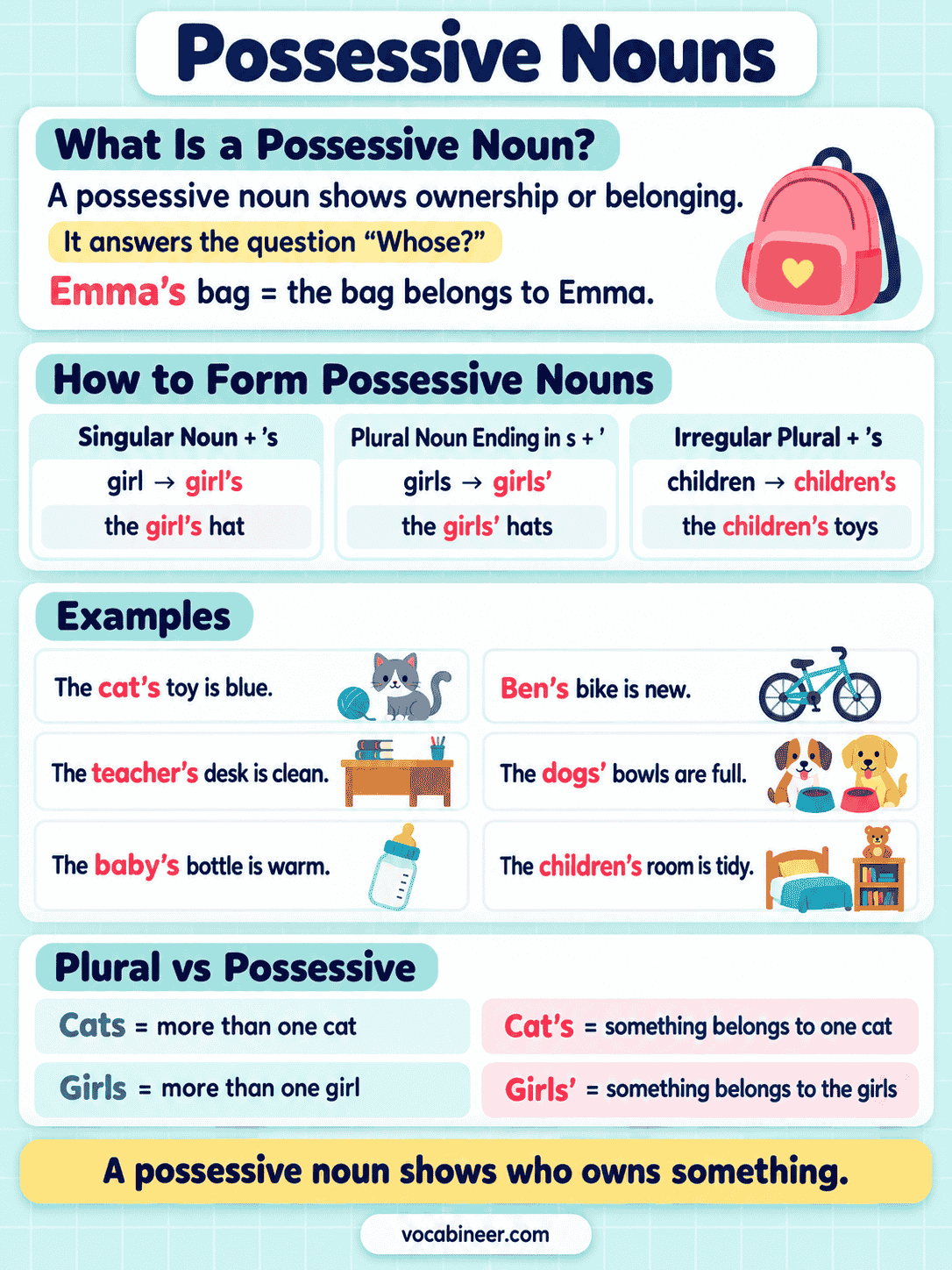
| regular plural ending in s | add ’ after s | students → students’ |
| irregular plural not ending in s | add ’s | children → children’s |
| compound noun | add the possessive ending to the full compound | mother-in-law → mother-in-law’s |
Singular Nouns
Most singular nouns form the possessive by adding ’s.
Examples:
- boy → boy’s
- teacher → teacher’s
- dog → dog’s
- Maria → Maria’s
- company → company’s
In sentences:
- The boy’s bicycle is outside.
- The teacher’s desk is near the window.
- The dog’s collar is red.
- Maria’s bag is on the chair.
- The company’s office is downtown.
The basic pattern is:
singular noun + ’s
Singular Nouns Ending in S
Singular nouns ending in s commonly take ’s.
Examples:
- boss → boss’s
- class → class’s
- James → James’s
In sentences:
- The boss’s office is upstairs.
- The class’s project is complete.
- James’s car is outside.
Some style guides prefer different forms for certain names ending in s, so formal writing should follow the required style when one is specified.
Regular Plural Nouns
Regular plural nouns that already end in s take only an apostrophe after the final s.
Examples:
- students → students’
- teachers → teachers’
- players → players’
- dogs → dogs’
In sentences:
- The students’ books are on the desks.
- The teachers’ room is upstairs.
- The players’ uniforms are clean.
- The dogs’ bowls are outside.
The basic pattern is:
regular plural ending in s + apostrophe
Irregular Plural Nouns
Irregular plural nouns that do not end in s take ’s.
Examples:
- children → children’s
- men → men’s
- women → women’s
- people → people’s
- mice → mice’s
In sentences:
- The children’s toys are everywhere.
- The men’s changing room is downstairs.
- The women’s team won the match.
- The people’s choice was clear.
Because these plurals do not already end in s, the apostrophe comes before the possessive s.
Singular vs Plural Possessives
The apostrophe position can change the meaning completely.
| Singular Possessive | Plural Possessive |
|---|---|
| girl’s bag | girls’ bags |
| teacher’s room | teachers’ room |
| player’s uniform | players’ uniforms |
| dog’s bowl | dogs’ bowls |
| student’s book | students’ books |
Compare:
- the girl’s bag → belongs to one girl
- the girls’ bags → belong to several girls
- the teacher’s room → associated with one teacher
- the teachers’ room → associated with several teachers
Always identify whether the noun is singular or plural before placing the apostrophe.
Plural Nouns vs Possessive Nouns
A plural noun shows more than one, while a possessive noun shows ownership or connection.
| Form | Meaning |
|---|---|
| dogs | more than one dog |
| dog’s | belonging to one dog |
| dogs’ | belonging to more than one dog |
Examples:
- The dogs are barking. → plural
- The dog’s collar is blue. → singular possessive
- The dogs’ collars are blue. → plural possessive
This distinction is one of the most important apostrophe rules in English.
What Possessive Nouns Can Show
Possessive forms appear in more situations than simple ownership.
Ownership and Relationships
Possessive ’s is especially common with people and animals.
Examples:
- Sarah’s book
- the teacher’s chair
- the doctor’s office
- the cat’s paw
- the horse’s saddle
- my brother’s room
In sentences:
- Sarah’s notebook is on the table.
- The cat’s paw was wet.
- My brother’s room is upstairs.
- The horse’s saddle is new.
Possessive nouns also express family and social relationships:
- my sister’s friend
- John’s brother
- the child’s teacher
Groups and Organizations
Possessive nouns can show association with institutions, groups, organizations, and countries.
Examples:
- the company’s policy
- the school’s rules
- the team’s captain
- the government’s decision
- Britain’s coastline
In sentences:
- The company’s policy changed.
- The school’s rules are clear.
- The team’s captain spoke first.
- The government’s decision caused debate.
These examples express connection rather than literal ownership.
Time and Duration
Possessive forms are common with time expressions.
Examples:
- today’s meeting
- yesterday’s newspaper
- tomorrow’s schedule
- this week’s lesson
In sentences:
- Today’s meeting starts at ten.
- Yesterday’s newspaper is on the desk.
- Tomorrow’s schedule is full.
- This week’s lesson covers nouns.
Possessives can also express duration:
- one day’s work
- two days’ work
- one week’s holiday
- three weeks’ notice
- ten minutes’ walk
Compare:
- one day’s work
- two days’ work
The same singular and plural apostrophe rules still apply.
Joint vs Separate Possession
Possessive endings can show whether two people share something or own separate things.
| Type | Example | Meaning |
|---|---|---|
| Joint possession | Ali and Sara’s house | one shared house |
| Separate possession | Ali’s and Sara’s houses | different houses |
| Joint possession | Jack and Mia’s project | one shared project |
| Separate possession | Jack’s and Mia’s projects | different projects |
For joint possession, add the possessive ending only to the final name:
- Ali and Sara’s house
- Jack and Mia’s project
- Tom and Anna’s restaurant
For separate possession, make each name possessive:
- Ali’s and Sara’s cars
- Jack’s and Mia’s desks
- Tom’s and Anna’s offices
Meaning determines the punctuation.
Compound Possessive Nouns
A compound noun takes the possessive ending on the complete compound.
Examples:
- mother-in-law → mother-in-law’s
- school bus → school bus’s
- company director → company director’s
In sentences:
- My mother-in-law’s recipe is excellent.
- The school bus’s door was open.
- The company director’s office is upstairs.
Do not insert the possessive ending inside the compound.
Incorrect:
- mother’s-in-law recipe
Correct:
- mother-in-law’s recipe
Plural compound nouns follow the same logic:
- mothers-in-law → mothers-in-law’s
- school buses → school buses’
- company directors → company directors’
First form the plural correctly, then apply the possessive rule.
Possessive ’s vs Of
English can show possession or connection with either ’s or an of phrase.
| Possessive ’s | Of Phrase |
|---|---|
| Sarah’s bag | the roof of the house |
| the dog’s paw | the name of the ship |
| the company’s policy | the end of the road |
| today’s meeting | the top of the page |
Possessive ’s is especially common with:
- people
- animals
- groups
- organizations
- countries
- time expressions
Examples:
- Maria’s bag
- the dog’s collar
- the school’s rules
- Britain’s coastline
- today’s meeting
By contrast, of is often natural with inanimate things or longer phrases:
- the roof of the house
- the end of the road
- the name of the ship
These are usage tendencies rather than absolute rules.
Possessive Nouns vs Possessive Pronouns
Possessive nouns and possessive pronouns can both show possession, but they are formed differently.
| Possessive Noun | Possessive Pronoun |
|---|---|
| Sarah’s | hers |
| John’s | his |
| the students’ | theirs |
| my parents’ | theirs |
Compare:
- This is Sarah’s book.
- This book is hers.
Possessive pronouns include:
- mine
- yours
- his
- hers
- ours
- theirs
These words do not take apostrophes.
Its, It’s, and Other Apostrophe Confusions
Some of the most common apostrophe mistakes involve words that look possessive but follow different rules.
Its vs It’s
Its is possessive.
Examples:
- The dog wagged its tail.
- The company changed its policy.
- The tree lost its leaves.
It’s means it is or it has.
Examples:
- It’s raining.
- It’s very cold.
- It’s been a long day.
The key rule is:
Possessive its has no apostrophe.
Possessive Pronouns
Do not add apostrophes to possessive pronouns.
Correct:
- yours
- hers
- ours
- theirs
Incorrect:
- your’s
- her’s
- our’s
- their’s
Ordinary Plurals
Apostrophes do not normally form plurals.
Incorrect when meaning more than one:
- apple’s
- book’s
- car’s
- student’s
Correct:
- apples
- books
- cars
- students
Compare:
- books → several books
- book’s cover → one book has a cover
- books’ covers → several books have covers
Apostrophe Errors to Avoid
Correct apostrophe placement depends on both number and meaning.
Incorrect: girls bag
Correct: girl’s bag / girls’ bags
Incorrect: childrens’ toys
Correct: children’s toys
Incorrect: teacher’s room when several teachers share it
Correct: teachers’ room
Incorrect: The cat licked it’s paw.
Correct: The cat licked its paw.
Incorrect: This book is your’s.
Correct: This book is yours.
Incorrect: mother’s-in-law recipe
Correct: mother-in-law’s recipe
Incorrect: Ali’s and Sara’s house, when they share one house
Correct: Ali and Sara’s house
The safest approach is to identify the noun form and intended meaning before adding the apostrophe.
Frequently Asked Questions
What is a possessive noun?
A possessive noun shows ownership, relationship, association, time, duration, or another close connection. It usually uses ’s or an apostrophe after plural s.
How do you form a singular possessive noun?
Add ’s to most singular nouns, such as girl → girl’s, teacher → teacher’s, and dog → dog’s.
How do you form a plural possessive noun?
For regular plurals ending in s, add an apostrophe after the s, as in students → students’. For irregular plurals, add ’s, as in children → children’s.
Where does the apostrophe go in possessive nouns?
It usually comes before s with singular nouns and irregular plurals, but after s with regular plurals that already end in s.
What is the difference between a plural noun and a possessive noun?
A plural noun shows more than one, while a possessive noun shows ownership or connection. For example, dogs is plural, dog’s is singular possessive, and dogs’ is plural possessive.
Read More
- 12 English Tenses Chart
- Parts of Speech in English
- Nouns in English with Examples
- Common and Proper Nouns
- Countable and uncountable nouns
- Be Going To in English