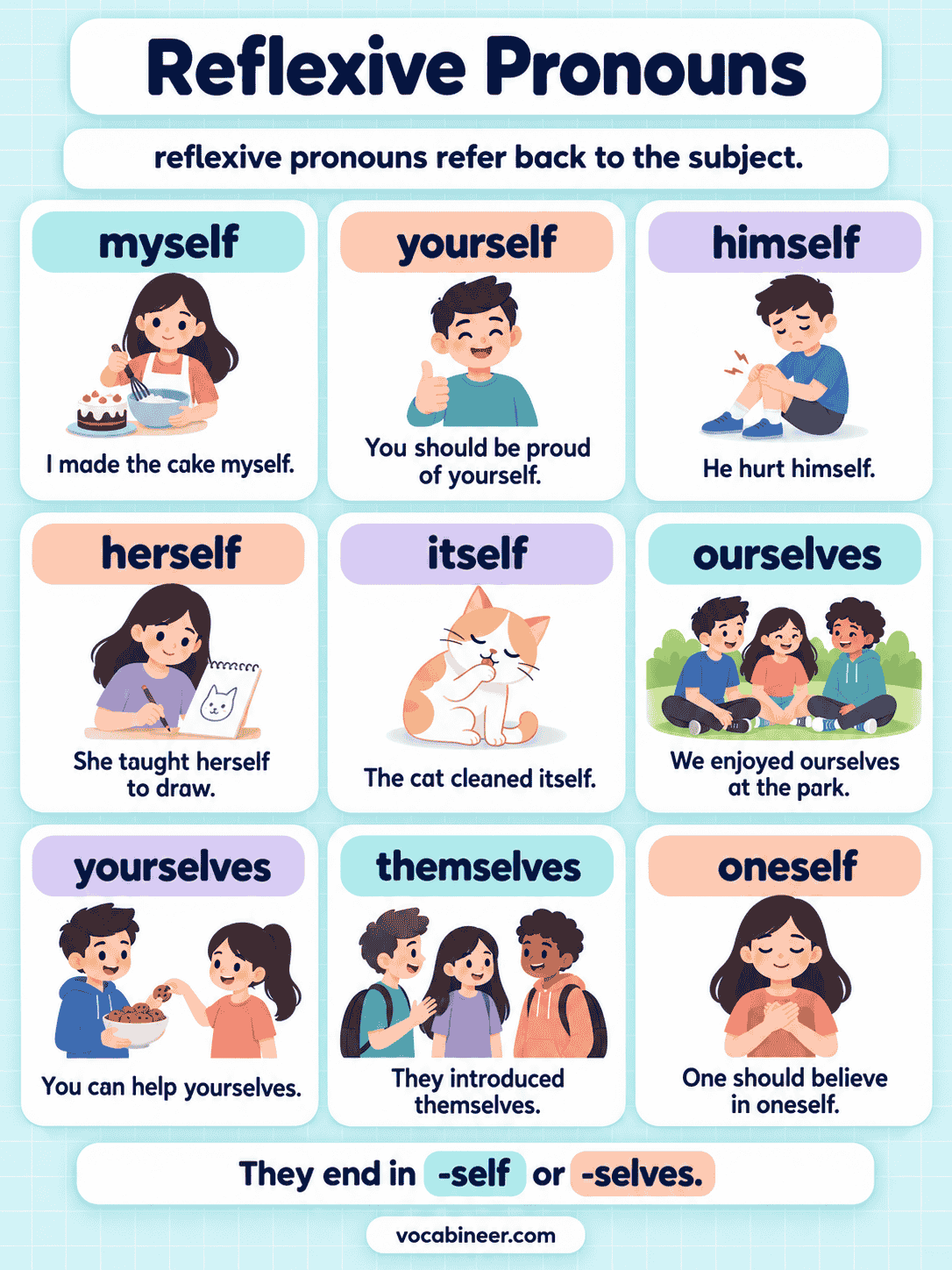
Reflexive pronouns refer back to the subject when the person or thing performing an action also receives that action. Common reflexive pronouns include myself, yourself, himself, herself, itself, ourselves, yourselves, and themselves.
Learning reflexive pronouns helps students understand when the subject and object are the same, how forms such as myself differ from me, and how reflexive pronouns add emphasis or express the idea of doing something alone. They also help learners avoid common errors such as using myself where me is required.
In This Page
What Are Reflexive Pronouns?
A reflexive pronoun refers back to the subject of a sentence.
Examples:
- I hurt myself.
- She introduced herself.
- He blamed himself.
- They prepared themselves.
The key idea is:
Use a reflexive pronoun when the action returns to the same person or thing that performs it.
In:
She introduced herself.
She performs the action, and herself refers back to the same person.
Reflexive Pronouns List
The main reflexive pronouns in English are:
- myself
- yourself
- himself
- herself
- itself
- ourselves
- yourselves
- themselves
These forms end in -self in the singular and -selves in the plural.
Reflexive Pronouns Chart
| Personal Pronoun | Reflexive Pronoun |
|---|---|
| I | myself |
| you | yourself |
| he | himself |
| she | herself |
| it | itself |
| we | ourselves |
| you | yourselves |
| they | themselves |
The reflexive form must match the subject in person and number.
Singular and Plural Reflexive Pronouns
Singular reflexive pronouns include:
- myself
- yourself
- himself
- herself
- itself
Plural reflexive pronouns include:
- ourselves
- yourselves
- themselves
Compare:
- I taught myself.
- We taught ourselves.
- You taught yourself. → one person
- You taught yourselves. → more than one person
Because you can be singular or plural, English uses both yourself and yourselves.
When Subject and Object Are the Same
The main use of reflexive pronouns appears when the subject and object refer to the same person or thing.
Examples:
- I cut myself.
- You hurt yourself.
- He introduced himself.
- She looked at herself.
- We prepared ourselves.
- They blamed themselves.
Compare:
Maria saw her.
Here, her refers to another female person.
Maria saw herself.
Here, herself refers back to Maria.
This difference is central to reflexive-pronoun use.
Reflexive Pronouns as Direct Objects
A reflexive pronoun can act as a direct object.
Examples:
- I hurt myself.
- She cut herself.
- He taught himself French.
- They introduced themselves.
- The cat cleaned itself.
The subject performs the action, and the reflexive pronoun receives that action.
Reflexive Pronouns as Indirect Objects
Reflexive pronouns can also act as indirect objects.
Examples:
- I bought myself a notebook.
- She made herself a cup of tea.
- We prepared ourselves some food.
- He poured himself a glass of water.
In each sentence, the subject also receives or benefits from the action.
Reflexive Pronouns After Prepositions
Reflexive pronouns can follow prepositions when they refer back to the subject.
Examples:
- He was talking to himself.
- She was proud of herself.
- We should believe in ourselves.
- They cooked for themselves.
- I kept the secret to myself.
The reflexive form works because the prepositional object and the subject refer to the same person or people.
Reflexive Pronouns vs Object Pronouns
Object pronouns and reflexive pronouns do not mean the same thing.
| Object Pronoun | Reflexive Pronoun |
|---|---|
| me | myself |
| you | yourself / yourselves |
| him | himself |
| her | herself |
| it | itself |
| us | ourselves |
| them | themselves |
Compare:
- Anna saw her. → another female person
- Anna saw herself. → Anna
- John blamed him. → another male person
- John blamed himself. → John
- They helped us. → another group
- They helped themselves. → the same group
The reflexive form shows that the action returns to the subject.
Myself vs Me
Use me when the object is different from the subject.
Examples:
- Sara called me.
- Please contact me.
- The teacher spoke to me.
Use myself when I am both the subject and object.
Examples:
- I hurt myself.
- I taught myself to cook.
- I reminded myself about the meeting.
Compare:
| Me | Myself |
|---|---|
| Sara called me. | I called myself foolish. |
| Please contact me. | I prepared myself for the test. |
| ordinary object | refers back to I |
A common mistake is using myself simply because it sounds more formal.
Incorrect:
Please contact myself.
Correct:
Please contact me.
Himself vs Him
Use him when the object is another male person.
- John saw him.
- Maria spoke to him.
Use himself when the subject and object are the same male person.
- John saw himself in the mirror.
- He introduced himself.
The rule is:
him = ordinary object
himself = refers back to he
Herself vs Her
Use her when the object is another female person.
- Maria called her.
- I spoke to her.
Use herself when the action returns to the female subject.
- Maria blamed herself.
- She looked at herself in the mirror.
Compare:
- Sara helped her. → another person
- Sara helped herself. → Sara
Ourselves vs Us
Use us as an ordinary object pronoun.
- They invited us.
- The teacher spoke to us.
Use ourselves when we is both the subject and the object.
- We prepared ourselves.
- We introduced ourselves.
Themselves vs Them
Use them when referring to another person or group.
- We saw them.
- She called them.
Use themselves when they refers back to the same subject.
- They saw themselves in the mirror.
- They introduced themselves.
Reflexive Pronouns for Emphasis
Reflexive pronouns can also emphasize who performed an action.
Examples:
- I wrote the report myself.
- The director himself called us.
- She baked the cake herself.
- The students themselves organized the event.
- We completed the project ourselves.
In these sentences, the reflexive pronoun is not the object of the action. Instead, it emphasizes the person who did something.
Reflexive vs Intensive Pronouns
Some grammar books call this emphatic use an intensive pronoun.
The form is the same, but the function changes.
| Reflexive Use | Intensive or Emphatic Use |
|---|---|
| She hurt herself. | She wrote the report herself. |
| pronoun is needed for the meaning | pronoun adds emphasis |
| subject and object are the same | emphasizes who performed the action |
A simple test is to remove the pronoun.
She wrote the report herself.
Without herself:
She wrote the report.
The basic sentence still works, so herself adds emphasis.
Now compare:
She hurt herself.
Removing herself changes the structure and meaning.
By + Reflexive Pronoun
The structure by + reflexive pronoun commonly means alone or without help.
Examples:
- I did it by myself.
- She lives by herself.
- He traveled by himself.
- We completed the work by ourselves.
- The children cooked dinner by themselves.
The pattern works with all common reflexive forms:
- by myself
- by yourself
- by himself
- by herself
- by itself
- by ourselves
- by yourselves
- by themselves
Myself vs By Myself
Myself and by myself express different ideas.
| Myself | By Myself |
|---|---|
| emphasizes who did it | means alone or without help |
| I fixed it myself. | I fixed it by myself. |
| I personally did it. | Nobody helped me. |
Compare:
- She wrote the report herself. → she personally did it
- She wrote the report by herself. → she did it without help
This distinction is important because the two structures are not always interchangeable.
Yourself vs Yourselves
Use yourself when you refers to one person.
Examples:
- You should believe in yourself.
- Did you hurt yourself?
Use yourselves when you refers to more than one person.
Examples:
- You should believe in yourselves.
- Please introduce yourselves.
The form of you stays the same, but the reflexive pronoun shows number.
How We Use Itself
Use itself when the subject is it.
Examples:
- The cat cleaned itself.
- The machine turns itself off.
- The door closed itself.
- The system checks itself automatically.
This form commonly refers to animals, machines, objects, systems, and other things.
Themselves with Singular They
When singular they refers to one person, themselves can refer back to that person.
Example:
- Everyone should ask themselves whether they are ready.
- A person should give themselves enough time.
The form themself also appears in some modern usage, but themselves remains the safer general form for most learners.
When Reflexive Pronouns Are Not Needed
English does not use reflexive pronouns after every action people perform on themselves.
With ordinary personal-care actions, the reflexive form is often unnecessary.
Natural:
- He washed.
- She dressed.
- He shaved.
- She showered.
Usually unnecessary without emphasis:
- He washed himself.
- She dressed herself.
- He shaved himself.
The reflexive becomes useful when the sentence emphasizes independence, contrast, difficulty, or an unusual situation.
Examples:
- The child dressed himself for the first time.
- She washed herself despite her injured arm.
- He shaved himself without any help.
Object Pronouns After Prepositions of Place
Do not automatically use a reflexive pronoun after every preposition just because the subject refers to the same person.
When the preposition simply describes physical position, ordinary object pronouns are usually more natural.
Examples:
- The suitcase was beside him.
- She placed the bag behind her.
- The children had their bags in front of them.
Not normally:
- beside himself
- behind herself
- in front of themselves
when the phrase simply describes location.
With Meaning Accompanied By
After with meaning “accompanied by,” use an ordinary object pronoun.
Correct:
- She had several friends with her.
- He took his brother with him.
Not normally:
- She had several friends with herself.
- He took his brother with himself.
This is an important exception to the simple “same person = reflexive” shortcut.
Reflexive Pronouns Cannot Normally Act as Subjects
Reflexive pronouns do not normally act alone as sentence subjects.
Incorrect:
- Myself completed the report.
- Himself called yesterday.
- Herself prepared the meal.
Correct:
- I completed the report.
- He called yesterday.
- She prepared the meal.
For emphasis, place the reflexive pronoun with the ordinary subject:
- I completed the report myself.
- He himself called yesterday.
- She prepared the meal herself.
Reflexive Pronoun Agreement
The reflexive pronoun must match its subject.
Correct:
- I hurt myself.
- She hurt herself.
- He blamed himself.
- We prepared ourselves.
- They introduced themselves.
Incorrect:
- She hurt himself.
- He blamed herself.
- We prepared themselves.
The pronoun should agree in person and number.
Reflexive vs Reciprocal Pronouns
Reflexive and reciprocal pronouns express different relationships.
| Reflexive Pronoun | Reciprocal Pronoun |
|---|---|
| themselves | each other / one another |
| action returns to each subject | action passes between people |
| They looked at themselves. | They looked at each other. |
| They helped themselves. | They helped one another. |
Consider:
The students looked at themselves in the mirrors.
Each student looked at himself or herself.
The students looked at each other.
Each student looked at another student.
This difference changes the meaning of the sentence.
Reflexive Pronouns in Sentences
These examples show the main uses of reflexive pronouns:
- I cut myself.
- You should believe in yourself.
- He taught himself Spanish.
- She looked at herself in the mirror.
- The cat cleaned itself.
- We prepared ourselves for the test.
- You should enjoy yourselves.
- They introduced themselves.
- I completed the work myself.
- She traveled by herself.
- He was talking to himself.
- We cooked dinner by ourselves.
- The children dressed themselves.
- The machine switched itself off.
- The students organized the event themselves.
Common Mistakes with Reflexive Pronouns
Using a Reflexive When the Subject and Object Are Different
Incorrect: Sara called myself.
Correct: Sara called me.
Using a Reflexive as the Subject
Incorrect: Myself will attend the meeting.
Correct: I will attend the meeting.
Using the Wrong Reflexive Form
Incorrect: She hurt himself.
Correct: She hurt herself.
Using Reflexives Instead of Object Pronouns
Incorrect: Please contact myself.
Correct: Please contact me.
Overusing Reflexives with Everyday Actions
Awkward without emphasis: He washed himself and dressed himself.
Natural: He washed and dressed.
Using Reflexives After Ordinary Place Prepositions
Incorrect in simple location meaning: The bag was beside herself.
Correct: The bag was beside her.
Confusing Reflexive and Reciprocal Meaning
They helped themselves and they helped each other express different ideas.
Reflexive Pronouns for Kids
A simple way to understand reflexive pronouns is:
A reflexive pronoun points back to the person or thing doing the action.
Examples:
- I hurt myself.
- He taught himself.
- She looked at herself.
- The cat cleaned itself.
- We prepared ourselves.
- They introduced themselves.
Useful beginner forms include:
- myself
- yourself
- himself
- herself
- itself
- ourselves
- yourselves
- themselves
Children can first learn the idea of same subject + object before moving to emphasis and by + reflexive structures.
FAQs
Reflexive pronouns are forms such as myself, yourself, himself, herself, itself, ourselves, yourselves, and themselves. They refer back to the subject when the subject and object are the same.
Use them when an action returns to the subject, as in She hurt herself. They can also add emphasis or appear in expressions such as by myself.
Me is an ordinary object pronoun, while myself refers back to I. Compare Sara called me with I hurt myself.
By myself usually means alone or without help. For example, I completed the project by myself means nobody helped me.
A reflexive pronoun sends the action back to the subject, while a reciprocal pronoun shows an action between people. Compare They looked at themselves with They looked at each other.
Read More
- Parts of Speech in English
- Nouns in English with Examples
- Common and Proper Nouns
- Countable and uncountable nouns
- Collective nouns
- Abstract and concrete nouns
- Gender nouns
- Compound nouns
- Possessive nouns
- Singular and plural nouns
- Plural noun rules