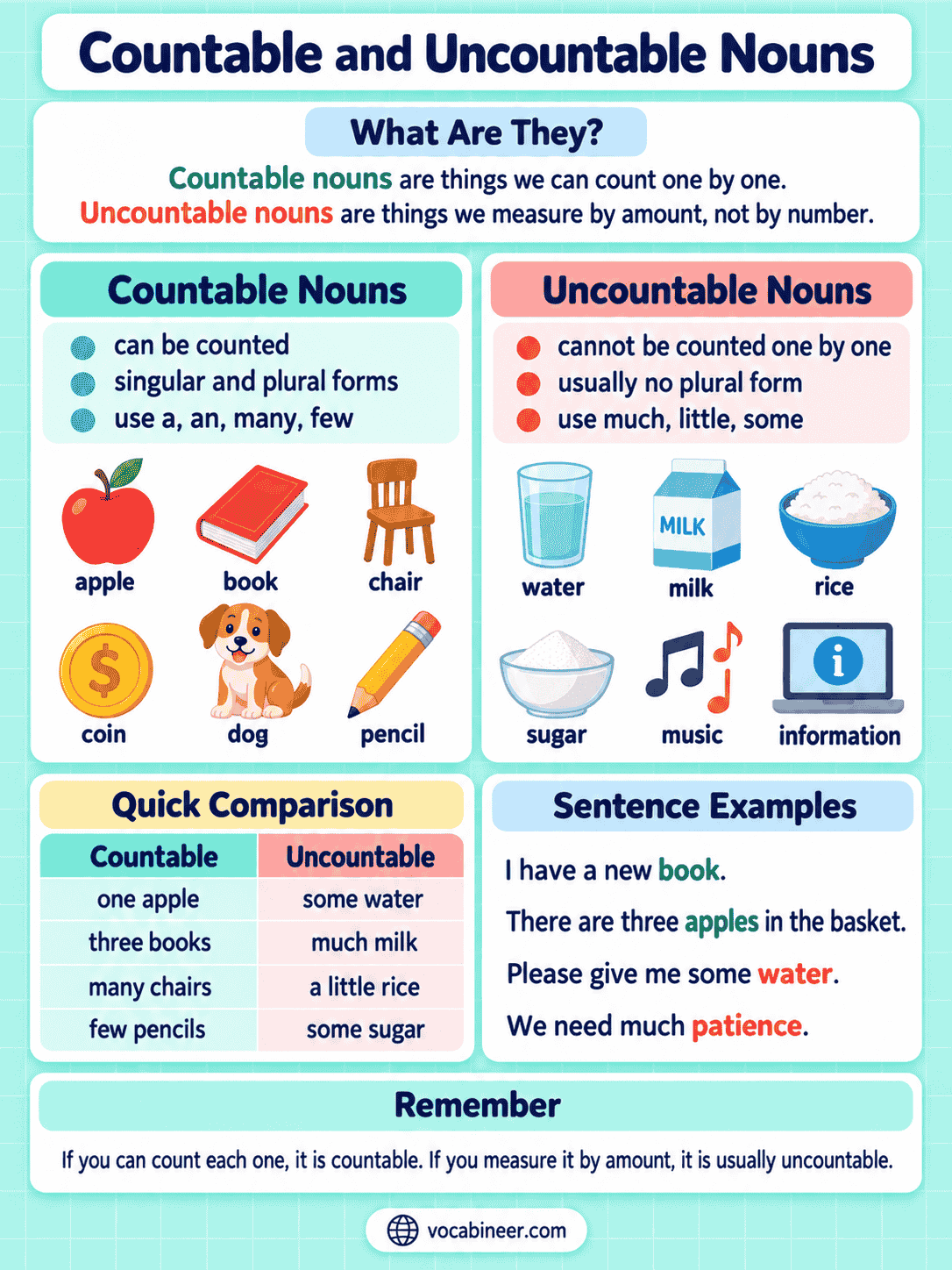
Countable and uncountable nouns are two important noun groups in English. Countable nouns refer to things we can usually count as separate units, while uncountable nouns refer to things English usually treats as an amount, mass, substance, whole, or general concept.
Learning the difference between countable and uncountable nouns helps with articles, plural forms, quantity words, and questions. It explains why we say a book, three books, many chairs, but some water, much information, and a little rice.
In This Page
What Are Countable and Uncountable Nouns?
A countable noun can usually be counted as separate units.
Examples:
- book
- apple
- chair
- student
- car
- bottle
We can say:
- one book
- two books
- three books
An uncountable noun is normally treated as an amount, mass, substance, collection, or general idea rather than as separate units.
Examples:
- water
- rice
- information
- furniture
- advice
- money
- traffic
- research
We usually say:
- some water
- much information
- a little rice
rather than counting these nouns directly.
Countable vs Uncountable Nouns at a Glance
| Countable Nouns | Uncountable Nouns |
|---|---|
| treated as separate units | treated as an amount, mass, or whole |
| usually have singular and plural forms | normally do not have an ordinary plural |
| can use a/an in the singular | do not normally use a/an |
| can use numbers directly | do not normally use numbers directly |
| use many / a few | use much / a little |
| book, chair, apple | water, advice, furniture |
The main difference is grammatical countability, not whether something can physically be divided or measured.
Countable Nouns
Countable nouns can normally be singular or plural.
Examples:
- book → books
- chair → chairs
- apple → apples
- student → students
- child → children
- person → people
Sentence examples:
- I bought a book.
- She has three apples.
- There are five chairs in the room.
- We invited a few friends.
- The students are waiting outside.
Countable nouns work naturally with:
- a/an
- numbers
- many
- a few
- several
- how many
Uncountable Nouns
Uncountable nouns do not normally use an ordinary plural form in their uncountable meanings.
Common examples include:
- water
- milk
- rice
- information
- advice
- furniture
- equipment
- luggage
- homework
- traffic
- research
- money
Sentence examples:
- We need some water.
- She gave me useful information.
- The room has new furniture.
- He gave me good advice.
- There is heavy traffic today.
Uncountable nouns commonly work with:
- some
- any
- much
- a little
- a lot of
- how much
Singular and Plural Countable Nouns
A countable noun can usually appear in both singular and plural forms.
Regular Plurals
- book → books
- car → cars
- chair → chairs
- apple → apples
Irregular Plurals
- child → children
- foot → feet
- mouse → mice
- person → people
- tooth → teeth
A singular countable noun usually needs a determiner.
Correct:
- I bought a book.
- The book is new.
- My book is on the desk.
Less natural in ordinary use:
- I bought book.
Uncountable Nouns and Plural Forms
Uncountable nouns normally remain in one form.
Incorrect:
- informations
- furnitures
- advices
- equipments
- luggages
Correct:
- information
- furniture
- advice
- equipment
- luggage
For example:
- She gave me some information.
- We bought new furniture.
- He gave me useful advice.
A and An with Countable Nouns
Use a or an with singular countable nouns.
Examples:
- a book
- a chair
- a student
- an apple
- an idea
- an orange
Sentence examples:
- She bought a bag.
- I ate an apple.
- He has a bicycle.
Do not normally use a/an directly with uncountable nouns.
Incorrect:
- an information
- an advice
- a furniture
Correct:
- some information
- a piece of advice
- a piece of furniture
Some with Countable and Uncountable Nouns
Some can be used with plural countable nouns and uncountable nouns.
Plural Countable Nouns
- some books
- some students
- some apples
- some chairs
Uncountable Nouns
- some water
- some rice
- some information
- some money
Sentence examples:
- There are some books on the desk.
- There is some milk in the fridge.
- We need some information.
- She bought some apples.
Any with Countable and Uncountable Nouns
Any commonly appears in questions and negative sentences.
Plural Countable
- Are there any chairs?
- There aren’t any books.
Uncountable
- Is there any sugar?
- There isn’t any milk.
More examples:
- Do you have any questions?
- We don’t have any rice.
- Are there any students outside?
- Is there any information available?
Many vs Much
Use many with plural countable nouns and much with uncountable nouns.
| Many | Much |
|---|---|
| many books | much water |
| many students | much information |
| many cars | much money |
| many questions | much time |
Examples:
- How many books do you have?
- How much water do we need?
- There aren’t many students here.
- We don’t have much time.
In everyday affirmative sentences, a lot of often sounds more natural.
A Few vs A Little
Use a few with plural countable nouns and a little with uncountable nouns.
| A Few | A Little |
|---|---|
| a few books | a little water |
| a few students | a little money |
| a few questions | a little time |
Examples:
- I have a few questions.
- We need a little sugar.
- She invited a few friends.
- There is a little milk left.
Few vs Little
Without a, these forms often suggest a small or insufficient quantity.
| Few | Little |
|---|---|
| plural countable nouns | uncountable nouns |
| few opportunities | little time |
| few people | little money |
Examples:
- Few students understood the question.
- We have little time left.
- Few buses run at night.
- There is little hope of finishing today.
How Many vs How Much
Use how many with plural countable nouns.
Examples:
- How many books?
- How many chairs?
- How many students?
- How many apples?
Use how much with uncountable nouns.
Examples:
- How much water?
- How much money?
- How much rice?
- How much information?
Compare:
- How many apples do you need?
- How much milk do you need?
A Lot of and Lots of with Both Types
A lot of and lots of work with both countable and uncountable nouns.
Countable
- a lot of books
- lots of students
- a lot of cars
Uncountable
- a lot of money
- lots of water
- a lot of information
Examples:
- She has a lot of books.
- We need a lot of water.
- There are lots of people outside.
- He has a lot of experience.
Other Useful Quantity Words
Some quantity expressions work mainly with one noun type.
With Countable Nouns
- several books
- many students
- a number of cars
With Uncountable Nouns
- much time
- a little milk
- a great deal of information
With Both
- some
- any
- enough
- a lot of
- lots of
The noun type helps determine which quantity expression is correct.
Measuring Uncountable Nouns
Uncountable nouns can be counted indirectly by using a unit, container, measure, piece, or portion.
Examples:
- a piece of advice
- a piece of information
- a loaf of bread
- a bottle of water
- a cup of tea
- a kilo of rice
- a litre of milk
- a bar of chocolate
The important rule is:
Count the unit or measure rather than the uncountable noun directly.
For example:
- two bottles of water
- three pieces of advice
- four cups of tea
- five kilos of rice
Countable Expressions for Uncountable Nouns
| Uncountable Noun | Countable Expression |
|---|---|
| advice | a piece of advice |
| information | a piece of information |
| furniture | a piece of furniture |
| bread | a loaf / slice of bread |
| water | a bottle / glass of water |
| rice | a bowl / kilo of rice |
| luggage | a bag / suitcase |
| work | a job / task |
These expressions allow us to talk about separate units naturally.
Nouns That Can Be Both Countable and Uncountable
Some nouns change countability when their meaning changes.
Coffee
- I drink coffee every morning. → uncountable
- We ordered two coffees. → two servings
Glass
- The table is made of glass. → material, uncountable
- I broke a glass. → drinking container, countable
Paper
- The printer needs paper. → material, uncountable
- I bought a paper. → newspaper or written work, depending on context
Chocolate
- I like chocolate. → food substance, uncountable
- She ate two chocolates. → individual pieces, countable
Chicken
- We ate chicken for dinner. → food, uncountable
- There are three chickens outside. → animals, countable
The meaning determines the countability.
Abstract Nouns That Can Be Countable or Uncountable
Some abstract nouns also change according to meaning.
Experience
- She has a lot of experience. → general knowledge or skill
- It was an interesting experience. → one event
Time
- Time passes quickly. → general concept
- We had a good time. → specific experience
Education
- Education is important. → general concept
- He received a good education. → particular educational experience
Therefore, countability should always be considered in context.
Food and Drink Nouns Used Countably
Food and drink nouns often become countable when they refer to servings or containers.
Examples:
- two coffees
- three teas
- two juices
- four waters
In context, these usually mean:
- two cups of coffee
- three cups of tea
- two glasses of juice
- four bottles or glasses of water
The serving meaning makes the noun countable.
Common Uncountable Nouns
Some uncountable nouns cause frequent learner mistakes.
Common examples include:
- advice
- information
- furniture
- equipment
- luggage
- homework
- research
- traffic
- progress
- news
- accommodation
- money
These are worth learning because their grammar may differ from similar words in other languages.
Information and Advice
Information and advice are especially important because learners often use them incorrectly.
Incorrect:
- an information
- informations
- an advice
- advices
Correct:
- some information
- a piece of information
- some advice
- a piece of advice
Sentence examples:
- She gave me some information.
- He gave me a useful piece of advice.
Furniture and Equipment
These nouns refer to collections of separate physical items, but English usually treats the general nouns as uncountable.
Correct:
- some furniture
- a piece of furniture
- some equipment
- a piece of equipment
Incorrect:
- furnitures
- equipments
You can count the individual items instead:
- three chairs
- two tables
- four machines
News Is Grammatically Singular
Although news ends in -s, it is normally treated as an uncountable singular noun.
Correct:
- The news is good.
- This news is surprising.
Incorrect:
- The news are good.
Its spelling does not make it grammatically plural.
Countability Depends on English Usage
Countability is not simply about whether something can logically be counted in the real world.
For example, a room may contain:
- one table
- three chairs
- two sofas
but English normally groups these items under the uncountable noun furniture.
Therefore:
Correct:
- There is some furniture in the room.
Incorrect:
- There are three furnitures in the room.
The grammar depends on how English treats the noun.
Countable and Uncountable Nouns with There Is and There Are
Countability also affects there is and there are.
Singular Countable
- There is a book on the table.
Plural Countable
- There are three books on the table.
Uncountable
- There is some water in the bottle.
Incorrect:
- There are some water.
Correct:
- There is some water.
Countable and Uncountable Nouns with Is and Are
Verb agreement also changes according to noun number and countability.
Examples:
- The book is new.
- The books are new.
- The information is useful.
- The furniture is expensive.
- The news is surprising.
Plural countable nouns normally take are, while ordinary uncountable nouns generally take singular agreement.
How to Identify a Countable Noun
A noun is likely countable if it can naturally appear with:
- a/an
- one, two, three
- a singular/plural contrast
- many
- a few
- how many
Example:
- a chair
- two chairs
- many chairs
- a few chairs
- how many chairs?
These clues work well, although context still matters.
How to Identify an Uncountable Noun
A noun may be uncountable if it normally:
- does not use a/an
- does not take numbers directly
- does not take an ordinary plural
- works with much
- works with a little
- works with how much
- needs a unit or measure to be counted
Example:
- some water
- much water
- a little water
- how much water?
- a bottle of water
No single test works in every context because some nouns can be both countable and uncountable.
Common Mistakes with Countable and Uncountable Nouns
Using A/An with an Uncountable Noun
Incorrect: an information
Correct: some information / a piece of information
Pluralizing an Uncountable Noun
Incorrect: furnitures
Correct: furniture
Using Many with an Uncountable Noun
Incorrect: many money
Correct: much money / a lot of money
Using Much with a Plural Countable Noun
Incorrect: much books
Correct: many books
Using How Many with an Uncountable Noun
Incorrect: How many water?
Correct: How much water?
Using How Much with a Plural Countable Noun
Incorrect: How much books?
Correct: How many books?
Treating Countability as Fixed in Every Meaning
Incorrect assumption: coffee is always uncountable.
Correct understanding: coffee can become countable when it means servings.
Pluralizing Advice or Information
Incorrect: advices / informations
Correct: advice / information
Countable and Uncountable Nouns for Kids
A simple way for children to understand the difference is:
Countable nouns are things English counts as separate items. Uncountable nouns are things English usually treats as an amount or whole.
Countable Examples
- one apple
- two apples
- three apples
- one book
- four books
Uncountable Examples
- water
- milk
- rice
- sugar
Sentence examples:
- I have two apples.
- She has three books.
- We need some water.
- There is some rice in the bowl.
FAQs
Countable nouns can usually be counted as separate units and have singular and plural forms, such as book/books. Uncountable nouns are normally treated as an amount, mass, whole, or general concept, such as water or information.
Uncountable nouns do not normally take ordinary plural forms in their uncountable meanings. For example, information, furniture, and advice usually remain unchanged.
Yes. The meaning can change the noun’s countability. For example, coffee is uncountable when it means the drink in general but countable in two coffees when it means two servings.
Use many with plural countable nouns, such as many books. Use much with uncountable nouns, such as much water.
Use a unit, measure, container, or piece expression, such as a piece of advice, two bottles of water, or three kilos of rice.
Read More
- 12 English Tenses Chart
- Parts of Speech in English
- Nouns in English with Examples
- Common and Proper Nouns
- Be Going To in English