

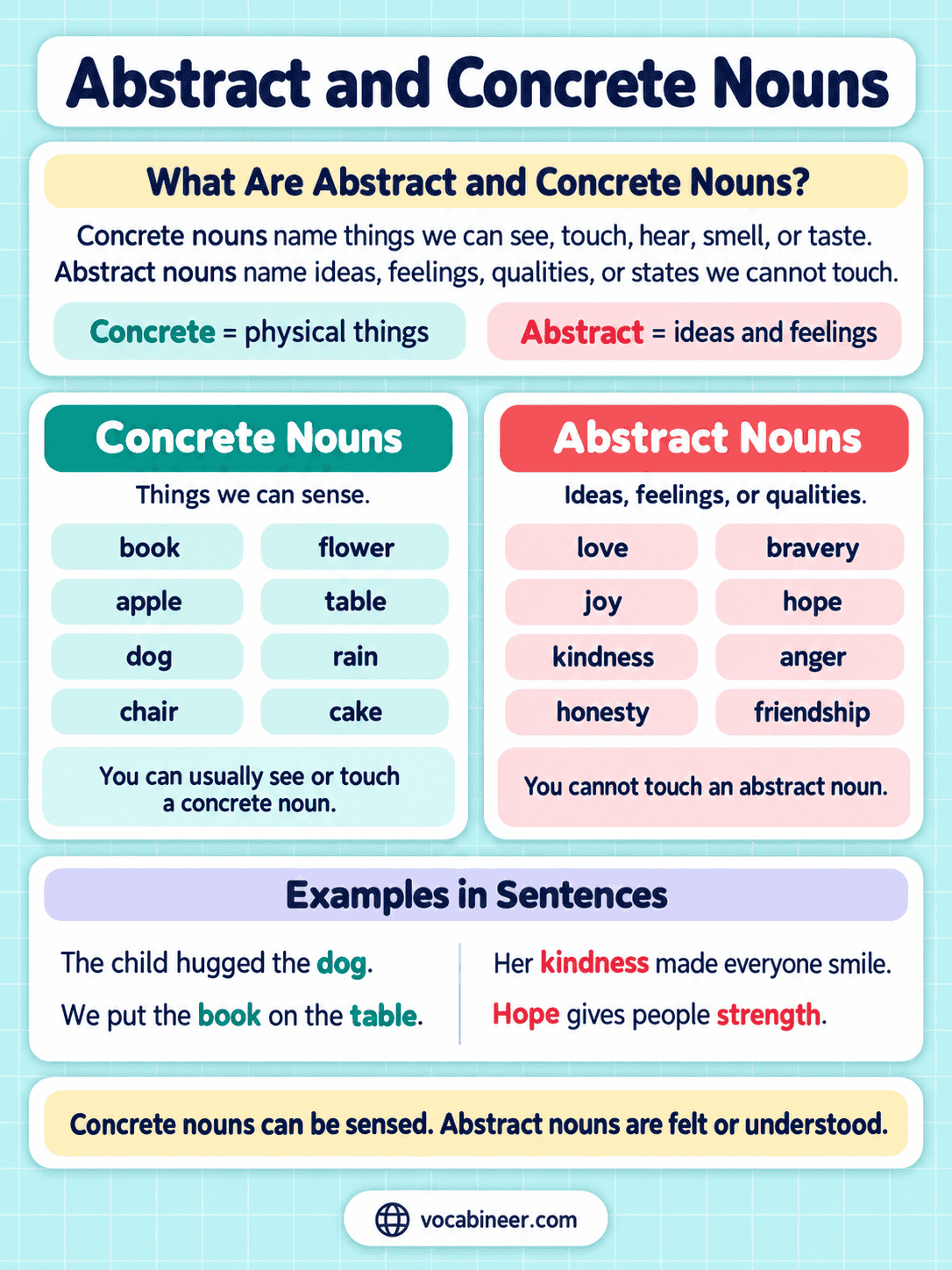
Abstract and concrete nouns are two important noun groups that describe different kinds of meaning. A concrete noun refers to something physical or materially real, while an abstract noun refers to an idea, feeling, quality, state, relationship, or concept.
Learning the difference between abstract and concrete nouns helps students classify nouns more accurately and understand how meaning affects grammar. Concrete nouns include words such as dog, school, flower, and water, while abstract nouns include love, honesty, courage, and knowledge.
In This Page
What Are Abstract and Concrete Nouns?
Abstract and concrete nouns differ mainly in whether they refer to something physical or non-physical.
A concrete noun names a person, animal, place, object, substance, or physical phenomenon.
Examples:
- teacher
- dog
- city
- apple
- phone
- water
An abstract noun names a feeling, quality, idea, state, relationship, or concept.
Examples:
- love
- honesty
- happiness
- courage
- friendship
- freedom
The key distinction is:
Concrete noun → physical or materially real
Abstract noun → non-physical idea, quality, feeling, state, or concept
Abstract vs Concrete Nouns at a Glance
| Concrete Nouns | Abstract Nouns |
|---|---|
| refer to physical or material things | refer to non-material ideas or states |
| chair | freedom |
| apple | happiness |
| dog | loyalty |
| flower | beauty |
| book | knowledge |
| person | courage |
This comparison helps show that the difference depends on meaning rather than spelling.
What Is a Concrete Noun?
A concrete noun refers to something that has physical or material existence.
Examples:
- child
- horse
- school
- pencil
- bread
- rain
- music
Sentence examples:
- The child opened the door.
- The horse ran across the field.
- She dropped her pencil.
- We bought some bread.
- The rain started suddenly.
Concrete nouns often refer to things we can experience through one or more senses.
What Is an Abstract Noun?
An abstract noun refers to something that does not exist as a physical object.
Examples:
- kindness
- freedom
- knowledge
- bravery
- friendship
- happiness
- patience
Sentence examples:
- Kindness improves relationships.
- Freedom carries responsibility.
- Knowledge grows through learning.
- Her patience helped the group.
- Their friendship lasted for years.
These nouns express concepts that we understand rather than physically handle.
Main Difference Between Abstract and Concrete Nouns
The clearest distinction is physical vs non-physical meaning.
Compare:
- flower → concrete
- beauty → abstract
- friend → concrete
- friendship → abstract
- child → concrete
- childhood → abstract
- leader → concrete
- leadership → abstract
A concrete noun names the entity itself, while an abstract noun may name a quality, state, relationship, or idea connected with it.
Concrete Nouns and the Five Senses
The five senses provide a useful way to recognize many concrete nouns.
A concrete noun may refer to something that can be:
- seen
- heard
- touched
- smelled
- tasted
Examples:
- bird → seen and heard
- perfume → smelled
- bread → tasted
- stone → touched
- music → heard
The senses test is useful, but it should be treated as a clue rather than the whole definition.
Concrete Does Not Mean Touchable Only
Concrete nouns are not limited to things that can easily be touched.
Examples include:
- air
- sound
- rain
- bacteria
These refer to physical or materially real phenomena even if direct touch is not the best way to experience them.
A more accurate rule is:
Concrete nouns refer to physical or material entities and phenomena.
Concrete Nouns for People
Names of people and general person categories can be concrete nouns.
Examples:
- teacher
- doctor
- child
- woman
- friend
- farmer
Sentence examples:
- The teacher entered the classroom.
- My friend lives nearby.
- The doctor examined the patient.
These nouns refer to physically existing people.
Concrete Nouns for Animals
Animal names are concrete nouns.
Examples:
- dog
- cat
- horse
- bird
- elephant
- rabbit
Sentence examples:
- The dog is sleeping.
- A bird landed on the tree.
- The horse ran across the field.
These examples are especially useful for children and beginners.
Concrete Nouns for Places
Places can also be concrete nouns.
Examples:
- school
- city
- park
- mountain
- river
- house
Sentence examples:
- The park is near our house.
- We visited the city yesterday.
- The river flows through the valley.
Concrete nouns are therefore not limited to objects.
Concrete Nouns for Objects and Substances
Common concrete nouns include objects and materials.
Examples:
- table
- pencil
- phone
- glass
- wood
- water
- bread
Sentence examples:
- The phone is on the table.
- The cup contains water.
- The shelf is made of wood.
Abstract Nouns for Feelings and Emotions
Feelings and emotions form one major group of abstract nouns.
Examples:
- love
- anger
- fear
- joy
- sadness
- excitement
- jealousy
Sentence examples:
- She felt great joy.
- His anger faded quickly.
- Love can influence decisions.
- The news caused sadness.
These nouns describe emotional experiences rather than physical objects.
Abstract Nouns for Qualities
Qualities and characteristics are also abstract nouns.
Examples:
- honesty
- bravery
- kindness
- patience
- intelligence
- beauty
- strength
Sentence examples:
- Honesty builds trust.
- Her patience helped everyone.
- His bravery impressed the group.
- Kindness can strengthen relationships.
Abstract Nouns for Ideas and Concepts
Ideas and concepts commonly appear as abstract nouns.
Examples:
- freedom
- justice
- democracy
- knowledge
- education
- equality
- peace
Sentence examples:
- Education creates opportunities.
- Justice requires fairness.
- Freedom comes with responsibility.
- Knowledge helps people make informed decisions.
Abstract Nouns for States and Relationships
Abstract nouns can also name states, conditions, or relationships.
Examples:
- childhood
- friendship
- poverty
- safety
- illness
- peace
- chaos
Sentence examples:
- Childhood shapes many memories.
- Their friendship lasted for years.
- Safety remains the main concern.
- Poverty affects many communities.
Abstract Noun Formation
Many abstract nouns are formed from adjectives, verbs, or other nouns.
| Base Word | Abstract Noun |
|---|---|
| kind | kindness |
| happy | happiness |
| brave | bravery |
| strong | strength |
| free | freedom |
| decide | decision |
| develop | development |
| friend | friendship |
Recognizing these patterns can make abstract nouns easier to identify.
Common Abstract Noun Endings
Several endings commonly appear in abstract nouns.
-ness
- happiness
- kindness
- darkness
-ment
- development
- excitement
- improvement
-ity
- ability
- activity
- equality
-ship
- friendship
- leadership
- membership
-tion / -sion
- education
- decision
- discussion
-ance / -ence
- importance
- confidence
- independence
These endings are useful clues, but they do not guarantee that every word with the ending is abstract.
Abstract and Concrete Nouns in Sentences
Looking at both types together makes the difference easier to understand.
Example
The child showed great courage.
- child → concrete noun
- courage → abstract noun
Example
The book gave her knowledge.
- book → concrete noun
- knowledge → abstract noun
Example
The teacher praised his honesty.
- teacher → concrete noun
- honesty → abstract noun
Example
The friend showed great kindness.
- friend → concrete noun
- kindness → abstract noun
Concrete and Abstract Noun Pairs
Some concrete nouns have closely related abstract concepts.
| Concrete Noun | Related Abstract Noun |
|---|---|
| friend | friendship |
| child | childhood |
| leader | leadership |
| hero | heroism |
| artist | creativity |
| person | personality |
These pairs show the contrast between an entity and a related non-material concept.
Concrete/Abstract vs Common/Proper
These are separate noun classifications.
| Classification | Main Question |
|---|---|
| concrete vs abstract | physical/material or non-material? |
| common vs proper | general name or specific name? |
Examples:
London
- proper noun
- concrete place noun
Teacher
- common noun
- concrete noun
Honesty
- common noun
- abstract noun
A noun can belong to more than one category at the same time.
Concrete/Abstract vs Countable/Uncountable
These classifications also describe different grammatical features.
| Classification | Main Question |
|---|---|
| concrete vs abstract | physical or non-physical? |
| countable vs uncountable | counted as separate units or not? |
Examples:
- chair → concrete + countable
- water → concrete + uncountable
- idea → abstract + countable
- happiness → abstract + usually uncountable
This distinction is important because concrete does not automatically mean countable, and abstract does not automatically mean uncountable.
Abstract Nouns Can Be Countable
Some abstract nouns can be counted.
Examples:
- idea
- thought
- dream
- experience
- decision
Sentence examples:
- She had an idea.
- He made two important decisions.
- We shared several interesting experiences.
These nouns are abstract because they are non-physical, but they can still have singular and plural forms.
Concrete Nouns Can Be Uncountable
Some concrete nouns are grammatically uncountable.
Examples:
- water
- air
- sand
- furniture
Sentence examples:
- We need some water.
- The room has new furniture.
- The beach has soft sand.
These nouns refer to physical things but are not normally counted directly in these meanings.
Meaning and Context Matter
A noun’s classification may depend on the meaning it has in a sentence.
Consider experience:
- She has a lot of experience. → abstract, uncountable
- It was an interesting experience. → abstract, countable
Consider light:
- The light filled the room. → noun referring to a physical phenomenon
- The bag is light. → adjective
Therefore, classification should always consider both meaning and grammatical function.
How to Identify a Concrete Noun
A noun is likely concrete if it:
- refers to something physically or materially real
- names a person, animal, place, object, substance, or physical phenomenon
- can often be experienced through one or more senses
Examples:
- dog
- table
- school
- water
- music
A useful question is:
Does this noun refer to something with physical or material existence?
If yes, it is probably concrete.
How to Identify an Abstract Noun
A noun is likely abstract if it refers to:
- a feeling
- an idea
- a quality
- a state
- a relationship
- a concept
Examples:
- happiness
- freedom
- kindness
- friendship
- knowledge
A useful question is:
Does this noun name something non-material?
If yes, it is probably abstract.
Common Mistakes with Abstract and Concrete Nouns
Thinking Concrete Means Touchable Only
Too narrow: A concrete noun must be something you can touch.
Better: Concrete nouns refer to physical or material entities and phenomena.
Thinking Every Abstract Noun Is Uncountable
Incorrect: All abstract nouns are uncountable.
Correct: Words such as idea, thought, and experience can be abstract and countable.
Thinking Every Concrete Noun Is Countable
Incorrect: All concrete nouns are countable.
Correct: Words such as water, air, and sand can be concrete and uncountable.
Confusing Adjectives with Abstract Nouns
Incorrect: beautiful → abstract noun
Correct: beauty → abstract noun / beautiful → adjective
Ignoring Context
The same form can perform a different grammatical function or carry a different meaning depending on its sentence.
Abstract and Concrete Nouns for Kids
A simple way to explain the difference is:
Concrete nouns name physical things. Abstract nouns name ideas, feelings, qualities, or states.
Concrete Nouns
- dog
- apple
- book
- school
- flower
Abstract Nouns
- love
- bravery
- happiness
- kindness
- friendship
Look at this sentence:
The girl showed great kindness.
Here:
- girl → concrete noun
- kindness → abstract noun
This comparison makes the difference easy to understand.
FAQs
Concrete nouns refer to physical or materially real things, while abstract nouns refer to non-physical ideas, feelings, qualities, states, relationships, or concepts.
Examples include dog, chair, teacher, school, apple, water, and flower.
Examples include love, honesty, courage, happiness, friendship, freedom, and knowledge.
Yes. Abstract nouns such as idea, decision, and experience can be countable because they can refer to separate instances.
Ask whether the noun refers to something physically or materially real. If it does, it is likely concrete. If it names a non-material feeling, idea, quality, state, relationship, or concept, it is likely abstract.
Read More
- 12 English Tenses Chart
- Parts of Speech in English
- Nouns in English with Examples
- Common and Proper Nouns
- Countable and uncountable nouns
- Be Going To in English