

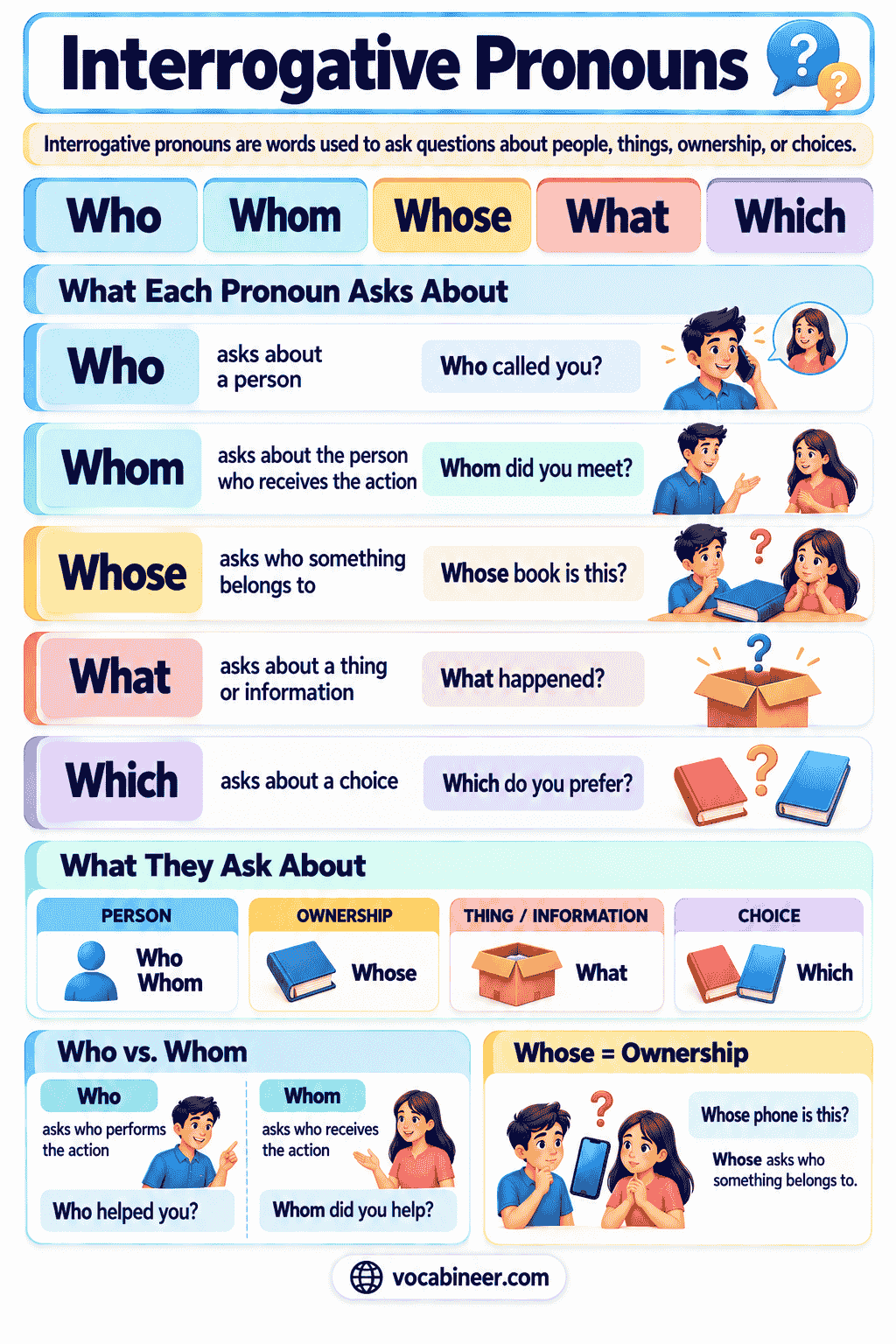
Interrogative pronouns are words used to ask questions about an unknown person, thing, choice, or possession. The five core interrogative pronouns in English are who, whom, whose, which, and what.
These words appear in questions such as Who called?, Whose is this?, Which do you prefer?, and What happened? Their correct use depends on whether the speaker is asking about a person, an object, ownership, or a limited choice.
In This Page
What Are Interrogative Pronouns?
An interrogative pronoun is a pronoun used to ask for information about a person, thing, choice, or possession.
For example:
Who called you?
The speaker wants to identify a person.
What happened?
The speaker wants information about an event.
Whose is this?
The speaker wants to know who owns something.
Interrogative pronouns replace the unknown person or thing instead of naming it directly.
5 Interrogative Pronouns in English
English has five core interrogative pronouns.
| Pronoun | Main Use | Example |
|---|---|---|
| who | asks about a person | Who called? |
| whom | asks about a person as an object | Whom did you invite? |
| whose | asks about possession | Whose is this? |
| which | asks about a limited choice | Which do you prefer? |
| what | asks about a thing or information | What happened? |
These five pronouns form the core of the interrogative-pronoun system in English.
How to Use the 5 Interrogative Pronouns
Who
Who is used to ask about a person.
It often functions as the subject of a question.
Who called you?
Who lives next door?
Who wants to come with us?
In everyday English, who is also commonly used as an object.
Who did you invite?
Who are you waiting for?
Although formal grammar may use whom in these object positions, who is natural and widely used in conversation.
Whom
Whom asks about a person who receives the action of the verb.
It is mainly used in formal English.
Whom did you invite?
Whom did the manager choose?
It is especially common after a preposition in formal writing.
To whom did you speak?
For whom is this gift?
In everyday English, speakers usually use who instead.
Whose
Whose asks about ownership or possession.
When it stands alone:
Whose is this?
Whose are those?
Before a noun:
Whose bag is this?
Whose phone is ringing?
Whose keys did you find?
Which
Which asks someone to choose from a limited or known set of options.
As a pronoun:
Which do you prefer?
Which is yours?
Before a noun:
Which shirt do you want?
Which train should we take?
The possible choices are normally known or restricted.
What
What asks about things, information, events, actions, or ideas.
As a pronoun:
What happened?
What do you need?
What caused the problem?
Before a noun:
What time is it?
What color do you prefer?
What book are you reading?
Unlike which, what usually asks about a broader or open range.
Subject and Object Interrogative Pronouns
Interrogative pronouns can function as subjects or objects. The difference affects the structure of the question.
| Function | Example | Explanation |
|---|---|---|
| Subject | Who called Maya? | Who performs the action. |
| Object | Who did Maya call? | Maya performs the action; who receives it. |
| Subject | What caused the noise? | What performs the action. |
| Object | What did you buy? | You perform the action; what receives it. |
Subject Questions
When the interrogative pronoun is the subject, English normally does not use do, does, or did.
Correct:
Who broke the window?
What caused the problem?
Not normally:
Who did break the window?
The form with did can be used for special emphasis, but it is not the normal neutral question.
Object Questions
When the interrogative pronoun is the object, English commonly uses an auxiliary verb.
Who did you call?
What did she buy?
Which did they choose?
Common Interrogative Pronoun Comparisons
Who vs Whom
| Point | Who | Whom |
|---|---|---|
| Main role | subject; also common object form | formal object form |
| As subject | Who called? | not used |
| As object | Who did you call? | Whom did you call? |
| Everyday speech | very common | less common |
| Formal writing | common | more common than in speech |
| After a preposition | Who did you speak to? | To whom did you speak? |
A useful test is:
Who matches he, she, or they.
Whom matches him, her, or them.
For example:
Who called?
He called.
Whom did you call?
I called him.
In everyday English, Who did you call? is usually preferred.
What vs Which
| Point | What | Which |
|---|---|---|
| Range of choices | open or broad | limited or known |
| General information | common | less common |
| Restricted choice | possible, but less precise | preferred |
| Example | What do you want to eat? | Which do you want, tea or coffee? |
| Before a noun | What book are you reading? | Which book do you want, this one or that one? |
A simple rule is:
Use what for an open range and which for a limited range.
Whose vs Who’s
| Form | Meaning | Example |
|---|---|---|
| whose | asks about possession | Whose bag is this? |
| who’s | contraction of who is | Who’s at the door? |
| who’s | contraction of who has | Who’s finished the work? |
Compare:
Whose phone is ringing? ✅
Who’s phone is ringing? ❌
Interrogative Pronouns vs Interrogative Determiners
Some interrogative words can function either as pronouns or as determiners.
| Pronoun Use | Determiner Use |
|---|---|
| Which do you want? | Which book do you want? |
| Whose is this? | Whose bag is this? |
| What happened? | What time is it? |
The key difference is simple:
A pronoun stands in place of a noun. A determiner comes directly before a noun and helps identify it.
For example:
Which do you prefer?
Here, which stands alone and functions as a pronoun.
Which shirt do you prefer?
Here, which modifies shirt, so it functions as a determiner.
Interrogative Pronouns With Prepositions
English can place prepositions before or after interrogative pronouns.
| Everyday English | Formal English |
|---|---|
| Who did you speak to? | To whom did you speak? |
| Who are you waiting for? | For whom are you waiting? |
| Who did you travel with? | With whom did you travel? |
Everyday English normally places the preposition at the end.
Formal English may place it before whom.
Both structures can be grammatical, but the first is usually more natural in ordinary conversation.
Interrogative Pronouns and Similar Question Words
Several forms look similar but perform different grammatical jobs.
Interrogative Pronouns vs Relative Pronouns
| Interrogative Use | Relative Use |
|---|---|
| Who called? | The person who called is my teacher. |
| Which do you prefer? | The book which I bought is new. |
| Whose is this? | I met the student whose bag was missing. |
An interrogative pronoun asks a question.
A relative pronoun introduces information about a noun or noun phrase.
The word itself may look the same, but its function changes.
Interrogative Pronouns vs Other Question Words
| Word | Main Function | Example |
|---|---|---|
| who | asks about a person | Who arrived? |
| what | asks about a thing or information | What happened? |
| which | asks about a choice | Which do you want? |
| where | asks about place | Where did they go? |
| when | asks about time | When will you leave? |
| why | asks about reason | Why did she leave? |
| how | asks about manner | How did you do that? |
Therefore, not every question word is an interrogative pronoun.
Where, when, why, and how usually function as other kinds of question words.
Core Pronouns vs Compound Forms
English also uses forms such as whoever, whomever, whatever, and whichever.
| Core Form | Compound Form |
|---|---|
| who | whoever |
| whom | whomever |
| what | whatever |
| which | whichever |
These compound forms can appear in emphatic questions.
Whoever told you that?
Whatever do you mean?
However, they can also perform relative or indefinite functions.
Take whichever you prefer.
For basic grammar, who, whom, whose, which, and what remain the five core interrogative pronouns.
How Interrogative Pronouns Form Questions
Three common patterns are especially useful.
Subject Question
Interrogative pronoun + verb
Who called?
Who knows the answer?
What happened?
Object Question
Interrogative pronoun + auxiliary + subject + verb
Who did you call?
What did she buy?
Which did they choose?
Question With a Noun
Interrogative determiner + noun + auxiliary + subject + verb
Which book did you choose?
What movie did they watch?
Whose bag did you find?
These patterns make it easier to build accurate questions.
Interrogative Pronoun Examples
Who sent this message?
Who wants to join us?
Who are you waiting for?
Whom did the committee choose?
To whom should I send the letter?
Whose is the red notebook?
Whose shoes are outside?
Whose phone did you find?
Which would you recommend?
Which belongs to you?
Which route should we take?
What caused the delay?
What made you change your mind?
What did she tell you?
What are you looking for?
These examples show how interrogative pronouns ask about people, things, ownership, choices, and unknown information.
Common Mistakes With Interrogative Pronouns
| Incorrect | Correct | Why |
|---|---|---|
| Whom called you? | Who called you? | Who is the subject. |
| Who’s bag is this? | Whose bag is this? | Whose shows possession. |
| Who did break the window? | Who broke the window? | A normal subject question does not need did. |
| Whom did call Sarah? | Who called Sarah? | The pronoun performs the action. |
| Which do you want to eat? | What do you want to eat? | What is better when the choice is open. |
Another common mistake is assuming whom must always replace who when the pronoun is an object.
Formal:
Whom did you invite?
Everyday English:
Who did you invite?
The everyday form is natural and widely accepted.
FAQs
Interrogative pronouns are pronouns used to ask questions about unknown people, things, choices, or possession.
The five core interrogative pronouns are who, whom, whose, which, and what.
Who normally functions as a subject and is also commonly used as an object in everyday English. Whom is mainly the formal object form.
What generally asks about an open range of possibilities, while which asks someone to choose from a limited or known set.
No. They are question words, but they usually perform other grammatical functions rather than acting as the five core interrogative pronouns.
Read More
- Parts of Speech in English
- Nouns in English with Examples
- Common and Proper Nouns
- Countable and uncountable nouns
- Collective nouns
- Abstract and concrete nouns
- Gender nouns
- Compound nouns
- Possessive nouns
- Singular and plural nouns
- Plural noun rules