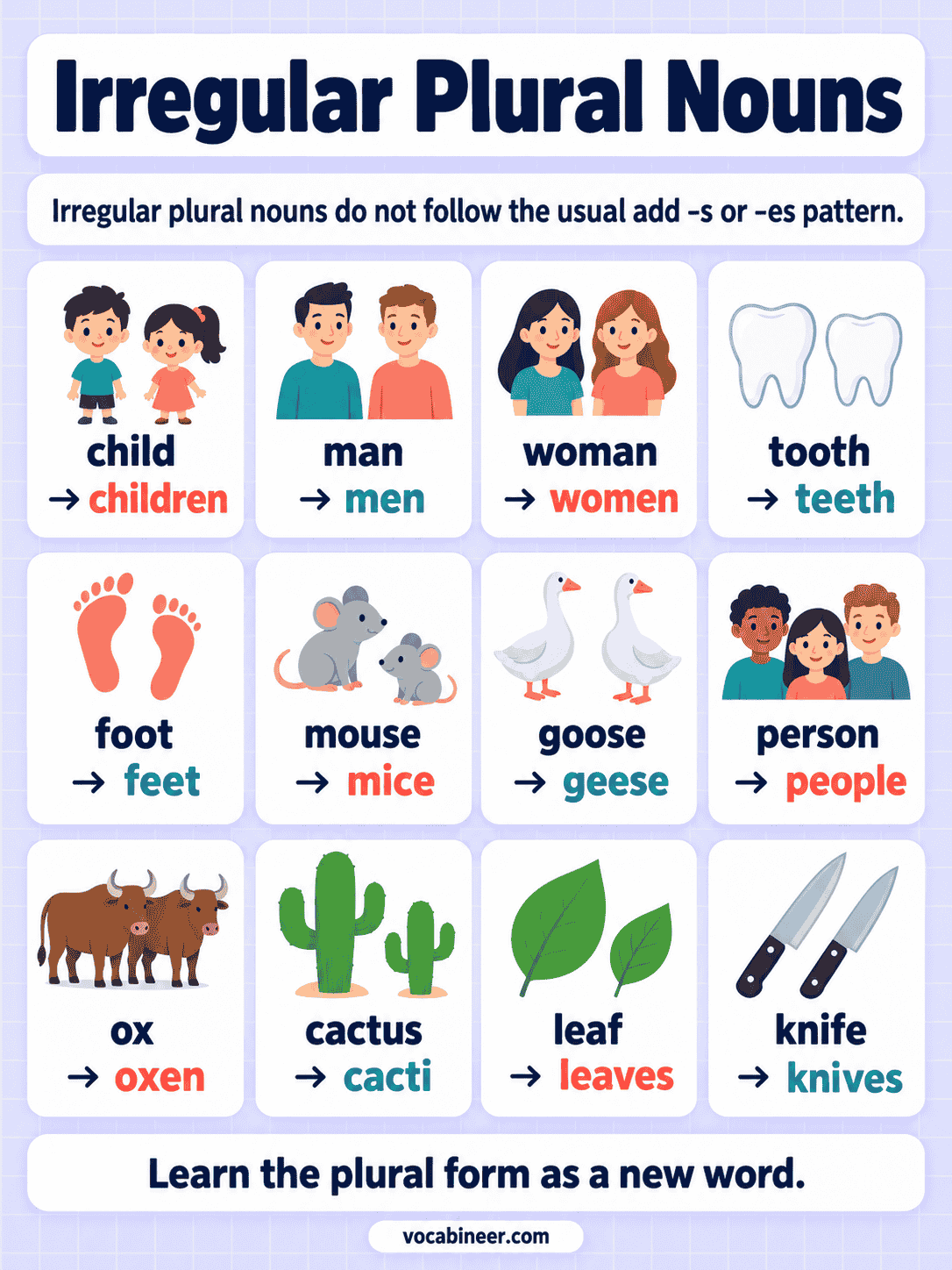
Irregular plural nouns are nouns that do not form their plurals by simply adding -s or -es. Instead, they may change a vowel, use an older plural ending, change to a completely different form, or remain exactly the same.
Learning irregular plurals helps students avoid forms such as childs, mouses, foots, and sheeps. Because these nouns do not follow one single rule, the best approach is to learn the most common patterns and memorize important singular-plural pairs.
In This Page
What Are Irregular Plural Nouns?
An irregular plural noun has a plural form that does not follow the usual -s or -es pattern.
Examples:
- child → children
- man → men
- woman → women
- foot → feet
- tooth → teeth
- mouse → mice
- goose → geese
The key idea is:
Irregular plural nouns change in special ways instead of following the normal plural rule.
Some nouns change dramatically, while others do not change at all.
Regular vs Irregular Plural Nouns
Regular plurals follow predictable spelling patterns. Irregular plurals use special forms.
| Regular Plural | Irregular Plural |
|---|---|
| book → books | child → children |
| box → boxes | man → men |
| apple → apples | foot → feet |
| class → classes | mouse → mice |
| chair → chairs | tooth → teeth |
For example:
- book → books follows the normal -s rule
- child → children does not
This distinction helps keep irregular plurals separate from ordinary plural spelling rules.
Vowel-Changing Irregular Plurals
Some irregular nouns form their plurals by changing a vowel inside the word.
Common examples include:
| Singular | Plural |
|---|---|
| man | men |
| woman | women |
| foot | feet |
| tooth | teeth |
| goose | geese |
| mouse | mice |
In sentences:
- One man is waiting.
- Two men are waiting.
- My foot hurts.
- My feet hurt.
- The mouse is under the table.
- The mice are under the table.
These forms are among the most common irregular plurals and should be learned as complete pairs.
Irregular Plurals with -en or -ren
A small number of nouns use older plural endings.
Examples:
- child → children
- ox → oxen
These are established forms rather than a productive modern rule.
Incorrect:
- childs
- oxes
Correct:
- children
- oxen
Learners should memorize these forms rather than try to apply -en to other nouns.
Completely Different Plural Forms
Some nouns change so much that their plural looks quite different from the singular.
A common example is:
- person → people
In everyday English:
- one person
- two people
- several people
The form persons also exists, but it is more common in formal, legal, or official contexts.
For general everyday English:
person → people
is the most useful pair to learn.
Nouns That Stay the Same in Singular and Plural
Some irregular nouns do not change at all when they become plural.
Examples:
- sheep → sheep
- deer → deer
- fish → fish
- species → species
- series → series
- bison → bison
Examples in context:
- one sheep
- five sheep
- one deer
- several deer
- one species
- many species
The surrounding words show whether the noun is singular or plural.
Compare:
- The sheep is in the field.
- The sheep are in the field.
The noun looks the same, but the verb shows the difference.
Fish vs Fishes
The usual plural of fish is fish.
Examples:
- one fish
- three fish
- many fish
The form fishes can be used when referring to different species or kinds of fish.
Examples:
- The lake contains many fish.
- Scientists study the different fishes of the region.
For everyday English, fish is the normal plural.
Common Irregular Plural Nouns List
The following table includes some of the most useful irregular plural forms.
| Singular | Plural |
|---|---|
| child | children |
| man | men |
| woman | women |
| foot | feet |
| tooth | teeth |
| mouse | mice |
| goose | geese |
| person | people |
| ox | oxen |
| sheep | sheep |
| deer | deer |
| fish | fish |
| species | species |
| series | series |
| bison | bison |
These forms cover the most common irregular patterns students encounter in everyday English.
Greek and Latin Irregular Plurals
Some English nouns borrowed from Greek or Latin retain traditional plural forms.
Examples:
| Singular | Plural |
|---|---|
| criterion | criteria |
| phenomenon | phenomena |
| analysis | analyses |
| crisis | crises |
| stimulus | stimuli |
| nucleus | nuclei |
Sentence examples:
- One criterion was important.
- Several criteria were considered.
- The strange phenomenon was recorded.
- Similar phenomena have occurred before.
- The report contains one detailed analysis.
- The book includes several analyses.
These forms are useful in academic and formal English.
Classical Plurals with More Than One Accepted Form
Some borrowed nouns allow both a traditional plural and a regular English plural.
For example:
- formula → formulas / formulae
The preferred form may depend on context, subject area, or style.
Beginners do not need to memorize large numbers of classical plurals. High-frequency everyday irregulars should come first.
Irregular Compound Plurals
Some compound nouns form their plural on the main noun rather than simply adding -s to the final word.
Examples:
- mother-in-law → mothers-in-law
- sister-in-law → sisters-in-law
- brother-in-law → brothers-in-law
- passer-by → passers-by
Incorrect:
- mother-in-laws
- sister-in-laws
Correct:
- mothers-in-law
- sisters-in-law
The useful rule is:
Find the main noun in the compound and pluralize that part.
Same-Form Plurals vs Changed Irregular Plurals
Irregular plurals do not all behave in the same way.
| Same Singular and Plural | Changed Plural |
|---|---|
| sheep → sheep | man → men |
| deer → deer | tooth → teeth |
| fish → fish | mouse → mice |
| species → species | child → children |
| series → series | person → people |
Some nouns remain unchanged, while others change internally or use a completely different form.
Both groups belong to irregular plural vocabulary.
Irregular Plural Nouns in Sentences
These examples show irregular plurals in natural sentence use:
- One child is playing.
- Three children are playing.
- The man is waiting outside.
- The men are waiting outside.
- My tooth hurts.
- My teeth hurt.
- One mouse ran across the floor.
- Two mice ran across the floor.
- The goose is near the lake.
- The geese are near the lake.
- The sheep is in the field.
- The sheep are in the field.
- One person is waiting.
- Several people are waiting.
- This species is rare.
- These species are rare.
These sentences also show how irregular plural nouns affect verb agreement.
Irregular Plural Nouns and Verb Agreement
Irregular plurals take plural verbs just like regular plural nouns.
Examples:
- The children are outside.
- The men work here.
- The women have arrived.
- The mice were hiding.
- The people are waiting.
- The geese are flying.
The unusual plural form does not change the normal subject-verb agreement rule.
Compare:
- The child is playing.
- The children are playing.
- The mouse was hiding.
- The mice were hiding.
Irregular Plurals vs Regular Spelling Changes
Not every plural that changes spelling is truly irregular.
| Regular Spelling Pattern | Irregular Plural |
|---|---|
| baby → babies | child → children |
| box → boxes | mouse → mice |
| city → cities | foot → feet |
| knife → knives | person → people |
Forms such as babies and boxes follow known plural spelling patterns.
Forms such as children and mice cannot be produced by an ordinary -s/-es rule.
This distinction keeps irregular plurals separate from general plural spelling rules.
How to Learn Irregular Plural Nouns
Irregular plurals become easier when learners study them as related pairs and pattern groups.
Useful strategies include:
Learn the Singular and Plural Together
Do not learn only child. Learn:
child → children
Likewise:
mouse → mice
Group Similar Changes
Learn vowel-changing forms together:
- man → men
- foot → feet
- tooth → teeth
- goose → geese
Practice with Numbers
Use forms such as:
- one child → three children
- one mouse → four mice
- one sheep → ten sheep
Use Complete Sentences
For example:
- One child is here.
- Three children are here.
This reinforces both noun form and verb agreement.
Learn Common Forms First
Focus on everyday words before advanced classical forms.
Irregular Plurals That Should Be Memorized First
The highest-value forms include:
- child → children
- man → men
- woman → women
- person → people
- foot → feet
- tooth → teeth
- mouse → mice
- goose → geese
- sheep → sheep
- deer → deer
- fish → fish
These occur much more often in everyday English than many Greek and Latin plurals.
Common Mistakes with Irregular Plural Nouns
Adding -s to an Irregular Noun
Incorrect: childs
Correct: children
Incorrect: mouses
Correct: mice
Incorrect: foots
Correct: feet
Adding a Second Plural Ending
Incorrect: childrens
Correct: children
Incorrect in ordinary use: peoples
Correct: people
Changing Same-Form Plurals
Incorrect: sheeps
Correct: sheep
Incorrect: deers
Correct: deer
Using a Singular Form After a Plural Number
Incorrect: three child
Correct: three children
Incorrect: two mouse
Correct: two mice
Using a Singular Verb with an Irregular Plural
Incorrect: The children is playing.
Correct: The children are playing.
Treating Regular Spelling Changes as Irregular Forms
Baby → babies follows a regular y → ies spelling rule, while child → children is truly irregular.
Applying One Irregular Pattern to Other Words
The fact that foot becomes feet does not mean every noun containing oo changes to ee.
Irregular patterns are limited to particular words.
Irregular Plural Nouns for Kids
A simple way to explain irregular plurals is:
Some nouns do not add s or es when they mean more than one. They change in a special way or stay the same.
Examples:
- child → children
- man → men
- foot → feet
- tooth → teeth
- mouse → mice
- sheep → sheep
Easy sentence examples:
- One child is running.
- Two children are running.
- One mouse is small.
- Three mice are small.
- One sheep is white.
- Five sheep are white.
Children should learn common forms first before moving to uncommon classical plurals.
FAQs
Irregular plural nouns are nouns that do not form their plurals by simply adding -s or -es. Examples include child → children, man → men, and mouse → mice.
Common examples include children, men, women, feet, teeth, mice, geese, people, sheep, and deer.
Common examples include sheep, deer, fish, species, series, and bison.
Many irregular forms developed from older English patterns or entered English from other languages. Their modern forms are established vocabulary and often need to be memorized.
Fish is the normal plural in everyday use. Fishes can be used when referring to different species or kinds of fish.
Yes. People is the normal everyday plural of person. Persons also exists in some formal and legal contexts.
Learn each singular and plural as a pair, group similar changes together, and practice them with numbers and short sentences.
Read More
- Parts of Speech in English
- Nouns in English with Examples
- Common and Proper Nouns
- Countable and uncountable nouns
- Collective nouns
- Abstract and concrete nouns
- Gender nouns
- Compound nouns
- Possessive nouns
- Singular and plural nouns
- Plural noun rules