

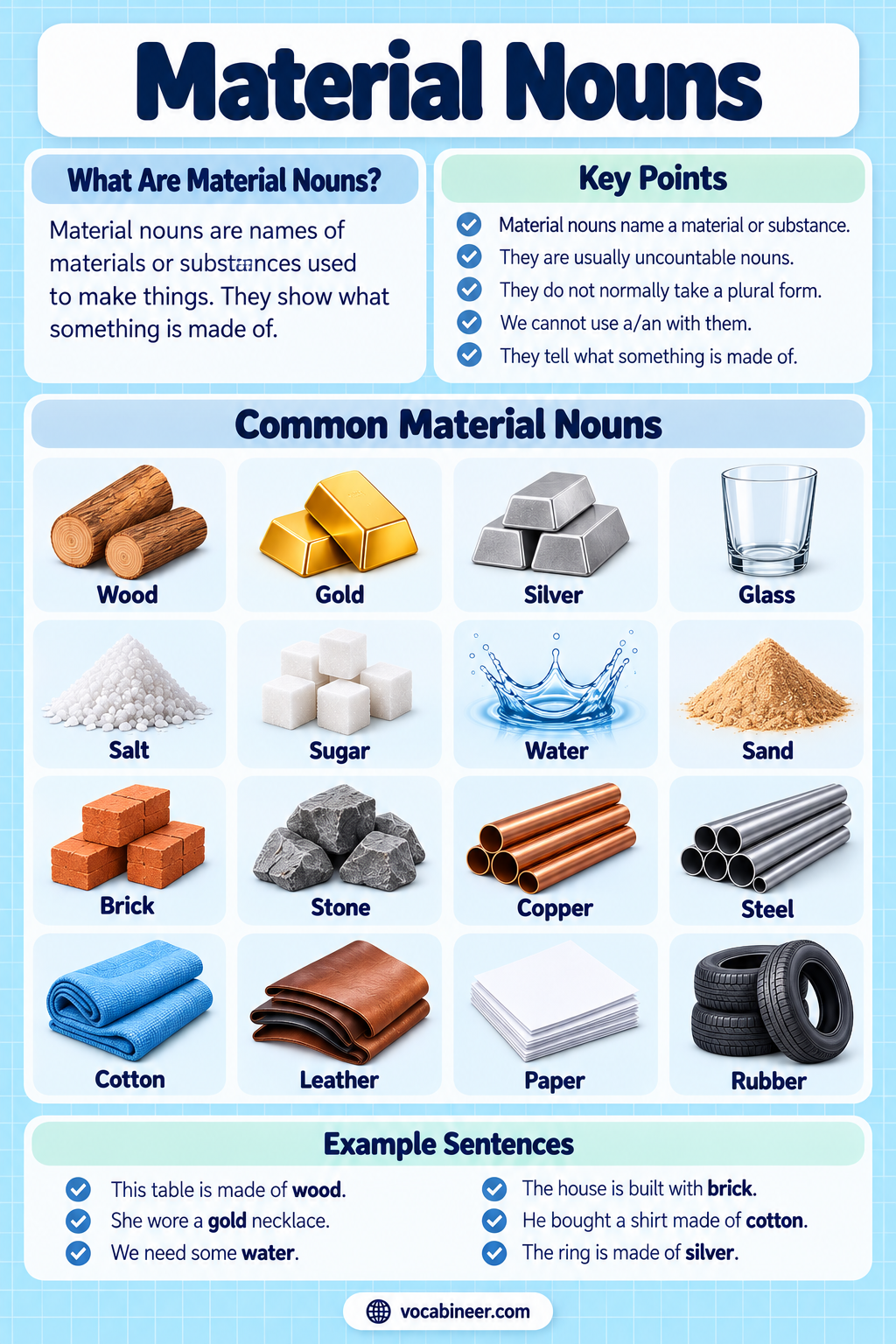
Material nouns name physical substances or materials from which things are made, formed, or produced. Common examples include gold, silver, iron, wood, cotton, wool, glass, plastic, clay, and steel.
Learning material nouns helps students distinguish the substance from the finished object and understand how these nouns behave with countability, articles, quantifiers, and sentence structure. Many material nouns are uncountable in their general substance meaning, but some can become countable when their meaning changes.
In This Page
Material Nouns: Meaning and Basic Idea
In traditional school grammar, a material noun names a substance or material.
Examples:
- gold
- silver
- iron
- steel
- wood
- cotton
- wool
- silk
- glass
- plastic
- clay
- cement
- leather
In sentences:
- The ring is made of gold.
- The table is made of wood.
- This shirt is made of cotton.
- The window is made of glass.
- The pot is made of clay.
The main idea is simple:
A material noun names the substance, not the finished object.
Material vs Object Made from It
A material noun names what something is made from, while the object noun names the finished item.
| Material Noun | Object Made from It |
|---|---|
| wood | table |
| gold | ring |
| cotton | shirt |
| glass | bottle |
| leather | shoe |
| clay | pot |
| steel | bridge |
| wool | sweater |
Compare:
- wood → material
- table → object
- gold → material
- ring → object
- cotton → material
- shirt → object
This distinction is one of the easiest ways to identify material nouns.
Common Types of Material Nouns
Material nouns can be grouped by source or use. These groups describe meaning, not separate grammatical rules.
Natural Materials
Natural materials occur in nature or come directly from natural sources.
Examples:
- gold
- silver
- iron
- copper
- stone
- sand
- clay
- coal
- water
Examples in sentences:
- The necklace contains gold.
- The wires are made of copper.
- The wall is built from stone.
- The pot is made from clay.
Plant-Based Materials
Plant-based materials come from plants or plant products.
Examples:
- wood
- cotton
- jute
- rubber
- paper
Examples:
- The chair is made of wood.
- This shirt is made of cotton.
- The bag is made of jute.
- The sheet is made of paper.
Animal-Based Materials
Some materials come from animals or animal products.
Examples:
- wool
- silk
- leather
- milk
- honey
Examples:
- The sweater is made of wool.
- She bought a silk scarf.
- The shoes are made of leather.
- The jar contains honey.
Man-Made Materials
Man-made materials are produced or processed for practical use.
Examples:
- plastic
- cement
- concrete
- nylon
- polyester
- glass
- steel
Examples:
- The bottle is made of plastic.
- The wall contains cement.
- The building uses concrete.
- The frame is made of steel.
Metals as Material Nouns
Metals are some of the clearest examples of material nouns.
Common examples include:
- gold
- silver
- iron
- copper
- steel
- aluminum
- brass
- bronze
In sentences:
- The ring is made of gold.
- The spoon is made of silver.
- The gate is made of iron.
- The pipes contain copper.
- The bridge uses steel.
These nouns clearly name physical substances rather than finished objects.
Fabrics and Fibers as Material Nouns
Many clothing and textile materials are also material nouns.
Examples:
- cotton
- wool
- silk
- linen
- nylon
- polyester
- leather
In sentences:
- The shirt is made of cotton.
- The sweater is made of wool.
- She bought a silk scarf.
- The jacket is made of leather.
- The curtains are made of linen.
Building Materials
Many common construction substances are material nouns.
Examples:
- cement
- concrete
- brick
- steel
- wood
- glass
- stone
- sand
In sentences:
- The wall contains cement.
- The foundation uses concrete.
- The windows are made of glass.
- The frame is made of steel.
- The floor contains stone.
Food and Liquid Substances
Some foods and liquids function as material nouns when they are treated as substances.
Examples:
- water
- milk
- sugar
- salt
- rice
- flour
- oil
- honey
In sentences:
- Add some sugar to the tea.
- We need more rice.
- The bottle contains oil.
- The jar contains honey.
- There is some water in the glass.
These nouns often behave as uncountable nouns in everyday English.
Material Nouns and Countability
Many material nouns are uncountable when they refer to a substance in general.
Examples:
- gold
- water
- wood
- cotton
- steel
- sugar
- rice
- glass
Natural examples include:
- Gold is valuable.
- Water is essential.
- Wood is used to make furniture.
- Cotton is soft.
- Steel is strong.
The important rule is:
Material nouns are often uncountable in their general substance meaning.
However, this does not mean every material noun is always uncountable.
When Material Nouns Become Countable
Some material nouns become countable when they refer to types, varieties, portions, or individual products.
Examples:
- different metals
- several plastics
- fine wines
- two coffees
Compare:
- Coffee is popular. → drink/substance in general
- We ordered two coffees. → two servings
- Plastic is widely used. → material in general
- These plastics have different properties. → types of plastic
The noun’s meaning in context determines whether it is countable or uncountable.
Articles Used with Material Nouns
Article use also depends on meaning and countability.
General Substance Meaning
In a general uncountable sense, material nouns usually appear without a/an.
Correct:
- Gold is valuable.
- Water is essential.
- Cotton is soft.
- Steel is strong.
Usually incorrect in the general substance meaning:
- a gold
- a water
- a cotton
Specific Material
Use the when referring to a specific amount or example of the material.
Examples:
- The water in this bottle is cold.
- The gold in this ring is pure.
- The wood used for the table is oak.
- The steel in this structure is reinforced.
So, material nouns do not simply “avoid articles.” Article choice depends on meaning.
A/An with Material Nouns
The articles a/an are normally not used with an uncountable material noun in its general mass meaning.
Use:
- some gold
- some water
- some wood
However, a/an becomes possible when the noun has a countable meaning.
Examples:
- a material
- a coffee
- a wine
The countable meaning must be clear from context.
Quantifiers Used with Material Nouns
Many material nouns commonly appear with quantifiers used for uncountable nouns.
Examples include:
- some
- much
- a little
- a lot of
- enough
- less
Examples:
- some water
- a little sugar
- much gold
- a lot of rice
- enough wood
- less oil
These structures make quantity clear without changing the noun into a plural.
Units and Containers for Material Nouns
Uncountable materials can be measured through units, containers, or portions.
Examples:
- a glass of water
- a piece of wood
- a bar of gold
- a sheet of paper
- a bag of rice
- a bottle of oil
- a spoonful of sugar
- a block of ice
This allows speakers to count quantities of substances that are not normally countable by themselves.
Material Nouns That Change Meaning
Some nouns can function as material nouns in one sentence and as countable object nouns in another.
Glass
- Glass is fragile. → material
- I bought two glasses. → drinking containers
Paper
- Paper is made from plant fibers. → material
- She submitted three papers. → documents or articles
Iron
- Iron is a metal. → material
- I bought an iron. → household appliance
Coffee
- Coffee is popular. → drink/substance
- We ordered two coffees. → two servings
Context determines the noun’s meaning and grammatical behavior.
Material Noun vs Concrete Noun
Material nouns and concrete nouns overlap, but they describe different features.
| Material Noun | Concrete Noun |
|---|---|
| names a substance or material | names something physically real |
| gold | chair |
| wood | dog |
| cotton | book |
| glass | building |
Most material nouns are also concrete nouns because they refer to physical substances.
For example:
Gold
- material noun
- concrete noun
- common noun
- usually uncountable in its substance meaning
The key distinction is:
Material noun tells us what kind of substance is named; concrete noun tells us that the noun refers to something physically real.
Material Noun vs Uncountable Noun
Material nouns are often uncountable, but the two terms do not mean the same thing.
| Material Noun | Uncountable Noun |
|---|---|
| defined by substance meaning | defined by countability |
| gold | information |
| water | advice |
| cotton | furniture |
| steel | knowledge |
Examples:
- gold → material + usually uncountable
- water → material + usually uncountable
- information → uncountable but not material
- advice → uncountable but not material
This distinction prevents the two categories from being treated as identical.
Material Noun vs Common Noun
A material noun can also be a common noun.
For example:
Wood
- common noun
- material noun
- concrete noun
Steel
- common noun
- material noun
- concrete noun
“Material” describes the noun’s substance meaning, while “common” shows that it is a general rather than a specific name.
Material Noun vs Abstract Noun
These noun types differ mainly in physical meaning.
| Material Noun | Abstract Noun |
|---|---|
| names a physical substance | names a non-physical idea, feeling, or quality |
| gold | honesty |
| water | happiness |
| wood | freedom |
| cotton | courage |
Material nouns refer to physical substances, while abstract nouns refer to non-material concepts.
Material Nouns in Sentences
These examples show common material nouns in natural use:
- The table is made of wood.
- This ring contains gold.
- The shirt is made of cotton.
- The sweater is made of wool.
- The window is made of glass.
- The bag is made of leather.
- The pot is made of clay.
- The bridge uses steel.
- Add some sugar to the tea.
- We need more cement.
- The bottle contains water.
- She bought a sheet of paper.
Common Errors with Material Nouns
Treating Every Material Noun as Always Uncountable
Material nouns are often uncountable in their substance meaning, but some can become countable in other meanings.
Using A/An with a General Substance Meaning
Incorrect: a gold, a water
Better: some gold, some water
Thinking The Cannot Be Used
Incorrect idea: material nouns never use articles.
Correct: the water in the glass, the gold in the ring
Confusing the Material with the Object
Wood is a material; a table is an object made from wood.
Confusing Material and Uncountable Nouns
Information is uncountable, but it is not a material noun.
Ignoring Context
Words such as glass, paper, iron, and coffee can change meaning and countability depending on how they are used.
FAQs
A material noun names a physical substance or material from which something can be made, formed, or produced, such as gold, wood, cotton, glass, or steel.
Common examples include gold, silver, iron, wood, cotton, wool, silk, leather, glass, plastic, clay, cement, and steel.
No. They are often uncountable when they refer to substances in general, but some become countable when they refer to types, varieties, portions, or products.
Yes. General uncountable material nouns usually do not take a/an, but the can be used for a specific material, as in the water in this bottle.
A material noun specifically names a substance, while a concrete noun can name any physically real person, animal, place, object, or substance. Most material nouns are therefore also concrete nouns.
Read More
- Parts of Speech in English
- Nouns in English with Examples
- Common and Proper Nouns
- Countable and uncountable nouns
- Collective nouns
- Abstract and concrete nouns
- Gender nouns
- Compound nouns
- Possessive nouns
- Singular and plural nouns
- Plural noun rules