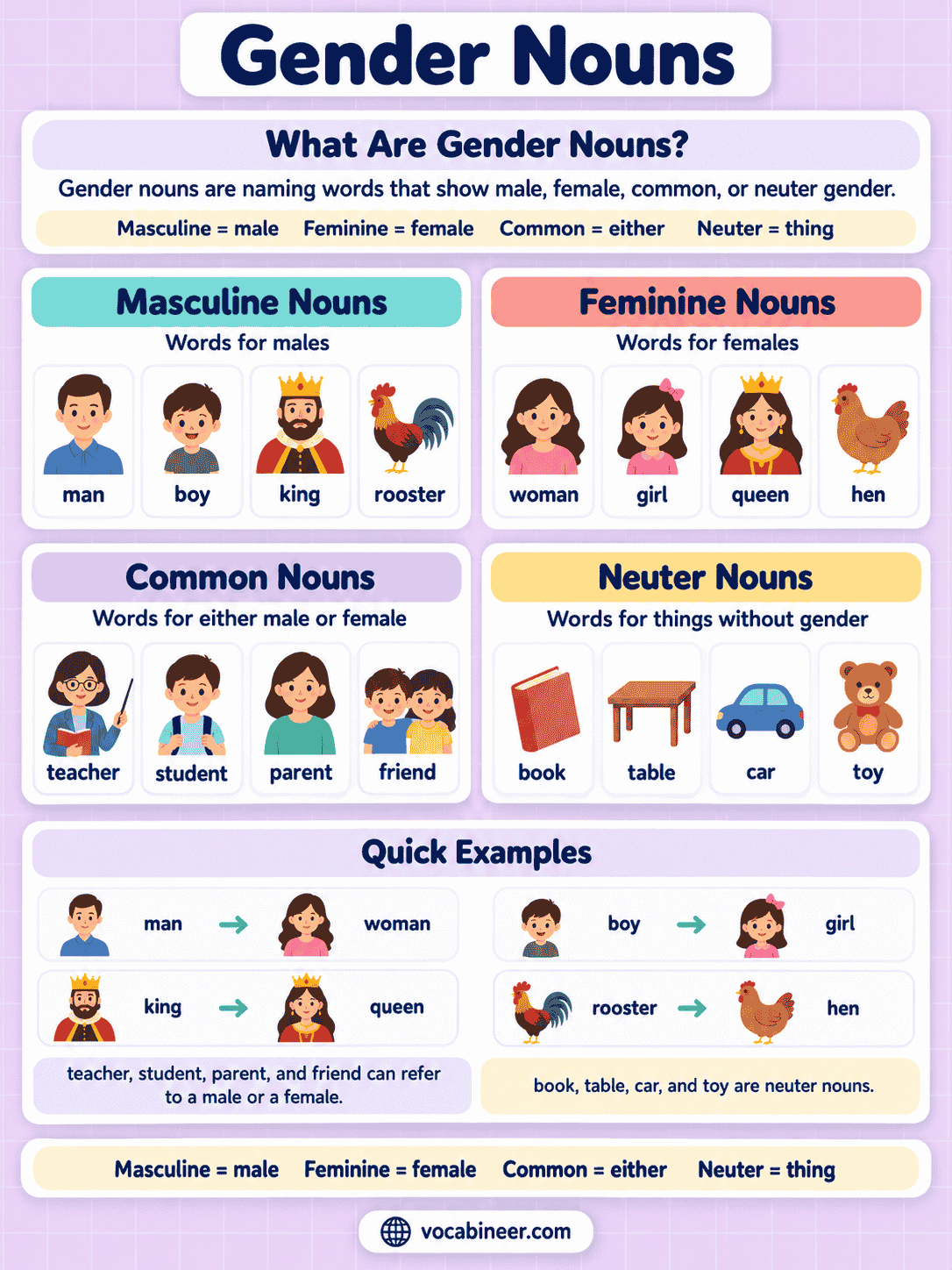
Gender nouns are traditionally grouped according to whether they refer specifically to males, females, people of any gender, or things without sex. In school grammar, these groups are usually called masculine, feminine, common, and neuter gender.
Modern English, however, has very little grammatical gender in nouns. Instead, gender is usually understood through meaning, context, and pronouns. Many occupations and roles also use gender-neutral nouns such as teacher, doctor, actor, firefighter, and police officer.
In This Page
Gender in English Nouns: An Important Clarification
English does not normally assign grammatical gender to every noun.
For example:
- teacher
- student
- city
- table
do not change their form because of gender.
Traditional grammar still uses four gender categories to help learners classify nouns by meaning:
- masculine
- feminine
- common
- neuter
So, in English, this system is mainly a meaning-based teaching classification, not a full grammatical gender system.
The Four Traditional Gender Categories
| Gender Type | Meaning | Examples |
|---|---|---|
| Masculine | specifically refers to a male | father, king, bull |
| Feminine | specifically refers to a female | mother, queen, cow |
| Common | can refer to a person of any gender | teacher, student, friend |
| Neuter | traditionally refers to things without sex | book, table, car |
This framework is useful for beginners, but modern English increasingly prefers gender-neutral forms when gender is not relevant.
Masculine and Feminine Gender Nouns
Masculine and feminine nouns specifically identify male or female people or animals.
| Masculine | Feminine |
|---|---|
| father | mother |
| brother | sister |
| son | daughter |
| husband | wife |
| uncle | aunt |
| king | queen |
| prince | princess |
| bull | cow |
| stallion | mare |
| rooster | hen |
Examples in sentences:
- The father carried the bags.
- The mother opened the door.
- The king addressed the crowd.
- The queen greeted the visitors.
- The stallion ran across the field.
- The mare followed behind.
Some masculine and feminine pairs use related forms, while others use completely different words.
Gender Nouns in Family Vocabulary
Family words provide some of the clearest gender distinctions.
Masculine Family Nouns
- father
- brother
- son
- husband
- uncle
- grandfather
Feminine Family Nouns
- mother
- sister
- daughter
- wife
- aunt
- grandmother
Gender-Neutral Family Nouns
- parent
- sibling
- child
- spouse
- relative
- grandparent
Gender-neutral family nouns are useful when gender is unknown, irrelevant, or unnecessary.
Gender Nouns for Animals
Some animals have different words for males and females.
| Male | Female | General Term |
|---|---|---|
| bull | cow | cattle |
| stallion | mare | horse |
| rooster | hen | chicken |
| ram | ewe | sheep |
| drake | duck | duck |
Examples:
- The bull stood near the fence.
- The cow was feeding in the field.
- The rooster crowed early.
- The hen stayed near her chicks.
Animal gender words are still useful because many of these distinctions remain common in farming, breeding, and everyday vocabulary.
Common Gender Nouns
A common gender noun can refer to a person of any gender.
Examples:
- teacher
- student
- friend
- doctor
- artist
- singer
- manager
- lawyer
- neighbour
- parent
- child
Sentence examples:
- The teacher explained the lesson.
- My friend is visiting tomorrow.
- The doctor called this morning.
- The student submitted the assignment.
- The manager spoke to the staff.
These nouns do not show gender by themselves.
Common Gender vs Common Noun
These two terms sound similar but describe different things.
| Common Gender Noun | Common Noun |
|---|---|
| can refer to a person of any gender | gives a general name rather than a specific name |
| teacher | teacher |
| student | city |
| doctor | river |
| friend | school |
For example, teacher is both:
- a common noun because it is a general name
- a common gender noun because it can refer to a person of any gender
The two classifications answer different questions.
Neuter Gender in Traditional Grammar
In traditional school grammar, a neuter gender noun refers to a thing without male or female sex.
Examples:
- book
- table
- chair
- car
- computer
- pencil
- house
- stone
Sentence examples:
- The book is on the desk.
- The car is outside.
- The computer is new.
- The chair is beside the table.
The term neuter is useful in traditional grammar lessons, but modern English does not treat these nouns as members of a strong grammatical neuter class.
Neuter Nouns and the Pronoun It
Objects and many non-human things commonly take the pronoun it.
Examples:
- The car is new. It is very fast.
- The phone is charging. It will be ready soon.
- The computer stopped because it overheated.
Animals may also be referred to as it when their sex is unknown or unimportant.
However, when an animal’s sex or identity is known, he or she may be used.
Gender-Neutral Nouns in Modern English
Modern English often avoids marking gender when it is not important.
Common gender-neutral nouns include:
- teacher
- doctor
- actor
- firefighter
- police officer
- flight attendant
- spokesperson
- chair
- headteacher
- manager
- engineer
- lawyer
Examples:
- The doctor will see you now.
- The firefighter entered the building.
- The actor accepted the award.
- The spokesperson answered the questions.
These words can refer to people of any gender.
Traditional Gendered Forms and Modern Alternatives
Many older job titles had separate male and female forms. Modern English often prefers one neutral term.
| Traditional Gendered Forms | Modern Neutral Form |
|---|---|
| chairman / chairwoman | chair / chairperson |
| policeman / policewoman | police officer |
| fireman | firefighter |
| steward / stewardess | flight attendant |
| spokesman / spokeswoman | spokesperson |
| headmaster / headmistress | headteacher / head |
| actor / actress | actor |
The neutral form is usually the better choice when gender does not add useful information.
Feminine Forms Ending in -ess
Some traditional feminine nouns use -ess.
Examples:
- prince → princess
- lion → lioness
- host → hostess
- actor → actress
However, -ess is not a general rule for forming feminine nouns.
Modern English commonly uses neutral forms such as:
- actor
- host
- poet
- author
Therefore, these older feminine forms should be learned as individual vocabulary rather than applied as a universal pattern.
Gendered and Gender-Neutral Occupation Nouns
Many occupations are naturally gender-neutral today.
Examples:
- teacher
- doctor
- nurse
- engineer
- lawyer
- manager
- writer
- artist
- singer
- actor
There is usually no need to add words such as male or female unless gender is relevant.
Natural:
- The doctor called.
- The nurse arrived.
- The engineer checked the design.
Unnecessary in most contexts:
- lady doctor
- male nurse
The profession itself does not require gender marking.
How English Shows Gender Without Changing the Noun
English often leaves the noun unchanged and shows gender through context or pronouns.
Examples:
- The teacher said she would return.
- My friend said he was busy.
- The student forgot their notebook.
- The machine stopped because it overheated.
The nouns teacher, friend, and student do not change form.
This is one reason English relies less on gendered nouns than many other languages.
Singular They with Gender-Neutral Nouns
They, them, and their can refer to one person when gender is unknown, irrelevant, or when those are the person’s pronouns.
Examples:
- A student should bring their notebook.
- If a customer calls, tell them I will respond later.
- Every applicant should check their email.
This works naturally with common-gender nouns.
Gender Nouns vs Grammatical Gender
Traditional English gender nouns should not be confused with true grammatical gender.
| Traditional Gender Noun Classification | Grammatical Gender |
|---|---|
| based mainly on meaning | built into the grammar of nouns |
| father is masculine because it refers to a male | noun itself may belong to a formal gender class |
| teacher can refer to anyone | agreement may change according to noun gender |
| English has little noun-gender marking | common in several other languages |
English relies mainly on meaning, context, and pronouns rather than noun endings or agreement.
Gender Nouns Can Belong to Other Noun Types
Gender is only one way to classify nouns.
For example:
Father
- common noun
- countable noun
- masculine noun
Mother
- common noun
- countable noun
- feminine noun
Teacher
- common noun
- countable noun
- common-gender noun
Book
- common noun
- concrete noun
- countable noun
- traditionally neuter noun
These classifications can overlap.
Gender Nouns in Sentences
The following examples show the traditional categories in context:
- The father prepared dinner. → masculine
- The mother drove the car. → feminine
- The teacher explained the lesson. → common gender
- The student asked a question. → common gender
- The stallion ran quickly. → masculine animal noun
- The mare followed behind. → feminine animal noun
- The book is on the desk. → traditional neuter
- The computer needs an update. → traditional neuter
These sentence examples make the meaning differences easier to recognize.
Common Errors in Gender-Noun Usage
Treating Every English Noun as Grammatically Gendered
English has very little grammatical noun gender. The four-category system is mainly a traditional teaching model.
Assuming Every Occupation Needs a Male and Female Form
Usually use neutral forms such as doctor, teacher, actor, firefighter, and police officer.
Using -ess as a Universal Feminine Rule
Not every female noun is formed by adding -ess.
Treating Actor as a Male-Only Word
Modern English commonly uses actor for people of any gender.
Confusing Common Gender with Common Noun
A common-gender noun refers to any gender, while a common noun is simply a general rather than specific name.
Treating Neuter as a Full English Grammatical Gender
In English, neuter is mainly a traditional school label for non-sexed things.
Adding Gender When It Is Not Relevant
Instead of unnecessarily saying female doctor or male teacher, simply use doctor or teacher unless gender matters to the context.
FAQs
Gender nouns are nouns traditionally classified according to whether they refer specifically to males, females, people of any gender, or things without sex.
The four traditional types are masculine, feminine, common, and neuter gender.
A common gender noun can refer to a person of any gender. Examples include teacher, student, friend, doctor, and manager.
English has very little grammatical gender compared with many other languages. Gender is usually shown through meaning, context, and pronouns rather than changes to noun forms.
Gender-neutral nouns can refer to people without specifying gender. Examples include teacher, actor, police officer, firefighter, spokesperson, and flight attendant.
Read More
- 12 English Tenses Chart
- Parts of Speech in English
- Nouns in English with Examples
- Common and Proper Nouns
- Countable and uncountable nouns
- Be Going To in English