

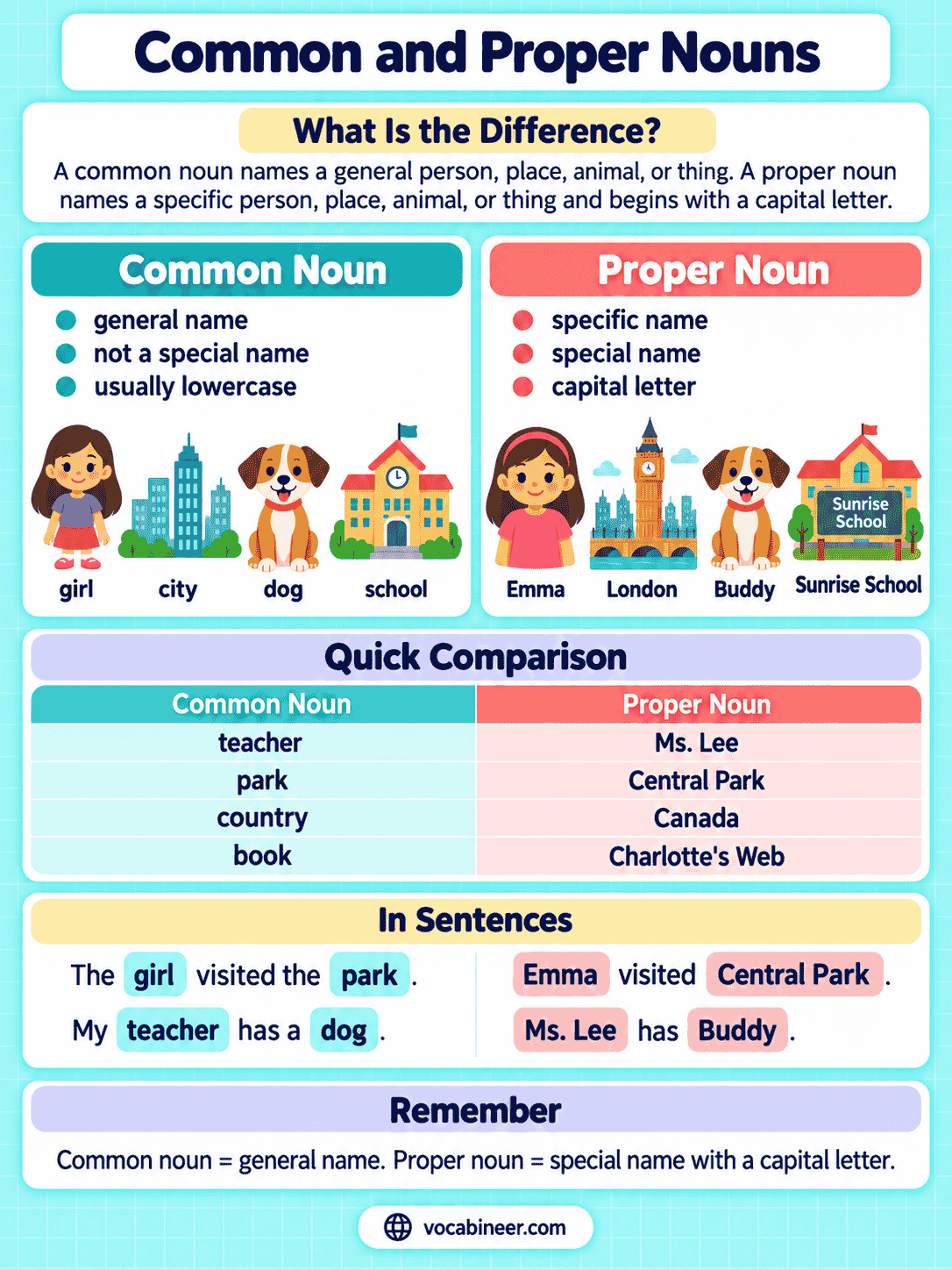
Common and proper nouns both name people, places, things, organizations, and other entities, but they do not work in exactly the same way. A common noun gives a general name, while a proper noun identifies a specific person, place, organization, day, month, language, or other named entity.
Learning the difference between common and proper nouns helps students use capitalization correctly and identify nouns more accurately in sentences. The key rule is simple: common nouns name general categories, while proper nouns give specific names and usually begin with capital letters.
In This Page
What Are Common and Proper Nouns?
Common and proper nouns are two important types of nouns.
A common noun gives a general name.
Examples:
- girl
- teacher
- city
- river
- company
- school
A proper noun gives the specific name of a person, place, organization, event, or other named entity.
Examples:
- Ayesha
- London
- Nile
- Microsoft
- Monday
- January
Compare:
- city → common noun
- London → proper noun
- girl → common noun
- Ayesha → proper noun
- river → common noun
- Nile → proper noun
Common and Proper Nouns at a Glance
| Common Noun | Proper Noun |
|---|---|
| general name | specific name |
| girl | Ayesha |
| boy | Ahmed |
| city | London |
| country | Canada |
| river | Nile |
| mountain | Mount Everest |
| company | Microsoft |
| university | Oxford University |
| day | Monday |
| month | January |
| language | English |
The main difference is general meaning vs specific naming.
What Is a Common Noun?
A common noun names a general person, place, animal, thing, or category.
Examples:
- teacher
- student
- school
- city
- river
- dog
- book
- company
Sentence examples:
- The teacher entered the classroom.
- We visited a city.
- The dog barked.
- She opened the book.
- The company hired new workers.
Common nouns normally begin with lowercase letters unless they appear at the beginning of a sentence.
What Is a Proper Noun?
A proper noun identifies a particular person, place, organization, institution, day, month, event, language, or other specific named entity.
Examples:
- Sara
- Pakistan
- London
- Microsoft
- Monday
- December
- English
- Oxford University
Sentence examples:
- Sara lives in London.
- We will meet on Monday.
- Microsoft is a company.
- She speaks English.
- He studies at Oxford University.
Proper nouns normally begin with capital letters.
Main Difference Between Common and Proper Nouns
A common noun identifies a general category, while a proper noun identifies one specific member of that category.
Compare:
| General Category | Specific Name |
|---|---|
| girl | Sara |
| boy | Ahmed |
| city | Paris |
| country | Japan |
| river | Nile |
| company | |
| month | March |
For example:
- city can refer to any city.
- Paris refers to one specific city.
Therefore, specific naming is the main distinction.
Capitalization of Common and Proper Nouns
Capitalization is one of the easiest ways to notice the difference, but meaning should come first.
Common Nouns
Common nouns normally begin with lowercase letters:
- teacher
- city
- school
- river
- company
Example:
- The teacher spoke to the students.
However, a common noun still begins with a capital letter when it starts a sentence:
- Teachers help students learn.
The word remains a common noun.
Proper Nouns
Proper nouns normally begin with capital letters:
- Sara
- Pakistan
- Monday
- English
- Oxford University
Examples:
- Sara visited Pakistan in January.
- We study English on Monday.
A proper noun is not proper simply because it is capitalized. Instead, it is capitalized because it functions as a specific name.
Common and Proper Nouns for People
General words for people are common nouns. Personal names are proper nouns.
| Common Noun | Proper Noun |
|---|---|
| boy | Ahmed |
| girl | Sara |
| teacher | Mr Brown |
| writer | William Shakespeare |
| scientist | Marie Curie |
| doctor | Doctor Wilson |
Examples:
- The boy is waiting.
- Ahmed is waiting.
- Our teacher arrived.
- Mr Brown arrived.
The first noun gives a general role, while the second gives a specific name.
Common and Proper Nouns for Places
General place words are common nouns, while specific place names are proper nouns.
| Common Noun | Proper Noun |
|---|---|
| country | Canada |
| city | London |
| continent | Asia |
| river | Nile |
| mountain | Mount Everest |
| ocean | Pacific Ocean |
Sentence examples:
- We visited a city last summer.
- We visited London last summer.
- The river is very long.
- The Nile is a famous river.
Countries and Cities as Proper Nouns
Specific countries and cities are proper nouns.
Countries:
- Pakistan
- Canada
- Japan
- France
- Brazil
Cities:
- Lahore
- London
- Tokyo
- Paris
- Toronto
Examples:
- Japan is a country.
- Tokyo is a city in Japan.
The words country and city are common nouns, while Japan and Tokyo are proper nouns.
Rivers, Mountains, and Oceans
Specific geographical names are proper nouns.
Examples:
Rivers
- Nile
- Indus
- Thames
- Amazon
Mountains
- Mount Everest
- K2
- Mount Fuji
Oceans
- Pacific Ocean
- Atlantic Ocean
- Indian Ocean
Compare:
- river → Nile
- mountain → Mount Everest
- ocean → Pacific Ocean
Days of the Week
The names of specific days are proper nouns and begin with capital letters.
Examples:
- Monday
- Tuesday
- Wednesday
- Thursday
- Friday
- Saturday
- Sunday
Sentence:
- We will meet on Friday.
The word day is a common noun, while Friday is a proper noun.
Months of the Year
Month names are also proper nouns.
Examples:
- January
- February
- March
- April
- December
Sentence:
- School starts in September.
Compare:
- month → common noun
- September → proper noun
Holidays and Festivals
Named holidays and festivals are proper nouns.
Examples:
- Christmas
- Eid
- Ramadan
- Diwali
- Thanksgiving
Sentence examples:
- They celebrate Christmas in December.
- Ramadan is observed during a specific month of the Islamic calendar.
The words holiday and festival are common nouns, while their specific names are proper nouns.
Languages and Nationalities
Names of languages and nationalities begin with capital letters.
Examples:
- English
- Urdu
- French
- Japanese
- Pakistani
- Canadian
Sentence examples:
- She speaks English and Urdu.
- He is Canadian.
Common mistakes include:
Incorrect:
- english
- urdu
- canadian
Correct:
- English
- Urdu
- Canadian
Companies and Organizations
Specific company and organization names are proper nouns.
Examples:
- Microsoft
- Apple
- United Nations
- World Health Organization
Compare:
| Common Noun | Proper Noun |
|---|---|
| company | Microsoft |
| organization | United Nations |
| institution | World Health Organization |
Examples:
- The company opened a new office.
- Microsoft opened a new office.
Schools, Colleges, and Universities
A general educational institution is a common noun, while its official name is a proper noun.
Examples:
- school → Lincoln High School
- university → Oxford University
- college → King’s College
Sentence examples:
- She studies at a university.
- She studies at Oxford University.
Titles Before Names
A general professional title is usually a common noun, but a title used directly with a name may be capitalized.
Compare:
- The doctor arrived.
- Doctor Wilson arrived.
- The professor spoke first.
- Professor Ahmed spoke first.
This distinction is especially useful when identifying capitalization.
Multiword Proper Nouns
Proper nouns are not always single words.
Examples:
- New York City
- Oxford University
- United Nations
- Pacific Ocean
- Mount Everest
- World Health Organization
All words that belong to the official name follow proper-noun capitalization rules.
Therefore, learners should not assume that a proper noun must contain only one word.
Common Nouns Inside Proper Names
A common noun can become part of a proper name.
Compare:
- university → Oxford University
- river → River Thames
- school → Lincoln High School
- hospital → City Hospital
Example:
- The university is old. → common noun
- Oxford University is old. → proper noun
The same general word changes its role when it becomes part of a specific official name.
Common-to-Proper Noun Examples
The following pairs make the difference easier to understand.
| Common Noun | Proper Noun |
|---|---|
| girl | Maria |
| boy | Adam |
| teacher | Mrs Brown |
| city | Paris |
| country | Canada |
| river | Nile |
| mountain | Mount Everest |
| ocean | Pacific Ocean |
| company | |
| university | Harvard University |
| day | Tuesday |
| month | March |
| festival | Christmas |
| language | English |
Common and Proper Nouns in Sentences
Looking at both noun types in the same sentence makes identification easier.
Example
The girl named Ayesha lives in the city of Lahore.
- girl → common noun
- Ayesha → proper noun
- city → common noun
- Lahore → proper noun
Example
Our teacher, Mr Khan, visited London in July.
- teacher → common noun
- Mr Khan → proper noun
- London → proper noun
- July → proper noun
Example
The company opened a new office on Monday.
- company → common noun
- office → common noun
- Monday → proper noun
Example
My friend Sara studies English at Oxford University.
- friend → common noun
- Sara → proper noun
- English → proper noun
- Oxford University → proper noun
How to Identify a Common Noun
A noun is likely a common noun if it:
- gives a general name
- refers to a class or category
- can describe many different people, places, or things
- is not an official or specific name
- normally begins with lowercase
Examples:
- teacher
- school
- city
- river
- company
- dog
Ask:
Is this a general category rather than one specific name?
If yes, it is probably a common noun.
How to Identify a Proper Noun
A noun is likely proper if it:
- identifies a particular person or place
- names a specific company or organization
- identifies a day, month, language, nationality, festival, or named entity
- functions as a specific name
- normally begins with a capital letter
Examples:
- Ayesha
- London
- Monday
- January
- English
- Microsoft
Ask:
Is this the specific name of someone or something?
If yes, it is probably a proper noun.
Capitalization Alone Is Not Enough
A capital letter can help identify a proper noun, but capitalization alone does not determine noun type.
Consider:
Teacher training requires preparation.
The word Teacher starts with a capital letter because it begins the sentence. It is still a common noun.
Therefore, always check the meaning and function of the noun.
Common vs Proper Is Different from Concrete vs Abstract
These classifications answer different questions.
| Common vs Proper | Concrete vs Abstract |
|---|---|
| asks whether a name is general or specific | asks whether the noun is physical or non-physical |
| city / London | chair / happiness |
| girl / Ayesha | dog / loyalty |
For example, London is a proper noun, but it can also refer to a physical place.
One Noun Can Belong to More Than One Type
A noun can fit several categories at once.
London
London can be:
- proper noun
- singular noun
- place noun
Sara
Sara can be:
- proper noun
- singular noun
- person noun
Team
Team can be:
- common noun
- collective noun
- countable noun
Therefore, common/proper is only one way to classify a noun.
Common Capitalization Mistakes
Writing Proper Nouns with Lowercase Letters
Incorrect: london
Correct: London
Incorrect: monday
Correct: Monday
Incorrect: english
Correct: English
Capitalizing Ordinary Common Nouns
Incorrect: I spoke to the Teacher.
Correct: I spoke to the teacher.
Confusing Titles with General Roles
Correct:
- The doctor arrived.
- Doctor Wilson arrived.
Forgetting Capital Letters in Multiword Names
Incorrect:
- oxford university
Correct:
- Oxford University
Thinking Every Capitalized Word Is a Proper Noun
A common noun at the beginning of a sentence is still a common noun.
Common and Proper Nouns for Kids
A simple way for children to remember the difference is:
A common noun gives a general name. A proper noun gives a special or specific name.
Examples:
- girl → Sara
- boy → Ahmed
- city → London
- country → Canada
- day → Monday
- river → Nile
Look at this sentence:
The girl Sara visited the city of London.
Here:
- girl → common noun
- Sara → proper noun
- city → common noun
- London → proper noun
The comparison makes the difference easy to recognize.
FAQs
A common noun gives a general name, such as girl, city, or river. A proper noun gives a specific name, such as Sara, London, or Nile.
Proper nouns normally begin with capital letters in standard English. However, capitalization is a result of specific naming, so meaning should also be considered when identifying the noun.
Examples include girl → Sara, city → London, country → Canada, river → Nile, and company → Microsoft.
Yes. Words such as Monday, January, English, and French are proper nouns and should begin with capital letters.
Yes. For example, London is a proper noun, but it is also a singular place noun. Noun classifications can overlap.
Read More
- 12 English Tenses Chart
- Parts of Speech in English
- Nouns in English with Examples
- Be Going To in English