

Pronouns reduce repetition by referring to people or things already mentioned. In “The children were tired, so they rested,” they refers to the children. Because both are plural, the pronoun agrees with its antecedent.
Pronoun-antecedent agreement involves checking number, keeping grammatical person consistent, and choosing an appropriate pronoun. However, agreement alone does not guarantee clarity: readers must also understand exactly who or what each pronoun means.
In This Page
What Is Pronoun-Antecedent Agreement?
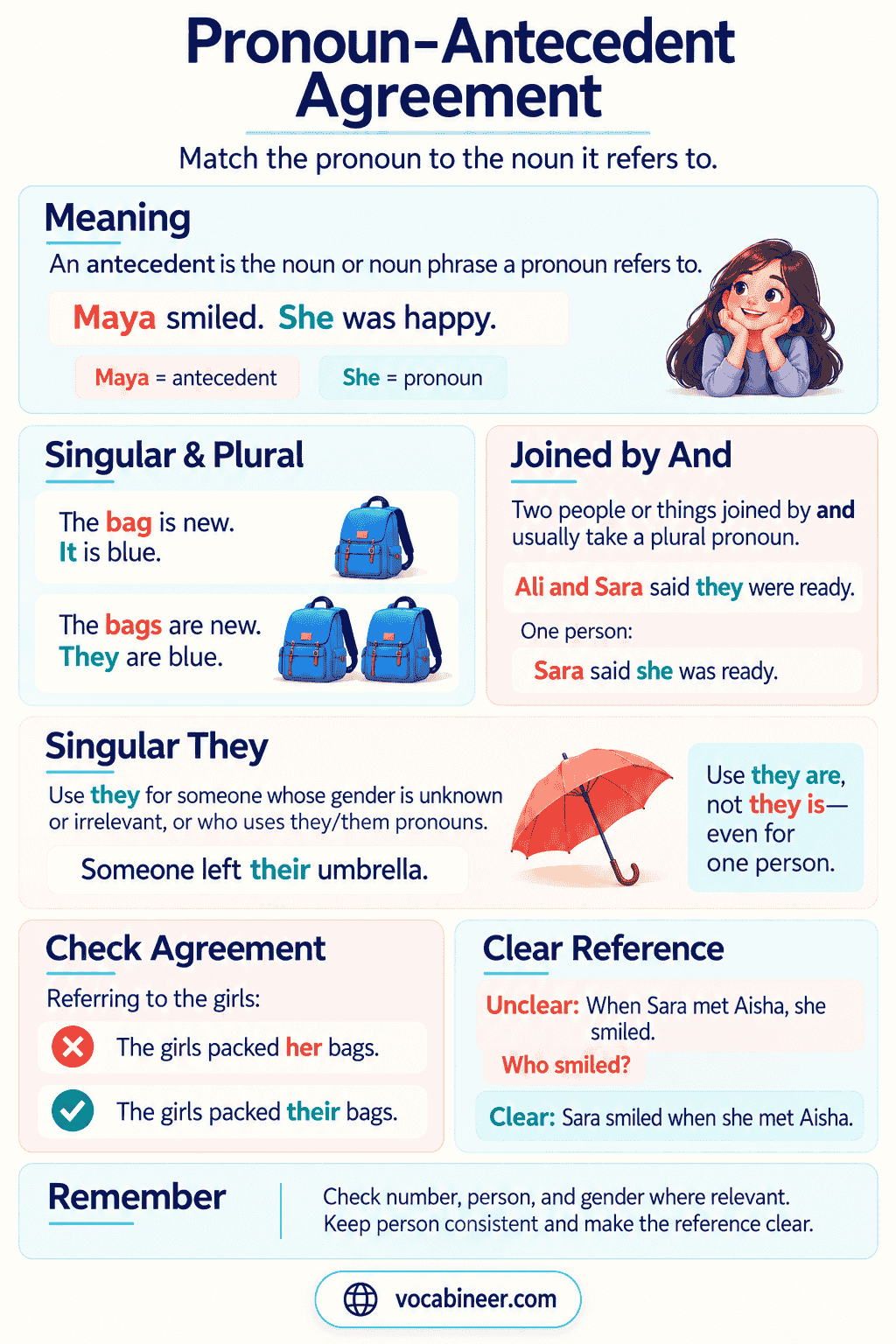
Pronoun-antecedent agreement means choosing a pronoun that fits the person or thing it refers to. Check number, grammatical person, and the appropriate personal pronoun.
The antecedent is the word or phrase that gives the pronoun its meaning.
The puppy was hungry, so it ate.
Here, the puppy is the antecedent, and it is the pronoun. Both refer to one animal.
| Antecedent | Referring form | Example |
|---|---|---|
| The puppy | it | The puppy ate because it was hungry. |
| The children | they | The children smiled when they arrived. |
| The bicycle | its | The bicycle lost its chain. |
| The players | their | The players collected their bags. |
Possessive forms such as its and their also follow agreement patterns. Before nouns, they function as possessive determiners, but they belong in this lesson because they involve the same matching skill.
How to Find the Antecedent
Find the pronoun and ask, “Who or what does this word refer to?”
The lantern flickered before it went out.
Because it refers to the lantern, the lantern is its antecedent.
An antecedent can appear in several places:
| Position | Example |
|---|---|
| Earlier in the same sentence | The cookies cooled before we packed them. |
| In the previous sentence | The bus arrived. It stopped near the gate. |
| After the pronoun | Before she left, Ava checked the door. |
Also, the antecedent does not have to be the subject. In “We found the keys and returned them,” the pronoun them refers to the keys, not we.
Basic Pronoun-Antecedent Agreement Rules
Start by checking number and person. Then choose the pronoun that accurately identifies the intended person or thing.
Singular and Plural Agreement
A singular antecedent refers to one person or thing. A plural antecedent refers to more than one.
Singular: The kite lost its string.
Plural: The kites lost their strings.
The same distinction applies when a pronoun receives an action:
Incorrect: The folders were empty, so I put it away.
Correct: The folders were empty, so I put them away.
Because folders is plural, them supplies the correct match. However, they and its related forms can also refer to one person, as explained below.
Agreement in Person
Grammatical person shows whether you mean the speaker, the listener, or someone being discussed.
| Person | Meaning | Common forms |
|---|---|---|
| First person | The speaker or a group including the speaker | I, me, my, we, us, our |
| Second person | The person or people being addressed | you, your |
| Third person | Someone or something being discussed | he, she, it, they, their |
Keep the reference consistent when discussing the same people.
For example, if a group means its own project, write:
“We finished our project.”
Similarly, a group that includes the speaker takes a first-person plural form:
“Liam and I brought our lunches.”
Different grammatical persons can appear together when they refer to different people. Therefore, “I will help you” is correct: I identifies the speaker, while you identifies the listener.
Choosing the Right Personal Pronoun
For a particular person, use that person’s pronouns.
- If Emma uses she/her: “Emma brought her sketchbook.”
- If Noah uses he/him: “Noah said he was ready.”
- If Alex uses they/them: “Alex finished their drawing.”
For an ordinary object, use it: “The clock stopped because its battery died.”
For animals, he or she can fit when the animal’s sex is known. Otherwise, it is often suitable.
Using Singular They
Singular they refers to one person, including an unspecified person or someone who uses they/them pronouns.
For example:
- Someone left their umbrella.
- Each student should bring their notebook.
- A visitor can ask for help if they need it.
The MLA Style Center accepts both specific and generic uses of singular they. Therefore, a singular antecedent does not automatically make they or their incorrect.
Although singular they refers to one person, use the verb forms they are and they have.
Correct: Someone said they are ready.
Incorrect: Someone said they is ready.
Meanwhile, the antecedent keeps its own verb pattern: “Each student has a notebook.” Using their later does not make each student grammatically plural.
Pronoun Agreement with Different Antecedents
Some sentences contain words that make agreement harder to recognize. Focus on the intended reference rather than the nearest noun alone.
Indefinite Pronouns as Antecedents
Indefinite pronouns refer to people or things without naming them exactly.
| Type | Common words | Example |
|---|---|---|
| Singular person reference | someone, anyone, everyone | Everyone brought their lunch. |
| Singular thing reference | something, anything, everything | Something fell, but I could not see it. |
| Plural reference | both, few, many, several | Both arrived before they expected to. |
Words such as all and some depend on what they refer to.
“Some of the soup remained, so we reheated it.”
“Some of the rolls remained, so we reheated them.”
In the first sentence, it refers to soup. In contrast, them refers to several rolls in the second.
Antecedents Joined by And
Two distinct people or things joined by and normally take a plural pronoun when you refer to both.
The notebook and the folder fell, so Mia picked them up.
Because the sentence refers to two objects, them fits.
However, two descriptions can identify one person:
“Our neighbor and coach, Mr. Reed, brought his whistle.”
Here, neighbor and coach describe the same person. Consequently, the pronoun remains singular.
Antecedents Joined by Or or Nor
When two singular alternatives appear with or or nor, a singular referring form often fits:
“Either the rabbit or the hamster has escaped from its cage.”
If the alternatives differ in number, traditional agreement usually follows the nearer antecedent:
“Either the small box or the large crates will arrive with their lids attached.”
Here, their follows the nearer plural antecedent, crates. However, mixed-number constructions can sound awkward. When necessary, rewrite the sentence:
“The shipment will contain either a small box with its lid attached or large crates with their lids attached.”
Matching the Antecedent, Not a Nearby Noun
Words between an antecedent and a pronoun do not automatically change the agreement.
The box of markers lost its lid.
The lid belongs to the box, so its matches the singular box. The nearby plural word markers does not control the choice.
Similarly:
“The bikes near the fence still have their price tags.”
Because the tags belong to the bikes, their fits despite the nearby singular noun fence.
To check the relationship, temporarily remove the extra phrase: “The box lost its lid.” Then restore the phrase and reread the sentence.
Collective Nouns and Their Pronouns
A collective noun names a group, such as a team, class, family, or committee.
In American English, a singular pronoun usually fits when the group acts as one unit. However, naming the members makes a plural reference clearer when you mean individuals.
| Group as one unit | Individual members |
|---|---|
| The class chose its project topic. | The students opened their notebooks. |
| The team changed its name. | The players tied their shoes. |
| The committee announced its decision. | The committee members shared their opinions. |
Usage varies with meaning and English variety. These explicit distinctions help readers see whether you mean the whole group or its members.
Common Pronoun-Antecedent Agreement Mistakes
An incorrect pronoun can create a mismatch. However, even a grammatically suitable pronoun can leave its meaning unclear.
Agreement vs. Unclear Reference
| Problem | Example | Correction |
|---|---|---|
| Number mismatch | The books fell, so I picked it up. | The books fell, so I picked them up. |
| Unclear reference | Ava called Grace after she finished lunch. | After Ava finished lunch, she called Grace. |
| Missing reference | At the bakery, they smelled delicious. | The rolls at the bakery smelled delicious. |
In the second example, she could refer to Ava or Grace. Therefore, the correction depends on who finished lunch.
If Grace finished lunch, write:
“Ava called Grace after Grace finished lunch.”
Repeating a name is useful when it removes uncertainty.
In the bakery example, they lacks a clear antecedent unless earlier context identifies the food. Naming the rolls supplies that information.
How to Correct Agreement Errors
Find the intended antecedent.
Ask what the pronoun actually refers to. For example, in “The basket of apples lost their handle,” the handle belongs to the basket.
Choose a matching form.
Change the sentence to “The basket of apples lost its handle.” The singular basket takes its.
Name the person or thing when needed.
“The backpack was beside the suitcase, but it was empty” has two possible meanings. Instead, write, “The backpack was beside the suitcase, but the suitcase was empty.”
Check the whole sentence.
Finally, reread your revision. If you change an antecedent from singular to plural, you may also need to change its verb or other referring words.
Frequently Asked Questions
“The dog wagged its tail” is a simple example. The possessive form its refers to the singular antecedent the dog. With a plural antecedent, write, “The dogs wagged their tails.”
Yes. “Everyone should bring their lunch” correctly uses singular their. However, everyone still takes a singular verb: “Everyone has their lunch.”
No. It usually appears earlier, but it can follow the pronoun. In “Before he sat down, Noah moved the chair,” he refers to Noah.
Pronoun agreement connects a pronoun with its antecedent. Subject-verb agreement connects a subject with its verb. In “The bird spreads its wings,” its refers to the bird, while spreads agrees with the singular subject.
Find the pronoun, identify its antecedent, and check number, person, and pronoun choice. Then check clarity. If readers could connect the pronoun to two different nouns, name the intended person or thing.
Read More
- Parts of Speech in English
- Nouns in English with Examples
- Common and Proper Nouns
- Countable and uncountable nouns
- Collective nouns
- Abstract and concrete nouns
- Gender nouns
- Compound nouns
- Possessive nouns
- Singular and plural nouns
- Plural noun rules