

“We expected an assistant, but the principal herself welcomed us.” Here, herself highlights the principal’s personal involvement. It adds emphasis to a sentence that already tells us who gave the welcome.
Intensive pronouns draw attention to particular people or things. Learning their purpose helps you use them naturally, recognize the words they emphasize, and distinguish them from reflexive pronouns.
In This Page
What Are Intensive Pronouns?
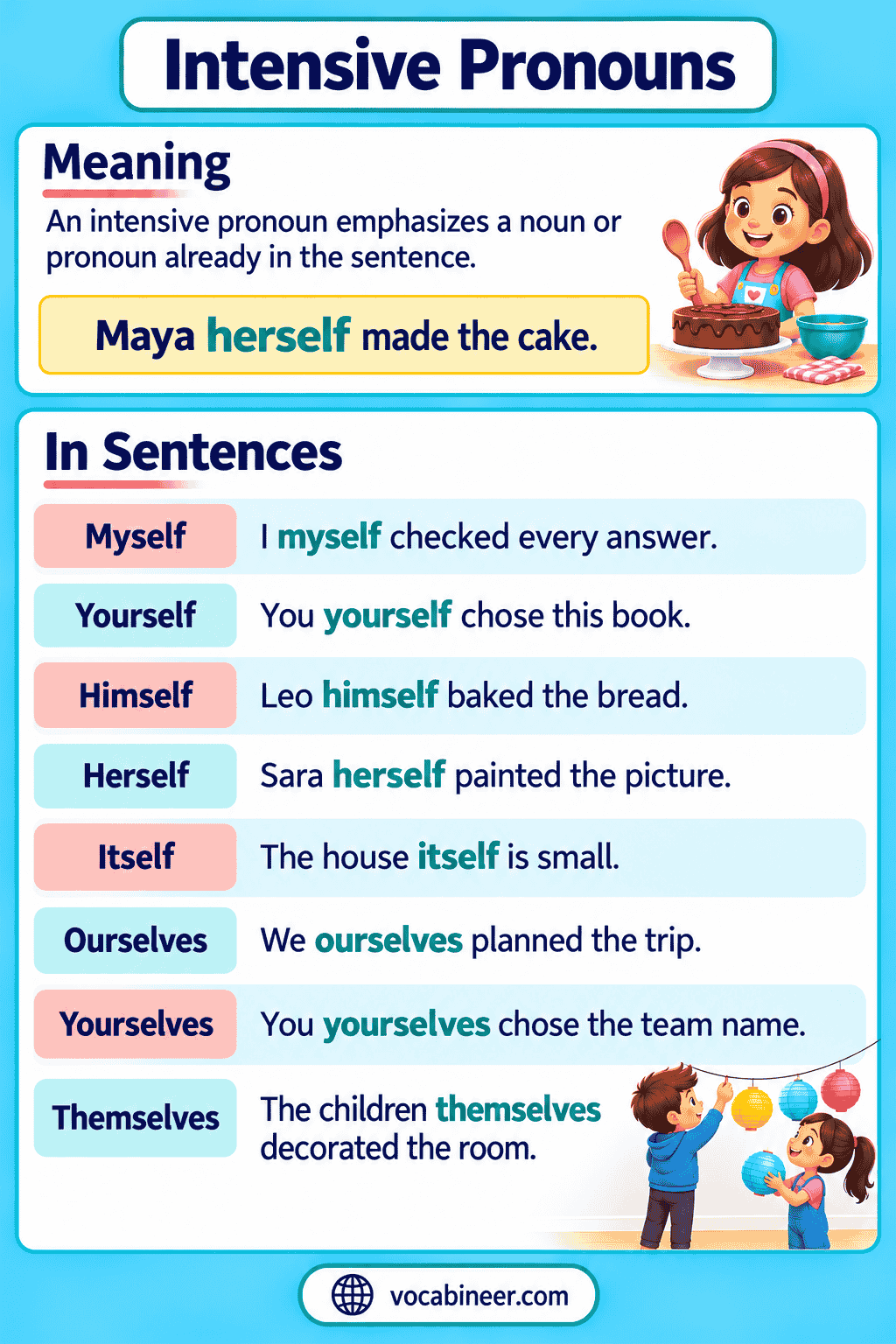
An intensive pronoun emphasizes a noun or another pronoun in a sentence. Common forms include myself, herself, ourselves, and themselves. They are also called emphatic pronouns.
For example:
“The author herself signed my book.”
Here, herself emphasizes the author. It highlights that the author personally signed the book, which may be especially meaningful.
The noun or pronoun receiving emphasis is the antecedent. Therefore, the author is the antecedent of herself.
Intensive pronouns can also emphasize things:
“The box was damaged, but the gift itself was fine.”
In this sentence, itself directs attention to the gift.
| Basic statement | With an intensive pronoun | Added emphasis |
|---|---|---|
| The author signed my book. | The author herself signed my book. | Highlights the author’s personal involvement |
| We checked the results. | We ourselves checked the results. | Stresses that we performed the check |
| The gift was fine. | The gift itself was fine. | Focuses specifically on the gift |
Use an intensive pronoun when the extra focus contributes something useful. You do not need one in every sentence.
Intensive Pronouns List with Examples
The eight commonly taught intensive pronouns are myself, yourself, himself, herself, itself, ourselves, yourselves, and themselves.
Choose a form that matches the person or thing receiving emphasis.
| Personal pronoun | Intensive form | Example |
|---|---|---|
| I | myself | I myself heard the announcement. |
| You—one person | yourself | You yourself chose this game. |
| He | himself | He himself admitted the mistake. |
| She | herself | She herself wrote the invitation. |
| It | itself | The building itself needs repairs. |
| We | ourselves | We ourselves checked the results. |
| You—several people | yourselves | You yourselves suggested the change. |
| They | themselves | They themselves organized the event. |
Pay particular attention to how many people you addresses.
| Audience | Correct form | Example |
|---|---|---|
| One person | yourself | Ava, you yourself selected the book. |
| Several people | yourselves | Children, you yourselves selected the books. |
When a group includes the speaker, use ourselves: “My brother and I built the model ourselves.”
The formal pronoun one has the corresponding form oneself, as in “One must make that choice oneself.” Also, singular they can take themselves or themself. The familiar eight-form chart is therefore a starting point rather than an exhaustive list.
How to Identify Intensive Pronouns
First, find a word ending in -self or -selves. Then determine its job.
Use these three steps:
- Find the antecedent. Identify the person or thing the pronoun highlights.
- Check its function. Decide whether it adds emphasis or fills an object role.
- Try removing it. An intensive pronoun leaves the basic statement intact, although its emphasis disappears.
For example:
“The students themselves decorated the classroom.”
Themselves emphasizes the students. It does not identify an additional person or thing involved in the action.
| Original sentence | After removal | What happens? |
|---|---|---|
| The students themselves decorated the classroom. | The students decorated the classroom. | The basic statement remains; the emphasis disappears. |
| Ella washed herself. | Ella washed. | The sentence remains grammatical, but the explicit object disappears. |
The second example shows why removal alone is not a perfect test. In “Ella washed herself,” herself identifies the person Ella washed. It is reflexive because of its object role.
Therefore, use grammatical function as your main guide and removal as a supporting check.
Intensive vs. Reflexive Pronouns
Intensive and reflexive pronouns share the same forms. However, their roles differ.
| Feature | Intensive pronoun | Reflexive pronoun |
|---|---|---|
| Main purpose | Adds emphasis | Acts as an object referring back to the subject |
| Example | Maya herself introduced the guest. | Maya introduced herself. |
| Job of herself | Emphasizes Maya | Identifies the person Maya introduced |
| Effect of removal | Preserves the basic statement but removes emphasis | May leave a gap or change the sentence’s meaning or structure |
In the intensive example, the guest receives the introduction. Meanwhile, herself highlights Maya’s involvement.
Use the same approach with other pronouns:
| Intensive use | Reflexive use |
|---|---|
| I myself checked the photograph. | I saw myself in the photograph. |
| The players themselves selected the uniforms. | The players congratulated themselves. |
| Nora herself introduced the speaker. | Nora introduced herself. |
In each intensive example, the pronoun emphasizes someone already identified. In each reflexive example, it fills an object role referring back to the subject.
Some grammar references describe intensive pronouns as reflexive pronouns used for emphasis. This terminology recognizes that the same forms perform different functions.
Myself vs. By Myself
The phrase by myself usually means alone or without help. Its meaning differs from the emphasis added by a standalone intensive pronoun.
| Construction | Example | Meaning |
|---|---|---|
| Intensive myself | I myself painted the sign. | Highlights my personal involvement |
| By myself | I painted the sign by myself. | Indicates that I worked alone or without help |
Personal involvement does not necessarily exclude assistance. For example, “I myself painted the sign, with help from my sister” clearly allows another person’s help.
Where to Place Intensive Pronouns
Place an intensive pronoun where readers can easily identify the word it emphasizes.
Beside the Noun or Pronoun
An intensive pronoun commonly follows its antecedent directly:
“The coach herself demonstrated the movement.”
This position makes the connection clear. However, the antecedent does not have to be the subject.
| Sentence | Word receiving emphasis | Role of that word |
|---|---|---|
| The coach herself demonstrated the movement. | the coach | Subject |
| We thanked the coach herself. | the coach | Object of the verb |
| We received a message from the coach herself. | the coach | Object of the preposition |
These examples show why “an intensive pronoun emphasizes the subject” is too narrow as a definition. It can emphasize other nouns or pronouns as well.
Later in the Sentence
An intensive pronoun can also appear later when its reference remains clear.
| Beside the antecedent | Later in the sentence |
|---|---|
| I myself checked the answer. | I checked the answer myself. |
| The teacher herself read the story. | The teacher read the story herself. |
| They themselves repaired the fence. | They repaired the fence themselves. |
Both positions add emphasis. Context and spoken stress influence the precise focus, so neither position carries one fixed meaning.
When a sentence mentions several people, placing the intensive pronoun beside its antecedent can prevent confusion:
“The manager herself spoke to the assistant.”
Here, the placement clearly identifies the manager as the person receiving emphasis.
Common Mistakes with Intensive Pronouns
Most errors involve mismatched forms, unnecessary emphasis, or using an intensive form where an ordinary personal pronoun belongs.
| Mistake | Incorrect or wordy example | Better version | Reason |
|---|---|---|---|
| Using an intensive form alone as the subject | Myself wrote the note. | I myself wrote the note. | I supplies the subject. |
| Replacing an ordinary object pronoun | Please send the photo to myself. | Please send the photo to me. | Me is the appropriate object form here. |
| Mismatching person | We themselves made the banner. | We ourselves made the banner. | Ourselves matches we. |
| Mismatching number | Children, you yourself chose the game. | Children, you yourselves chose the game. | The speaker addresses several children. |
| Using a nonstandard form | He hisself answered. | He himself answered. | Himself is the standard written form. |
| Using a nonstandard plural form | They theirselves packed the supplies. | They themselves packed the supplies. | Themselves is the standard written form. |
| Repeating the emphasis | I myself personally checked it myself. | I checked it myself. | One emphatic form is sufficient. |
Do not choose myself simply to sound formal.
In a straightforward request such as “Please contact Jordan or me,” me correctly identifies one of the people receiving the action. Adding another person does not make myself necessary.
Do not classify a pronoun by position alone.
A word appearing after a verb is not automatically reflexive. Check whether it adds emphasis or acts as an object.
Use emphasis selectively.
An intensive pronoun works best when personal involvement, identity, or a contrast matters. If it adds no useful focus, leave it out.
Frequently Asked Questions
Yes. Emphatic pronoun is another name for an intensive pronoun. Both terms describe a pronoun that adds emphasis to a noun or another pronoun.
No. Its function depends on the sentence. It is intensive when it adds emphasis and reflexive when it fills an object role referring back to the subject.
Yes. “We repaired the fence ourselves” places the intensive pronoun at the end. Its reference should remain clear wherever it appears.
It preserves the basic statement but removes emphasis. However, removal alone is not enough to classify every pronoun; also check its grammatical role.
Usually, no. Write “The artist herself explained the painting” without commas around herself. Adding emphasis does not by itself require commas.
Read More
- Parts of Speech in English
- Nouns in English with Examples
- Common and Proper Nouns
- Countable and uncountable nouns
- Collective nouns
- Abstract and concrete nouns
- Gender nouns
- Compound nouns
- Possessive nouns
- Singular and plural nouns
- Plural noun rules