

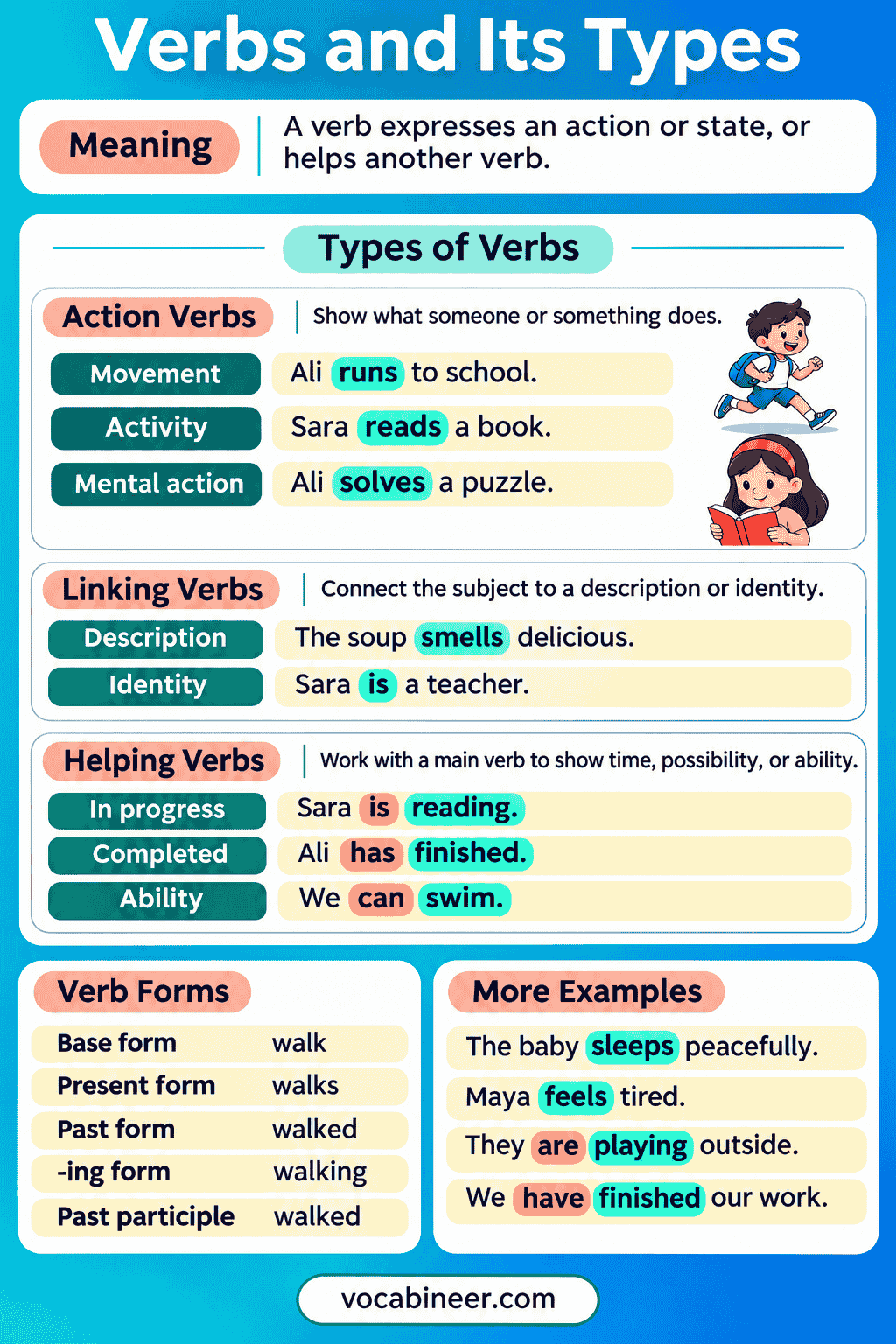
Verbs express actions, events, and states. Words such as run, happen, and know tell us what someone does, what occurs, or what is true. For example, in “Maya knows the answer,” knows describes Maya’s state of knowledge.
Verbs also help us express time, ask questions, and describe possibilities. By recognizing their roles and forms, you can build sentences such as “She writes,” “She is writing,” and “She can write.” This guide explains the main verb types, sentence patterns, and rules through everyday examples.
In This Page
Understanding Verbs in English
A verb gives essential information about the subject. However, its meaning can extend beyond a visible action.
| Meaning | Example | Verb |
|---|---|---|
| Action | The children play outside. | Play |
| Event | An accident happened nearby. | Happened |
| State | Maya knows the answer. | Knows |
| Change | The leaves turned yellow. | Turned |
Verb categories describe different features, so they can overlap. In “Maya opened the window,” opened describes an action, takes a direct object, and follows a regular past-tense pattern.
Identifying Verbs in Sentences
First, find the words that tell you what happens or what state the subject is in. Then check whether helping verbs appear with the main verb.
- A single verb. In “The baby sleeps,” the verb is sleeps.
- A verb group. In “She has been studying,” has been studying forms the verb group. Studying is the main verb.
- A command. In “Close the door,” close is the verb. The understood subject is you.
A word’s role also depends on its sentence. For example, paint can name a material or describe an activity.
| Sentence | Role of paint |
|---|---|
| The paint is dry. | Noun naming a material |
| They paint the fence. | Verb describing an action |
Main Types of Verbs
Some categories describe meaning, while others describe grammatical function or sentence structure. Look at how a verb works in its sentence before classifying it.
Action and Stative Verbs
Action verbs, also called dynamic verbs, describe activities and processes. They include physical activities such as run and mental activities such as calculate.
Stative verbs describe conditions, feelings, possession, or knowledge. Common examples include know, belong, own, and believe.
| Use | Example | Explanation |
|---|---|---|
| Action | Maya calculates the total. | Maya performs a mental activity. |
| State | Maya knows the total. | The sentence describes her knowledge. |
Stative meanings usually take simple forms. However, some verbs have both stative and dynamic meanings.
| Sentence | Meaning |
|---|---|
| I think you are right. | Think expresses an opinion. |
| I am thinking about the problem. | Thinking describes an ongoing mental activity. |
Linking Verbs
Linking verbs connect a subject to information that describes or identifies it. Common examples include be, seem, become, and some uses of feel, look, and taste.
The description or identity after a linking verb is a subject complement.
| Sentence | Verb use | Words following the verb |
|---|---|---|
| Maya seems happy. | Linking | Happy describes Maya. |
| Maya became a teacher. | Linking | A teacher identifies Maya’s role. |
| Maya reads a book. | Action, transitive | A book is the direct object of reads. |
Some verbs change function with context.
| Sentence | Function of tastes |
|---|---|
| The soup tastes delicious. | Links the soup to a description |
| Maya tastes the soup. | Describes an action with a direct object |
Main and Helping Verbs
A main verb carries the central meaning. A helping verb, or auxiliary verb, works with it to form constructions such as continuous tenses, perfect tenses, questions, and negatives.
The primary auxiliaries are be, have, and do. These words can also function as main verbs.
| Verb | Main-verb use | Helping-verb use |
|---|---|---|
| Be | She is happy. | She is reading. |
| Have | She has a bicycle. | She has finished. |
| Do | She does the shopping. | Does she shop here? |
Modal Verbs
Modal verbs are auxiliaries that express meanings such as ability, permission, possibility, obligation, and advice.
| Modal | Example | Meaning in the example |
|---|---|---|
| Can | Maya can swim. | Ability |
| May | You may leave early. | Permission |
| Might | It might rain. | Possibility |
| Must | Visitors must sign in. | Obligation |
| Should | You should rest. | Advice |
Core modals take the base form of the following verb. They also keep the same form with different subjects, as in “I can swim” and “She can swim.”
Transitive and Intransitive Uses
A transitive verb use includes a direct object. An intransitive verb use has no direct object.
Some verbs allow both patterns, so check the whole sentence.
| Sentence | Use | Direct object |
|---|---|---|
| Maya reads books. | Transitive | Books |
| Maya reads every evening. | Intransitive | None |
| The baby sleeps peacefully. | Intransitive | None |
Some verbs can take two objects. In “Maya gave her brother a book,” a book is the direct object, and her brother is the indirect object identifying the recipient.
Phrasal Verbs
A phrasal verb combines a verb with a particle, such as up, off, or out. The combination may have a meaning that differs from the verb alone.
| Phrasal verb | Meaning | Example |
|---|---|---|
| Give up | Stop trying | Keep going and don’t give up. |
| Turn off | Stop a device from operating | Turn off the light. |
| Find out | Discover information | We need to find out the answer. |
With a separable phrasal verb such as turn off, an object pronoun goes between the verb and particle. For example, write “Turn it off.”
The Five Main Verb Forms
Most main verbs follow a pattern with five grammatical forms. Some forms share the same spelling, while be has additional forms.
| Form | Regular example | Irregular example | Sentence |
|---|---|---|---|
| Base form | Walk | Write | I write every day. |
| Third-person singular present | Walks | Writes | Maya writes every day. |
| Past form | Walked | Wrote | Maya wrote yesterday. |
| Past participle | Walked | Written | Maya has written a letter. |
| -ing form | Walking | Writing | Maya is writing now. |
In many textbooks, V1 means the base form, V2 means the past form, and V3 means the past participle. For example, write–wrote–written follows that order.
Regular and Irregular Verbs
Regular verbs form their past and past participle with the -ed ending, including spelling adjustments. Irregular verbs use other patterns, so learn their forms together.
| Pattern | Base form | Past form | Past participle |
|---|---|---|---|
| Regular | Play | Played | Played |
| Regular | Study | Studied | Studied |
| Irregular | Go | Went | Gone |
| Irregular | Bring | Brought | Brought |
| Irregular | Put | Put | Put |
Common spelling changes also affect the -ing and third-person singular forms.
| Spelling pattern | Examples |
|---|---|
| Add -es after endings such as -ch or -sh | Watch → watches, wash → washes |
| Change consonant + y before -s or -ed | Study → studies, studied |
| Keep y after a vowel | Play → plays, played |
| Add -d to a verb ending in e | Move → moved |
| Usually drop final silent e before -ing | Make → making |
| Double the final consonant in common short vowel patterns | Stop → stopped, stopping |
For longer words, stress affects consonant doubling. For example, prefer becomes preferred, while visit becomes visited.
The Forms of Be
The verb be has more forms than most main verbs.
| Function | Forms |
|---|---|
| Base | Be |
| Present | Am, is, are |
| Past | Was, were |
| Past participle | Been |
| -ing form | Being |
Verb Groups, Tense, and Voice
A verb form is one part of a larger construction. For example, written is a past participle, while has written combines an auxiliary with that participle.
| Construction | Example | What it expresses |
|---|---|---|
| Simple present | Maya writes every morning. | A habit |
| Simple past | Maya wrote yesterday. | A past event |
| Present continuous | Maya is writing now. | An activity in progress |
| Present perfect | Maya has written three pages so far. | Completion connected to the present |
| Future with will | Maya will write tomorrow. | A future event |
| Future with going to | Maya is going to write tonight. | An intention |
English expresses future time through constructions such as will and be going to. Present-tense forms can also express future arrangements or schedules.
Verbs also help express voice, which affects how a sentence presents an action.
| Voice | Example |
|---|---|
| Active | Maya wrote the letter. |
| Passive | The letter was written by Maya. |
In the passive example, was written combines be with a past participle. The letter becomes the subject.
Verb Mood
Mood concerns how a clause presents a statement, command, or other meaning. Three traditional categories are indicative, imperative, and subjunctive.
| Mood | Example | Use |
|---|---|---|
| Indicative | Maya arrives early. | Makes a statement |
| Imperative | Arrive early. | Gives an instruction |
| Subjunctive | They recommended that Maya arrive early. | Expresses a recommendation using the base form |
Subject–Verb Agreement
In the simple present, most verbs add -s or -es with a third-person singular subject. However, be, have, and do have special forms.
| Subject | Work | Be | Have | Do |
|---|---|---|---|---|
| I | Work | Am | Have | Do |
| You | Work | Are | Have | Do |
| He / She / It | Works | Is | Has | Does |
| We / They | Work | Are | Have | Do |
Singular they follows the same pattern as plural they. Therefore, use “They are ready” even when they refers to one person.
Questions and Negative Sentences
With most ordinary verbs in the simple present and simple past, use do, does, or did to form questions and negatives. Then use the base form of the main verb.
| Statement | Question | Negative |
|---|---|---|
| Maya works here. | Does Maya work here? | Maya doesn’t work here. |
| Maya went home. | Did Maya go home? | Maya didn’t go home. |
| Maya is ready. | Is Maya ready? | Maya isn’t ready. |
| Maya can swim. | Can Maya swim? | Maya can’t swim. |
With be and core modals, form these patterns directly. If another auxiliary is already present, use it, as in “Has Maya finished?” and “Maya hasn’t finished.”
Subject questions usually need no added do.
| Question | What it asks |
|---|---|
| Who called Maya? | Who performed the action |
| Who did Maya call? | Who received the call |
Common Verb Patterns
When one verb follows another, the first verb often determines the form of the second. Learn frequent combinations as complete patterns.
| Pattern | Example |
|---|---|
| Verb + to-infinitive | I want to learn. |
| Verb + -ing form | I enjoy reading. |
| Verb + object + to-infinitive | Maya asked Ben to help. |
| Core modal + base form | Ben can help. |
An -ing form can have different jobs in different sentences.
| Sentence | Use of swimming |
|---|---|
| She is swimming. | Forms a continuous construction with is |
| Swimming helps her relax. | Heads the activity expression serving as the subject, traditionally called a gerund |
Finite and Non-Finite Verb Forms
A finite verb carries tense or functions as the finite element of a clause. A non-finite form, such as an infinitive or participle, does not independently establish tense.
For example, in “She wants to leave,” wants is finite, and to leave is a non-finite infinitive.
| Sentence | Finite element | Non-finite form |
|---|---|---|
| She wants to leave. | Wants | To leave |
| She is reading. | Is | Reading |
| She has finished. | Has | Finished |
In a verb group, the first auxiliary is normally the finite element. The remaining verb forms depend on it.
Common Mistakes With Verbs
Check the helping verb before choosing the main verb’s form. This simple step prevents many common errors.
| Incorrect | Correct | Reason |
|---|---|---|
| She doesn’t plays. | She doesn’t play. | Use the base form after doesn’t. |
| Did he went? | Did he go? | Use the base form after did. |
| He can sings. | He can sing. | Core modals take a base verb. |
| They have wrote. | They have written. | Perfect constructions require a past participle. |
| She working now. | She is working now. | The continuous construction needs a form of be. |
| He enjoy reading. | He enjoys reading. | Add -s for third-person singular present agreement. |
FAQ About Verbs
Yes. Verbs such as know, believe, and own describe states. For example, “Maya owns a bicycle” describes possession.
Yes. In “Maya opened the door,” opened is a regular action verb with a transitive use. Each label describes a different feature.
A form is a version of a verb, such as write, wrote, or written. A tense construction uses a verb or verb group to express grammatical time, often together with aspect, as in has written.
Yes. Verbs can combine in a group, as in “She has been studying,” or occur in separate clauses, as in “She smiled when I arrived.”
The past form can serve as the verb in a simple past statement, as in “She wrote yesterday.” A past participle combines with auxiliaries in constructions such as “She has written” and “The letter was written.”
Read More
- Parts of Speech in English
- Nouns in English with Examples
- Common and Proper Nouns
- Countable and uncountable nouns
- Collective nouns
- Abstract and concrete nouns
- Gender nouns
- Compound nouns
- Possessive nouns
- Singular and plural nouns
- Plural noun rules