

At the school lost-and-found, a teacher points to a row of backpacks. “Mine is the green one,” Ava says. Even though there are several backpacks, Ava uses one because she means a single bag.
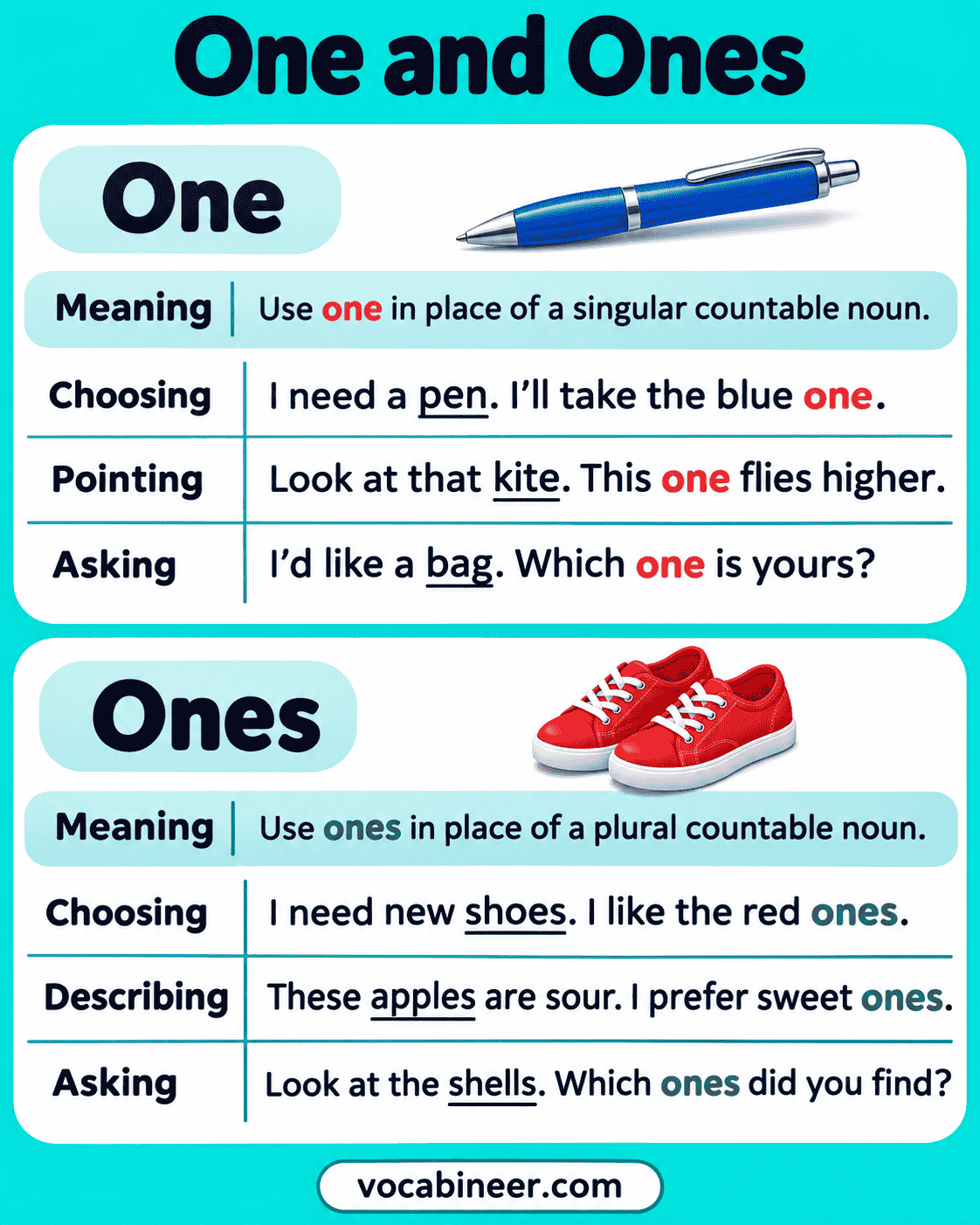
Use one for a singular countable noun and ones for a plural countable noun when the listener can tell which noun you mean. To check your choice, put the noun back into the phrase. Ava’s green one is her green backpack.
In This Page
How One and Ones Replace Nouns
A countable noun names something you can count, such as a button, a marble, or a chair. Once you introduce that noun, you can use one or ones to avoid repeating it. Imagine sorting buttons for an art project.
| Full phrase | Shorter phrase | What the speaker means |
|---|---|---|
| I need a round button. | I need a round one. | A single round button |
| I like the wooden buttons. | I like the wooden ones. | Two or more wooden buttons |
| Save the button with the star. | Save the one with the star. | A particular button |
| Use the buttons in the jar. | Use the ones in the jar. | A particular group of buttons |
The conversation or the setting supplies the noun. For example, if a baker holds out a tray of muffins and you point to a muffin and say, “I’ll take that one,” the baker knows what one means even if neither of you has said the word muffin.
The same pattern works for people. At a track meet, you might say, “See those runners? My sister is the one in the yellow shirt.” Although runners is plural, the description picks out one runner.
Asking “Which One?” and “Which Ones?”
Use which one to ask someone to identify a single person or item. Use which ones when asking about several. The number of choices available can stay exactly the same.
| Situation | Question | Possible answer |
|---|---|---|
| Three drawings lie on the table. You want to frame one. | Which one should we frame? | The one with the lighthouse. |
| The same drawings lie on the table. You want to display several. | Which ones should we hang in the hall? | The two with sailboats. |
A short question often sounds natural in conversation. If a friend says, “Pass me a marker,” you can ask, “Which one?” The word marker is still fresh in both speakers’ minds.
When which one or which ones is the subject, the verb also shows how many items you mean.
| Asking about one item | Asking about several items |
|---|---|
| Which one is yours? | Which ones are yours? |
| Which one fits in the drawer? | Which ones fit in the drawer? |
Describing a Choice with One and Ones
A listener sometimes needs a clue to identify the right item. You can give a short description before one or ones, or add a detail afterward.
Using Adjectives Before One and Ones
An adjective tells the listener which quality matters, such as size, color, or condition. Keep that describing word when you shorten the phrase.
| Situation | Natural sentence | Meaning of the bold phrase |
|---|---|---|
| Your helmet feels loose. | May I try a smaller one? | A smaller helmet |
| You need brushes for a wide stripe. | Let’s use the thick ones. | The thick brushes |
| Your socks got wet on the hike. | I packed some dry ones. | Some dry socks |
Notice the small words before the adjectives. A smaller one works when any suitable smaller helmet will do. The thick ones works when you can identify the brushes you mean. In some dry ones, the adjective tells the listener what kind of socks you packed, even though you leave the exact number open.
Adding Details After One and Ones
A detail can also follow one or ones. This is especially helpful when several items share the same color or size. If all the lunch boxes are blue, a sticker or a location may be a better clue.
| Detail | Example | What it identifies |
|---|---|---|
| Location | My lunch box is the one by the window. | A lunch box in a particular place |
| Feature | We need the ones with handles. | Lunch boxes that have handles |
| Something that happened | Here are the photos. The ones we took at sunset came out best. | A particular group of photos |
For a quick check, restore the noun and keep the detail in place. The ones we took at sunset becomes the photos we took at sunset. The longer version tells you exactly what ones stands for.
One or It? Ones or Them?
Start with the message you want to give. It and them can refer back to a particular item or group you have already identified. One and ones let you reuse a countable noun in a phrase such as a new one, the green one, or the larger ones.
| Situation | Referring back with it or them | Reusing the noun with one or ones |
|---|---|---|
| My flashlight broke. | Can you fix it? | Can I borrow one? |
| The gloves in this drawer are wet. | Please hang them up. | I’ll wear the dry ones from my bag. |
In the first row, fix it means fix the flashlight that broke. Borrow one means borrow a flashlight. In the second row, them refers to the wet gloves, while the dry ones identifies another pair.
Sometimes both forms can point to the very same item. Suppose you choose a red kite from a shop display. You tell the shopkeeper, “I’d like the red one.” After the shopkeeper takes it down, you ask, “Could you put it in a bag?” First you identify the kite by color. Then you refer back to the kite you just chose.
When to Use Some Instead of One or Ones
Some is a natural choice when you mean an unspecified amount or number. For example, if a classmate asks whether you brought crayons, “Yes, I brought some” answers the question. A description such as the washable ones becomes helpful when your classmate wants to know which crayons you brought.
| Question | Natural answer | Reason |
|---|---|---|
| Do you have any crayons? | Yes, I have some. | An unspecified number is enough to answer. |
| Which crayons did you bring? | The washable ones. | The description identifies the kind. |
| Would you like some water? | Yes, I’d like some. | Water refers to an amount. |
| Do you need a water bottle? | Thanks, I have one. | Bottle names an item you can count. |
A container can change the choice of word. At lunch, “Could I have some?” makes sense when someone offers you juice from a pitcher. If someone offers you a juice box, “I already have one” works because one stands for a juice box.
FAQs
Yes. If someone asks, “Do you need a pencil?” you can reply, “I have one.” The question supplies the noun, so the listener understands one as a pencil.
Yes. “I bought two” gives the number. “I bought two blue ones” gives the number and the color. For example, after a conversation about folders, two blue ones means two blue folders.
Yes. If you point to a pair of shoes, “I like those” is natural. To identify them by a feature, you could say, “I like those green ones.”
No. Write “the small ones” when referring to several small items. The plural ending is simply -s.
Yes. In “Of all the volunteers, the ones who arrived early set up the chairs,” the ones who arrived early means the volunteers who arrived early.
Read More
- Parts of Speech in English
- Nouns in English with Examples
- Common and Proper Nouns
- Countable and uncountable nouns
- Collective nouns
- Abstract and concrete nouns
- Gender nouns
- Compound nouns
- Possessive nouns
- Singular and plural nouns
- Plural noun rules