

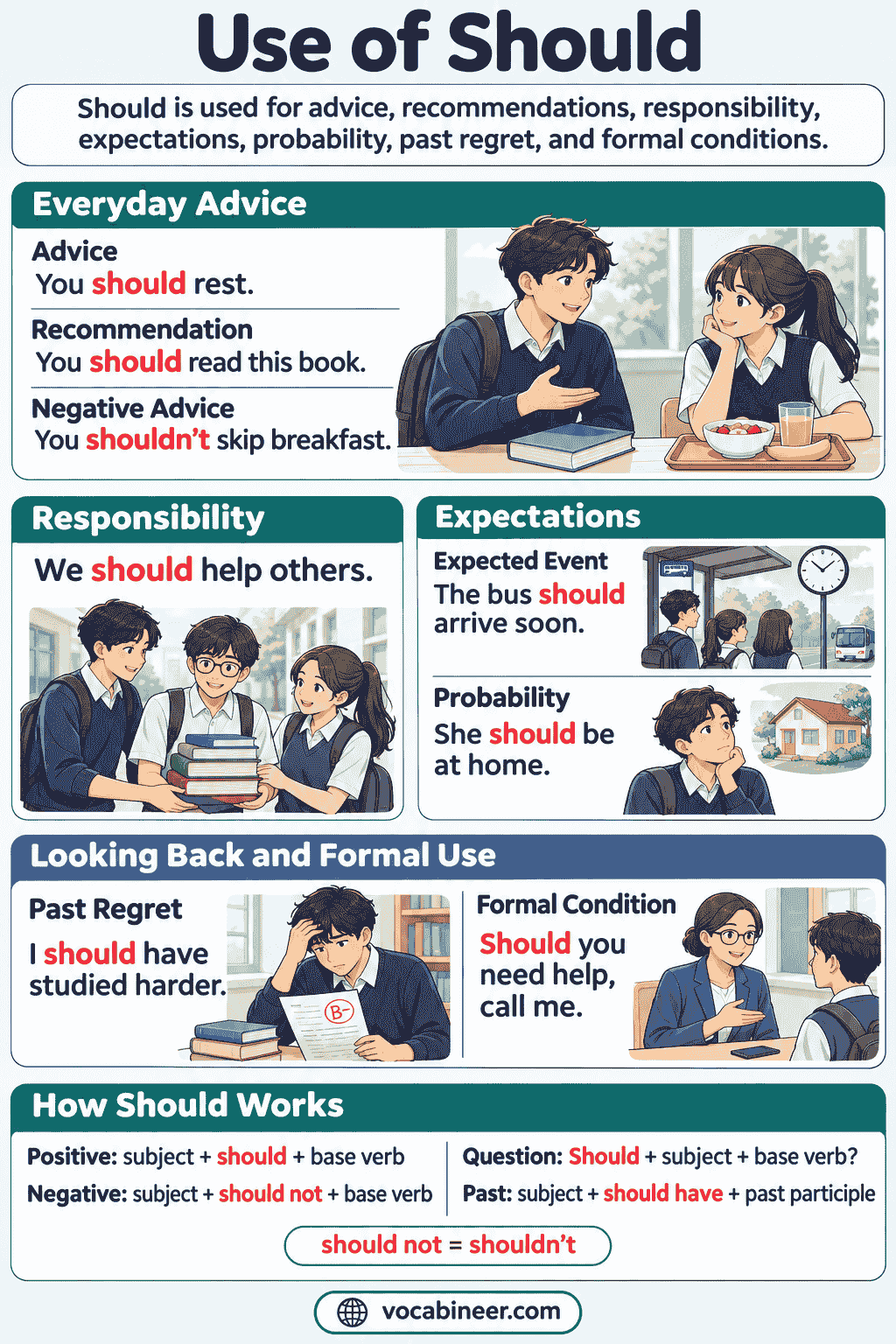
The modal verb should helps speakers give advice, express opinions, describe duties, and talk about expected results. For example, “You should rest” recommends an action, while “The train should arrive soon” expresses a reasonable expectation. Although both sentences contain the same modal, their meanings depend on context.
This guide explains how to use should in affirmative, negative, and interrogative sentences. It also covers should be, should have, and should have been, along with formal conditions, passive structures, reported speech, common expressions, comparisons, and frequent mistakes.
In This Page
Should at a Glance
Should is a modal auxiliary verb. It comes before the base form of a main verb and stays the same with every subject.
| Use | Meaning | Example |
|---|---|---|
| Advice | An action is a good idea | You should rest. |
| Recommendation | One choice seems best | We should take the earlier train. |
| Opinion | Something is right or desirable | Schools should provide safe classrooms. |
| Duty | An action is responsible or expected | Drivers should remain alert. |
| Expectation | Something will probably happen | The package should arrive today. |
| Past regret | A better action did not happen | I should have called her. |
| Past criticism | Someone made the wrong choice | You shouldn’t have lied. |
| Formal condition | An event is possible but uncertain | Should you need help, call us. |
Main Meanings of Should
Most uses of should belong to three broad groups:
- Advice and desirable action: The speaker recommends what is sensible, responsible, or right.
- Expectation and probability: The speaker believes something will probably be true or happen normally.
- Special formal uses: Should can appear in conditional clauses and after words expressing recommendations, demands, importance, or surprise.
The first two meanings sometimes overlap. Therefore, readers must use context to decide whether a sentence gives advice or states an expectation.
| Sentence | Advice or duty | Expectation |
|---|---|---|
| Sara should be at home. | It would be sensible for Sara to stay home. | The speaker expects Sara to be home. |
| The door should be locked. | Someone ought to lock the door. | The speaker expects that the door is already locked. |
| They should be working. | Working is what they ought to do. | The speaker expects that they are working now. |
Basic Grammar Rules
Keep these rules in mind:
- Use the base form of the main verb after should.
- Do not place to between should and the main verb.
- Do not add -s for he, she, or it.
- Use should not or shouldn’t for the negative.
- Place should before the subject to form a question.
- Do not use do, does, or did with modal should.
- Use should have + past participle for past advice, criticism, regret, or expectation.
| Correct | Incorrect |
|---|---|
| She should leave now. | She should leaves now. |
| You should be careful. | You should to be careful. |
| Should I call him? | Do I should call him? |
| They shouldn’t wait. | They don’t should wait. |
Sentence Structures with Should
The form of should does not change according to person, number, or gender.
Affirmative Sentences
Use subject + should + base verb.
Structure: Subject + should + base form + rest of sentence
| Subject | Example |
|---|---|
| I | I should finish this report today. |
| You | You should check the details. |
| He | He should apologize. |
| She | She should speak to the manager. |
| It | It should work now. |
| We | We should leave early. |
| They | They should receive the results tomorrow. |
Negative Sentences
Use subject + should not + base verb. The contraction is shouldn’t.
Structure: Subject + should not/shouldn’t + base form + rest of sentence
- You shouldn’t skip breakfast.
- We should not ignore the warning.
- He shouldn’t drive while he is tired.
- They should not have any difficulty.
The full form should not can sound more formal or emphatic. In conversation, shouldn’t is usually more natural.
Questions with Should
Place should before the subject.
Structure: Should + subject + base form + rest of sentence?
- Should I send the email now?
- Should we book a table?
- Should she speak to her teacher?
- Should they wait outside?
Use a question word before should when asking for specific guidance.
- What should I do?
- Where should we meet?
- Who should she contact?
- When should they arrive?
- How should I explain it?
Short Answers
| Question | Positive answer | Negative answer |
|---|---|---|
| Should I call her? | Yes, you should. | No, you shouldn’t. |
| Should we wait? | Yes, we should. | No, we shouldn’t. |
| Should he apply? | Yes, he should. | No, he shouldn’t. |
Short answers repeat should but omit the main verb because the meaning is already clear.
Should for Advice and Recommendations
Advice is the most familiar use of should. It presents an action as sensible, helpful, or beneficial without making it strictly compulsory.
Giving Personal Advice
- You should get more sleep.
- She should talk to someone she trusts.
- He should save part of his income.
- They should leave before the traffic gets heavy.
Negative advice uses shouldn’t.
- You shouldn’t worry so much.
- He shouldn’t stay up late before the exam.
- We shouldn’t make a decision without more information.
Making Recommendations
- You should try the vegetable soup.
- Visitors should explore the old part of the city.
- We should use the blue design.
- She should apply for the position.
In these examples, the speaker recommends what seems to be the best option.
Asking for Advice
Questions with should often ask another person to recommend an action.
- Should I accept the offer?
- What should we bring to the meeting?
- Which route should they take?
- Who should I ask for permission?
Advice with If I Were You
English commonly combines would with if I were you to give advice. However, the person asking for advice can also report the recommended action with should.
| Form | Example |
|---|---|
| Advice to another person | If I were you, I would wait. |
| Advice understood from context | “What should I do?” “I should wait a little longer.” |
| Direct recommendation | You should wait a little longer. |
Should for Opinions, Duties, and Ideals
Should can describe what the speaker considers right, fair, responsible, or desirable.
Expressing Opinions
- Education should be accessible to everyone.
- The city should provide more public spaces.
- Companies should protect customer information.
- People should respect different viewpoints.
These statements express beliefs rather than personal advice to one listener.
Duties and Responsibilities
- Parents should listen to their children.
- Drivers should remain alert.
- Team members should support one another.
- Writers should check their sources carefully.
Here, should presents the action as responsible or morally appropriate. However, it does not necessarily describe a legally enforceable rule.
Ideal and Desirable Situations
- There should be more trees in the neighborhood.
- Every student should have access to learning materials.
- Public buildings should be accessible.
- The process should be fair and transparent.
Instructions and Formal Guidelines
Manuals, policies, academic papers, and professional guidelines often use should for recommended procedures.
- The device should be stored in a dry place.
- Applications should include two references.
- Researchers should report any limitations.
- The results should be interpreted with caution.
In this context, should can sound stronger than casual advice but weaker than must. Therefore, writers should use must when a step is genuinely mandatory.
Should for Expectations and Probability
Use should when something is likely according to present information, normal circumstances, or a reasonable schedule.
Present Expectations
- The keys should be in the top drawer.
- Amir should know the answer.
- There should be enough food for everyone.
- This medicine should help with the pain.
Future Expectations
- The bus should arrive in ten minutes.
- The weather should improve tomorrow.
- We should receive the results next week.
- The repairs should take about two hours.
Expected Ongoing Actions
Use should be + verb-ing when an activity is expected to be in progress.
- They should be arriving now.
- She should be working in her office.
- The children should be sleeping by this time.
- The technicians should be testing the system today.
Negative Expectations
Use shouldn’t when something is unlikely or when no problem is expected.
- The journey shouldn’t take long.
- There shouldn’t be much traffic.
- This change shouldn’t affect your account.
- The task shouldn’t be difficult.
Do not assign should a fixed percentage of certainty. Its strength depends on context, evidence, and intonation.
Understanding Should Be
The words after should be determine the structure and meaning.
| Pattern | Common function | Example |
|---|---|---|
| should be + adjective | Advice, ideal state, or expectation | You should be careful. |
| should be + noun phrase | Expected identity or role | This should be the correct room. |
| should be + place expression | Expected location | She should be at home. |
| should be + verb-ing | Advice or ongoing expectation | He should be studying. |
| should be + past participle | Passive advice or expectation | The form should be signed. |
Advice and Expectation with Should Be
Some sentences remain ambiguous without context.
- “He should be at school” can mean that school is the proper place for him or that the speaker expects him to be there.
- “The window should be closed” can recommend closing it or state an expectation that it is already closed.
Therefore, add context when the intended meaning is not obvious.
Understanding Should Have
The construction should have + past participle can express past regret, criticism, unfulfilled duty, or expectation.
Past Advice and Regret
Use this structure for an action that would have been better but did not happen.
- I should have studied harder.
- We should have booked earlier.
- She should have asked for help.
- They should have taken an umbrella.
The usual implication is that the subject did not perform the recommended action.
Criticism of Past Actions
- You should have told me about the change.
- He should have apologized.
- They should have followed the instructions.
- The company should have warned its customers.
Tone determines whether the sentence sounds like gentle reflection or strong criticism.
Negative Past Criticism
Use shouldn’t have + past participle for an action that happened but was a mistake.
- You shouldn’t have shouted at him.
- She shouldn’t have shared the password.
- We shouldn’t have ignored the warning.
- They shouldn’t have driven in the storm.
Past Expectations
Should have does not always express regret. It can also indicate that an event is expected to have happened.
- The train should have arrived by now.
- She should have received the email.
- The payment should have reached your account.
- They should have finished the meeting.
The speaker does not necessarily know whether the action occurred; the action is simply expected according to available information.
Expected Future Completion
The same structure can describe an expected completed action before a future point.
- They should have finished by Friday.
- We should have received a decision by next week.
- By noon, the technicians should have repaired the system.
Should Have Had
When lexical have is the main verb, the perfect construction produces should have had.
- You should have had more time.
- The room should have had another window.
- They should have had the results by now.
The first have forms the modal perfect, while had is the past participle of the main verb have.
Uses of Should Have Been
The words following should have been determine whether the sentence describes an ideal past state, an expected activity, or a passive action.
| Pattern | Meaning | Example |
|---|---|---|
| should have been + adjective | Ideal or expected past condition | The task should have been easier. |
| should have been + noun phrase | Ideal or expected past identity | This should have been the final version. |
| should have been + verb-ing | Expected or proper past activity | He should have been studying. |
| should have been + past participle | Past passive duty or expectation | The parcel should have been delivered. |
Expected Past Activity
- She should have been working at that time.
- They should have been waiting outside.
- The team should have been preparing for the match.
Depending on context, these sentences can express expectation or criticism.
Past Passive Criticism and Expectation
- The error should have been corrected earlier.
- Passengers should have been informed about the delay.
- The documents should have been delivered yesterday.
The first two examples may criticize a failure, while the third may simply express an expectation.
Should in Passive Sentences
Use the passive when the action or receiver matters more than the person performing it.
| Time and form | Structure | Example |
|---|---|---|
| Present or future | should be + past participle | The form should be submitted online. |
| Ongoing | should be being + past participle | The bridge should be being inspected now. |
| Past | should have been + past participle | The report should have been completed. |
The form should be being + past participle is grammatical but often sounds heavy. A clearer active sentence may work better: “The engineers should be inspecting the bridge now.”
Should in Conditional Sentences
Formal English uses should in conditional clauses to present a possibility as tentative, uncertain, or less likely.
If Clauses with Should
- If you should need assistance, contact reception.
- If the situation should change, we will inform you.
- If any problem should arise, restart the system.
These sentences are more formal and tentative than ordinary first conditional sentences.
| Ordinary condition | More formal or tentative form |
|---|---|
| If you need help, call us. | If you should need help, call us. |
| If the price changes, tell me. | If the price should change, tell me. |
Formal Inversion with Should
Remove if and place should before the subject.
- Should you need assistance, contact reception.
- Should the situation change, we will inform you.
- Should any problem arise, restart the system.
This inverted structure frequently appears in formal notices, policies, contracts, and professional correspondence.
Should Happen To
Should happen to emphasizes that an event is possible but accidental or not strongly expected.
- If you should happen to see Ali, ask him to call me.
- Should you happen to find my keys, leave them at reception.
- If she should happen to arrive early, show her to the meeting room.
Lest with Should
Formal English sometimes uses should after lest, meaning “to prevent the possibility that.”
- He spoke quietly lest he should wake the baby.
- She saved the document twice lest it should be lost.
Modern speakers often prefer clearer alternatives such as “so that he would not wake the baby” or “in case the document was lost.”
Should After Suggestions and Demands
British English often uses should in clauses after verbs that express advice, demands, proposals, requests, or recommendations. Grammarians commonly call this pattern mandative should.
Common Verbs Before Mandative Should
- advise
- ask
- demand
- insist
- propose
- recommend
- request
- suggest
Examples include:
- They recommended that she should apply.
- The manager insisted that everyone should attend.
- We proposed that the policy should be revised.
- The customer requested that the payment should be refunded.
Should After Nouns
Mandative clauses can also follow related nouns.
- Her recommendation was that we should wait.
- They accepted the proposal that the rule should be changed.
- The requirement that everyone should register caused confusion.
- His request that the meeting should be postponed was denied.
Mandative Should and the Subjunctive
American English often favors the subjunctive base form where British English commonly allows mandative should.
| Mandative should | Subjunctive alternative |
|---|---|
| They suggested that he should apply. | They suggested that he apply. |
| It is essential that she should attend. | It is essential that she attend. |
| We demanded that the error should be corrected. | We demanded that the error be corrected. |
Both patterns occur in standard English. However, frequency and preference vary by region and register.
Should After Adjectives
Clauses with should can follow adjectives that express importance, necessity, surprise, concern, or emotional reaction.
Importance and Necessity
- It is important that everyone should understand the rules.
- It is essential that each applicant should provide identification.
- It is advisable that the system should be checked regularly.
- It is appropriate that the matter should be discussed openly.
Surprise and Emotional Reaction
- It is strange that he should refuse.
- I am surprised that she should say that.
- It is unfortunate that they should have missed the opportunity.
- I am sorry that you should feel this way.
This emotive should does not give advice. Instead, it emphasizes the speaker’s surprise, concern, regret, or judgment about a situation.
Rhetorical Questions with Should
Not every question with should asks for advice. Some express disbelief, irritation, surprise, or rejection of an expectation.
- Why should I apologize? — questions the reason for apologizing
- How should I know? — expresses irritation or lack of knowledge
- Why should anyone object? — suggests that no good reason exists
- Who should arrive but the manager? — introduces a surprising arrival
- Should you be doing that? — may express doubt or criticism
Tone and context determine whether a question is genuine or rhetorical.
Negative Opinions with Should
English often places the negative in the main clause with verbs such as think, believe, and suppose.
| More natural in many contexts | Possible alternative |
|---|---|
| I don’t think you should go. | I think you shouldn’t go. |
| We don’t believe they should interfere. | We believe they shouldn’t interfere. |
| I don’t suppose we should wait. | I suppose we shouldn’t wait. |
The meanings may be very similar, but the first pattern often sounds more neutral and idiomatic.
Question Tags with Should
Use shouldn’t after a positive statement and should after a negative statement.
- We should leave, shouldn’t we?
- She should call, shouldn’t she?
- He shouldn’t worry, should he?
- They should have arrived, shouldn’t they?
Question tags can seek confirmation, encourage agreement, or soften a recommendation.
Should in Reported Speech
Should usually remains unchanged when advice, recommendations, criticism, or expectations move into reported speech.
| Direct speech | Reported speech |
|---|---|
| The doctor said, “You should rest.” | The doctor said that I should rest. |
| She said, “You should apply.” | She said that I should apply. |
| He said, “You should have called.” | He said that I should have called. |
| Maya said, “The bus should arrive soon.” | Maya said that the bus should arrive soon. |
Should as a Traditional Past Form of Shall
In formal or traditional British English, should can represent shall from a past viewpoint, especially with I and we.
- I knew that I should need more time.
- We expected that we should return before dark.
Modern English often uses would in these sentences. Therefore, learners should recognize this use without treating it as the normal past form of shall in every context.
Formal Should as an Alternative to Would
Traditional formal British English sometimes uses should with I and we where modern speakers generally use would.
| Traditional or formal | Common modern form |
|---|---|
| I should be pleased to help. | I would be pleased to help. |
| We should accept if they invited us. | We would accept if they invited us. |
| I should think that the plan will work. | I would think that the plan will work. |
This use is stylistic and regional rather than a basic rule for giving advice.
Common Expressions with Should
You Shouldn’t Have
People often say You shouldn’t have! after receiving a gift or kind favor. The expression communicates grateful surprise rather than criticism.
That Should Do It
That should do it means that an action or amount will probably be sufficient.
- Tighten this screw, and that should do it.
That Shouldn’t Be a Problem
This expression reassures someone that a request or situation will probably be manageable.
- “Can you finish by Tuesday?” “That shouldn’t be a problem.”
I Should Think So
I should think so can express confident expectation, agreement, or sometimes indignation.
- “Will they accept the proposal?” “I should think so.”
You Should Know Better
This expression criticizes someone who was expected to make a wiser choice.
- You should know better than to share your password.
I Should Be So Lucky
This ironic expression suggests that a desirable event is unlikely.
- “Perhaps they will give you a free holiday.” “I should be so lucky!”
One Should
Formal English sometimes uses impersonal one with should.
- One should respect other people’s privacy.
- One should not make claims without evidence.
In everyday conversation, generic you is usually more natural.
Adverb Placement with Should
Frequency and viewpoint adverbs generally appear after should and before the main verb.
- You should always check the details.
- She should probably wait.
- We should never ignore a warning.
- They should definitely apply.
The placement of only can change the focus.
| Sentence | Emphasis |
|---|---|
| You should only use this button in an emergency. | Using the button is restricted to emergencies. |
| Only you should use this button. | No other person should use it. |
| You should use only this button. | No other button should be used. |
Should Compared with Related Forms
Should vs Must
| Should | Must |
|---|---|
| Gives advice or expresses mild duty | Expresses strong obligation or necessity |
| The action is recommended | The action is required |
| You should wear warm clothes. | You must wear protective clothing. |
Should vs Ought To
| Should | Ought to |
|---|---|
| More common in everyday English | Slightly more formal and less common |
| Common in questions and negatives | Less natural in many questions and negatives |
| You should apologize. | You ought to apologize. |
The two forms often express similar advice, duty, or expectation.
Should vs Had Better
| Should | Had better |
|---|---|
| Gives general advice | Gives strong advice or a warning |
| A consequence may remain unstated | Often suggests a negative consequence |
| You should leave soon. | You had better leave before the storm begins. |
Although had better contains had, it normally refers to the present or future.
Should vs Could
| Should | Could |
|---|---|
| Recommends what seems best | Presents a possible option |
| You should call the manager. | You could call the manager. |
Should vs Would
| Should | Would |
|---|---|
| Advice, duty, or expectation | Hypothetical result, willingness, preference, or past habit |
| You should speak to her. | I would speak to her if I had time. |
| The parcel should arrive today. | I would deliver it if I had a car. |
Should vs Need To
| Should | Need to |
|---|---|
| Recommends an action | Expresses practical necessity |
| You should charge your phone. | You need to charge it before the journey. |
Should vs Have To
| Should | Have to |
|---|---|
| Mild duty, advice, or expectation | Stronger requirement or necessity |
| You should attend the meeting. | You have to attend the meeting. |
Should Not vs Must Not
| Should not | Must not |
|---|---|
| Advises against an action | Prohibits an action |
| You shouldn’t eat so much sugar. | You mustn’t enter this room. |
Should Have vs Must Have
| Should have | Must have |
|---|---|
| Past advice, criticism, regret, or expectation | Strong deduction about the past |
| She should have called. | She must have called while I was away. |
Should Have vs Would Have
| Should have | Would have |
|---|---|
| Desirable or expected past action | Hypothetical past result |
| We should have left earlier. | We would have left if the car had started. |
Pronunciation and Contractions
Pronunciation of Should
Should is commonly pronounced /ʃʊd/. In connected speech, it may receive little stress unless the speaker wants to emphasize the recommendation or expectation.
Pronunciation of Shouldn’t
Shouldn’t is commonly pronounced /ˈʃʊdənt/. Speakers should make the negative ending clear when misunderstanding could change the advice.
Should Have and Should’ve
The contraction of should have is should’ve. In natural speech, it may sound similar to “should of,” but should of is never the correct written form.
| Correct | Incorrect |
|---|---|
| You should have called. | You should of called. |
| You should’ve called. | You should of call. |
Informal representations such as shoulda imitate pronunciation and do not belong in standard formal writing.
Common Mistakes with Should
Using To After Should
| Incorrect | Correct |
|---|---|
| You should to rest. | You should rest. |
| We should to leave. | We should leave. |
Adding S to the Main Verb
| Incorrect | Correct |
|---|---|
| She should calls him. | She should call him. |
| He should apologizes. | He should apologize. |
Using Do or Does with Should
| Incorrect | Correct |
|---|---|
| Do I should wait? | Should I wait? |
| She doesn’t should go. | She shouldn’t go. |
Using the Wrong Past Participle
| Incorrect | Correct |
|---|---|
| You should have went. | You should have gone. |
| She should have wrote. | She should have written. |
Omitting Have
| Incorrect | Correct |
|---|---|
| You should called me. | You should have called me. |
| They shouldn’t left early. | They shouldn’t have left early. |
Writing Should Of
Use should have or should’ve, never should of.
Confusing Shouldn’t with Mustn’t
Shouldn’t advises against an action, whereas mustn’t prohibits it.
- You shouldn’t drink so much coffee. — advice
- You mustn’t use your phone during the examination. — prohibition
Confusing Advice with Expectation
Do not assume that every sentence with should gives advice. “The train should arrive soon” expresses expectation, not a recommendation to the train.
Confusing Should Have with Must Have
- She should have called. — calling was advisable or expected
- She must have called. — the evidence supports the conclusion that she called
Confusing Should Have with Had To
- I should have left early. — leaving early would have been better
- I had to leave early. — circumstances required me to leave
Combining Should with Another Modal
Standard international English does not normally place two central modal verbs together.
| Incorrect in standard usage | Correct alternative |
|---|---|
| You might should wait. | You might have to wait. |
| She will should call. | She will probably need to call. |
Some regional dialects use double modals, but learners should avoid them in formal standard English.
Treating Should as a Strict Command
Use must, have to, or another clear requirement when compliance is compulsory. Using should for a mandatory safety rule can make the rule sound optional.
Assuming Should Have Always Expresses Regret
“The train should have arrived” may express an expectation rather than regret. Always examine the context.
Misplacing Adverbs
Place most frequency and viewpoint adverbs between should and the main verb: should always check, should probably wait, and should never ignore.
Overusing Should
Repeated should statements can make advice sound judgmental or controlling. In softer contexts, consider could, might want to, or a direct explanation of the available options.
Choosing the Correct Form
| Intended meaning | Recommended form | Example |
|---|---|---|
| General advice | should | You should rest. |
| Negative advice | shouldn’t | You shouldn’t worry. |
| Strong obligation | must / have to | You must wear a helmet. |
| Prohibition | mustn’t | You mustn’t enter. |
| Possible option | could | You could call later. |
| Strong warning | had better | You had better leave now. |
| Present expectation | should | The bus should arrive soon. |
| Past regret or criticism | should have + past participle | We should have checked. |
| Past expectation | should have + past participle | She should have arrived. |
| Strong past deduction | must have + past participle | She must have arrived. |
| Hypothetical past result | would have + past participle | She would have arrived earlier. |
| Formal tentative condition | should + subject + verb | Should you need help, call us. |
First, decide whether you are giving advice, expressing a requirement, presenting an option, or stating an expectation. Next, identify the time reference. Finally, choose a form whose strength and tone match the situation.
FAQs
The most common use of should is to give advice or recommend a sensible action. However, it can also express duty, opinions, expectations, probability, regret, criticism, and formal conditions.
Use the base form without to, as in should go, should study, and should be. For past meanings, use should have + past participle.
Should usually expresses advice, mild duty, or expectation. In contrast, must expresses strong obligation, necessity, prohibition, or a confident deduction.
Should have + past participle can describe a better action that did not happen, criticize a past choice, or express an expectation that an action has already occurred.
No. Write should have or its contraction should’ve. The incorrect form should of comes from mishearing the pronunciation of should’ve.
Final Summary
Should is a flexible modal verb that expresses advice, recommendations, opinions, duties, and reasonable expectations. It takes the base form of a verb, remains unchanged with every subject, and forms questions without do. Its negative forms are should not and shouldn’t.
For past meanings, should have + past participle can express regret, criticism, unfulfilled duty, or expectation. In addition, should appears in passive structures, reported speech, formal conditions, mandative clauses, rhetorical questions, and several common expressions. By considering meaning, time, context, and strength, learners can choose should and its related forms accurately.
Read More
- Verbs in English
- Action Verbs
- Regular Verbs
- Irregular Verbs
- Transitive and Intransitive verbs
- Finite and Non-finite verbs
- Principal Parts of Verbs
- Forms of Verbs