

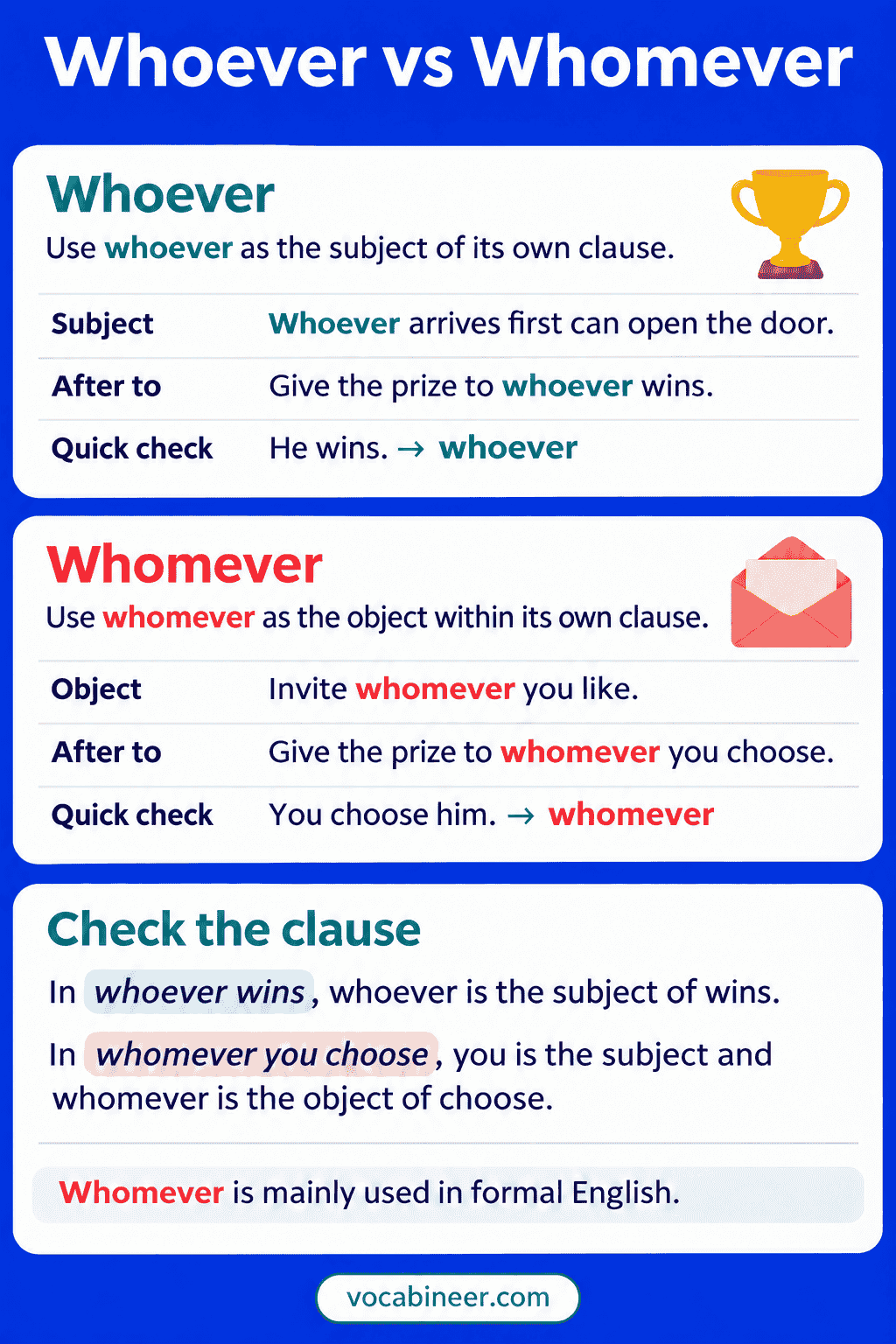
Whoever and whomever refer to a person whose identity is unknown or unrestricted. In traditional formal grammar, use whoever as the subject of its clause and whomever as an object within that clause. For example, “Whoever calls first will get the ticket” uses whoever as the subject of calls.
The choice becomes easier when you focus on the part of the sentence containing the pronoun. First, turn that part into a simple statement. Then test whether he or him fits. This method helps you choose the correct form in invitations, requests, and longer sentences.
In This Page
The Difference Between Whoever and Whomever
A clause is a group of words containing a subject and a verb. One sentence can contain several clauses, so the pronoun’s role within its own clause matters.
| Pronoun | Traditional role | Example | Simple check |
|---|---|---|---|
| Whoever | Subject | Whoever calls first gets the ticket. | He calls first. |
| Whomever | Object | Invite whomever you choose. | You choose him. |
In the first example, whoever identifies the person making the call. In the second, you is the subject of choose, and whomever identifies the person you choose.
However, a subject can also receive an action. In “Whoever is selected will lead the team,” whoever is the subject of is selected. The check is “He is selected,” so whoever fits even though someone else makes the selection.
Choosing the Right Pronoun With the He and Him Test
The test works when you examine the relevant clause. If you replace the entire clause, you may hide the distinction you need to check.
- Find the relevant words. Focus on the clause containing whoever or whomever.
- Make a simple statement. Put the words into ordinary subject–verb order.
- Test the pronoun. If he fits, use whoever. If him fits, the traditional formal choice is whomever.
You can also use she and her for the same test. These substitutions check grammatical role, regardless of the person’s gender.
| Complete sentence | Clause to check | Simple statement | Choice |
|---|---|---|---|
| Thank whoever helped you. | whoever helped you | He helped you. | Whoever |
| Invite whomever you trust. | whomever you trust | You trust him. | Whomever |
| Whoever knows the answer can speak. | whoever knows the answer | He knows the answer. | Whoever |
For example, “Thank him” is a complete sentence, but it replaces all of “whoever helped you.” To choose the original pronoun, check who helped you. The statement “He helped you” shows why whoever belongs there.
Whoever and Whomever After Prepositions
A preposition such as to or for can introduce a whole clause. In that situation, look inside the clause before choosing the pronoun.
| Sentence | Check inside the clause | Explanation |
|---|---|---|
| Give the ticket to whoever arrives first. | He arrives first. | Whoever is the subject of arrives. |
| Give the ticket to whomever you choose. | You choose him. | Whomever is the object of choose. |
| Save a seat for whoever needs one. | He needs one. | Whoever is the subject of needs. |
| Save a seat for whomever Maya invites. | Maya invites him. | Whomever is the object of invites. |
Both forms can therefore appear after to or for. The verb inside the following clause reveals which form the traditional rule requires.
Choosing the Pronoun in Longer Sentences
Phrases such as you think or you believe can separate the pronoun from the verb that determines its role. When that happens, identify the underlying statement.
| Sentence | Underlying statement | Reason |
|---|---|---|
| Choose whoever you think will help. | He will help. | The pronoun is the subject of will help. |
| Choose whomever you think we should invite. | We should invite him. | The pronoun is the object of invite. |
| Support whoever you believe can lead the team. | He can lead the team. | The pronoun is the subject of can lead. |
In these examples, you think and you believe introduce someone’s judgment. However, the pronoun’s relationship to help, invite, or lead determines the choice.
Formal Writing and Everyday Usage
Whomever remains useful in formal writing that follows the traditional subject–object distinction. In everyday speech and informal writing, people commonly use whoever in object positions too.
If a sentence feels overly formal, you can often express the same idea with anyone or the person.
| Traditional formal wording | Common everyday wording | Alternative with anyone |
|---|---|---|
| Invite whomever you like. | Invite whoever you like. | Invite anyone you like. |
| Choose whomever you trust. | Choose whoever you trust. | Choose anyone you trust. |
For a grammar exercise or a document that follows a formal style guide, apply the clause test. For conversational writing, consider the wording that fits your audience and tone.
Common Mistakes With Whoever and Whomever
Two common errors come from judging the pronoun by its position. Instead, identify its role in the relevant clause.
| Problem | Example | Correction or explanation |
|---|---|---|
| Automatically choosing whomever after to | Give it to whomever needs it. | Write “Give it to whoever needs it.” The check is “He needs it.” |
| Assuming a sentence must begin with whoever | Whoever you invite will be welcome. | Under the traditional formal rule, use “Whomever you invite will be welcome.” The check is “You invite him.” |
The second example is common in everyday English. In the formal version, whomever is the object of invite, while the complete clause “whomever you invite” is the subject of will be.
FAQs About Whoever and Whomever
It can mean “any person who,” as in “Whoever finishes first can leave.” It can also express “it doesn’t matter who,” as in “Whoever wins, we will celebrate.”
Yes. It is common in everyday English. In traditional formal usage, “Invite whomever you want” follows the object pattern “You want him.”
Yes. In formal usage, “Whomever you invite will be welcome” is a standard example. The pronoun is the object of invite, even though the whole clause begins the sentence.
Yes. It appears in formal speech and writing, although whoever is more common in everyday language. Use the clause test when you need to follow the traditional distinction.
Try anyone or the person followed by a suitable clause. For example, “Choose anyone you trust” expresses the idea naturally and clearly.
Read More
- Parts of Speech in English
- Nouns in English with Examples
- Common and Proper Nouns
- Countable and uncountable nouns
- Collective nouns
- Abstract and concrete nouns
- Gender nouns
- Compound nouns
- Possessive nouns
- Singular and plural nouns
- Plural noun rules