

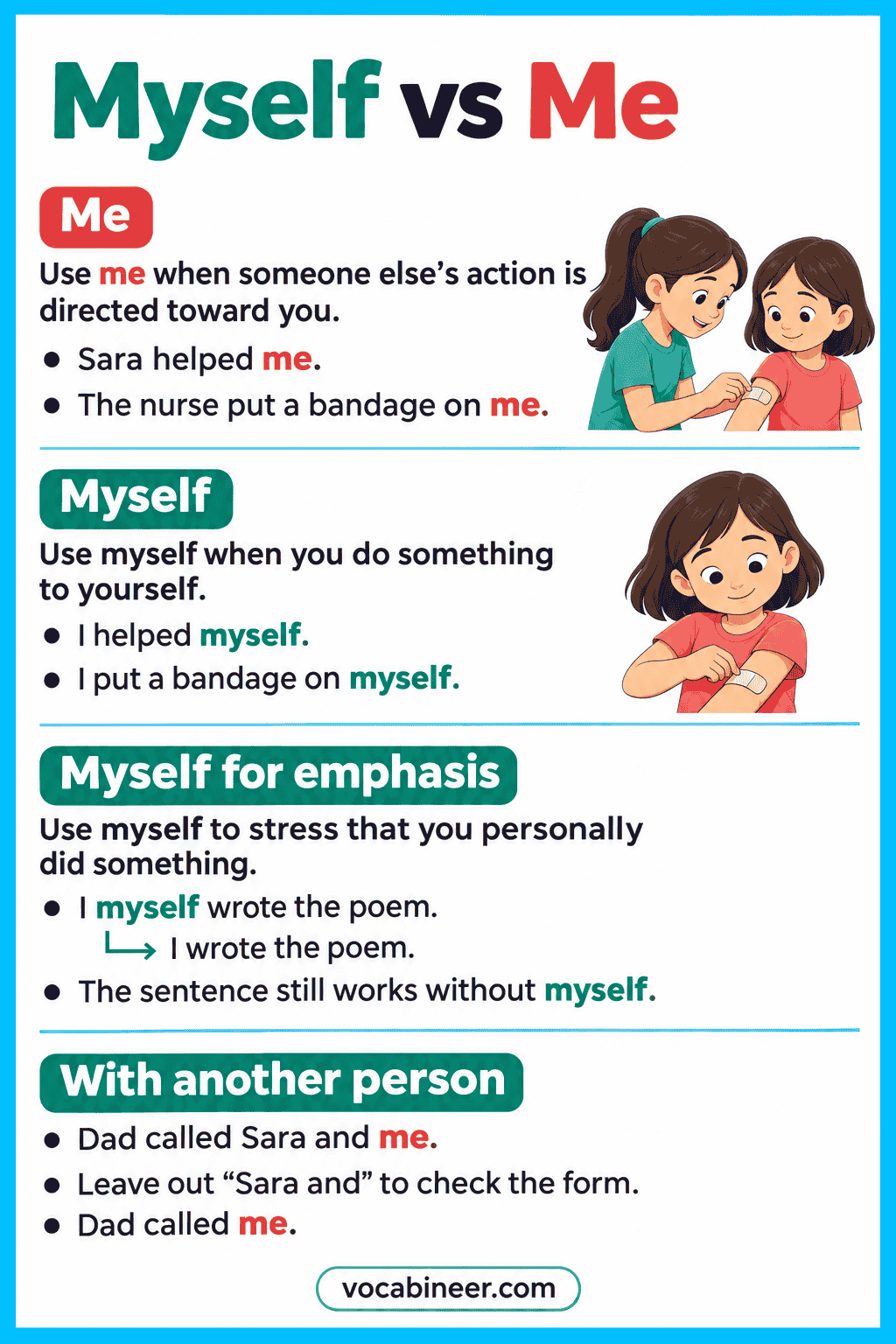
Me and myself both refer to the person speaking or writing. Use me as an object, as in “Maya called me.” Use myself when an action comes back to you or when you want to emphasize that you did something personally.
The choice often comes up when you mention someone else in a request. If you’re writing “Please contact Maya or me,” try leaving out Maya’s name. The shorter request is “Please contact me.” Adding another person gives the reader a second contact, but it doesn’t change your pronoun.
In This Page
The Difference Between Myself and Me
Imagine sending a file by email. The pronoun you choose can identify who received the file or emphasize who sent it.
| Use | Example | Meaning |
|---|---|---|
| Me as an object | Maya emailed me the file. | Maya sent the file. I received it. |
| Myself as a reflexive pronoun | I emailed myself the file. | I sent the file to my own inbox. |
| Myself for emphasis | I emailed Maya the file myself. | Maya received the file. I’m emphasizing that I personally sent it. |
When to Use Me as an Object
Use me when a verb names something someone does to or for you. In “The coach thanked me,” the speaker receives the thanks. You can also use me after a preposition. In “The coach saved a seat for me,” the word for introduces the person who gets the seat.
If a sentence has more than one verb, look at the verb that goes with the pronoun. For example, “I hope Maya calls me” begins with I, but Maya is the subject of calls. She’s making the call, and you’re the person she’ll call.
When to Use Myself for an Action or for Emphasis
Reflexive use. Use myself when you direct an action toward yourself. In “I introduced myself to the new neighbors,” you’re both the person making the introduction and the person you introduce.
Emphatic use. You can also add myself to stress your personal involvement. This is called an intensive use. For example, if someone thinks a mechanic repaired your bike, you might say, “I repaired it myself.”
| Sentence | Without myself | What changes |
|---|---|---|
| I introduced myself to the neighbors. | I introduced ___ to the neighbors. | The listener still needs to know whom you introduced. |
| I taught myself to swim. | I taught ___ to swim. | The original identifies you as both teacher and learner. Removing myself loses that meaning. |
| I repaired the bike myself. | I repaired the bike. | The basic statement stays complete. Only the emphasis disappears. |
Choosing Me or Myself in Requests and Emails
In a request such as “Please send a copy to Maya and me,” the understood subject is you. You’re asking the reader to send the copy, and you’re one of its recipients. Two checks can help you choose the pronoun.
- Find the person doing the action. Ask who will send, call, or reply. In a request beginning with please send, that person is usually the reader.
- Leave out the other name. Read the request with just your pronoun, then put the name back. “Please send a copy to me” still works when Maya joins the list.
| Situation | Natural wording | Why it works |
|---|---|---|
| Giving someone two contacts | Please call Maya or me. | The reader can call either person. |
| Asking for a reply | Please reply to Maya and me. | Both people should receive the reply. |
| Describing your own mailing list | I sent a copy to Maya and myself. | You sent the copy, and one of the recipients was you. |
The Two Meanings of By Myself
By myself can mean alone or without help. The activity and the surrounding details usually tell you which meaning the speaker intends.
| Meaning | Example | What the speaker means |
|---|---|---|
| Alone | I live by myself. | I share my home with no one else. |
| Without help | I assembled the desk by myself while my sister watched. | My sister was there, but I did the work without her help. |
Sometimes either meaning fits. If you say “I drove there by myself,” a listener might understand that you had no passengers or that you managed the drive independently. If the distinction matters, add a detail such as “It was my first trip without an instructor.”
FAQs About Myself and Me
The ordinary wording is “Please contact me.” If you want a warmer tone, “Please feel free to contact me” keeps the same pronoun and makes the invitation more welcoming.
In standard written English, use I as the subject. For example, write “I will lead the meeting.” You can add myself for emphasis if the identity of the person leading matters.
Here, with me tells us that the notes accompanied you. English normally uses the ordinary object pronoun in this expression, even though the sentence begins with I.
Yes. In “I myself heard the announcement,” myself emphasizes that you heard it firsthand. The subject is I.
No. It emphasizes that you personally made it. For example, you might say it about a cake you baked using your sister’s advice. If you mean you had no help, “I made it by myself” expresses that more clearly.
Read More
- Parts of Speech in English
- Nouns in English with Examples
- Common and Proper Nouns
- Countable and uncountable nouns
- Collective nouns
- Abstract and concrete nouns
- Gender nouns
- Compound nouns
- Possessive nouns
- Singular and plural nouns
- Plural noun rules