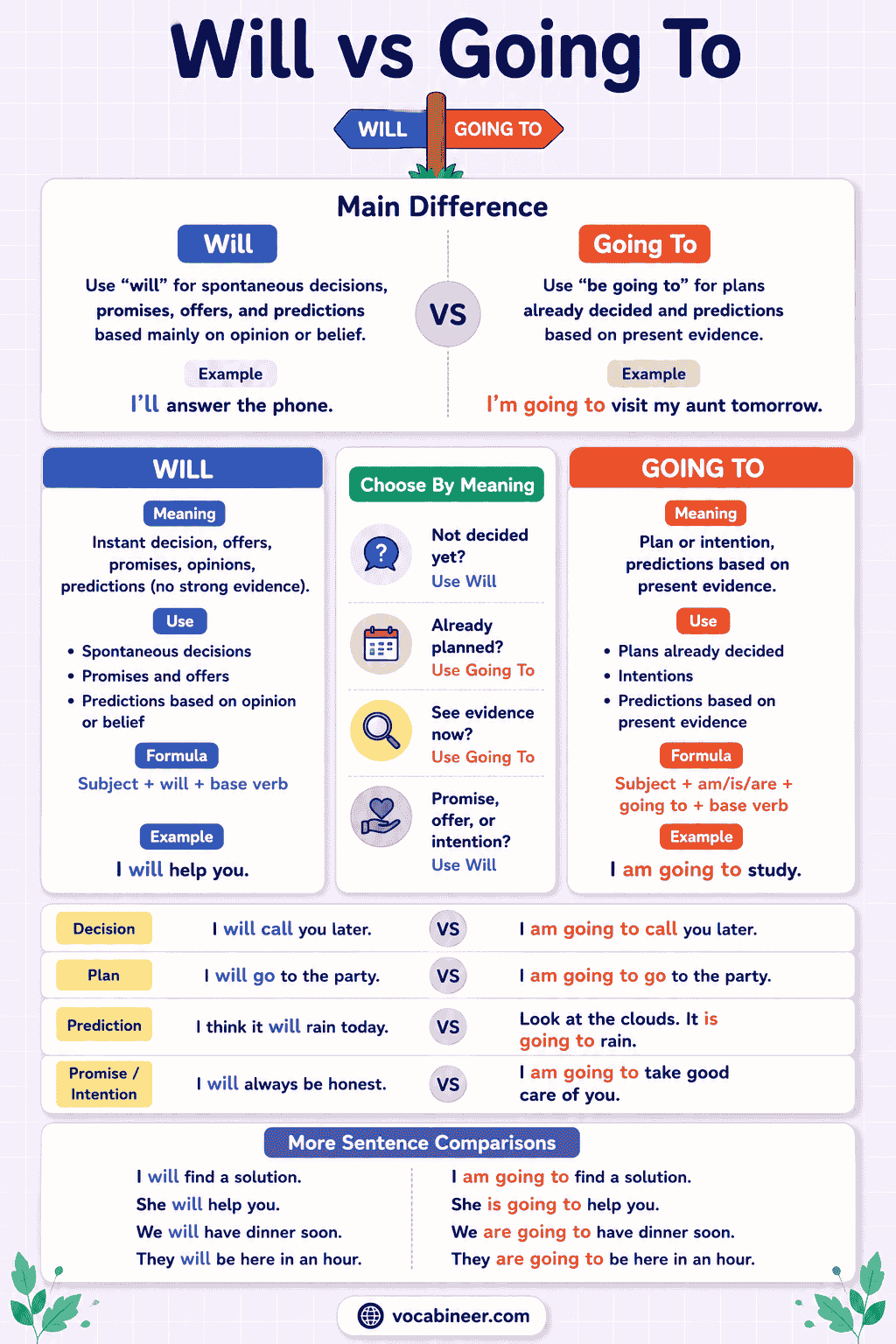
Will and going to both express future meaning, but they often present future events differently. Will commonly expresses immediate decisions, newly formed intentions, general predictions, future facts, offers, promises, requests, willingness, and refusals. Going to commonly expresses prior plans, prior intentions, and predictions based on present evidence.
Understanding the difference helps learners choose the more natural form for decisions, plans, predictions, promises, and arrangements. The key is not simply that both refer to the future, but how the speaker presents the decision, intention, or prediction.
In This Page
Will vs Going To: What Is the Difference?
The main difference often concerns decision timing and prediction basis.
| Will | Going To |
|---|---|
| commonly expresses an immediate decision | commonly expresses a prior plan or intention |
| often expresses a prediction based on belief or expectation | often expresses a prediction based on present evidence |
| commonly expresses offers, promises, requests, willingness, and refusals | mainly expresses plans, intentions, and evidence-based predictions |
| uses will + V1 | uses am/is/are + going to + V1 |
| I will answer the phone. | I am going to call Maya tonight. |
A useful core rule is:
Will commonly presents a decision or intention as newly formed, while going to commonly presents a plan or intention as already established before the moment of speaking.
However, this is not the only difference. Both forms can overlap in some contexts.
Will vs Going To at a Glance
| Meaning | Will | Going To |
|---|---|---|
| spontaneous decision | I will answer the phone. | — |
| prior plan | — | I am going to study tonight. |
| belief-based prediction | I think it will rain tomorrow. | — |
| prediction from present evidence | — | Look at those clouds. It is going to rain. |
| offer | I will help you. | — |
| promise | I will call you tonight. | — |
| request | Will you help me? | — |
| refusal | I won’t do it. | — |
| prior intention | — | She is going to apply for the job. |
| future fact | The course will end in June. | — |
This table gives the main pattern, but context still determines the most natural form.
How Will and Going To Are Formed
The two forms use different structures.
| Feature | Will | Going To |
|---|---|---|
| affirmative | will + V1 | am/is/are + going to + V1 |
| negative | will not + V1 | am/is/are not + going to + V1 |
| question | Will + subject + V1? | Am/Is/Are + subject + going to + V1? |
| common contraction | ’ll / won’t | I’m / he’s / they’re going to |
Examples:
| Will | Going To |
|---|---|
| She will travel. | She is going to travel. |
| She will not travel. | She is not going to travel. |
| Will she travel? | Is she going to travel? |
The main verb stays in V1 after both forms.
Correct:
- She will go.
- She is going to go.
Incorrect:
- She will goes.
- She is going to went.
Spontaneous Decisions vs Prior Plans
This is the central comparison.
| Will | Going To |
|---|---|
| decision made at or around the moment of speaking | plan or decision formed before speaking |
| The phone is ringing. I will answer it. | I am going to call Maya after dinner. |
| There’s no milk. I will buy some. | I am going to buy groceries after work. |
| I’m cold. I will close the window. | I am going to replace the window next month. |
Compare:
- The phone is ringing. I will answer it.
- I am going to call Maya tonight.
The first decision is made now. The second intention already exists.
A useful principle is:
Will commonly marks a newly formed decision, while going to commonly marks a plan already formed before the current conversation.
Predictions with Will vs Going To
Both forms can express predictions, but the basis of the prediction often differs.
| Will | Going To |
|---|---|
| prediction based on belief, opinion, expectation, or general knowledge | prediction based on evidence in the present situation |
| I think it will rain tomorrow. | Look at those clouds. It is going to rain. |
| She will probably pass the exam. | She has studied every day. She is going to do well. |
| I think they will win. | They are already far ahead. They are going to win. |
Use this teaching point:
Will commonly expresses what the speaker believes or expects will happen, while going to often emphasizes present evidence for the prediction.
This is a strong tendency, not an absolute rule.
What Does Present Evidence Mean?
Present evidence means that something in the current situation supports the prediction.
The speaker may:
- see something
- hear something
- observe a current condition
- infer a likely result from what is happening now
Examples:
- Look at those dark clouds. It is going to rain.
- Watch that glass! It is going to fall.
- The team is far ahead. They are going to win.
- He looks exhausted. He is going to fall asleep soon.
The evidence exists now, while the predicted event lies in the future.
Offers, Promises, Requests, Willingness, and Refusals
Will has several important uses that going to does not normally replace in the same way.
| Function | Example |
|---|---|
| offer | I will carry that bag for you. |
| promise | I will call you tonight. |
| request | Will you help me? |
| willingness | I will help if you need me. |
| refusal | I won’t do it. |
Offers
Will commonly expresses an offer made at the moment of speaking.
- I will help you with those boxes.
- I will make some coffee.
Promises
Will can make a direct promise.
- I will call you tonight.
- I will not forget.
Requests
Will also appears in requests.
- Will you open the window?
- Will you help me with this?
Willingness
Will can express readiness to do something.
- I will stay if you need me.
- She will help if you ask.
Refusals
Won’t can express refusal.
- He won’t listen.
- I won’t do that.
These uses belong much more strongly to will than to going to.
Immediate Intentions vs Prior Intentions
Both forms can express intention, but they often frame that intention differently.
| Will | Going To |
|---|---|
| intention formed now | intention already formed |
| I think I will call her now. | I am going to call her tonight. |
| I will take the earlier train, then. | I am going to take the early train tomorrow. |
Compare:
- I think I will stay home tonight.
- I am going to stay home tonight.
The first can present the intention as newly formed. The second presents it as already established.
Therefore, will can express intention. It should not be taught only as a prediction form.
Future Facts with Will vs Plans with Going To
Will commonly suits neutral future facts, expectations, and general predictions, while going to commonly suits personal plans or intentions.
| Will | Going To |
|---|---|
| future fact or neutral expectation | personal plan or intention |
| The sun will rise tomorrow. | I am going to wake up early tomorrow. |
| The course will end in June. | I am going to take another course in July. |
| The meeting will last two hours. | We are going to discuss the new project. |
This distinction is useful, but decision timing and prediction basis remain more central.
Can Both Will and Going To Be Correct?
Yes. In some situations, both forms are grammatically possible.
The difference may be one of emphasis.
| Will | Going To |
|---|---|
| I think it will rain later. | It is going to rain later. |
| I will talk to Maya about it. | I am going to talk to Maya about it. |
| She will probably leave soon. | She is going to leave soon. |
In the prediction pair:
- will can present a general expectation
- going to can emphasize present evidence
In the intention pair:
- will can present a decision or commitment
- going to more clearly presents an existing plan
The key principle is:
Will and going to can overlap, so the difference is sometimes one of viewpoint and emphasis rather than strict correctness.
Will vs Going To vs Present Continuous
These three forms can all refer to future events, but they commonly differ in meaning.
| Will | Going To | Present Continuous |
|---|---|---|
| spontaneous decision | prior plan or intention | arranged future event |
| I will call Maya. | I am going to call Maya tonight. | I am meeting Maya at seven. |
| decision formed now | decision formed earlier | practical arrangement already organized |
Compare:
- I will see Maya later.
- I am going to see Maya later.
- I am seeing Maya at seven at the café.
The first can express a decision or prediction. The second presents an intention. The third presents a more definite arrangement.
Going To Plans vs Present Continuous Arrangements
Going to and Present Continuous are related but not identical.
| Going To | Present Continuous |
|---|---|
| prior plan or intention | arranged event |
| I am going to visit Maya next week. | I am meeting Maya at three on Tuesday. |
| the plan exists | practical details are more definite |
Another comparison:
- I am going to travel to Dubai next month.
- I am flying to Dubai at 8 a.m. on Monday.
The first expresses a plan. The second more strongly marks a concrete arrangement.
A useful principle is:
Going to does not automatically mean that every detail is arranged. Present Continuous more commonly marks a definite future arrangement.
Will vs Going To for Certainty
Certainty alone does not determine the choice between will and going to.
Do not teach:
- will = more certain
- going to = less certain
or the reverse.
Compare:
- I’m sure she will win.
- Look at her lead. She is going to win.
Both sentences can express strong confidence.
| Will | Going To |
|---|---|
| confidence based on belief, expectation, or knowledge | confidence supported by present evidence |
| I’m sure she will succeed. | Look at her progress. She is going to succeed. |
The better principle is:
Decision timing, evidence, intention, and viewpoint matter more than a simple certainty scale.
Time Expressions with Will and Going To
Both forms can occur with the same future-time expressions.
Common examples include:
- tomorrow
- tonight
- later
- soon
- next week
- next month
- next year
Compare:
- I will call you tomorrow.
- I am going to call you tomorrow.
The expression tomorrow does not determine the form.
The intended meaning does.
For example:
- I will call you tomorrow.
This can function as a promise or decision. - I am going to call you tomorrow.
This presents the call as an existing plan.
Future-time expressions support the context, but they are not automatic signal words.
Common Will vs Going To Mistakes
Learners often make mistakes by treating the distinction as an absolute rule instead of considering decision timing, intention, evidence, and context.
Using going to for an immediate decision when will is more natural
Context:
- The phone is ringing.
Less natural for the intended immediate-decision meaning:
- I am going to answer it.
More natural:
- I will answer it.
Using will for a clearly pre-decided plan
Context:
- I decided yesterday.
Less natural for the intended prior-plan meaning:
- I will start the course next month.
More natural:
- I am going to start the course next month.
The first sentence is not automatically ungrammatical, but it presents the future differently.
Using will for a prediction based on obvious present evidence
Less typical for the intended evidence-based contrast:
- Look at those clouds. It will rain.
More natural:
- Look at those clouds. It is going to rain.
Using going to for a direct promise
Less direct as the promise itself:
- I am going to help you, I promise.
More natural:
- I will help you.
Going to can still describe an existing intention to help.
Omitting be with going to
Incorrect:
- She going to travel.
Correct:
- She is going to travel.
Using the wrong form of be
Incorrect:
- They is going to leave.
Correct:
- They are going to leave.
Using the wrong verb form after will
Incorrect:
- She will goes.
- She will went.
Correct:
- She will go.
Use V1 after will.
Using the wrong verb form after going to
Incorrect:
- She is going to travels.
- She is going to went.
Correct:
- She is going to travel.
Use V1 after going to.
Assuming will cannot express intention
Incorrect rule:
Will cannot describe plans or intentions.
Better principle:
Will can express intention, especially when that intention is formed at or around the moment of speaking.
Assuming going to always means a confirmed arrangement
Incorrect rule:
Going to = fully arranged future event.
Better principle:
Going to commonly expresses a prior plan or intention, while Present Continuous more strongly marks an organized arrangement.
Assuming certainty determines the form
Incorrect rule:
Will and going to differ mainly in certainty.
Better principle:
The choice depends more on decision timing, prediction basis, intention, and speaker viewpoint than on a fixed certainty scale.
Treating future-time expressions as signal words
Incorrect rule:
Tomorrow = will.
or:
Next week = going to.
Better principle:
The same future-time expression can occur with either form. Meaning determines the choice.
FAQs
Will commonly expresses immediate decisions, newly formed intentions, general predictions, future facts, offers, promises, requests, willingness, and refusals. Going to commonly expresses prior plans, prior intentions, and predictions based on present evidence.
Use will especially for immediate decisions, offers, promises, requests, willingness, refusals, and many predictions based on belief or expectation.
A spontaneous decision is made at or around the moment of speaking and commonly uses will. A prior plan was already decided before speaking and commonly uses going to.
Will commonly expresses predictions based on belief, opinion, expectation, or general knowledge. Going to commonly expresses predictions supported by evidence in the present situation.
Yes. Both forms can sometimes express predictions or intentions. The difference may concern whether the speaker emphasizes a general expectation, present evidence, a new decision, or an existing plan.
Read More
- 12 English Tenses Chart
- All Tenses Rules and Formula
- English Tenses with Examples
- Present Tenses in English
- Past Tenses in English
- Future Tenses in English
- Be Going To in English