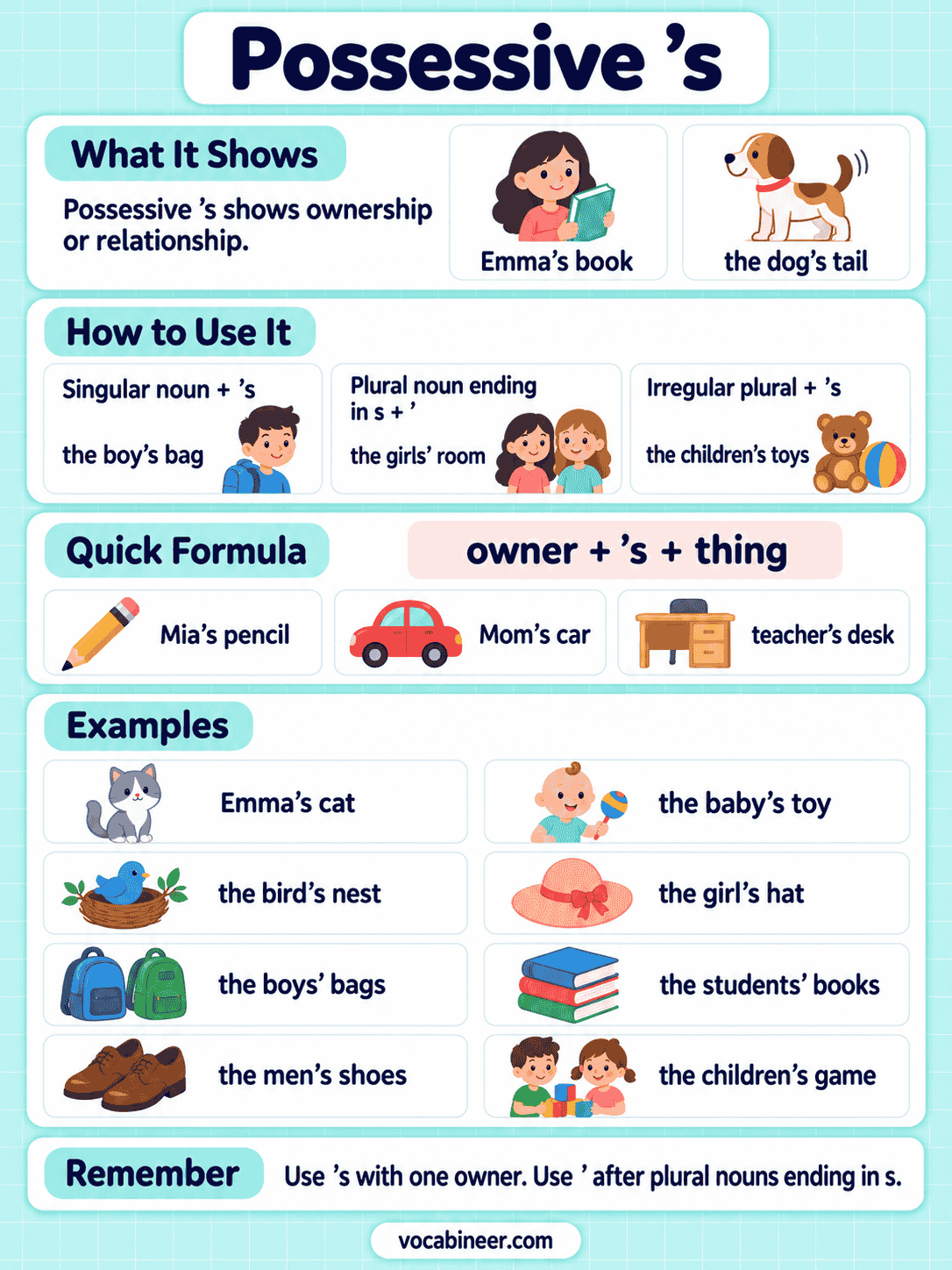
Possessive ’s is used to show ownership, relationship, association, time, or another close connection. It commonly appears after singular nouns, as in the girl’s bag, the teacher’s desk, the dog’s collar, and today’s meeting.
The main challenge is knowing when to use ’s, when to use s’, and when an s is not possessive at all. Possessive forms can look similar to ordinary plurals and contractions such as is and has, so clear apostrophe rules are essential.
In This Page
What Is Possessive ’s?
Possessive ’s is added to a noun or name to show that another person, thing, place, time, or idea is closely connected with it.
Examples:
- Sarah’s bag
- the teacher’s desk
- the dog’s collar
- the company’s policy
- today’s meeting
Possessive ’s can show more than literal ownership.
It can express:
- ownership
- relationships
- body parts
- organizations
- places
- time
- duration
The key idea is:
Possessive ’s shows ownership or another close connection.
Where the Apostrophe Goes
The apostrophe position depends on whether the noun is singular, a regular plural, or an irregular plural.
| Noun Type | Rule | Example |
|---|---|---|
| singular noun | add ’s | girl → girl’s |
| regular plural ending in s | add ’ | students → students’ |
| irregular plural not ending in s | add ’s | children → children’s |
| singular name ending in s | often add ’s; style may vary | James → James’s |
Singular Nouns
Add ’s to most singular nouns.
Examples:
- girl → girl’s
- boy → boy’s
- teacher → teacher’s
- dog → dog’s
- company → company’s
In sentences:
- The girl’s bag is red.
- The teacher’s desk is near the window.
- The dog’s collar is blue.
- The company’s policy changed.
The basic pattern is:
singular noun + ’s
Regular Plural Nouns Ending in S
If a plural noun already ends in s, add only an apostrophe after the final s.
Examples:
- students → students’
- teachers → teachers’
- parents → parents’
- dogs → dogs’
In sentences:
- The students’ books are on the desks.
- The teachers’ room is upstairs.
- My parents’ house is nearby.
- The dogs’ bowls are outside.
The basic pattern is:
regular plural ending in s + apostrophe
Irregular Plural Nouns
If a plural noun does not end in s, add ’s.
Examples:
- children → children’s
- men → men’s
- women → women’s
- people → people’s
In sentences:
- The children’s playground is closed.
- The men’s shoes are downstairs.
- The women’s team won the match.
- The people’s choice was clear.
’s vs s’
The difference between ’s and s’ depends mainly on whether the possessor is singular or plural.
| Form | Use | Example |
|---|---|---|
| ’s | singular possessive | the student’s book |
| s’ | regular plural possessive | the students’ books |
| ’s | irregular plural possessive | the children’s books |
Compare:
- the student’s book → one student
- the students’ books → several students
- the children’s books → irregular plural
The apostrophe position changes the meaning.
Names Ending in S
Singular names ending in s can cause confusion.
Examples include:
- James
- Chris
- Charles
Common possessive forms include:
- James’s bag
- Chris’s car
- Charles’s office
Some style guides also allow forms such as:
- James’ bag
The safest rule is:
Follow the style guide required by your school, publisher, or workplace. Many modern styles prefer ’s after singular names, even when the name ends in s.
What Possessive ’s Can Show
Possessive ’s is used for several kinds of relationships.
Ownership
Examples:
- Sarah’s bag
- John’s car
- the child’s toy
In sentences:
- Sarah’s bag is on the chair.
- John’s car is outside.
- The child’s toy is broken.
Relationships
Examples:
- my brother’s friend
- Maria’s husband
- the child’s teacher
- John’s sister
These forms describe personal or family relationships rather than physical ownership.
Body Parts and Features
Examples:
- the dog’s tail
- the horse’s leg
- Kim’s hair
- the child’s hand
English naturally uses possessive ’s for body parts and personal features.
Organizations and Groups
Examples:
- the company’s policy
- the school’s rules
- the team’s captain
- the government’s decision
These expressions show association or connection.
Countries, Cities, and Places
Examples:
- Britain’s coastline
- the city’s population
- the country’s economy
- the town’s center
Possessive ’s can therefore be used with places as well as people.
Possessive ’s with Time
Possessive forms are common in time expressions.
Examples:
- today’s meeting
- yesterday’s newspaper
- tomorrow’s schedule
- this week’s lesson
- next month’s event
In sentences:
- Today’s meeting starts at ten.
- Tomorrow’s schedule is full.
- This week’s lesson covers nouns.
Possessive ’s with Duration
Possessive forms can also express duration.
Examples:
- one day’s work
- one week’s holiday
- two days’ work
- three weeks’ notice
- ten minutes’ walk
Compare:
- one day’s work
- two days’ work
The apostrophe follows the normal singular and plural possessive rules.
Joint Possession
When two or more people share the same thing, add ’s only to the final name.
Examples:
- Ali and Sara’s house
- Jack and Mia’s project
- Tom and Anna’s restaurant
These mean:
- one house shared by Ali and Sara
- one project shared by Jack and Mia
- one restaurant shared by Tom and Anna
The rule is:
Shared possession → add ’s to the final owner only.
Separate Possession
When each person owns a different thing, make each name possessive.
Examples:
- Ali’s and Sara’s cars
- Jack’s and Mia’s desks
- Tom’s and Anna’s offices
This means each person owns a separate item.
Joint vs Separate Possession
| Joint Possession | Separate Possession |
|---|---|
| Ali and Sara’s house | Ali’s and Sara’s houses |
| one shared house | different houses |
| Jack and Mia’s project | Jack’s and Mia’s projects |
| one shared project | separate projects |
This is a meaning difference, not just a punctuation difference.
Multiple Possessives
More than one possessive can appear in the same phrase.
Examples:
- my friend’s father’s house
- Sarah’s brother’s car
- the teacher’s daughter’s book
For example:
my friend’s father’s house
means:
the house belonging to the father of my friend
These forms are grammatically possible, but very long chains may sound awkward and can often be rewritten.
Stand-Alone Possessives
A possessive form can stand alone when the missing noun is already understood.
Examples:
- Is that John’s coat?
- No, it’s Mary’s.
Here, Mary’s means Mary’s coat.
Another example:
- Whose bag is this?
- It’s Sarah’s.
The possessed noun does not need to be repeated.
Possessive ’s vs Plural S
Plural s and possessive ’s do different jobs.
| Form | Meaning |
|---|---|
| dogs | more than one dog |
| dog’s | belonging to one dog |
| dogs’ | belonging to more than one dog |
Examples:
- The dogs are barking. → plural
- The dog’s collar is blue. → singular possessive
- The dogs’ collars are blue. → plural possessive
The key rule is:
An apostrophe does not normally make a noun plural.
Incorrect when simply meaning more than one:
- apple’s
- book’s
- car’s
Correct:
- apples
- books
- cars
Possessive ’s vs Is
’s can also be a contraction of is.
Examples:
- Sarah’s tired. → Sarah is tired.
- The dog’s sleeping. → The dog is sleeping.
- John’s at home. → John is at home.
Compare:
- Sarah’s bag → possessive
- Sarah’s tired → is
The form looks the same, but the grammatical function is different.
Possessive ’s vs Has
’s can also be a contraction of has.
Examples:
- Sarah’s finished her work. → Sarah has finished her work.
- John’s gone home. → John has gone home.
- The train’s arrived. → The train has arrived.
Compare:
- John’s car → possessive
- John’s gone home → has
How to Tell What ’s Means
The word following ’s often provides a clue.
If a Noun Follows
- Maria’s book
- John’s car
The ’s is likely possessive.
If an Adjective Follows
- Maria’s happy
- John’s tired
The ’s means is.
If an -ing Form Follows
- Maria’s working
- John’s sleeping
The ’s means is.
If a Past Participle Follows
- Maria’s finished
- John’s gone
The ’s usually means has.
Compare:
| Example | Meaning of ’s |
|---|---|
| Sarah’s bag | possessive |
| Sarah’s tired | is |
| Sarah’s working | is |
| Sarah’s finished | has |
This is one of the easiest practical ways to interpret ’s correctly.
Its vs It’s
Its and it’s are often confused.
Its
Its is possessive.
Examples:
- The dog wagged its tail.
- The company changed its policy.
- The tree lost its leaves.
It’s
It’s means it is or it has.
Examples:
- It’s raining. → it is
- It’s very cold. → it is
- It’s been a long day. → it has
The important rule is:
Possessive its has no apostrophe.
Possessive Pronouns Do Not Use Apostrophes
Possessive pronouns do not take apostrophes.
Correct:
- mine
- yours
- his
- hers
- ours
- theirs
Incorrect:
- your’s
- her’s
- our’s
- their’s
Compare:
- This book is Sarah’s.
- This book is hers.
The first uses a possessive noun form. The second uses a possessive pronoun.
Possessive ’s vs Of
English can express possession or connection with either ’s or an of phrase.
Compare:
- Sarah’s bag
- the roof of the house
Possessive ’s is especially common with:
- people
- animals
- groups
- organizations
- places
- time expressions
Examples:
- Maria’s bag
- the dog’s collar
- the company’s policy
- Britain’s coastline
- today’s meeting
An of phrase is often natural with objects or longer noun phrases:
- the roof of the house
- the end of the road
- the door of the building
These are tendencies rather than absolute rules.
Can Possessive ’s Be Used with Things?
Yes. Possessive ’s is not limited to people and animals.
Natural examples include:
- the book’s cover
- the car’s engine
- the company’s policy
- the city’s population
- the country’s economy
- today’s weather
Older rules that completely ban ’s with things are too restrictive for modern English.
Possessive ’s in Sentences
These examples show the main patterns:
- The girl’s bag is red.
- The students’ books are on the table.
- The children’s playground is closed.
- James’s car is outside.
- The dog’s tail is wet.
- The company’s policy changed.
- Today’s meeting starts at ten.
- We completed two days’ work.
- Ali and Sara’s house is nearby.
- Ali’s and Sara’s cars are outside.
- My friend’s father’s house is large.
- Is that John’s coat? No, it’s Mary’s.
- The city’s population is growing.
- The book’s cover is damaged.
- The team’s captain spoke first.
Common Apostrophe Errors
Using ’s for Ordinary Plurals
Incorrect: apple’s, book’s, car’s
Correct: apples, books, cars
Confusing Singular and Plural Possession
Student’s = one student
Students’ = several students
Putting an Apostrophe in Possessive Its
Incorrect: it’s tail
Correct: its tail
Adding Apostrophes to Possessive Pronouns
Incorrect: your’s, their’s
Correct: yours, theirs
Using the Wrong Form with Irregular Plurals
Incorrect: childrens’ books
Correct: children’s books
Confusing Joint and Separate Possession
Ali and Sara’s house → shared
Ali’s and Sara’s houses → separate
Assuming ’s Always Shows Possession
It can also mean is or has.
Ignoring Style Differences with Names Ending in S
Forms such as James’s and James’ may both appear depending on style.
FAQs
Possessive ’s is used after a noun or name to show ownership, relationship, association, time, or another close connection, as in Sarah’s bag or today’s meeting.
Use ’s with singular nouns and irregular plurals, such as student’s and children’s. Use s’ with regular plurals already ending in s, such as students’.
If the plural ends in s, add only an apostrophe: teachers → teachers’. If it does not end in s, add ’s: children → children’s.
Many modern styles use ’s, as in James’s car, although some styles allow James’ car. Follow the style guide required for your writing.
Look at what follows. A noun often signals possession, as in Sarah’s book. An adjective or -ing form usually signals is, while a past participle often signals has.
Read More
- Parts of Speech in English
- Nouns in English with Examples
- Common and Proper Nouns
- Countable and uncountable nouns
- Collective nouns
- Abstract and concrete nouns
- Gender nouns
- Compound nouns
- Possessive nouns
- Singular and plural nouns
- Plural noun rules