

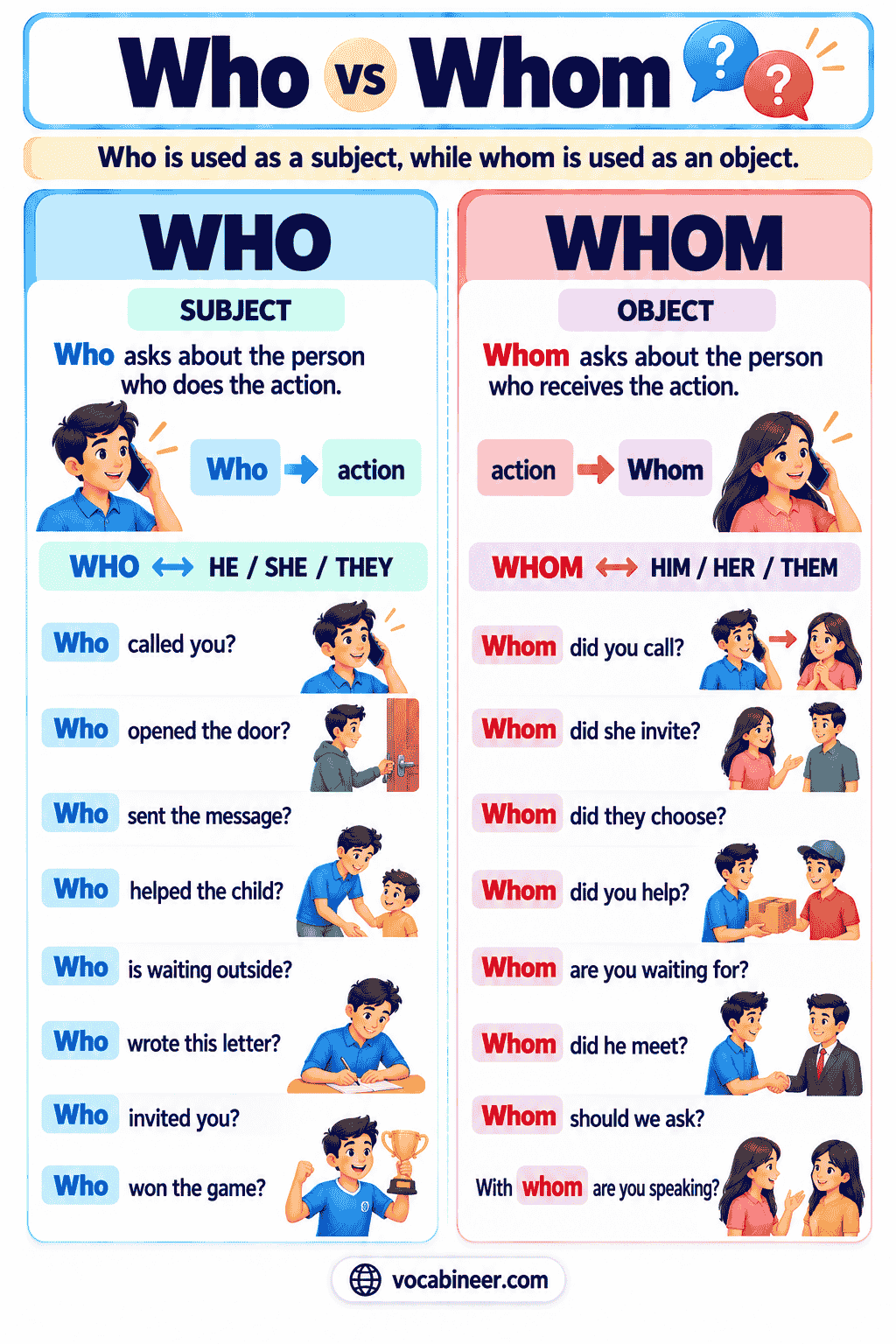
Who and whom both refer to people, but they perform different grammatical jobs. Who usually acts as a subject, while whom acts as an object.
In modern English, however, who often replaces whom in everyday speech and informal writing. Understanding the subject-object difference, formal usage, and common sentence patterns makes it much easier to choose the correct form.
In This Page
Who vs Whom: What Is the Difference?
The basic difference is grammatical function.
| Point | Who | Whom |
|---|---|---|
| Main function | subject | object |
| Refers to | people | people |
| Performs the action | usually yes | no |
| Receives the action | not usually | yes |
| Everyday use | very common | less common |
| Formal use | common | more common than in speech |
| Example | Who called? | Whom did you call? |
A simple rule is:
Use who for the person performing the action and whom for the person receiving the action.
When to Use Who
Use who when the person is the subject of the verb.
Who called you?
Who opened the door?
Who wants to leave?
Who knows the answer?
In each example, who performs the action.
Who called you?
The unknown person performed the action of calling.
Who opened the window?
The unknown person performed the action of opening.
Modern English also frequently uses who as an object in everyday conversation.
Who did you invite?
Who did she meet?
Who are you waiting for?
These sentences are natural and common even though traditional formal grammar may use whom.
When to Use Whom
Use whom when the person functions as the object of a verb or preposition, especially in formal English.
Whom did you invite?
Whom did the manager choose?
Whom should we contact?
In:
Whom did you invite?
you is the subject performing the action, while whom represents the person receiving the invitation.
Whom is especially common after a preposition in formal structures.
To whom did you speak?
With whom did you travel?
For whom is this gift?
In everyday conversation, these sentences are more likely to appear as:
Who did you speak to?
Who did you travel with?
Who is this gift for?
Who and Whom as Subject and Object
The subject-object distinction is the most important rule for choosing between who and whom.
| Function | Example | Explanation |
|---|---|---|
| subject | Who called Maya? | who performs the action |
| object | Whom did Maya call? | Maya performs the action; whom receives it |
| subject | Who knows the answer? | who is the subject |
| object | Whom does he know? | he is the subject; whom is the object |
| subject | Who invited them? | who performs the action |
| object | Whom did they invite? | they perform the action |
Compare:
Who called Sam?
The unknown person performed the action.
Whom did Sam call?
Sam performed the action, while whom represents the person he called.
The He/Him Test for Who and Whom
A useful shortcut is to replace the unknown person with another pronoun.
| If the Answer Uses | Choose |
|---|---|
| he | who |
| she | who |
| they | who |
| him | whom |
| her | whom |
| them | whom |
For example:
Who called?
Answer:
He called.
Because he fits, use who.
Now consider:
Whom did you call?
Answer:
I called him.
Because him fits, whom is formally correct.
Another example:
Who is coming with us?
She is coming with us.
Therefore, use who.
Whom did they choose?
They chose her.
Therefore, whom fits.
The he/him test is a useful shortcut, but the real rule is still based on whether the pronoun functions as a subject or object.
Who vs Whom in Everyday and Formal English
Modern English does not use whom equally in every situation.
| Context | More Natural Form | Example |
|---|---|---|
| everyday conversation | who | Who did you invite? |
| informal writing | who | Who did you speak to? |
| formal writing | whom | Whom did you invite? |
| formal question with preposition | whom | To whom did you speak? |
| everyday question with preposition | who | Who did you speak to? |
Using who as an object is extremely common.
For example:
Who did you meet?
is natural everyday English.
The more formal version is:
Whom did you meet?
Both can be grammatically acceptable depending on style and context.
Who vs Whom After Prepositions
Prepositions strongly affect the choice between who and whom.
Everyday English commonly places the preposition at the end and uses who.
Formal English may place the preposition before whom.
| Everyday English | Formal English |
|---|---|
| Who did you speak to? | To whom did you speak? |
| Who are you going with? | With whom are you going? |
| Who did you vote for? | For whom did you vote? |
| Who did you hear from? | From whom did you hear? |
| Who are you working with? | With whom are you working? |
The formal versions are grammatically correct, but they may sound less natural in ordinary conversation.
Who vs Whom in Questions
Both forms can appear in direct questions.
| Use | Example |
|---|---|
| who as subject | Who called you? |
| who as everyday object | Who did you call? |
| whom as formal object | Whom did you call? |
| who after final preposition | Who did you speak to? |
| whom after fronted preposition | To whom did you speak? |
Subject questions usually do not use do, does, or did.
Correct:
Who called you?
Not normally:
Who did call you?
The second form is possible when did adds special emphasis, but it is not the normal neutral question.
Object questions often use an auxiliary.
Who did you call?
Whom did you call?
Who vs Whom in Relative Clauses
Who and whom also appear in relative clauses.
| Function | Example |
|---|---|
| who as subject | The woman who called is my teacher. |
| who as everyday object | The woman who I met was friendly. |
| whom as formal object | The woman whom I met was friendly. |
| whom after preposition | The person with whom I worked was helpful. |
In:
The student who won the competition is here.
who is the subject of won.
In:
The student whom I met was helpful.
I is the subject of met, while whom is the object.
In everyday English, this sentence is often written or spoken as:
The student who I met was helpful.
Can Who or Whom Be Omitted?
When who or whom functions as the object in certain defining relative clauses, it can often be omitted.
Compare:
| Form | Example |
|---|---|
| formal object form | The woman whom I met was friendly. |
| common object form | The woman who I met was friendly. |
| pronoun omitted | The woman I met was friendly. |
All three can express the same basic meaning.
However, the pronoun cannot normally be omitted when it functions as the subject.
Correct:
The woman who called me is here.
Incorrect:
The woman called me is here.
Here, who is needed because it performs the action of calling.
Who and Whom in Indirect Questions
Who and whom can also appear inside indirect questions.
Examples:
Do you know who called?
Can you tell me who I should contact?
Formal:
Can you tell me whom I should contact?
Compare:
| Function | Example |
|---|---|
| subject | Do you know who called? |
| everyday object | Do you know who they invited? |
| formal object | Do you know whom they invited? |
The same subject-object rule still applies.
Is Whom Still Used?
Yes. Whom is still used, but its role in modern English is more limited than the role of who.
| Context | Use of Whom |
|---|---|
| casual conversation | uncommon |
| informal writing | uncommon |
| formal writing | still used |
| formal relative clauses | still used |
| after fronted prepositions | common in formal style |
| fixed formal expressions | still common |
Whom remains especially natural in sentences such as:
To whom should I address the letter?
With whom did you speak?
It also appears in fixed formal expressions such as:
To whom it may concern
However, in ordinary speech, speakers often choose who instead.
Who vs Whom in Complex Sentences
Who and whom can become more difficult when several verbs appear in the same sentence.
The correct choice depends on the role the pronoun plays inside its own clause.
Compare:
| Sentence | Correct Form | Reason |
|---|---|---|
| Who do you think will win? | who | who is the subject of will win |
| Whom do you think they will choose? | whom | whom is the object of choose |
| Who do you believe called? | who | who performs called |
| Whom do you believe she invited? | whom | whom receives the action of invited |
A useful strategy is to focus on the clause directly connected to who or whom.
For example:
Who do you think will win?
Ignore:
do you think
and examine:
Who will win?
Because who performs the action, who is correct.
Now consider:
Whom do you think they will choose?
Focus on:
They will choose whom.
Because the pronoun receives the action, whom is formally correct.
Who vs Whom Examples
| Use | Example |
|---|---|
| subject question | Who called? |
| subject question | Who opened the door? |
| everyday object | Who did you invite? |
| formal object | Whom did you invite? |
| after final preposition | Who did you speak to? |
| after fronted preposition | To whom did you speak? |
| relative subject | The student who won is here. |
| relative object | The student whom I met was helpful. |
| everyday relative object | The student who I met was helpful. |
| indirect subject question | Do you know who called? |
| indirect object question | Do you know whom they selected? |
| complex subject | Who do you think will win? |
More examples:
Who wants some tea?
Who sent this message?
Whom should we ask?
Who are you waiting for?
To whom should I send the form?
The teacher who helped us was kind.
The person whom we contacted replied quickly.
Common Mistakes With Who and Whom
| Incorrect or Misunderstood Form | Better Form | Reason |
|---|---|---|
| Whom called you? | Who called you? | the pronoun is the subject |
| Whom wants to go? | Who wants to go? | the pronoun performs the action |
| The man whom called me… | The man who called me… | the pronoun is the subject |
| To who did you speak? | To whom did you speak? | formal fronted preposition favors whom |
| Who did you invite? | Who did you invite? | this is natural modern English |
| Whom do you think will win? | Who do you think will win? | the pronoun is the subject of will win |
Another common mistake is assuming that every object must use whom.
Formal:
Whom did you meet?
Everyday English:
Who did you meet?
The everyday form is widely used and natural.
FAQs
Who normally functions as a subject, while whom functions as an object.
Use who when the person performs the action. It is also commonly used instead of whom as an object in everyday English.
Use whom when the person is the object, especially in formal writing or after a preposition placed before the pronoun.
No. Who did you invite? is normal and widely accepted in everyday modern English. Whom did you invite? is more formal.
Yes. Whom is still used, especially in formal writing, formal relative clauses, after fronted prepositions, and in expressions such as To whom it may concern.
Read More
- Parts of Speech in English
- Nouns in English with Examples
- Common and Proper Nouns
- Countable and uncountable nouns
- Collective nouns
- Abstract and concrete nouns
- Gender nouns
- Compound nouns
- Possessive nouns
- Singular and plural nouns
- Plural noun rules