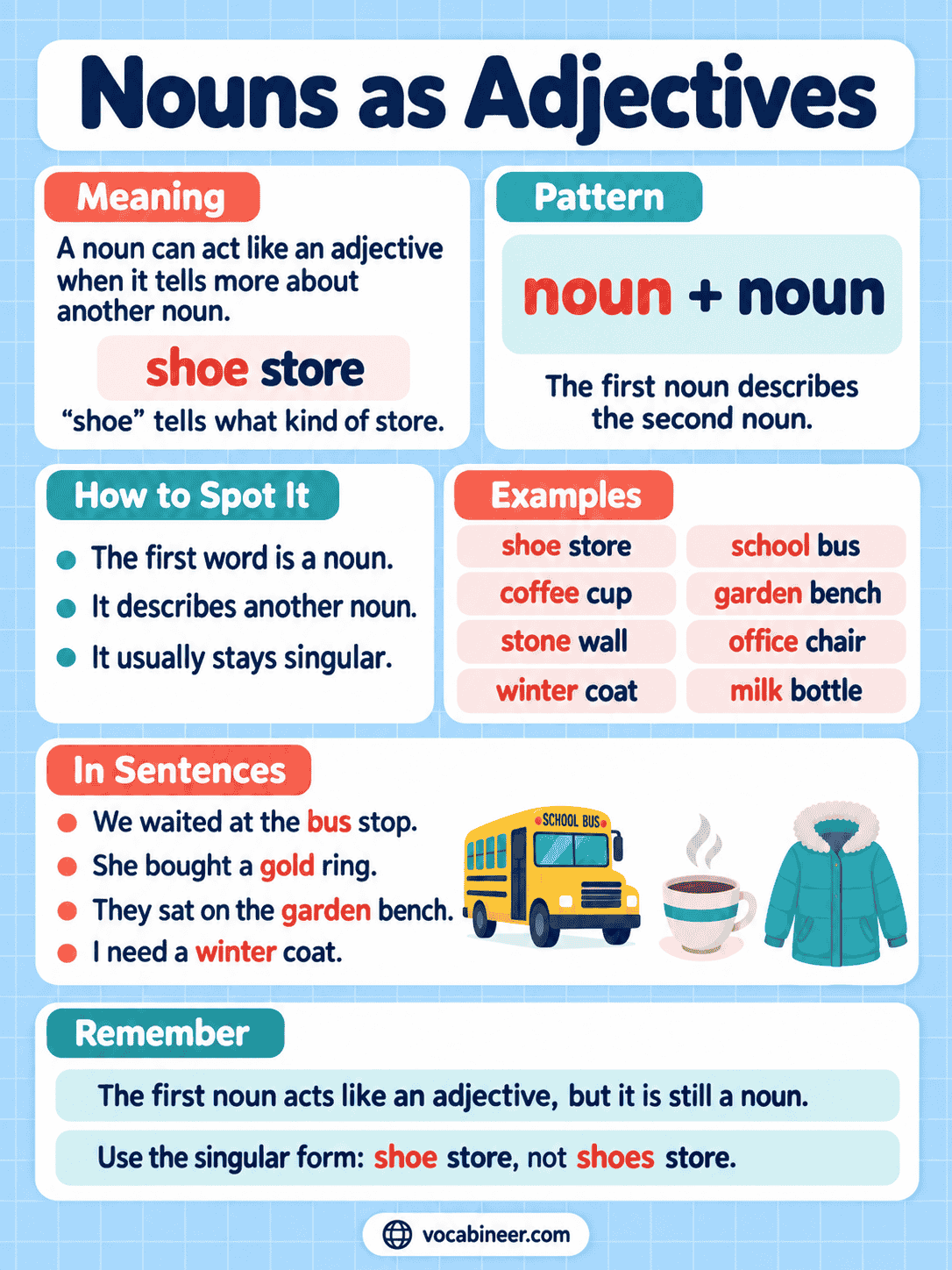
Nouns as adjectives are nouns that appear before other nouns to describe, classify, or identify them more precisely. In phrases such as school bus, office chair, coffee cup, stone bridge, and winter coat, the first noun modifies the second noun.
In more precise grammar, these words are usually called noun modifiers or attributive nouns rather than true adjectives. Learning how noun modifiers work helps students understand noun + noun combinations, plural forms, word order, measurements, and the difference between noun modifiers, adjectives, possessives, and compound nouns.
In This Page
What Are Nouns Used as Adjectives?
A noun can come before another noun and give more information about it.
Examples:
- school bus
- office chair
- coffee cup
- car door
- stone bridge
- winter coat
In each phrase, the first noun modifies the second.
For example:
- school tells us what kind of bus
- office tells us what kind of chair
- coffee tells us what kind of cup
- stone tells us what kind of bridge
The simple rule is:
A noun can modify another noun by appearing before it.
Although learners often say the first noun is “used as an adjective,” it is more accurately called a noun modifier.
Noun Modifier and Head Noun
In a noun + noun phrase, the final noun is usually the head noun.
The head noun tells us what the whole phrase actually refers to.
Examples:
| Noun Modifier | Head Noun | Complete Phrase |
|---|---|---|
| school | bus | school bus |
| office | chair | office chair |
| coffee | cup | coffee cup |
| car | door | car door |
| stone | bridge | stone bridge |
| winter | coat | winter coat |
For example:
school bus
is a type of bus, not a type of school.
Likewise:
coffee cup
is a type of cup.
The head noun carries the main meaning of the phrase, while the noun modifier narrows or classifies that meaning.
What Noun Modifiers Can Express
Noun modifiers can show several kinds of relationships between nouns.
Purpose
The first noun can show what something is used for.
Examples:
- coffee cup
- soup bowl
- shopping bag
- tennis shoes
- computer table
In coffee cup, the noun coffee tells us the purpose of the cup.
Place or Location
The first noun can show where something belongs, is used, or is commonly found.
Examples:
- office chair
- garden wall
- kitchen table
- school library
- bedroom window
In office chair, the word office identifies the setting connected with the chair.
Material
A noun modifier can name the material from which something is made.
Examples:
- stone bridge
- gold watch
- leather bag
- metal box
- glass door
In leather bag, the noun leather tells us the material.
Part–Whole Relationship
One noun can identify the larger thing to which another part belongs.
Examples:
- car door
- chair leg
- coat pocket
- kitchen window
- table top
In car door, the door is part of a car.
Time and Season
A noun modifier can identify the time or season connected with the head noun.
Examples:
- winter coat
- summer holiday
- morning meeting
- evening class
- weekend trip
In winter coat, winter identifies when the coat is normally used.
Subject, Type, or Category
The first noun can identify a subject or category.
Examples:
- science teacher
- history book
- computer game
- football match
- language course
In history book, history identifies the subject of the book.
Why Noun Modifiers Are Usually Singular
A noun used as a modifier is usually singular, even when the meaning involves many items.
Examples:
- shoe shop
- car factory
- book store
- computer room
- ticket office
Normally, English does not use:
- shoes shop
- cars factory
- books store
The basic rule is:
The modifying noun is usually singular.
For example:
- a shop that sells shoes → shoe shop
- a factory that makes cars → car factory
The first noun describes the type or purpose rather than showing grammatical number.
Plural Nouns Used as Modifiers
The singular-modifier rule is common, but it is not absolute.
Some established expressions use plural nouns as modifiers.
Examples:
- sports car
- sales manager
- clothes shop
- arms race
- savings account
These forms are conventional and should usually be learned as complete expressions.
So the accurate rule is:
Noun modifiers are usually singular, but some established expressions use plural modifiers.
Singular and Plural Head Nouns
When the whole phrase becomes plural, the head noun usually takes the plural ending.
Examples:
| Singular | Plural |
|---|---|
| school bus | school buses |
| coffee cup | coffee cups |
| office chair | office chairs |
| stone bridge | stone bridges |
| car door | car doors |
The modifier normally stays unchanged.
Correct:
- school buses
- coffee cups
- office chairs
Incorrect:
- schools buses
- coffees cups
- offices chairs
The rule is:
Pluralize the head noun, not the modifier.
Measurements as Noun Modifiers
Measurement expressions commonly work as modifiers before nouns.
Examples:
- a ten-minute break
- a two-hour meeting
- a five-mile walk
- a twenty-dollar bill
- a fifty-kilometre journey
Notice that the measurement unit stays singular before the head noun.
Compare:
- The meeting lasted two hours.
- It was a two-hour meeting.
- The walk was five miles.
- We went on a five-mile walk.
Incorrect:
- a two-hours meeting
Correct:
- a two-hour meeting
This is one of the most important practical rules for noun modifiers.
Nouns Ending in -ing as Modifiers
Some -ing forms also appear before nouns.
Examples:
- shopping bag
- swimming pool
- washing machine
- walking stick
- dining room
These forms modify the following noun.
For example:
- a shopping bag is a bag used for shopping
- a swimming pool is a pool used for swimming
- a washing machine is a machine used for washing
The grammatical analysis of some -ing forms can vary, so it is better to focus on their modifying function rather than assume every -ing modifier belongs to exactly the same category.
Multiple Noun Modifiers
English can place more than one noun before the head noun.
Examples:
- school bus driver
- home office chair
- computer science teacher
- city bus station
- office building entrance
The final noun is usually the head noun.
For example:
school bus driver
is mainly a driver.
home office chair
is mainly a chair.
office building entrance
is mainly an entrance.
The other nouns narrow the meaning step by step.
How to Read Multiple Noun Modifiers
Long noun phrases become easier when read from the head noun backward.
School Bus Driver
- driver = head noun
- bus = type of driver
- school = type of bus
The phrase means a driver who drives a school bus.
Computer Science Teacher
- teacher = head noun
- science = subject
- computer = type of science
The phrase refers to a teacher of computer science.
Office Building Entrance
- entrance = head noun
- building = what the entrance belongs to
- office = what kind of building
This method helps learners understand longer noun strings more accurately.
Word Order with Adjectives and Noun Modifiers
When both an adjective and a noun modifier appear before the head noun, the adjective normally comes first.
The usual order is:
determiner + adjective + noun modifier + head noun
Examples:
- a new school bus
- an expensive leather bag
- a large office building
- a red sports car
- a modern computer system
Compare:
Correct:
- a new school bus
Incorrect:
- a school new bus
Correct:
- an expensive leather bag
Incorrect:
- a leather expensive bag
This word order keeps the noun phrase natural.
Articles with Noun Modifiers
Articles and determiners come before the whole noun phrase.
Examples:
- a school bus
- an office chair
- the coffee shop
- those car doors
- these stone bridges
The pattern is:
article/determiner + noun modifier + head noun
For example:
a + school + bus
The article does not go between the modifier and the head noun.
Noun Modifier vs True Adjective
A noun modifier and a true adjective both come before nouns, but they do different jobs.
| Noun Modifier | True Adjective |
|---|---|
| school bus | yellow bus |
| stone wall | high wall |
| coffee cup | hot cup |
| office chair | comfortable chair |
A true adjective describes a quality or characteristic.
Examples:
- yellow
- high
- hot
- comfortable
A noun modifier usually identifies a type, purpose, material, place, time, or relationship.
Compare:
- school bus → tells us the type of bus
- yellow bus → describes the bus’s color
- stone wall → identifies the material
- high wall → describes the wall’s height
Why Noun Modifiers Are Not Ordinary Adjectives
True adjectives often appear after linking verbs.
Examples:
- The wall is high.
- The chair is comfortable.
- The bag is expensive.
Noun modifiers usually do not work in the same way.
Examples:
- a school bus
- a coffee cup
- an office chair
We do not normally say:
- The bus is school.
- The cup is coffee.
- The chair is office.
with the same modifying meaning.
Adjectives can also take degree words:
- very large
- extremely expensive
- quite comfortable
Noun modifiers normally cannot:
- very school
- extremely coffee
- quite office
This shows that noun modifiers are not ordinary adjectives even though they appear in a similar position.
Noun Modifier vs Possessive Noun
A noun modifier usually classifies or identifies the head noun, while a possessive noun usually shows ownership or another close relationship.
| Noun Modifier | Possessive Noun |
|---|---|
| car door | John’s car |
| school bus | teacher’s bag |
| office chair | manager’s office |
| kitchen table | Maria’s table |
Compare:
- car door → the door is part of a car
- John’s car → the car belongs to or is associated with John
The two structures express different grammatical relationships.
Noun Modifier vs Possessive ’s
Some nouns can appear in either a noun-modifier or possessive structure, but the meaning or emphasis may differ.
Examples:
- company policy
- company’s policy
- city center
- city’s population
A noun modifier often classifies or identifies the following noun:
- company policy → a type/category of policy
Possessive ’s more clearly emphasizes association:
- the company’s policy → the policy of that company
Both structures can sometimes be correct, depending on meaning and style.
Noun Modifier vs Of-Phrase
Some noun modifier relationships can also be expressed with an of phrase.
Examples:
- car door → door of the car
- chair leg → leg of the chair
- roof structure → structure of the roof
However, established noun + noun combinations are often shorter and more natural.
For example:
- car door
is usually more natural than:
- door of the car
when speaking generally about that part.
Noun Modifier vs Compound Noun
Noun modifiers and compound nouns overlap closely.
Examples:
- coffee shop
- school bus
- car park
- football
- bedroom
A noun modifier describes how one noun modifies another within a noun phrase.
A compound noun is an established noun formed from two or more words.
For example:
coffee shop
can be understood structurally as coffee + shop, where coffee modifies shop, while the whole expression is also an established compound noun.
Therefore:
Noun modification describes structure; compound noun describes the established lexical unit.
The boundary is not always sharp.
Noun Modifier vs Material Adjective
Some material words can behave like noun modifiers.
Examples:
- stone wall
- leather bag
- metal box
English also has adjective forms for some materials:
- wooden table
- woolen sweater
- metallic surface
Compare:
- wood table
- wooden table
Depending on the word and context, English may prefer either a noun modifier or a derived adjective.
This is a useful distinction, but it should remain secondary to the main topic.
Nouns as Adjectives in Sentences
These examples show noun modifiers in natural use:
- We waited for the school bus.
- She bought a new coffee cup.
- The car door is open.
- He works in an office building.
- They crossed a stone bridge.
- I need a shopping bag.
- We took a ten-minute break.
- She teaches computer science.
- He bought an expensive leather bag.
- The winter months are cold.
- The garden wall needs repair.
- We attended an evening class.
- I bought two train tickets.
- The kitchen table is made of wood.
- Their football team won the match.
Common Nouns Used as Modifiers
Many everyday noun phrases use noun modifiers.
Examples include:
- school bus
- office chair
- coffee shop
- coffee cup
- car door
- garden wall
- kitchen table
- football match
- science teacher
- history book
- computer game
- winter coat
- summer holiday
- stone bridge
- leather bag
- metal box
- shopping list
- swimming lesson
- bus station
- train ticket
- bedroom window
- company policy
- city center
- tennis shoes
These examples show purpose, material, place, time, subject, and other noun relationships.
Common Errors with Nouns Used as Adjectives
Saying the Noun Literally Becomes an Adjective
Better: the noun functions as a modifier and is usually called a noun modifier or attributive noun.
Making Every Modifier Plural
Incorrect: shoes shop
Correct: shoe shop
Treating the Singular Rule as Absolute
Expressions such as sports car and sales manager use established plural modifiers.
Pluralizing the Wrong Part
Incorrect: schools buses
Correct: school buses
Using the Wrong Word Order
Incorrect: a school new bus
Correct: a new school bus
Using Plural Measurement Units Before Nouns
Incorrect: a two-hours meeting
Correct: a two-hour meeting
Confusing Noun Modifiers with Possessives
A car door identifies a part of a car, while John’s car shows possession or association.
Ignoring the Head Noun
In school bus driver, the main noun is driver.
Assuming Every Noun + Noun Expression Is Only a Modifier Phrase
Some combinations are established compound nouns.
FAQs
Can a noun be used as an adjective?
Yes. A noun can appear before another noun and perform a modifying function, as in school bus or coffee cup. More precisely, it is usually called a noun modifier or attributive noun.
What is a noun modifier?
A noun modifier is a noun that comes before another noun and gives information about its type, purpose, material, place, time, or relationship.
Why are noun modifiers usually singular?
The first noun normally identifies a category rather than showing number, so English usually uses forms such as shoe shop, car factory, and book store.
Can a noun modifier ever be plural?
Yes. Some established expressions use plural modifiers, such as sports car, sales manager, clothes shop, and savings account.
What is the difference between a noun modifier and an adjective?
A noun modifier is noun-based and usually classifies the head noun, while an adjective describes a quality or characteristic. Compare school bus with yellow bus.
What is the difference between a noun modifier and a possessive noun?
A noun modifier usually identifies type, purpose, or another relationship, while a possessive noun typically shows ownership or close association. Compare car door with John’s car.
What is the difference between a noun modifier and a compound noun?
Noun modification describes the grammatical structure, while a compound noun is an established lexical unit. Some expressions, such as coffee shop, can be described from both perspectives.
Read More
- Parts of Speech in English
- Nouns in English with Examples
- Common and Proper Nouns
- Countable and uncountable nouns
- Collective nouns
- Abstract and concrete nouns
- Gender nouns
- Compound nouns
- Possessive nouns
- Singular and plural nouns
- Plural noun rules