

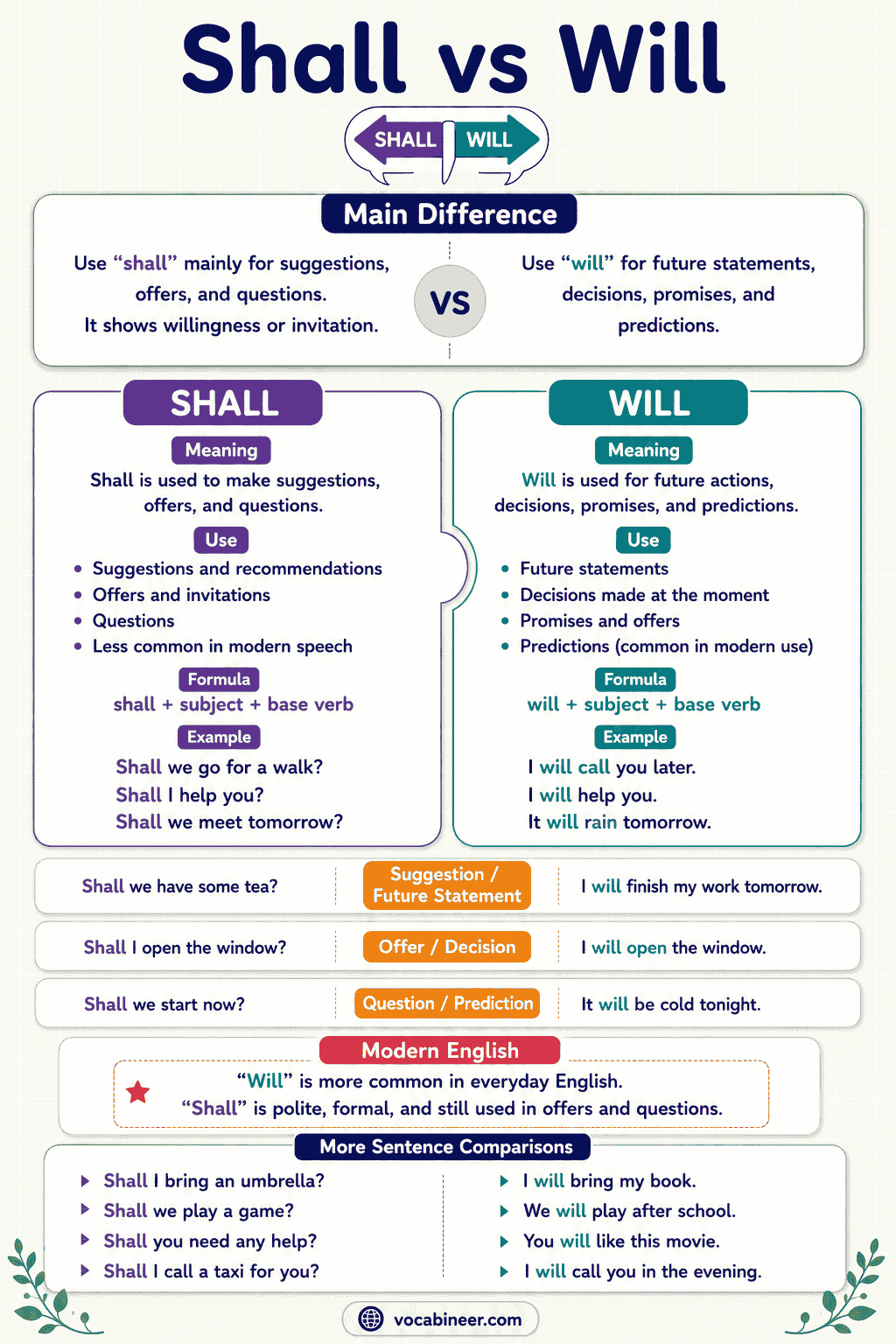
Shall and will both express future meaning, but they do not have equal roles in modern English. Will is the normal future modal with all subjects, while shall is less common, more formal in ordinary future statements, and especially useful in expressions such as Shall I…? and Shall we…?
Understanding the difference helps learners choose the natural form for future statements, offers, suggestions, requests, predictions, formal rules, and legal language. The key is to follow modern usage rather than the older rule that required shall with I and we.
In This Page
Shall vs Will: What Is the Difference?
The main difference concerns frequency, formality, subject choice, and function.
| Will | Shall |
|---|---|
| normal modern future modal | less common and generally more formal |
| works naturally with all subjects | ordinary future use mainly with I and we |
| common in everyday speech and writing | especially useful in Shall I…? and Shall we…? |
| expresses future facts, predictions, decisions, willingness, offers, and promises | expresses formal future meaning, offers, suggestions, advice questions, and formal requirements |
| will + V1 | shall + V1 |
| We will return tomorrow. | We shall return tomorrow. |
A useful modern principle is:
Will is the normal choice for future meaning with all subjects, while shall is more formal with I and we and remains especially useful in certain questions and formal contexts.
Shall vs Will at a Glance
| Meaning | Will | Shall |
|---|---|---|
| ordinary future statement | I will call tomorrow. | I shall call tomorrow. |
| neutral future with we | We will return soon. | We shall return soon. |
| suggestion | — | Shall we leave now? |
| offer by the speaker | I will help you. | Shall I help you? |
| asking for advice | — | What shall I do? |
| ordinary request | Will you help me? | — |
| formal future statement | possible | especially natural with I/we |
| formal rule or obligation | less typical in this role | The tenant shall pay the fee. |
| everyday conversation | very common | much less common |
The table gives the main modern usage pattern. However, some specialized uses of shall do not express ordinary future time.
How Shall and Will Are Formed
Both are modal verbs, so the main verb remains in the base form.
| Feature | Will | Shall |
|---|---|---|
| affirmative | will + V1 | shall + V1 |
| negative | will not + V1 | shall not + V1 |
| question | Will + subject + V1? | Shall + subject + V1? |
| contraction | ’ll / won’t | ’ll / shan’t |
Examples:
| Will | Shall |
|---|---|
| I will return. | I shall return. |
| We will not forget. | We shall not forget. |
| Will you come? | Shall we begin? |
Correct:
- We shall go.
- She will go.
Incorrect:
- We shall goes.
- She will went.
Will with All Subjects vs Shall Mainly with I and We
Will works normally with every subject in modern English.
| Will | Shall |
|---|---|
| works with all subjects | ordinary future use mainly with I and we |
| I will go. | I shall go. |
| We will return. | We shall return. |
| She will arrive soon. | not normally: She shall arrive soon. |
| They will call later. | not normally: They shall call later. |
For ordinary future meaning, will is the more natural and widely used choice with all subjects.
Formal and legal uses of shall are different. In those contexts, shall can occur with subjects other than I and we because it expresses a rule, duty, or requirement rather than ordinary future meaning.
Everyday Will vs Formal Shall
When both forms are possible with I or we, the difference is often stylistic.
| Will | Shall |
|---|---|
| neutral and common | more formal, traditional, or deliberate |
| I will contact you tomorrow. | I shall contact you tomorrow. |
| We will discuss this later. | We shall discuss this later. |
| common in everyday speech | more likely in formal speech or writing |
Compare:
- We will return tomorrow.
- We shall return tomorrow.
Both are grammatical. The second sounds more formal or traditional.
Shall I…? for Offers
One of the most important modern uses of shall appears in offers.
| Will | Shall |
|---|---|
| I will carry your bag. | Shall I carry your bag? |
| states willingness or intention | asks whether the offer is wanted |
Examples:
- Shall I open the window?
- Shall I call a taxi?
- Shall I carry that for you?
- Shall I help you?
Shall I…? commonly offers to do something and asks whether the listener wants the speaker to act.
Shall We…? for Suggestions
Shall we…? commonly proposes an action or asks for agreement.
Examples:
- Shall we go now?
- Shall we start the meeting?
- Shall we order some food?
- Shall we take a break?
Compare:
| Shall We…? | Will We…? |
|---|---|
| makes a suggestion or seeks agreement | asks about an expected future event |
| Shall we leave now? | Will we leave before six? |
| proposes an action | asks whether the action is expected to happen |
The two questions therefore serve different purposes.
Shall for Asking Advice
Shall can also ask what action is best, appropriate, or preferred.
Examples:
- What shall I do?
- Where shall we wait?
- Who shall I ask?
- How shall we proceed?
These questions ask for guidance rather than simply asking what will happen.
For example:
- What shall I do?
- You should call the doctor.
The first asks for advice, while the second gives it.
Will You…? vs Shall I…?
These forms perform different functions.
| Will You…? | Shall I…? |
|---|---|
| asks another person to act | offers for the speaker to act |
| Will you open the window? | Shall I open the window? |
| request | offer |
| Will you carry this? | Shall I carry this? |
Compare:
- Will you help me?
- Shall I help you?
The first asks the listener for help. The second offers help from the speaker.
Will We…? vs Shall We…?
These questions also differ in meaning.
| Will We…? | Shall We…? |
|---|---|
| asks what is expected to happen | proposes what the group should do |
| Will we finish by six? | Shall we finish this tomorrow? |
| future expectation | suggestion |
Compare:
- Will we meet again next week?
This asks whether another meeting is expected. - Shall we meet again next week?
This proposes another meeting.
Future Statements with Will vs Formal Shall
Will is the normal modern choice for predictions and future facts.
| Will | Shall |
|---|---|
| standard future prediction or fact | possible with I/we in more formal style |
| It will rain tomorrow. | We shall need more space. |
| She will arrive at six. | I shall be there at six. |
| They will probably win. | We shall probably return by noon. |
Use will freely for ordinary future statements with any subject.
Use shall mainly when a formal first-person style is intended.
Everyday Intentions with Will vs Formal Shall
Both forms can express decisions or intentions with I and we, but their style differs.
| Will | Shall |
|---|---|
| neutral decision or intention | formal or deliberate decision or intention |
| I will contact her later. | I shall contact her later. |
| We will investigate the problem. | We shall investigate the problem. |
In everyday English, will is normally more natural.
Formal and Legal Uses of Shall
Shall also has a specialized role in formal rules, requirements, contracts, and legal language.
Examples:
- No visitor shall enter without permission.
- The tenant shall pay the fee by Friday.
- This door shall remain closed.
- Each applicant shall provide identification.
In these examples, shall does not simply mark future time. It expresses an obligation, rule, or requirement.
The distinction is clearer in a comparison:
| Ordinary Future Shall | Formal or Legal Shall |
|---|---|
| mainly with I/we | can occur with any subject |
| expresses formal future meaning or intention | expresses duty, requirement, or rule |
| We shall return tomorrow. | The tenant shall pay the fee. |
| I shall contact you. | Each member shall comply with the rules. |
Formal or legal shall therefore differs from ordinary first-person future shall.
British English vs American English
Regional usage affects how common shall sounds.
| British English | American English |
|---|---|
| shall with I/we remains possible, especially formally | will strongly dominates ordinary future statements |
| Shall we…? remains familiar and useful | understood, but generally less central |
| formal/legal shall remains established | formal/legal shall also remains established |
Shall is more characteristic of British English, while American English normally prefers will for ordinary future statements.
However, American English still recognizes shall, especially in formal, legal, and fixed question patterns.
Is the Old Shall/Will Rule Still Necessary?
Traditional grammar often taught this pattern:
| Subject | Traditional Rule |
|---|---|
| I / we | shall |
| you / he / she / it / they | will |
Learners do not need to follow this as a mandatory modern rule.
A more useful modern principle is:
Use will for ordinary future statements with all subjects. Learn shall mainly for formal first-person statements, Shall I…? offers, Shall we…? suggestions, advice-seeking questions, and formal or legal requirements.
Examples:
- I will call you tomorrow.
- We will arrive soon.
- Shall I help you?
- Shall we begin?
This pattern reflects modern usage more accurately.
Shall vs Should
Shall and should have different functions.
| Shall | Should |
|---|---|
| can ask for a suggestion or advice with I/we | gives advice or expresses what is advisable |
| What shall I do? | You should rest. |
| Shall we leave now? | We should leave soon. |
Compare:
- What shall I do?
- You should call the doctor.
The first asks for advice. The second gives it.
Do not use shall as an ordinary substitute for should when giving advice.
Shan’t vs Won’t
The negative contractions differ mainly in frequency and style.
| Won’t | Shan’t |
|---|---|
| contraction of will not | contraction of shall not |
| very common | much less common |
| I won’t go. | I shan’t go. |
| neutral modern English | more associated with British, formal, or traditional usage |
In everyday English, won’t is much more common.
Common Shall vs Will Mistakes
Learners often make mistakes by applying older rules too rigidly or by treating every use of shall as ordinary future meaning.
Treating shall as mandatory with I and we
Incorrect modern rule:
I and we must use shall.
Better principle:
Will is completely normal with I and we; shall is more formal or specialized.
Using shall with every subject for ordinary future meaning
Less natural:
- She shall arrive tomorrow.
More natural:
- She will arrive tomorrow.
Formal requirement meaning is different:
- The applicant shall provide identification.
Using Will we…? for a suggestion
Different meaning:
- Will we go now?
More natural as a suggestion:
- Shall we go now?
Using Shall you…? for an ordinary request
Unnatural in normal modern English:
- Shall you open the door?
Better:
- Will you open the door?
For an offer by the speaker:
- Shall I open the door?
Confusing Shall I…? and Will I…?
| Shall I…? | Will I…? |
|---|---|
| asks what the speaker should do or offers action | asks what is expected to happen to the speaker |
| Shall I call her? | Will I see her tomorrow? |
Using shall instead of should for ordinary advice
Incorrect for ordinary advice:
- You shall rest more.
Better:
- You should rest more.
Using do with shall or will
Incorrect:
- Do you will come?
- Do we shall begin?
Correct:
- Will you come?
- Shall we begin?
Using the wrong main verb form
Incorrect:
- We shall goes.
- She will went.
Correct:
- We shall go.
- She will go.
Both modal verbs require V1.
Assuming shall always expresses future time
Incorrect rule:
Shall = formal future only.
Better principle:
Shall can also express offers, suggestions, advice-seeking questions, formal requirements, and legal obligations.
Assuming shall is obsolete
Incorrect rule:
Shall is no longer used.
Better principle:
Shall is much less common than will in ordinary statements, but Shall I…?, Shall we…?, formal first-person usage, and legal or regulatory shall remain relevant.
FAQs
Will is the normal modern future modal with all subjects. Shall is less common, more formal with I and we, and especially useful in offers, suggestions, advice questions, and formal or legal requirements.
Yes. It is less common than will in ordinary future statements, but it remains useful in forms such as Shall I…? and Shall we…?, as well as in some formal and legal contexts.
Both can be grammatical, but I will is more neutral and common in modern everyday English. I shall usually sounds more formal or traditional.
Shall we…? commonly makes a suggestion or seeks agreement, while Will we…? asks what is expected to happen in the future.
In formal rules and legal provisions, shall can express a requirement or obligation, as in The tenant shall pay the fee by Friday. In this use, it can occur with subjects other than I and we.
Read More
- 12 English Tenses Chart
- All Tenses Rules and Formula
- English Tenses with Examples
- Present Tenses in English
- Past Tenses in English
- Future Tenses in English
- Be Going To in English