Do, does, and did are forms of the verb do. They are commonly used to make questions and negative sentences in the Present Simple and Past Simple, and they can also work as main verbs or add emphasis in affirmative sentences.
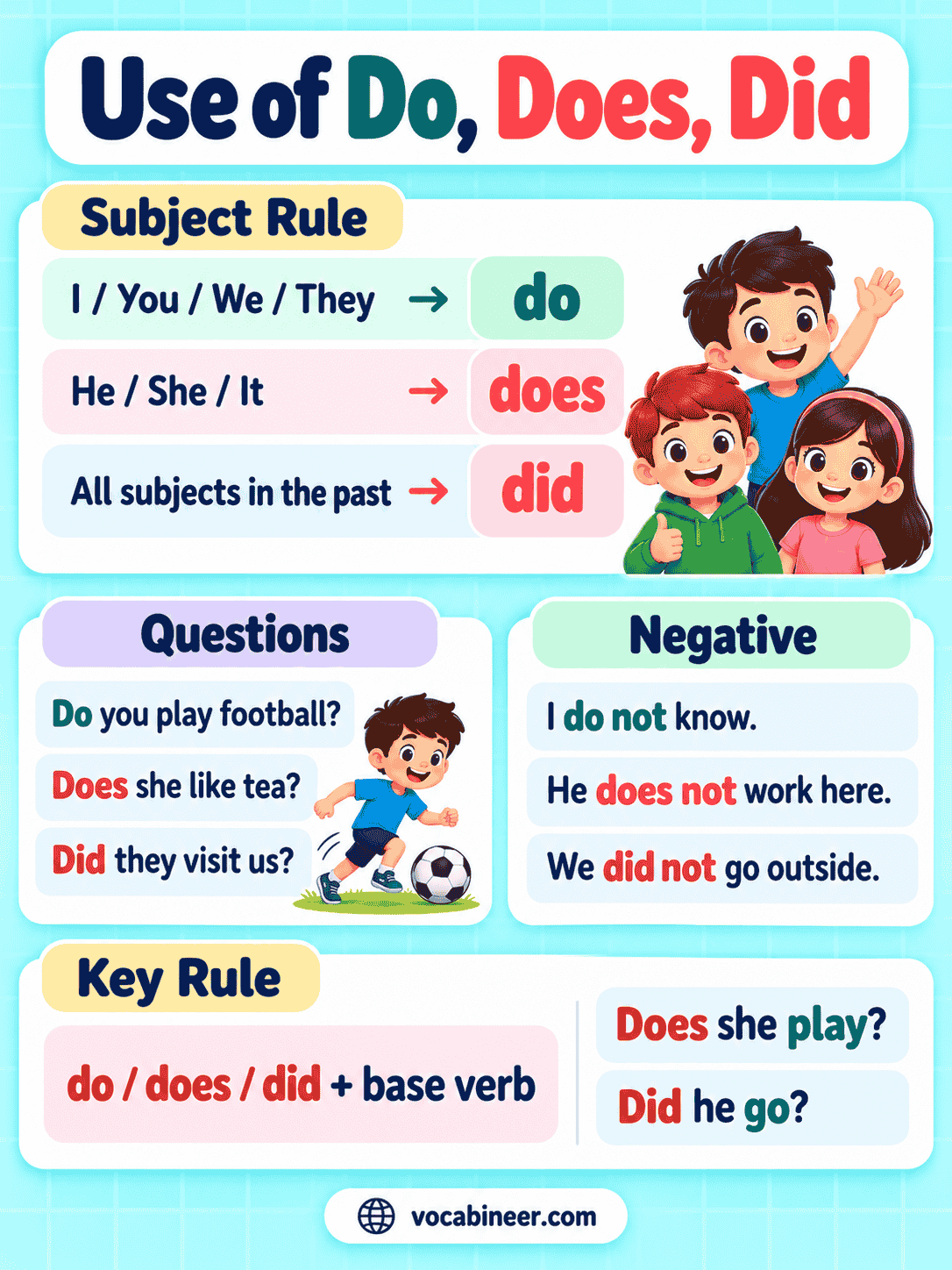
Learning the correct use of do, does, and did helps beginners form accurate questions, negatives, and short answers. Use do with I, you, we, they, and plural nouns; use does with he, she, it, and singular nouns; and use did with all subjects in the past.
In This Page
Quick Rule for Do, Does, and Did
| Subject | Present Form | Past Form | Example |
|---|---|---|---|
| I | do | did | I do my work. / I did my work. |
| you | do | did | You do your work. / You did your work. |
| he | does | did | He does his work. / He did his work. |
| she | does | did | She does her work. / She did her work. |
| it | does | did | It does the job. / It did the job. |
| we | do | did | We do our work. / We did our work. |
| they | do | did | They do their work. / They did their work. |
| singular noun | does | did | The boy does the task. / The boy did the task. |
| plural noun | do | did | The boys do the task. / The boys did the task. |
A simple memory rule is:
I / You / We / They / plural noun → do
He / She / It / singular noun → does
All subjects in the past → did
Use of Do
Use do with I, you, we, they, and plural nouns.
Examples:
- Do you like tea?
- Do they live here?
- I do my homework after school.
- We do our work carefully.
- The students do their exercises every day.
- You do a good job.
- They do the cleaning on Saturday.
Here, do can work either as a helping verb or as the main verb itself.
Use of Does
Use does with he, she, it, and singular nouns.
Examples:
- Does she work here?
- Does he play football?
- My brother does his homework after dinner.
- The machine does its job well.
- Sara does the cooking at home.
- The dog does what it is told.
When does works as a helping verb, the main verb stays in its base form.
Correct:
- Does she play tennis?
- He doesn’t like coffee.
Incorrect:
- Does she plays tennis?
- He doesn’t likes coffee.
Use of Did
Use did with every subject in the past.
Examples:
- Did you call him?
- Did she finish the work?
- He didn’t eat breakfast.
- We did the job yesterday.
- They did their homework before dinner.
- The children did well in class.
After did or didn’t, the main verb also stays in its base form.
Correct:
- Did she go home?
- He didn’t eat breakfast.
Incorrect:
- Did she went home?
- He didn’t ate breakfast.
Questions with Do, Does, and Did
One of the main uses of these words is to form questions with ordinary action verbs.
Questions with Do
Use do with I, you, we, they, and plural subjects.
- Do you speak English?
- Do they live nearby?
- Do we need more time?
- Do the children play outside?
- Do your parents work here?
Questions with Does
Use does with he, she, it, and singular nouns.
- Does she work here?
- Does he play football?
- Does your brother drive?
- Does the shop open early?
- Does the dog bark at night?
Questions with Did
Use did with all subjects in the past.
- Did you call yesterday?
- Did she finish the work?
- Did he visit you?
- Did they arrive on time?
- Did the children enjoy the trip?
The basic pattern is:
Do / Does / Did + subject + base verb
WH-Questions with Do, Does, and Did
Question words such as what, where, why, when, how, and who can appear before do, does, or did.
Examples:
- Where do you live?
- What does she want?
- Why does he leave early?
- When did they arrive?
- Where did you go?
- Why did she call?
- How do they travel to work?
- What did he buy?
These patterns are common in everyday conversation.
Negative Sentences with Do, Does, and Did
Do, does, and did also help form negative sentences.
Do Not / Don’t
Use don’t with I, you, we, they, and plural subjects.
- I don’t like coffee.
- We don’t work on Sundays.
- They don’t live here.
- The children don’t watch television at night.
Does Not / Doesn’t
Use doesn’t with he, she, it, and singular nouns.
- She doesn’t like coffee.
- He doesn’t work here.
- The dog doesn’t eat that food.
- My brother doesn’t drive.
Did Not / Didn’t
Use didn’t with every subject in the past.
- I didn’t call yesterday.
- She didn’t finish the work.
- He didn’t come to class.
- They didn’t arrive early.
In every case, the main verb remains in its base form.
Short Answers with Do, Does, and Did
Short answers repeat the auxiliary rather than the main verb.
- Do you like tea? — Yes, I do. / No, I don’t.
- Does she work here? — Yes, she does. / No, she doesn’t.
- Does he play football? — Yes, he does. / No, he doesn’t.
- Did they call? — Yes, they did. / No, they didn’t.
- Did she arrive? — Yes, she did. / No, she didn’t.
These forms are especially useful in spoken English.
Do, Does, and Did as Main Verbs
Do, does, and did can also be the main verb in a sentence.
Examples:
- I do my homework every evening.
- She does the cleaning on Saturday.
- He does his job carefully.
- They do their work on time.
- We did the shopping yesterday.
- He did the washing last night.
- The children did their exercises.
As a main verb, do often means perform, complete, carry out, or handle an activity.
Helping Verb vs Main Verb
The same word can have different grammatical roles.
| Helping Verb | Main Verb |
|---|---|
| Do you work here? | I do my work here. |
| She doesn’t drive. | She does the cooking. |
| Did they call? | They did the job yesterday. |
As a helping verb, do/does/did supports another main verb. By contrast, as a main verb, it carries the main action itself.
Emphatic Do, Does, and Did
Do, does, and did can also add emphasis to an affirmative sentence.
Examples:
- I do understand your point.
- She does know the answer.
- He does work very hard.
- They did finish the project.
- I did call you yesterday.
- We do appreciate your help.
This use can emphasize truth, correction, contrast, or reassurance.
The base-form rule still applies.
Correct:
- She does know the answer.
Incorrect:
- She does knows the answer.
Why the Main Verb Stays in the Base Form
This rule causes many beginner mistakes.
Compare:
- She plays tennis.
- Does she play tennis?
- She doesn’t play tennis.
In the question and negative forms, the third-person singular marking appears in does, so the main verb returns to play.
The same pattern works in the past:
- She went home.
- Did she go home?
- She didn’t go home.
Here, did carries the past meaning. Therefore, the main verb returns to its base form.
Do and Does with Singular and Plural Subjects
The difference becomes clearer with noun subjects.
| Singular Subject | Plural Subject |
|---|---|
| Does the boy play? | Do the boys play? |
| Does the dog bark? | Do the dogs bark? |
| Does your friend work here? | Do your friends work here? |
| Does the student understand? | Do the students understand? |
In the present, singular third-person subjects take does, while plural subjects take do.
Do, Does, Did with Common Verbs
These auxiliaries frequently appear with everyday verbs such as like, want, need, know, work, live, and play.
With Like
- Do you like coffee?
- Does she like music?
- Did they like the movie?
With Want
- Do you want help?
- Does he want tea?
- Did she want to leave?
With Need
- Do we need more time?
- Does he need a ticket?
- Did they need help?
With Know
- Do you know him?
- Does she know the answer?
- Did he know about it?
These patterns make the rule easier to apply in everyday English.
Do/Does/Did with Have
When have is an ordinary main verb, do, does, and did commonly form its questions and negatives.
Examples:
- Do you have a car?
- Does she have a bicycle?
- Do they have enough time?
- Did he have breakfast?
- Did we have enough money?
Notice that the main verb stays as have.
Incorrect:
- Does she has a car?
Correct:
- Does she have a car?
Likewise:
Incorrect:
- Did he had breakfast?
Correct:
- Did he have breakfast?
Do/Does/Did vs Am/Is/Are/Was/Were
A common learner problem is using do-support where a form of be is needed.
Use do/does/did with ordinary action verbs:
- Do you work here?
- Does she like tea?
- Did they play yesterday?
Use am/is/are/was/were when be itself is the verb:
- Are you tired?
- Is she a teacher?
- Were they late?
- Was he at home?
Also use be forms before verb-ing:
- Are you working?
- Is she sleeping?
- Were they playing?
Incorrect:
- Do you be tired?
Correct:
- Are you tired?
Do/Does/Did in Present and Past
The present forms change according to the subject, while did works with every subject in the past.
| Present | Past |
|---|---|
| Do you work here? | Did you work here? |
| Does she work here? | Did she work here? |
| I don’t work here. | I didn’t work here. |
| She doesn’t work here. | She didn’t work here. |
This is one of the simplest ways to remember the difference.
Common Mistakes with Do, Does, and Did
Using Do with He, She, or It
Incorrect: She do like coffee.
Correct: She does like coffee.
Using Does with I, You, We, or They
Incorrect: They does work here.
Correct: They do work here.
Adding -s after Does
Incorrect: Does he plays football?
Correct: Does he play football?
Using a Past Verb after Did
Incorrect: Did she went home?
Correct: Did she go home?
Using a Past Verb after Didn’t
Incorrect: He didn’t ate breakfast.
Correct: He didn’t eat breakfast.
Using Does + Has
Incorrect: Does she has a car?
Correct: Does she have a car?
Using Do with Be
Incorrect: Do you be tired?
Correct: Are you tired?
Easy Do, Does, and Did Sentences for Kids
Children and beginners can start with short and familiar examples:
- Do you like apples?
- Do they play outside?
- Does she read books?
- Does he like milk?
- I do my homework.
- She does her work.
- Did you see the dog?
- Did he eat lunch?
- We did our work.
- They didn’t play yesterday.
- He doesn’t like carrots.
- I don’t watch TV at night.
FAQs
Use do with I, you, we, they, and plural nouns in the present. Use does with he, she, it, and singular nouns. Use did with every subject in the past.
The difference is mainly subject agreement. Do goes with I, you, we, they, and plural nouns, while does goes with he, she, it, and singular nouns.
Use did for Past Simple questions, negatives, emphasis, and as the past form of the main verb do. For example, Did she call?, She didn’t call, and She did call are all correct.
Does already carries the third-person singular marking, while did carries the past marking. Therefore, the main verb stays in its base form, as in Does she play? and Did she go?
Use do/does/did with ordinary action verbs, as in Do you work here? Use forms of be when be itself is needed or before an -ing verb, as in Are you tired? and Are you working?
Read More
- 12 English Tenses Chart
- All Tenses Rules and Formula
- English Tenses with Examples
- Present Tenses in English
- Past Tenses in English
- Future Tenses in English
- Be Going To in English