Has, have, and had are forms of the verb have. They are used to talk about possession, relationships, characteristics, meals, experiences, and events. In addition, they work as helping verbs in perfect tenses such as She has finished and They had left.
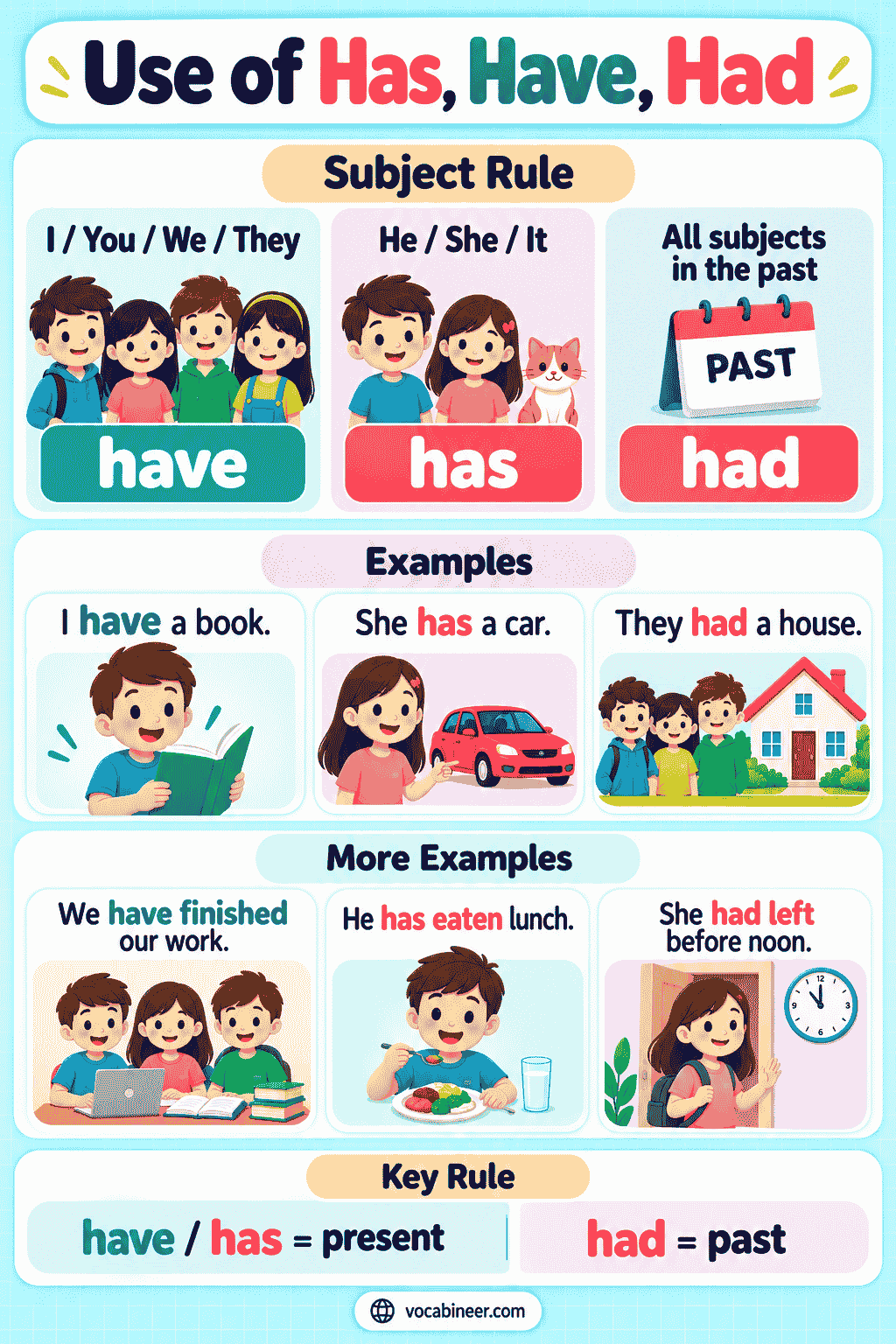
Learning the correct use of has, have, and had becomes easier once you separate two ideas: who the subject is and whether the sentence refers to the present or past. Use has with he, she, it, and singular nouns; use have with I, you, we, they, and plural nouns; and use had with all subjects in the past.
In This Page
Quick Rule for Has, Have, and Had
| Subject | Present Form | Past Form | Example |
|---|---|---|---|
| I | have | had | I have a bike. / I had a bike. |
| you | have | had | You have time. / You had time. |
| he | has | had | He has a car. / He had a car. |
| she | has | had | She has a job. / She had a job. |
| it | has | had | It has four legs. / It had four legs. |
| we | have | had | We have a plan. / We had a plan. |
| they | have | had | They have tickets. / They had tickets. |
| singular noun | has | had | The house has a garden. / The house had a garden. |
| plural noun | have | had | The houses have gardens. / The houses had gardens. |
A simple memory rule is:
He / She / It / singular noun → has
I / You / We / They / plural noun → have
All subjects in the past → had
Use of Has
Use has with he, she, it, and singular nouns in the present.
Examples:
- He has a new phone.
- She has two sisters.
- It has a long tail.
- The house has three bedrooms.
- My teacher has a laptop.
- Sara has a question.
- The dog has brown eyes.
- This book has ten chapters.
The subject is singular in each example, so has is the correct present form.
Incorrect:
- She have a bicycle.
Correct:
- She has a bicycle.
Use of Have
Use have with I, you, we, they, and plural nouns.
Examples:
- I have a bicycle.
- You have a good idea.
- We have enough time.
- They have two children.
- The students have new books.
- My parents have a car.
- These flowers have long stems.
- The children have lunch at noon.
Unlike has, have is used with both singular I/you and plural subjects such as we and they.
Use of Had
Had is the past form of have for every subject.
Examples:
- I had a bicycle.
- She had a headache.
- He had a meeting.
- We had enough food.
- They had a large garden.
- The house had three bedrooms.
- You had a good idea.
- My parents had a small shop.
Notice that had does not change according to the subject.
- I had
- She had
- We had
- They had
Has, Have, and Had for Possession
One of the most common uses of these forms is to show possession or ownership.
Present Possession
- I have a car.
- She has a bicycle.
- He has a laptop.
- They have a house.
- The dog has a collar.
Past Possession
- I had a car.
- She had a bicycle.
- He had a laptop.
- They had a house.
- The dog had a collar.
The choice changes according to both subject and time.
Has, Have, and Had for Relationships
These words can also describe relationships rather than physical ownership.
Examples:
- I have two brothers.
- She has a younger sister.
- He has many friends.
- We have helpful neighbours.
- They have three children.
- My father had two brothers.
- She had many friends at school.
So, have does not always mean “own.”
Has, Have, and Had for Characteristics
These forms can describe features, parts, or qualities.
Examples:
- The dog has brown eyes.
- My car has four doors.
- Elephants have large ears.
- These plants have long leaves.
- The old house had a red roof.
- That phone had a small screen.
This use is common when describing people, animals, plants, objects, and places.
Has, Have, and Had for Meals and Daily Activities
The verb have can also describe meals and everyday activities.
Examples:
- I have breakfast at seven.
- She has lunch at school.
- We have dinner together.
- He had breakfast early.
- They had lunch at noon.
- My family had dinner outside.
Here, have means to eat or take part in the meal rather than possess it.
Has, Have, and Had for Events and Experiences
These forms also occur in many common expressions involving experiences, events, and situations.
Examples:
- She has a meeting today.
- We have a problem.
- They have fun together.
- He has a headache.
- I had a difficult day.
- She had a meeting yesterday.
- We had a long conversation.
- They had a great time.
This is why the verb have appears so frequently in everyday English.
Negative Sentences with Has and Have
When have works as an ordinary main verb in Present Simple, negative sentences commonly use do not / don’t or does not / doesn’t + have.
Examples:
- I don’t have a car.
- You don’t have enough time.
- We don’t have any questions.
- They don’t have a garden.
- She doesn’t have a bicycle.
- He doesn’t have a ticket.
- The shop doesn’t have this size.
After doesn’t, use have, not has.
Incorrect:
- She doesn’t has a car.
Correct:
- She doesn’t have a car.
Negative Sentences with Had
Past Simple negatives use did not / didn’t + have.
Examples:
- I didn’t have enough money.
- She didn’t have time.
- He didn’t have breakfast.
- We didn’t have a car.
- They didn’t have any food.
Because did already marks past time, the main verb returns to have.
Incorrect:
- They didn’t had enough time.
Correct:
- They didn’t have enough time.
Questions with Has and Have as Main Verbs
When have is the main verb in Present Simple, questions commonly use do or does.
Examples:
- Do you have a car?
- Do they have enough time?
- Do we have any milk?
- Does she have a brother?
- Does he have a ticket?
- Does the house have a garden?
Again, use have after does.
Incorrect:
- Does he has a car?
Correct:
- Does he have a car?
Questions with Had as a Main Verb
Past Simple questions use did + have.
Examples:
- Did you have breakfast?
- Did she have a meeting?
- Did he have enough money?
- Did they have a car?
- Did we have enough time?
Incorrect:
- Did she had breakfast?
Correct:
- Did she have breakfast?
Have Got and Has Got
Have got and has got are also common ways to express present possession.
Examples:
- I have got a new phone.
- You have got a good idea.
- We have got a garden.
- They have got two children.
- She has got a new job.
- He has got two brothers.
These often have the same basic meaning as:
- I have a new phone.
- She has a new job.
- We have a garden.
For ordinary past possession, however, had is the simpler standard form:
- She had a bicycle when she was younger.
Has and Have as Helping Verbs
Has and have do not always work as main verbs. They also function as helping verbs in the Present Perfect.
The pattern is:
subject + has/have + past participle
Examples:
- I have finished my work.
- You have improved a lot.
- We have seen that film.
- They have completed the project.
- She has arrived.
- He has written a letter.
- The teacher has checked our work.
Here, has/have help form the tense rather than express possession.
Has vs Have in Present Perfect
The same subject rule continues in the Present Perfect.
| Subject | Correct Form | Example |
|---|---|---|
| I | have | I have finished. |
| you | have | You have finished. |
| he | has | He has finished. |
| she | has | She has finished. |
| it | has | It has stopped. |
| we | have | We have finished. |
| they | have | They have finished. |
Therefore, learning the basic has vs have rule also helps with Present Perfect grammar.
Had as a Helping Verb
In the Past Perfect, had works as a helping verb before a past participle.
The pattern is:
subject + had + past participle
Examples:
- I had finished before noon.
- She had left before we arrived.
- He had eaten already.
- We had completed the work.
- They had gone home.
- The train had departed before we reached the station.
Once again, had works with every subject.
Present Perfect vs Past Perfect
The helping-verb use becomes easier to understand when the two perfect forms are compared.
| Present Perfect | Past Perfect |
|---|---|
| have/has + past participle | had + past participle |
| connects an earlier event with the present | shows an earlier event before another past point |
| She has finished. | She had finished before I arrived. |
| They have left. | They had left before noon. |
The difference is mainly the time relationship, not the meaning of have as possession.
What Do Has Had and Have Had Mean?
The combinations has had and have had are correct Present Perfect forms.
In these structures:
- has/have = helping verb
- had = past participle of the main verb have
Examples:
- She has had breakfast.
- He has had a busy day.
- My phone has had several problems.
- I have had enough rest.
- We have had several meetings.
- They have had this car for years.
Compare:
- She has a car. → Present Simple
- She has had the car for three years. → Present Perfect
The second sentence connects past possession with the present.
Is Had Had Correct?
Yes, had had is grammatically correct.
In this structure:
- the first had is the Past Perfect helping verb
- the second had is the past participle of have
Examples:
- She had had breakfast before she left.
- We had had enough time before the meeting began.
- They had had several problems before they changed the system.
- He had had the car for years before he sold it.
Although the repeated word may look unusual, the grammar is correct.
Has Been, Have Been, and Had Been
These forms provide another clear example of has/have/had acting as helping verbs.
Has Been and Have Been
- She has been busy all day.
- He has been at home.
- We have been here before.
- They have been friends for years.
Had Been
- She had been busy before the meeting.
- He had been there before.
- We had been friends for years before he moved away.
These forms belong to perfect structures, so they should not be confused with ordinary possession.
Main Verb vs Helping Verb
This distinction is one of the most important parts of the topic.
| Main Verb | Helping Verb |
|---|---|
| I have a car. | I have finished. |
| She has a sister. | She has arrived. |
| They had a problem. | They had left. |
As a main verb, has/have/had can express:
- possession
- relationships
- characteristics
- meals
- events
- experiences
As a helping verb, has/have/had help form perfect verb structures.
Do, Does, Did vs Has, Have, Had
Whether you use do/does/did depends on the grammatical role of have.
Have as a Main Verb
Use:
- Do you have a car?
- Does she have a car?
- Did they have a car?
Have as a Helping Verb
Do not add do, does, or did:
- Have you finished?
- Has she arrived?
- Had they left?
Compare:
- Does she have a car? → main verb
- Has she finished her work? → helping verb
This difference explains many common learner errors.
Has vs Have vs Had
The main forms can be summarized clearly:
| Form | Basic Use | Example |
|---|---|---|
| has | present with he/she/it/singular noun | She has a car. |
| have | present with I/you/we/they/plural noun | They have a car. |
| had | past with every subject | They had a car. |
When they work as helping verbs:
| Form | Perfect Structure | Example |
|---|---|---|
| has | Present Perfect | She has finished. |
| have | Present Perfect | They have finished. |
| had | Past Perfect | They had finished. |
Common Mistakes with Has, Have, and Had
Using Have with He, She, or It
Incorrect: She have a car.
Correct: She has a car.
Using Has with I, You, We, or They
Incorrect: They has a house.
Correct: They have a house.
Using Has after Does
Incorrect: Does he has a bicycle?
Correct: Does he have a bicycle.
Using Had after Did
Incorrect: Did she had breakfast?
Correct: Did she have breakfast?
Using the wrong Present Perfect auxiliary
Incorrect: She have finished.
Correct: She has finished.
Changing Had according to the subject
Incorrect: They use a different form because the subject is plural.
Correct: I had, she had, we had, and they had all use the same form.
Confusing Had with Has Had
Compare:
- She had a car when she was younger.
- She has had this car for three years.
The first describes past possession. By contrast, the second connects possession with the present.
Using Has as the main verb after Does
Incorrect: Does the house has a garage?
Correct: Does the house have a garage?
Easy Has, Have, and Had Sentences for Kids
These short examples make the basic patterns easier to recognize:
- I have a book.
- She has a doll.
- He has a bicycle.
- The cat has a long tail.
- We have two pets.
- They have new bags.
- The children have lunch at school.
- I had a toy car.
- She had a red dress.
- He had a small dog.
- We had lunch early.
- They had fun yesterday.
FAQs
Use has with he, she, it, and singular nouns in the present. Use have with I, you, we, they, and plural nouns. Use had with all subjects when referring to the past.
Has is used with he, she, it, and singular nouns, while have is used with I, you, we, they, and plural nouns.
Use had as the past form of have with any subject, as in She had a car. It also works as a helping verb in the Past Perfect, as in She had left before noon.
Has had and have had are Present Perfect forms of have. For example, She has had this phone for two years and We have had enough time are both correct.
After does, the main verb stays in its base form. Therefore, Does she have a car? is correct, while Does she has a car? is incorrect.
Read More
- 12 English Tenses Chart
- All Tenses Rules and Formula
- English Tenses with Examples
- Present Tenses in English
- Past Tenses in English
- Future Tenses in English
- Be Going To in English