

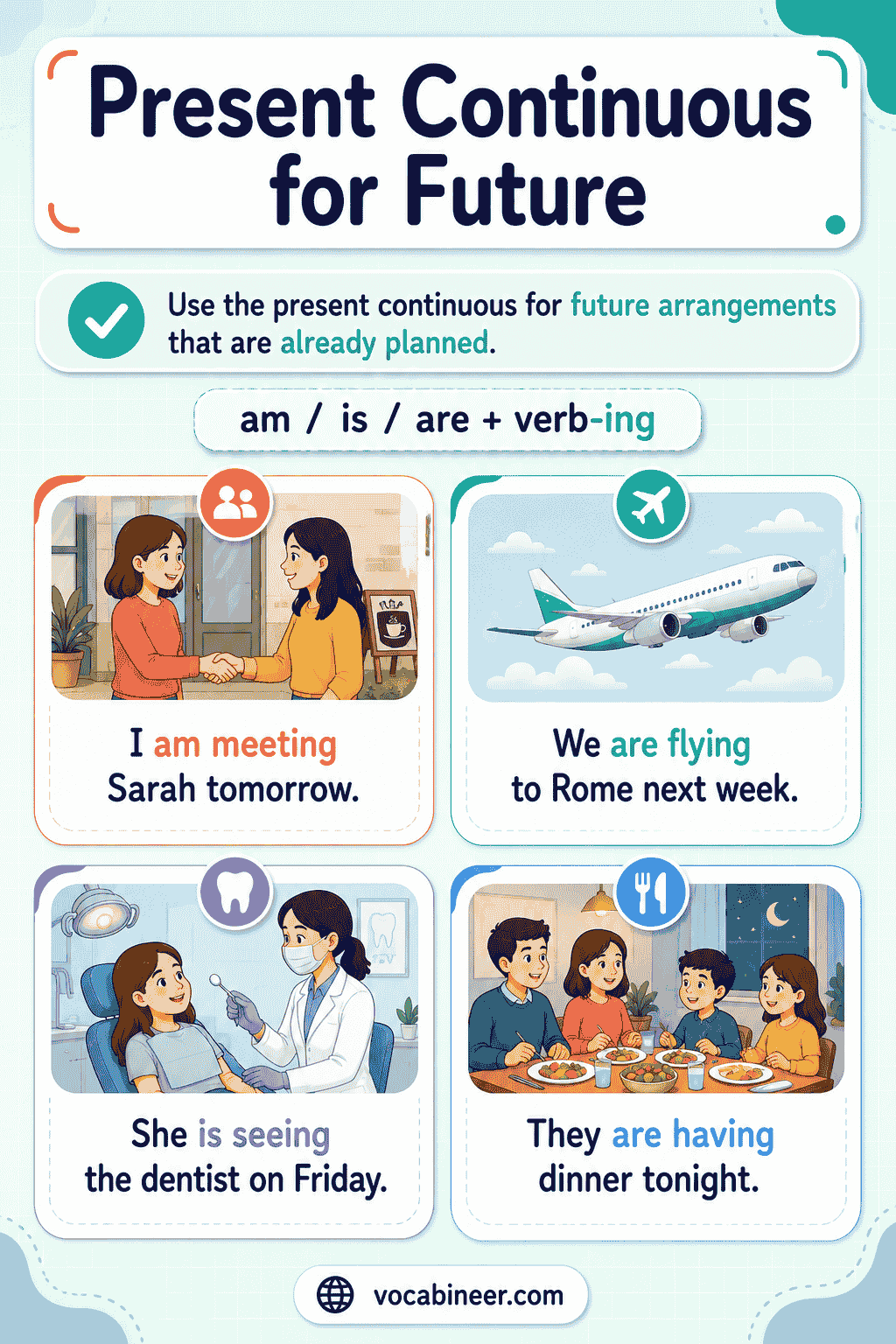
Present Continuous can describe future events when the speaker presents them as arranged or firmly planned. This use is common for meetings, appointments, travel, social plans, work commitments, and other future activities that already feel established.
Understanding Present Continuous for future meaning helps learners distinguish arrangements from intentions, spontaneous decisions, predictions, and schedules. The key is to focus on how the speaker presents the plan, not simply on future words such as tomorrow or next week.
In This Page
What Is Present Continuous for Future?
Present Continuous can refer to a future event when the speaker presents that event as an arrangement or firm plan that has already been made.
Examples:
- I am meeting Sara tomorrow.
- We are flying to Rome on Friday.
- She is seeing the dentist at three.
- They are having dinner with us tonight.
The structure remains:
am / is / are + V-ing
Future meaning comes from context rather than from a different grammatical form.
A useful principle is:
Present Continuous for future meaning presents an event as arranged or sufficiently fixed from the speaker’s current viewpoint.
Present Continuous for Future at a Glance
| Future Use | Example |
|---|---|
| meeting | I am meeting Leo at six. |
| appointment | She is seeing the doctor tomorrow. |
| travel | We are flying on Friday. |
| social plan | They are having dinner with us tonight. |
| work arrangement | I am working late tomorrow. |
| future question | Are you coming tonight? |
| negative arrangement | We aren’t meeting on Monday. |
These examples all describe future events that the speaker treats as established plans.
How Present Continuous Expresses Future Meaning
The grammatical form does not change.
| Form | Structure | Example |
|---|---|---|
| affirmative | am/is/are + V-ing | I am meeting her tomorrow. |
| negative | am/is/are not + V-ing | We aren’t travelling next week. |
| question | Am/Is/Are + subject + V-ing? | Are you coming tonight? |
Compare:
- I am meeting Sam.
This may describe something happening now or around now. - I am meeting Sam tomorrow.
The future time expression gives it future reference.
Future meaning can also come from context:
- What are your plans for Friday?
- I am meeting Sam.
Because Friday is already established, the answer is clearly future.
Use this principle:
The form remains Present Continuous; future context gives it future reference.
Future Arrangement vs General Plan
A future arrangement is usually more established than a general intention.
| General Plan or Intention | Arranged Future Event |
|---|---|
| I am going to visit Maya sometime next week. | I am visiting Maya at three on Saturday. |
| intention already exists | event is presented as organized |
| details may still be broad | practical details are often established |
Use this principle:
An intention tells us what someone plans to do, while an arrangement presents that plan as already organized or established.
Speaker Presentation Matters
Practical details help make an arrangement clear, but grammar also depends on how the speaker chooses to present the event.
Compare:
| Be Going To | Present Continuous |
|---|---|
| I am going to see Daniel tomorrow. | I am seeing Daniel tomorrow. |
| presents the event as a plan or intention | presents the event as an arrangement |
The real-world event may be the same. The difference lies partly in the speaker’s viewpoint.
Use this principle:
Present Continuous does not require proof of a booking or appointment; it presents the future event as arranged from the speaker’s perspective.
What Makes a Future Plan an Arrangement?
An arrangement often has practical details already established.
These may include:
- an agreed time
- a place
- another participant
- an appointment
- a reservation
- a booking
- a ticket
- a work commitment
- a fixed personal schedule
| Evidence of Arrangement | Example |
|---|---|
| agreed meeting | I am meeting James at five. |
| appointment | She is seeing the dentist tomorrow. |
| ticket | We are flying to Madrid on Friday. |
| reservation | We are having dinner at eight. |
| work commitment | I am working late tomorrow. |
These details support arrangement meaning, but they are not a rigid checklist.
Does a Future Arrangement Need Another Person?
No. Another participant is common, but not grammatically required.
Examples involving other people:
- I am meeting Anna tomorrow.
- We are having dinner with them tonight.
- She is seeing the doctor on Tuesday.
Firm personal plans can also use Present Continuous:
- I am staying home tonight.
- I am studying tomorrow morning.
- I am leaving early tomorrow.
Use this principle:
The key idea is an established plan, not the presence of another person.
Near vs Distant Future Arrangements
Present Continuous is not limited to the immediate or near future.
It can describe an arrangement that is months away if the speaker presents it as fixed.
Examples:
- We are getting married next June.
- She is starting university in September.
- They are moving abroad next year.
- I am attending a conference in December.
Use this principle:
Present Continuous can describe near or distant future arrangements; closeness in time is not the defining rule.
Does a Future Time Expression Have to Be Stated?
No. A future time expression is common, but it is not always necessary.
Examples with explicit time:
- I am seeing Maya tomorrow.
- We are leaving after lunch.
- She is starting next Monday.
Future meaning can also come from context:
- What are you doing this weekend?
- I am staying with my parents.
However, without an explicit future expression, the context must make the future meaning clear.
Compare:
- I am meeting Daniel.
This may be interpreted as present or future. - I am meeting Daniel next week.
The future reference is explicit.
Use this principle:
A time expression is optional only when the surrounding context already establishes future reference clearly.
Present Continuous vs Be Going To
Both forms can describe future plans, but they usually emphasize different things.
| Be Going To | Present Continuous |
|---|---|
| prior intention or plan | arranged or fixed plan |
| I am going to visit Maya this weekend. | I am visiting Maya at three on Saturday. |
| emphasizes intention | emphasizes arrangement |
| practical details may still be broad | details are often established |
Compare:
- I am going to meet Tom tomorrow.
- I am meeting Tom tomorrow.
Both can be natural.
The first highlights the prior plan. The second presents the meeting more directly as an arrangement.
Use this principle:
Be going to commonly expresses prior intention, while Present Continuous presents the future event as arranged.
Do not reduce the distinction to certainty.
Present Continuous “Going” vs Be Going To
These two forms look similar but have different structures.
| Present Continuous of Go | Be Going To Future |
|---|---|
| We are going to Paris tomorrow. | We are going to visit Paris tomorrow. |
| going is the main verb | going to introduces another verb |
| describes arranged movement or travel | expresses a prior plan or intention |
Compare:
- We are going to London on Friday.
Present Continuous of go. - We are going to stay in London for three days.
Be going to + verb.
This distinction is especially important because the forms look almost identical.
Present Continuous vs Will
Will and Present Continuous usually express different future meanings.
| Will | Present Continuous |
|---|---|
| spontaneous decision, promise, prediction, willingness | arranged future event |
| I will call her now. | I am calling her at eight tonight. |
| decision may be made while speaking | arrangement already exists |
| I’ll meet you outside. | I’m meeting you outside at six. |
For example:
The phone rings.
- I will answer it.
The speaker decides at that moment.
Compare:
- I am calling Daniel at eight tonight.
The call is already planned.
Use this principle:
Will commonly expresses a decision or prediction from the present moment, while Present Continuous normally refers to an arrangement already made.
Present Continuous vs Present Simple for Future
Both forms can express future time, but they serve different purposes.
| Present Continuous | Present Simple |
|---|---|
| personal, group, or organized arrangement | timetable, schedule, or programmed event |
| I am meeting the manager at ten. | The meeting starts at ten. |
| We are flying on Monday. | The flight leaves at 7:30. |
| focuses on participation in an arrangement | focuses on an external schedule |
Same-event comparisons make the distinction clearer:
| Present Continuous | Present Simple |
|---|---|
| We are flying at seven tomorrow. | Our flight leaves at seven tomorrow. |
| our travel arrangement | scheduled departure |
| I am meeting the manager at ten. | The meeting starts at ten. |
| my arrangement | programmed event |
Use this principle:
Present Continuous commonly describes arrangements involving people or plans, while Present Simple commonly describes fixed schedules and timetables.
Present Continuous for Organized Public or Institutional Events
Present Continuous is not limited to personal plans.
It can also describe organized future events involving teams, companies, public figures, institutions, or groups.
Examples:
- The team is playing Madrid on Saturday.
- The company is opening a new office in June.
- The president is visiting France next week.
- The university is hosting a conference in October.
These are arranged events involving organizations rather than simple personal appointments.
Will vs Going To vs Present Continuous vs Present Simple
The main future forms can be compared by meaning.
| Future Form | Main Meaning | Example |
|---|---|---|
| will | spontaneous decision / prediction | I will call her. |
| be going to | prior intention / plan | I am going to call her tonight. |
| Present Continuous | arrangement | I am calling her at eight. |
| Present Simple | timetable / schedule | The meeting starts at eight. |
Use this principle:
Future form choice depends on whether the speaker presents the event as a decision, intention, arrangement, prediction, or schedule.
Why Present Continuous Is Not Normally Used for Predictions
Present Continuous for future meaning mainly expresses arrangements rather than ordinary predictions.
Incorrect for a normal weather prediction:
- It is raining tomorrow.
Better:
- It will rain tomorrow.
- It is going to rain tomorrow.
However:
- We are leaving tomorrow.
is correct because it describes an arrangement.
| Prediction | Arrangement |
|---|---|
| It will rain tomorrow. | We are leaving tomorrow. |
| expected future event | organized future plan |
Use this principle:
Future Present Continuous normally expresses arrangements rather than predictions.
How Definite Is the Present Continuous Future?
Present Continuous often makes a plan sound organized or fixed, but it does not guarantee that the event will happen.
Compare:
| Be Going To | Present Continuous |
|---|---|
| I am going to visit Sam soon. | I am visiting Sam at four tomorrow. |
| intention | arrangement presented as fixed |
A planned event may still be cancelled.
For example:
- We are flying on Friday.
- Later: We aren’t flying on Friday after all.
The original sentence was still correct because the arrangement existed at the time of speaking.
Use this principle:
Present Continuous presents an event as arranged now; it does not guarantee the future outcome.
Appointments, Meetings, Travel, and Social Plans
These are some of the clearest contexts for future Present Continuous.
| Context | Example |
|---|---|
| appointment | I am seeing the dentist tomorrow. |
| meeting | We are meeting the clients at ten. |
| travel | They are flying to Rome on Friday. |
| social plan | We are having dinner with Maya tonight. |
| visit | I am visiting my parents this weekend. |
| work | She is starting her new job on Monday. |
Movement verbs are especially common:
| Verb | Example |
|---|---|
| come | Maya is coming tomorrow. |
| go | We are going to London on Friday. |
| leave | I am leaving at six. |
| arrive | They are arriving on Monday. |
Common Future Time Expressions
Future Present Continuous often appears with:
- tonight
- tomorrow
- tomorrow morning
- this evening
- this weekend
- on Monday
- next week
- next month
- next year
- at six
- after work
- later today
- in the morning
Examples:
- I am meeting her tomorrow.
- We are leaving at six.
- She is starting next Monday.
- They are coming this weekend.
These expressions do not automatically require Present Continuous.
| Form | Example |
|---|---|
| will | I will call tomorrow. |
| going to | I am going to call tomorrow. |
| Present Continuous | I am calling her tomorrow. |
The time expression locates the event in the future; the intended meaning determines the form.
Questions About Future Arrangements
Present Continuous is very natural when asking about future arrangements.
Examples:
- Are you doing anything tonight?
- Are you working tomorrow?
- Are you coming to the party?
- What are you doing this weekend?
- Who are you meeting later?
- Where are you staying in London?
A comparison with be going to shows a subtle difference:
| Present Continuous Question | Going To Question |
|---|---|
| What are you doing this weekend? | What are you going to do this weekend? |
| asks about arranged or established plans | asks more generally about intentions or plans |
| Are you meeting Maya tomorrow? | Are you going to meet Maya tomorrow? |
The distinction can overlap in real conversation, but the Present Continuous more strongly frames the event as arranged.
Negative Future Arrangements
Use the normal negative Present Continuous form.
Examples:
- I am not working tomorrow.
- We aren’t meeting on Friday.
- She isn’t coming tonight.
- They aren’t staying for the weekend.
The negative can show that no arrangement exists or that an earlier plan has changed.
Present Continuous vs Be Going To in Negatives
The negative forms can carry different emphasis.
| Present Continuous | Be Going To |
|---|---|
| I am not meeting him tomorrow. | I am not going to meet him tomorrow. |
| says the meeting is not part of the arrangement | expresses a negative intention or plan |
| We aren’t travelling this weekend. | We aren’t going to travel this weekend. |
| arranged trip is not happening | intention is not to travel |
The meanings can overlap, but the semantic focus differs.
Changed and Cancelled Arrangements
Present Continuous can naturally express revised plans.
Examples:
- We are meeting on Thursday instead.
- I am not flying on Friday anymore.
- She is coming next week instead.
- They aren’t staying overnight after all.
| Original Arrangement | Changed Arrangement |
|---|---|
| We are meeting on Tuesday. | We are meeting on Thursday instead. |
| She is coming tonight. | She isn’t coming tonight after all. |
Use this principle:
An arrangement can change later without making the original Present Continuous sentence incorrect.
Present Continuous for Future vs Future Continuous
These forms are easy to confuse because both can refer to future activity.
| Present Continuous for Future | Future Continuous |
|---|---|
| I am meeting her at six. | I will be meeting her at six. |
| emphasizes an arrangement | presents the activity as occurring or expected around that future time |
| arrangement exists now | focuses on the future situation |
Compare:
- I am meeting the director tomorrow at ten.
The meeting is arranged. - At ten tomorrow, I will be meeting the director.
The sentence views the meeting as an activity that will be happening at that future time.
Keep this distinction concise because Future Continuous is a separate topic.
Stative Verbs with Future Meaning
Future reference does not remove the normal restrictions on continuous forms.
Common stative verbs include:
- know
- believe
- want
- need
- understand
- own
- belong
- remember
Incorrect:
- I am knowing the answer tomorrow.
- She is wanting more information next week.
Better:
- I will know the answer tomorrow.
- She will want more information later.
However, some verbs can have dynamic meanings.
For example:
- I am seeing the doctor tomorrow.
Here, see means meet or visit, so the continuous form is natural.
Use this principle:
Future meaning does not remove the normal grammatical restrictions on stative verbs.
Common Present Continuous for Future Mistakes
Learners often make mistakes when they treat all plans as arrangements or use future time expressions as automatic tense signals.
Using Present Continuous for an ordinary prediction
Incorrect:
- It is raining tomorrow.
Better:
- It will rain tomorrow.
- It is going to rain tomorrow.
Using Present Continuous for a spontaneous decision
Context: The phone rings.
Less suitable:
- I am answering it.
More natural:
- I will answer it.
Confusing intention with arrangement
| Intention | Arrangement |
|---|---|
| I am going to visit my aunt sometime next month. | I am visiting my aunt next Saturday at two. |
Confusing Present Continuous “going” with be going to
| Present Continuous | Be Going To |
|---|---|
| We are going to Paris tomorrow. | We are going to visit Paris tomorrow. |
| movement | intention |
Assuming another person is required
Incorrect rule:
Present Continuous for future must involve another person.
Better principle:
A firm personal plan can also use Present Continuous.
Assuming Present Continuous is only for the near future
Incorrect rule:
It can only describe tonight, tomorrow, or next week.
Better:
- We are getting married next June.
- They are moving abroad next year.
Assuming a future time expression is mandatory
Incorrect rule:
Tomorrow, tonight, or next week must always appear.
Better principle:
Future reference can be explicit or already clear from context.
Using Present Continuous for a timetable
For a schedule:
- The train leaves at 7:15.
For an arrangement:
- We are leaving on the 7:15 train.
Treating Present Continuous as always more certain than going to
Incorrect rule:
Present Continuous is certain; going to is uncertain.
Better principle:
Present Continuous emphasizes arrangement, while going to emphasizes prior intention.
Confusing Present Continuous for future with Future Continuous
| Arrangement | Future Activity |
|---|---|
| I am meeting her at six. | I will be meeting her at six. |
Using stative verbs incorrectly
Incorrect:
- I am knowing tomorrow whether I passed.
Correct:
- I will know tomorrow whether I passed.
Forgetting be
Incorrect:
- I meeting her tomorrow.
Correct:
- I am meeting her tomorrow.
Using the wrong verb form
Incorrect:
- She is meet him tomorrow.
- We are leave tonight.
Correct:
- She is meeting him tomorrow.
- We are leaving tonight.
FAQs
Use Present Continuous when a future event is presented as an arrangement or firm plan that is already established.
Be going to commonly emphasizes a prior intention or plan, while Present Continuous presents the future event as arranged or organized.
Not always. A future time expression often makes the meaning clearer, but context can establish future reference. Without such context, the form may be interpreted as present-time activity.
Yes. It can describe arrangements months away, such as We’re getting married next June, as long as the speaker presents the event as established.
Not normally for ordinary predictions. Will or be going to is usually more appropriate, while Present Continuous mainly expresses arrangements.
Read More
- 12 English Tenses Chart
- All Tenses Rules and Formula
- English Tenses with Examples
- Present Tenses in English
- Past Tenses in English
- Future Tenses in English
- Be Going To in English