

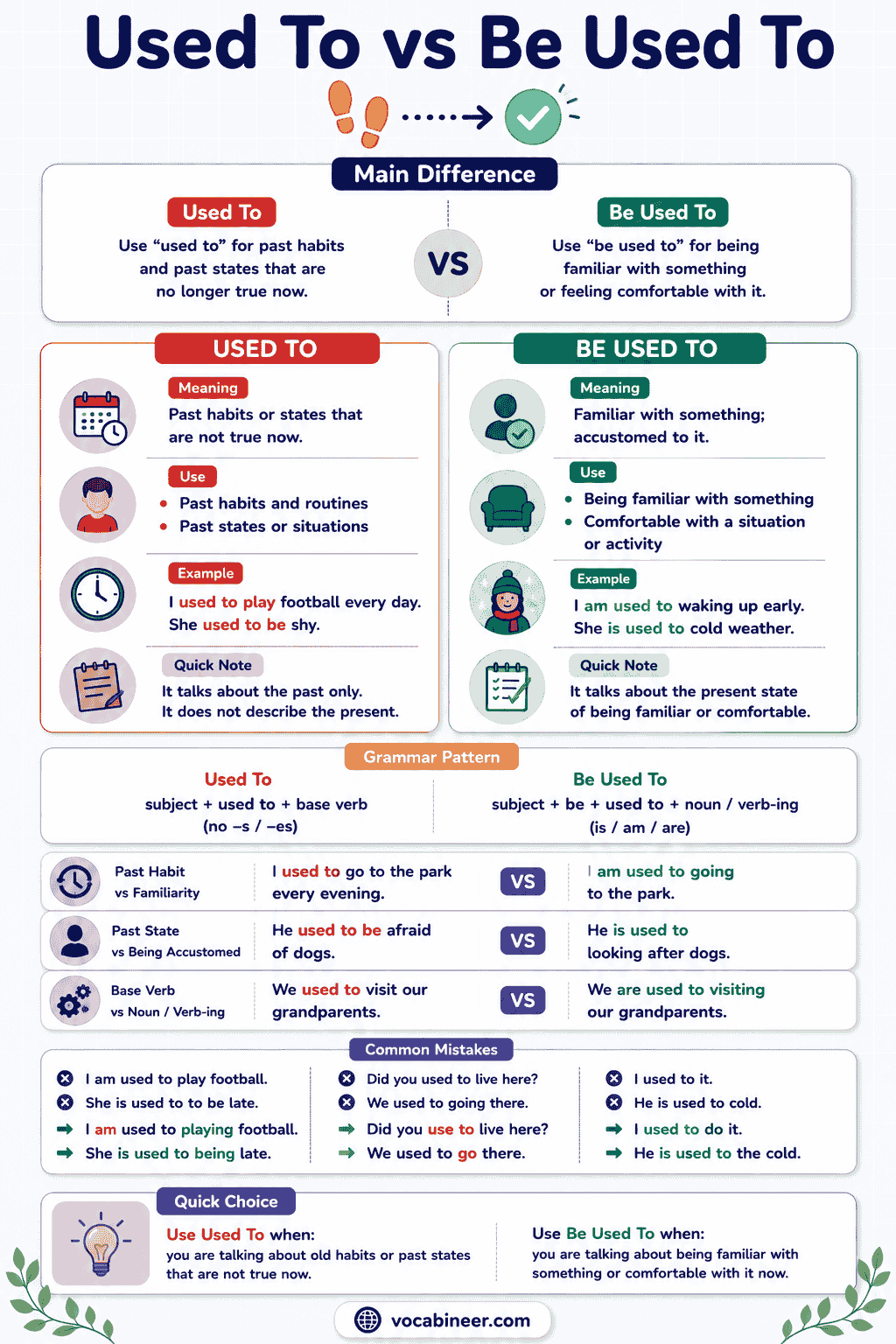
Used to and be used to look similar, but they express different meanings. Used to describes a former habit or state, while be used to describes something that feels familiar or normal.
Understanding the difference helps learners choose the correct verb pattern, time reference, question form, and negative form. It also makes used to + V1, be used to + noun/V-ing, and get used to much easier to distinguish.
In This Page
Used To vs Be Used To: What Is the Difference?
The main difference concerns former habits or states vs familiarity.
| Used To | Be Used To |
|---|---|
| describes a former habit, state, or situation | describes familiarity or accustomation |
| refers to past time only | can refer to past, present, or future |
| takes V1 | takes a noun, pronoun, or V-ing |
| used to + V1 | be + used to + noun/pronoun/V-ing |
| I used to wake early. | I am used to waking early. |
| She used to live here. | She is used to the noise. |
A useful core rule is:
Used to describes what regularly happened or was true in the past, while be used to describes what feels familiar or normal to someone.
Used To vs Be Used To at a Glance
| Meaning | Used To | Be Used To |
|---|---|---|
| former habit | I used to walk to school. | — |
| former state | She used to be shy. | — |
| present familiarity | — | She is used to speaking in public. |
| past familiarity | — | He was used to working long hours. |
| future familiarity | — | He will be used to the schedule soon. |
| verb pattern | used to + V1 | be used to + noun/V-ing |
| meaning of to | part of the infinitive structure | preposition |
The two structures therefore differ in both meaning and form.
How Used To and Be Used To Are Formed
The structural difference is especially important.
| Feature | Used To | Be Used To |
|---|---|---|
| basic structure | used to + V1 | be + used to + noun/pronoun/V-ing |
| example with verb | I used to drive. | I am used to driving. |
| example with noun | — | I am used to the traffic. |
| example with pronoun | — | I am used to it. |
The main rule is:
After used to, use V1. After be used to, use a noun, pronoun, or V-ing.
Correct:
- I used to work nights.
- I am used to working nights.
Incorrect:
- I used to working nights.
- I am used to work nights.
Past Habit or State vs Familiarity
This is the central semantic difference.
| Used To | Be Used To |
|---|---|
| former habit or state | familiarity or accustomation |
| I used to wake at six. | I am used to waking at six. |
| She used to work nights. | She is used to working nights. |
| We used to live near the airport. | We are used to the noise. |
Compare:
- I used to wake at six.
- I am used to waking at six.
The first sentence says that waking at six was a former habit.
The second says that waking at six feels normal or familiar now.
Another comparison:
- She used to work under pressure.
- She is used to working under pressure.
The first describes a former work pattern. The second describes familiarity with that situation.
Used To Always Refers to the Past
Used to + V1 describes a past habit, state, or situation.
Examples:
- I used to live in Dubai.
- She used to play tennis.
- They used to have a dog.
- We used to visit our grandparents every summer.
- Daniel used to be very shy.
The structure does not describe a present habit.
Incorrect:
- I use to wake early now.
Better:
- I usually wake early now.
A useful rule is:
Used to + V1 refers to past time only.
Be Used To in the Past, Present, and Future
Unlike used to + V1, be used to can refer to different times.
| Time | Example |
|---|---|
| past | He was used to working long hours. |
| present | He is used to working long hours. |
| future | He will be used to working long hours soon. |
The form of be determines the time reference.
Compare:
- I was used to the cold. → past familiarity
- I am used to the cold. → present familiarity
- I will be used to the cold soon. → future familiarity
Therefore, do not use this oversimplified rule:
Be used to = present.
A better principle is:
Be used to can describe familiarity in the past, present, or future.
Why Be Used To Takes V-ing
In be used to, the word to functions as a preposition.
Because of this, a verb after to takes the -ing form.
| Structure | Correct Pattern |
|---|---|
| used to + V1 | I used to drive. |
| be used to + V-ing | I am used to driving. |
Incorrect:
- I am used to drive in traffic.
Correct:
- I am used to driving in traffic.
Another example:
Incorrect:
- She is used to work late.
Correct:
- She is used to working late.
The important structural distinction is:
Used to takes V1, while be used to takes V-ing when a verb follows.
Be Used To with Nouns, Pronouns, and V-ing
A verb does not have to follow be used to.
It can take a noun, pronoun, or V-ing form.
| What Follows | Example |
|---|---|
| noun | I am used to the heat. |
| pronoun | I am used to it. |
| V-ing | I am used to working late. |
More examples:
- She is used to the noise.
- We are used to it.
- They are used to travelling often.
- Daniel is used to long meetings.
- Maya is used to speaking in public.
The complement after to identifies the situation that feels familiar.
Be Used To Means Familiarity, Not Preference
Be used to means that something feels familiar or no longer unusual.
It does not necessarily mean that someone likes it.
Examples:
- I am used to the traffic.
- She is used to working under pressure.
- They are used to cold weather.
- He is used to waking early.
A person can dislike something and still be accustomed to it.
For example:
- I am used to the noise, but I still dislike it.
The sentence expresses familiarity, not preference.
Used To vs Be Used To with the Same Verb
Using the same verb in both structures makes the difference especially clear.
Work
| Used To | Be Used To |
|---|---|
| I used to work nights. | I am used to working nights. |
| working nights was my former habit | working nights feels normal to me |
Drive
| Used To | Be Used To |
|---|---|
| She used to drive on the left. | She is used to driving on the left. |
| she did this in the past | she is accustomed to doing it |
Wake
| Used To | Be Used To |
|---|---|
| We used to wake early. | We are used to waking early. |
| waking early was a former habit | waking early feels familiar |
The difference comes from meaning as well as structure.
Questions with Used To vs Be Used To
The two structures form questions differently.
| Used To | Be Used To |
|---|---|
| Did you use to work nights? | Are you used to working nights? |
| asks about a former habit or state | asks whether something feels familiar |
| Did she use to live here? | Is she used to living here? |
| uses did + use to | inverts the correct form of be |
More examples:
- Did you use to play football?
- Did they use to own this house?
- Are you used to driving in heavy traffic?
- Was she used to working alone?
Use this principle:
Questions with used to use did + use to, while questions with be used to invert the appropriate form of be.
Negatives with Used To vs Be Used To
The negative forms also express different meanings.
| Used To | Be Used To |
|---|---|
| I didn’t use to like coffee. | I am not used to drinking coffee. |
| absence of a former habit or state | lack of familiarity |
| She didn’t use to work nights. | She isn’t used to working nights. |
Compare:
- I didn’t use to drive at night.
Driving at night was not my former habit. - I am not used to driving at night.
Driving at night feels unfamiliar.
The difference is therefore semantic as well as structural.
Did You Use To or Did You Used To?
After did or didn’t, use use to in standard formal writing.
Correct:
- Did you use to live here?
- Did she use to work there?
- I didn’t use to drink coffee.
- We didn’t use to travel often.
Avoid in standard formal writing:
- Did you used to live here?
- She didn’t used to like coffee.
A simple rule is:
After did or didn’t, use the base form use to.
Be Used To vs Get Used To
Be used to and get used to are closely related, but they describe different stages.
| Be Used To | Get Used To |
|---|---|
| state of familiarity | process of becoming familiar |
| I am used to the noise. | I am getting used to the noise. |
| the situation already feels normal | the situation is becoming normal |
Compare:
- She is used to working from home.
- She is getting used to working from home.
The first means that working from home already feels normal.
The second means that the adjustment is still happening.
Use this principle:
Be used to describes an established state of familiarity, while get used to describes the process of reaching that state.
Used To vs Be Used To vs Get Used To
The three structures can be summarized clearly.
| Structure | Meaning | Example |
|---|---|---|
| used to + V1 | former habit or state | I used to work nights. |
| be used to + noun/V-ing | already accustomed | I am used to working nights. |
| get used to + noun/V-ing | becoming accustomed | I am getting used to working nights. |
Compare:
- I used to work nights.
This was my former habit. - I am used to working nights.
Working nights feels normal now. - I am getting used to working nights.
Working nights is becoming easier or more familiar.
Time Reference with Used To and Be Used To
The time difference can be summarized in one table.
| Structure | Time Reference |
|---|---|
| used to + V1 | past only |
| was/were used to | past familiarity |
| am/is/are used to | present familiarity |
| will be used to | future familiarity |
Examples:
- I used to work nights. → former habit
- I was used to working nights. → past familiarity
- I am used to working nights. → present familiarity
- I will be used to working nights soon. → future familiarity
The form of be determines the time of familiarity.
Common Used To vs Be Used To Mistakes
Learners often confuse these structures because both contain used to, but their grammar and meanings differ.
Using V-ing after used to
Incorrect:
- I used to working late.
Correct:
- I used to work late.
Using V1 after be used to
Incorrect:
- I am used to work late.
Correct:
- I am used to working late.
Omitting be
Incorrect for familiarity:
- I used to working late.
Correct:
- I am used to working late.
Adding be before former-habit used to
Incorrect for former-habit meaning:
- I was used to work there every day.
Correct:
- I used to work there every day.
Compare:
| Former Habit | Familiarity |
|---|---|
| I used to work there. | I was used to working there. |
The first describes a former habit. The second describes past familiarity.
Confusing past habit with familiarity
| Former Habit | Familiarity |
|---|---|
| I used to drive in heavy traffic. | I am used to driving in heavy traffic. |
Assuming be used to means a past habit
Incorrect rule:
Be used to = repeated past action.
Better principle:
Be used to means be accustomed to or familiar with something.
Assuming used to can refer to the present or future
Incorrect:
- I will used to wake early.
Correct for future familiarity:
- I will be used to waking early.
For a future habit, use another suitable future form instead.
Using did with be used to
Incorrect for familiarity:
- Did you used to working nights?
Correct:
- Were you used to working nights?
Omitting the correct form of be
Incorrect for familiarity:
- She used to the cold.
Correct:
- She is used to the cold.
Confusing be used to with get used to
Incorrect assumption:
Be used to = become accustomed.
Better principle:
Be used to describes an existing state of familiarity, while get used to describes the process of becoming familiar.
FAQs
Used to + V1 describes a former past habit or state, while be used to + noun, pronoun, or V-ing describes something that feels familiar or normal.
In used to work, to belongs to the infinitive structure, so V1 follows it. In be used to working, to functions as a preposition, so a following verb takes the -ing form.
Yes. The form of be determines the time: was used to for past familiarity, am/is/are used to for present familiarity, and will be used to for future familiarity.
Be used to describes an established state of familiarity, while get used to describes the process of becoming familiar with something.
The standard form is Did you use to…? because did already carries the past-tense marking, so use remains in its base form.
Read More
- 12 English Tenses Chart
- All Tenses Rules and Formula
- English Tenses with Examples
- Present Tenses in English
- Past Tenses in English
- Future Tenses in English
- Be Going To in English