Used to and would can both describe repeated actions in the past, but they do not work in exactly the same situations. Used to can describe both past habits and past states, while habitual would normally describes repeated past actions and works best when the past context is already clear.
Understanding this difference helps learners describe old routines, former situations, repeated story actions, past states, and changed habits more accurately. It also makes questions, negatives, Did you use to…?, and the difference between used to and be used to easier to use correctly.
In This Page
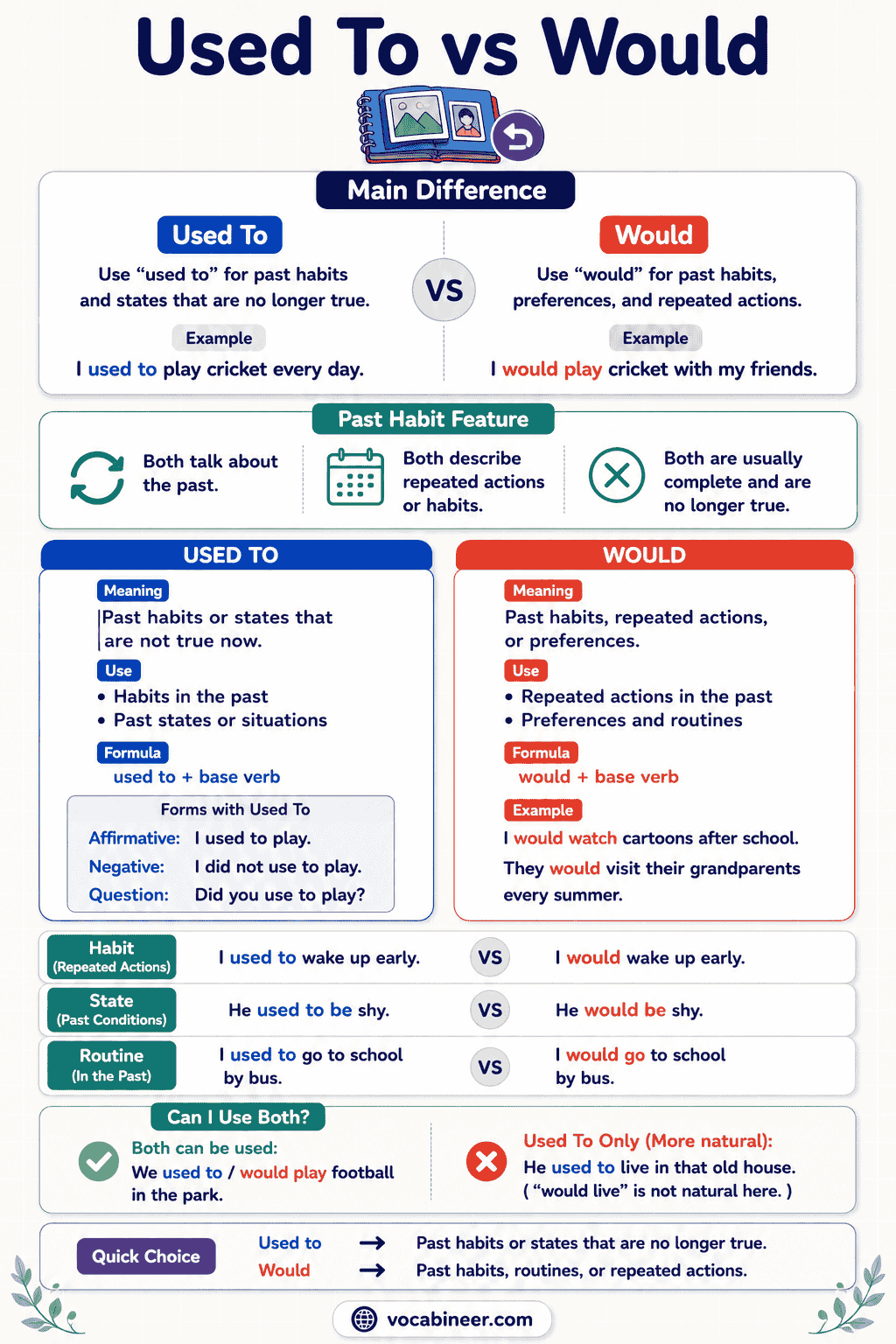
Used To vs Would: What Is the Difference?
The main difference concerns past habits, past states, and context.
| Used To | Would |
|---|---|
| describes repeated past actions | describes repeated past actions |
| can also describe past states and situations | does not normally describe past states |
| strongly presents the habit or state as belonging to the past | presents repeated behavior within an established past context |
| common in everyday speech and writing | especially natural in storytelling and recollection |
| used to + V1 | would + V1 |
| I used to play outside every day. | Every evening, we would play outside. |
| I used to live in Lahore. | not normally: I would live in Lahore. |
A useful core rule is:
Used to can describe both repeated past actions and past states, while would normally describes repeated past actions only.
Used To vs Would at a Glance
| Meaning | Used To | Would |
|---|---|---|
| repeated past habit | I used to walk to school. | I would walk to school every day. |
| past state | I used to know him well. | — |
| past living situation | We used to live near the sea. | — |
| repeated story action | possible | especially natural |
| past situation that changed | strongly expressed | usually inferred from context |
| question about past habit or state | Did you use to…? | uncommon with habitual would |
| negative past habit or state | didn’t use to | uncommon with habitual would |
The most important distinction is simple: both forms can describe repeated actions, but only used to normally describes past states.
How Used To and Would Are Formed
The two forms use the base verb.
| Feature | Used To | Would |
|---|---|---|
| affirmative | used to + V1 | would + V1 |
| negative | did not use to + V1 | would not + V1 |
| question | Did + subject + use to + V1? | Would + subject + V1? |
| common contraction | didn’t use to | wouldn’t |
Examples:
- I used to walk to school.
- Every morning, I would walk to school.
- I didn’t use to like coffee.
- Did you use to live here?
Although would has normal question and negative forms in English generally, they are not usually the standard forms for asking about or negating habitual past meaning.
Past Habits: When Both Forms Are Possible
For repeated past actions, used to and would can often express similar meaning.
| Used To | Would |
|---|---|
| I used to visit my grandparents every Sunday. | Every Sunday, I would visit my grandparents. |
| We used to play outside after school. | After school, we would play outside. |
| My father used to read to us at night. | My father would read to us every night. |
| We used to walk by the river. | In the evenings, we would walk by the river. |
Both forms describe recurring behavior. However, would is usually more natural when the past time or setting has already been established.
For example:
- When I was a child, I used to visit my grandparents every summer.
- When I was a child, I would visit my grandparents every summer.
Both are natural because the past context is clear.
Past States: Used To, Not Normally Would
This is the most important difference between the two forms.
Use used to for past states, conditions, possession, beliefs, and situations.
Examples:
- I used to be very shy.
- She used to know my sister.
- We used to live in Karachi.
- He used to have long hair.
- They used to own that house.
- I used to believe that story.
Habitual would does not normally replace used to in these meanings.
Not normally:
- I would be very shy.
- We would live in Karachi.
- They would own that house.
The stronger principle is:
Used to can describe a past state or situation, while habitual would normally requires a repeated action.
Repeated Actions vs Past States
The contrast is easy to see in a compact table.
| Repeated Past Action | Past State |
|---|---|
| We used to visit the beach every summer. | We used to live near the beach. |
| We would visit the beach every summer. | not normally: We would live near the beach. |
| both forms can work | used to is the normal choice |
The verb meaning determines whether habitual would is suitable.
Used To for Past Situations That Changed
Used to strongly presents a habit or state as characteristic of an earlier period and normally suggests that the situation is different now.
Examples:
- I used to smoke, but I quit.
- She used to live in London, but now she lives in Manchester.
- We used to play football every Friday, but we do not anymore.
- Daniel used to have long hair, but now it is short.
A useful principle is:
Used to normally implies a contrast between an earlier situation and the present.
That contrast can apply to both repeated actions and states.
Does Would Mean the Habit No Longer Happens?
Would can describe repeated behavior located in a past period.
For example:
- When we were children, we would swim in the river every summer.
The context places the habit in the past, so readers may infer that it no longer happens. However, would does not mark the past-to-present contrast as directly as used to does.
| Used To | Would |
|---|---|
| directly presents a habit or state as characteristic of the past | presents repeated behavior within a past setting |
| often makes past-to-present change more explicit | change is usually inferred from context |
Compare:
- I used to walk to school.
- When I was ten, I would walk to school every day.
The first directly presents the habit as former. The second focuses on repeated behavior within the stated past period.
Why Would Usually Needs Past Context
Habitual would is especially natural after the past period or situation has already been established.
Less clear without context:
- I would walk to school every day.
Clearer:
- When I was a child, I would walk to school every day.
Another natural pattern is:
- We used to live in a small village.
- Every evening, my brother and I would walk to the river.
- We would sit there until sunset.
The first sentence establishes the setting. The later sentences use would for repeated actions within it.
Use this principle:
Habitual would works especially well once the past time, period, or situation is already clear.
Used To and Would in Stories
The two forms often work well together in memories and stories.
| Used To | Would |
|---|---|
| can establish a past state, situation, or general habit | can develop repeated actions within that setting |
| We used to live near the sea. | Every morning, we would walk along the beach. |
| My grandmother used to have a garden. | In summer, she would spend hours working in it. |
Example:
- We used to live in a small house near the river.
- Every morning, my father would get up early.
- He would make tea and sit outside before work.
- In the evening, we would eat together on the porch.
Used to establishes the former situation, while would develops the repeated actions within it.
Used To vs Would in Questions
For questions about past habits or states, Did … use to…? is the standard form.
Examples:
- Did you use to play football?
- Did she use to live here?
- Did they use to have a car?
- Did he use to visit often?
Habitual would is not normally the default question form.
For example:
- Would you play football as a child?
can be understood in some contexts, but it is not the straightforward equivalent of:
- Did you use to play football as a child?
Use this principle:
Use Did … use to…? as the normal question form for past habits and states.
Used To vs Would in Negatives
For ordinary negative past habits or states, didn’t use to is generally clearer and more natural.
Examples:
- I didn’t use to like coffee.
- She didn’t use to live here.
- We didn’t use to eat out much.
- Daniel didn’t use to exercise regularly.
Be careful with wouldn’t, because it often expresses refusal, unwillingness, or failure rather than a simple negative habit.
| Didn’t Use To | Wouldn’t |
|---|---|
| describes absence of a former habit or state | can express refusal or unwillingness |
| He didn’t use to eat vegetables. | He wouldn’t eat the vegetables. |
| he did not have that habit | he refused to eat them |
The forms are therefore not always interchangeable in negatives.
Did You Use To or Did You Used To?
The standard form after did is use to.
Correct:
- Did you use to live here?
- Did she use to work with you?
- He didn’t use to drink coffee.
Avoid in standard formal writing:
- Did you used to live here?
- She didn’t used to like coffee.
A simple rule is:
After did or didn’t, use the base form use to.
Used To vs Past Simple
Past Simple can also describe past habits and states, but the emphasis can differ.
| Used To | Past Simple |
|---|---|
| emphasizes an old habit or state | states a past fact, habit, or state |
| We used to go there every summer. | We went there every summer. |
| She used to live in London. | She lived in London. |
| often suggests a contrast with the present | does not automatically emphasize present change |
Compare:
- She used to live in London.
- She lived in London from 2015 to 2020.
The first emphasizes a former situation. The second simply identifies a finished past fact.
One-Time Past Events
Used to and habitual would describe recurring patterns or former states, not single completed events.
Use Past Simple for an event that happened once.
Correct:
- I visited Paris in 2022.
- She met him at the conference.
- We moved house in June.
Not for one-time meaning:
- I used to visit Paris in 2022.
- I would visit Paris in 2022.
Use this rule:
Past Simple describes a single completed past event, while used to and habitual would describe recurring patterns or former situations.
Used To vs Be Used To
These structures look similar but have different meanings.
| Used To + V1 | Be Used To + Noun/V-ing |
|---|---|
| describes a past habit or state | means be accustomed to something |
| I used to wake early. | I am used to waking early. |
| describes an earlier situation | describes familiarity |
Compare:
- I used to drive to work.
Driving to work was my past habit. - I am used to driving in heavy traffic.
Driving in heavy traffic is familiar to me.
Do not confuse used to + V1 with be used to + V-ing.
Other Meanings of Would
The comparison in this article concerns habitual would only.
Would also has several other functions.
Examples:
- Would you help me? → polite request
- I would travel more if I had time. → conditional meaning
- He said he would call. → future in the past
- She said she would arrive later. → reported future
- The car wouldn’t start. → failure or refusal-type meaning depending on context
These uses do not express past habits.
Use this principle:
Used To vs Would applies specifically to habitual would, not to every grammatical use of would.
Time Expressions with Used To and Would
Several expressions commonly establish past time or repetition.
Examples include:
- when I was a child
- every day
- every evening
- every summer
- on Sundays
- whenever
- back then
- in those days
Examples:
- When I was a child, I used to swim every day.
- Every summer, we would visit our grandparents.
- In those days, my father used to work nearby.
- On Sundays, we would eat together.
These expressions help establish the context, but they do not automatically determine which form to use.
The central distinctions remain:
- repeated action
- past state
- established past context
Common Used To vs Would Mistakes
Learners often make mistakes by assuming the two forms are fully interchangeable.
Using would for a past state
Incorrect for habitual-state meaning:
- I would know him well when I was younger.
Correct:
- I used to know him well.
Using would for a past living situation
Incorrect for the intended state:
- We would live in London when I was young.
Correct:
- We used to live in London when I was young.
Assuming used to and would are always interchangeable
Incorrect rule:
Used to = would in every sentence.
Better principle:
They often overlap for repeated actions, but used to can also describe states while habitual would normally cannot.
Using would without clear past context
Less natural:
- I would play football every evening.
Clearer:
- When I was at school, I would play football every evening.
Using used to for a one-time event
Incorrect for one visit:
- I used to visit Paris in 2022.
Correct:
- I visited Paris in 2022.
Writing Did you used to
Avoid:
- Did you used to live here?
Standard:
- Did you use to live here?
Writing didn’t used to
Avoid:
- I didn’t used to like tea.
Standard:
- I didn’t use to like tea.
Using wouldn’t as the automatic negative of habitual would
Potentially different meaning:
- He wouldn’t eat vegetables.
This can mean that he refused to eat them.
For a simple negative former habit:
- He didn’t use to eat vegetables.
Confusing used to with be used to
Incorrect:
- I am used to wake early.
Correct:
- I am used to waking early.
Treating every would as a past habit
Incorrect assumption:
Would always describes repeated past behavior.
Better principle:
Would also expresses polite requests, conditional meaning, future in the past, reported future, and other functions. Context determines its meaning.
FAQs
Used to can describe both repeated past actions and past states, while habitual would normally describes repeated past actions only.
Yes. Both forms can often describe repeated past actions, especially when the past context is clear. For example, We used to visit our grandparents every summer and Every summer, we would visit our grandparents can express similar habitual meaning.
Habitual would normally describes repeated actions rather than states. Use used to for former states such as I used to know him, We used to live there, and She used to own that house.
The standard form is Did you use to…? because did already marks the past tense, so the following verb uses its base form.
Use Past Simple for one-time completed events and whenever you simply want to state a past fact without emphasizing a former habit or recurring pattern.
Read More
- 12 English Tenses Chart
- All Tenses Rules and Formula
- English Tenses with Examples
- Present Tenses in English
- Past Tenses in English
- Future Tenses in English
- Be Going To in English