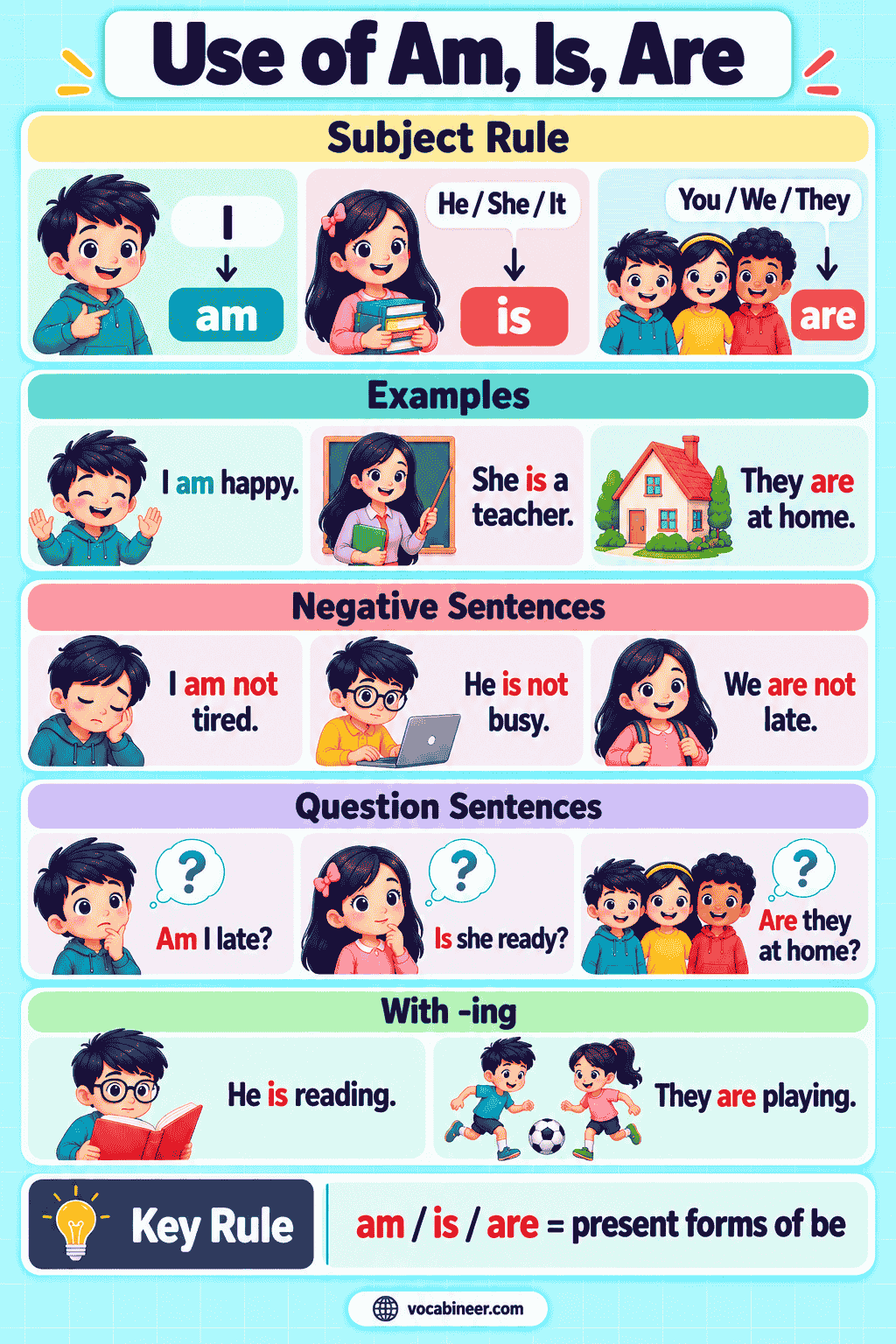
Am, is, and are are present forms of the verb be. They help us identify people and things, describe qualities and feelings, show locations, and form continuous verb structures such as I am reading or They are playing.
Learning the correct use of am, is, and are is one of the first steps in building accurate English sentences. The main rule is simple: use am with I, is with he, she, it, and singular nouns, and are with you, we, they, and plural nouns.
In This Page
Quick Rule for Am, Is, and Are
| Subject | Correct Form | Example |
|---|---|---|
| I | am | I am ready. |
| he | is | He is tired. |
| she | is | She is happy. |
| it | is | It is cold. |
| singular noun | is | The book is new. |
| you | are | You are late. |
| we | are | We are ready. |
| they | are | They are students. |
| plural noun | are | The books are new. |
A useful memory pattern is:
I → am
He / She / It / singular noun → is
You / We / They / plural noun → are
Use of Am
Use am only with the subject I in the present tense.
Examples:
- I am happy.
- I am tired.
- I am ready.
- I am a student.
- I am at home.
- I am hungry.
- I am ten years old.
- I am learning English.
Do not use is or are directly with I.
Incorrect:
- I is ready.
- I are ready.
Correct:
- I am ready.
Use of Is
Use is with:
- he
- she
- it
- singular nouns
Examples:
- He is my brother.
- She is a doctor.
- It is cold today.
- The dog is hungry.
- My teacher is kind.
- The book is on the table.
- Sara is at school.
- The room is clean.
In general, is matches one person, animal, thing, or singular noun, except I and you.
Use of Are
Use are with:
- you
- we
- they
- plural nouns
Examples:
- You are my friend.
- We are ready.
- They are at home.
- The children are happy.
- My shoes are wet.
- The books are on the desk.
- Sara and Ali are classmates.
- These apples are fresh.
Importantly, you always takes are, whether it refers to one person or several people.
Am, Is, Are with Nouns
Am, is, and are can connect the subject with a noun or noun phrase. This pattern often shows identity, occupation, relationship, or category.
Examples:
- I am a student.
- She is a teacher.
- He is my brother.
- Sara is the team leader.
- We are friends.
- They are doctors.
- Ali and Hamza are classmates.
- This is my book.
This pattern is especially common when saying who or what someone is.
Am, Is, Are with Adjectives
Am, is, and are also connect the subject with an adjective.
Examples:
- I am tired.
- She is happy.
- He is tall.
- The food is hot.
- We are busy.
- They are hungry.
- The children are excited.
- My parents are tired.
English normally needs a form of be before an adjective that describes the subject.
Incorrect:
- She happy.
Correct:
- She is happy.
Am, Is, Are for Location
These forms can show where a person, animal, or thing is.
Examples:
- I am at home.
- She is in the kitchen.
- He is at school.
- The cat is under the table.
- We are in the garden.
- They are on the bus.
- The books are on the shelf.
- My bag is beside the chair.
This pattern is one of the most useful forms in everyday conversation.
Am, Is, Are for Feelings and Conditions
Am, is, and are frequently describe feelings, physical conditions, or temporary states.
Examples:
- I am hungry.
- She is nervous.
- He is sick.
- The baby is sleepy.
- We are excited.
- They are tired.
- You are right.
- The children are afraid.
Because these words describe the subject, they usually follow the correct form of be.
Am, Is, Are with Age
English also uses be when stating age.
Examples:
- I am ten years old.
- She is six years old.
- He is twenty.
- My sister is twelve.
- We are the same age.
Do not omit am, is, or are in these sentences.
Negative Sentences with Am, Is, Are
To make a negative sentence, add not after am, is, or are.
| Positive | Negative |
|---|---|
| I am ready. | I am not ready. |
| She is tired. | She is not / isn’t tired. |
| He is busy. | He is not / isn’t busy. |
| We are late. | We are not / aren’t late. |
| They are ready. | They are not / aren’t ready. |
Examples:
- I am not angry.
- She isn’t at home.
- He isn’t busy.
- The shop isn’t open.
- We aren’t late.
- They aren’t ready.
- The children aren’t outside.
Unlike is not and are not, am not does not usually become amn’t in standard English.
Questions with Am, Is, and Are
To form a question, move am, is, or are before the subject.
Examples:
- Am I late?
- Is she your sister?
- Is he at school?
- Is the shop open?
- Are you ready?
- Are we early?
- Are they at home?
- Are the children hungry?
Compare:
Statement:
- She is happy.
Question:
- Is she happy?
WH-Questions with Am, Is, Are
Question words such as what, where, who, why, and how can also appear before am, is, or are.
Examples:
- Where are you?
- Who is she?
- Why is he upset?
- How are they?
- What is your name?
- Where are the children?
- Why are you tired?
- Who is your teacher?
These patterns are especially useful in daily conversation.
Short Answers with Am, Is, and Are
Short answers repeat the correct form of be.
- Are you ready? — Yes, I am. / No, I’m not.
- Is she at home? — Yes, she is. / No, she isn’t.
- Is he your brother? — Yes, he is. / No, he isn’t.
- Are they busy? — Yes, they are. / No, they aren’t.
Positive short answers normally use the full form:
- Yes, she is.
- Yes, they are.
Contractions of Am, Is, and Are
Contractions are common in speaking and informal writing.
| Full Form | Contraction |
|---|---|
| I am | I’m |
| he is | he’s |
| she is | she’s |
| it is | it’s |
| you are | you’re |
| we are | we’re |
| they are | they’re |
| is not | isn’t |
| are not | aren’t |
Examples:
- I’m ready.
- She’s at home.
- He’s tired.
- We’re late.
- They’re outside.
- She isn’t busy.
- We aren’t hungry.
Am, Is, Are + Verb-ing
Am, is, and are also work as helping verbs before an -ing verb in the Present Continuous.
The pattern is:
subject + am/is/are + verb-ing
Examples:
- I am reading.
- She is cooking.
- He is sleeping.
- The baby is crying.
- We are studying.
- They are playing.
- You are listening.
- The children are running.
Here, am/is/are do not simply describe the subject. Instead, they help form a verb structure that usually describes an action happening around the present time.
Incorrect:
- He playing football.
Correct:
- He is playing football.
Negative Sentences with Verb-ing
Add not after am, is, or are.
Examples:
- I am not working.
- She isn’t sleeping.
- He isn’t studying.
- We aren’t playing.
- They aren’t coming.
- The baby isn’t crying.
Questions with Am, Is, Are + Verb-ing
Move am, is, or are before the subject.
Examples:
- Are you listening?
- Is she working?
- Is he sleeping?
- Are they coming?
- What are you doing?
- Why is she crying?
This pattern belongs to the Present Continuous.
There Is and There Are
Use there is when talking about one person or thing.
Examples:
- There is a book on the table.
- There is a cat outside.
- There is one student in the room.
- There is a problem.
Use there are with plural nouns.
Examples:
- There are three books on the table.
- There are many students outside.
- There are two chairs in the room.
- There are some apples in the basket.
Therefore:
There is + singular noun
There are + plural noun
Is and Are with Singular and Plural Nouns
The number of the subject usually determines whether you need is or are.
| Singular | Plural |
|---|---|
| The boy is happy. | The boys are happy. |
| The book is new. | The books are new. |
| My friend is here. | My friends are here. |
| The child is tired. | The children are tired. |
| This apple is fresh. | These apples are fresh. |
This pattern makes the difference between is and are much easier to recognize.
What Can Come After Am, Is, and Are?
Am, is, and are can appear before different types of words and phrases.
| What Comes Next | Example |
|---|---|
| noun | She is a teacher. |
| adjective | She is happy. |
| location phrase | She is at home. |
| verb-ing | She is working. |
These four patterns cover many of the most common beginner sentences in English.
Am, Is, Are vs Do and Does
Learners often confuse am/is/are with do/does, especially in questions.
Use am/is/are when be itself is the main verb:
- Are you tired?
- Is she a teacher?
- Are they at home?
Use do/does with ordinary Present Simple action verbs:
- Do you like coffee?
- Does she work here?
- Do they play football?
Compare:
Incorrect:
- Are you like coffee?
Correct:
- Do you like coffee?
However, this sentence is correct:
- Are you drinking coffee?
Here, are + drinking forms the Present Continuous.
Common Mistakes with Am, Is, and Are
Using Is with I
Incorrect: I is happy.
Correct: I am happy.
Using Are with He, She, or It
Incorrect: She are tired.
Correct: She is tired.
Using Is with a Plural Noun
Incorrect: The children is ready.
Correct: The children are ready.
Forgetting Be before an Adjective
Incorrect: He tired.
Correct: He is tired.
Forgetting Be before Verb-ing
Incorrect: They playing football.
Correct: They are playing football.
Using Am, Is, or Are instead of Do/Does
Incorrect: Are you like tea?
Correct: Do you like tea?
Using There Is with Plural Nouns
Incorrect: There is many books.
Correct: There are many books.
Easy Am, Is, Are Sentences for Kids
These simple examples are useful for children and beginners:
- I am happy.
- She is my friend.
- He is tall.
- It is hot.
- We are ready.
- They are playing.
- The dog is hungry.
- The books are new.
- I am reading.
- She is singing.
- We are learning English.
- They are at school.
FAQs
Use am with I, is with he, she, it, and singular nouns, and are with you, we, they, and plural nouns. These forms can connect a subject with a noun, adjective, location, or an -ing verb.
Use is mainly with singular subjects, such as The boy is happy. By contrast, use are with plural subjects, such as The boys are happy. The pronoun you also always takes are.
Yes. Am/is/are + verb-ing forms the Present Continuous, as in I am reading, She is working, and They are playing.
Use there is before a singular noun and there are before plural nouns. For example, There is a book on the desk and There are three books on the desk.
Use are when the verb be is required or when forming the Present Continuous, as in Are you tired? and Are you working? Use do with ordinary Present Simple action verbs, as in Do you work here?
Am is the present form of be that agrees specifically with the subject I. Therefore, I am ready is correct, while I is ready is not.
Read More
- 12 English Tenses Chart
- All Tenses Rules and Formula
- English Tenses with Examples
- Present Tenses in English
- Past Tenses in English
- Future Tenses in English
- Be Going To in English