Have got and has got are common present-time forms used to talk about possession, relationships, appearance, characteristics, and similar situations. They are especially common in everyday spoken English and often have the same basic meaning as have and has.
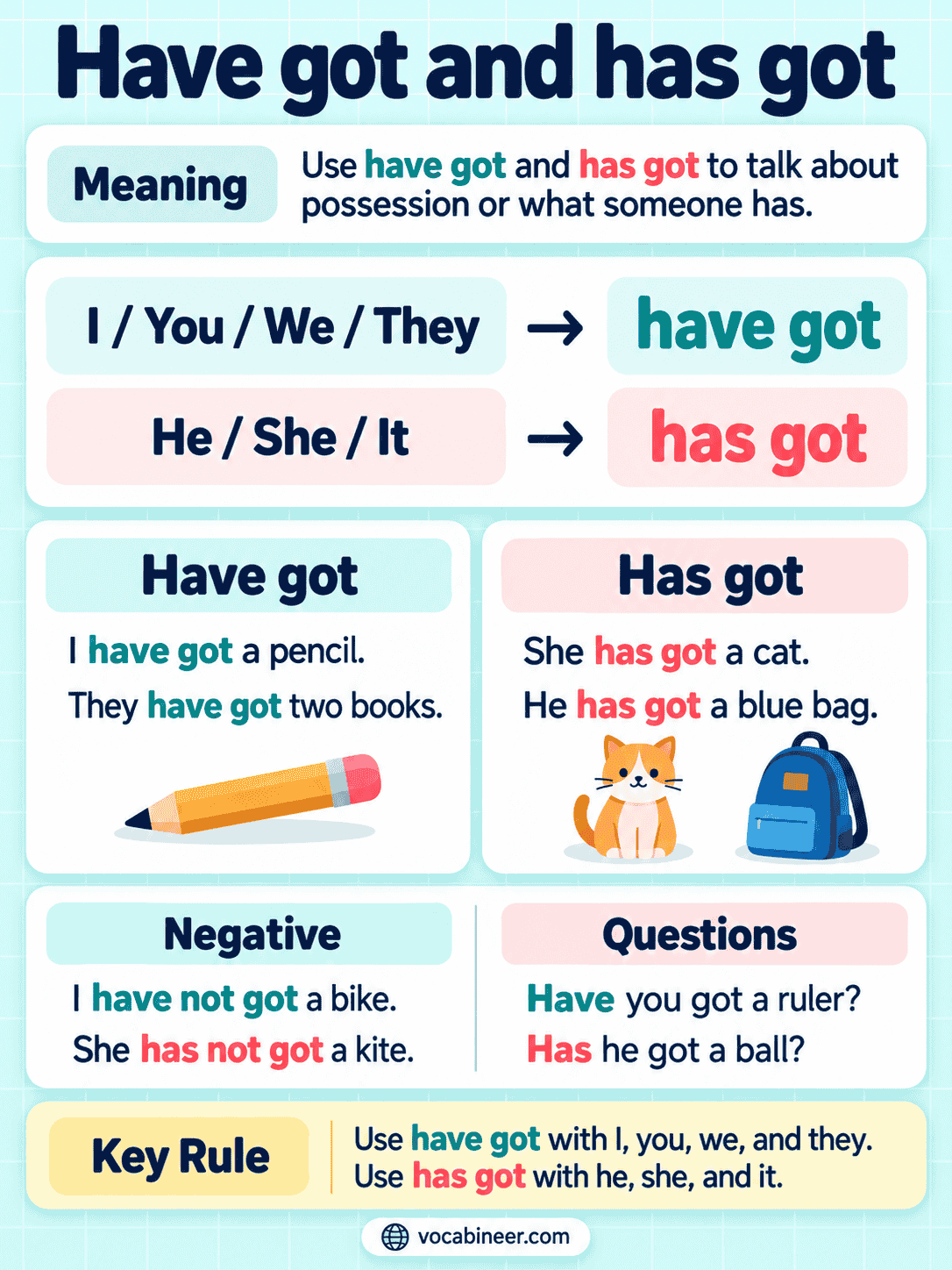
Learning the correct use of have got and has got helps beginners form clear statements, negatives, questions, and short answers. Use have got with I, you, we, they, and plural nouns, while has got goes with he, she, it, and singular nouns.
In This Page
Quick Rule for Have Got and Has Got
| Subject | Correct Form | Example |
|---|---|---|
| I | have got | I have got a bike. |
| you | have got | You have got a phone. |
| he | has got | He has got a car. |
| she | has got | She has got long hair. |
| it | has got | It has got four legs. |
| we | have got | We have got a garden. |
| they | have got | They have got two children. |
| singular noun | has got | Sara has got a laptop. |
| plural noun | have got | The boys have got new bags. |
A simple memory rule is:
I / You / We / They / plural noun → have got
He / She / It / singular noun → has got
Use of Have Got
Use have got with I, you, we, they, and plural nouns.
Examples:
- I have got a new phone.
- You have got a good idea.
- We have got a garden.
- They have got two children.
- The students have got new books.
- My parents have got a car.
- These flowers have got long stems.
Contractions are also common:
- I’ve got
- you’ve got
- we’ve got
- they’ve got
For example:
- I’ve got a new phone.
- We’ve got enough time.
Use of Has Got
Use has got with he, she, it, and singular nouns.
Examples:
- He has got a bicycle.
- She has got a new job.
- It has got a long tail.
- Sara has got brown eyes.
- The house has got three bedrooms.
- My brother has got a laptop.
- The dog has got a collar.
Common contractions include:
- he’s got
- she’s got
- it’s got
Here, ’s means has.
For example:
- She’s got blue eyes.
- He’s got a new bag.
Have Got and Has Got for Possession
One of the main uses of have got and has got is to show possession.
Examples:
- I have got a car.
- She has got a bicycle.
- We have got a house.
- He has got a laptop.
- They have got two pets.
- The school has got a library.
- My parents have got a small garden.
These sentences show what someone or something possesses.
Have Got and Has Got for Family and Relationships
These forms can also describe family and personal relationships.
Examples:
- I have got two brothers.
- She has got a sister.
- He has got many cousins.
- We have got relatives nearby.
- They have got three children.
- Sara has got a large family.
In these examples, the meaning is relationship rather than physical ownership.
Have Got and Has Got for Appearance
Have got and has got are very common when describing physical appearance.
Examples:
- I have got brown hair.
- She has got blue eyes.
- He has got a beard.
- They have got curly hair.
- The baby has got dark eyes.
- The dog has got a long tail.
This makes the structure useful for describing people and animals.
Have Got and Has Got for Characteristics
These forms can also describe features or characteristics.
Examples:
- The house has got three bedrooms.
- The car has got four doors.
- This phone has got a large screen.
- Elephants have got large ears.
- The plant has got long leaves.
- These bags have got strong handles.
This use extends naturally from possession into description.
Have Got and Has Got for Illnesses and Conditions
These forms can also appear with some physical conditions.
Examples:
- I have got a headache.
- She has got a cold.
- He has got a sore throat.
- They have got a fever.
This is a common everyday use, especially in conversation.
Have Got and Has Got for Events and Abstract Things
Have got and has got can also refer to events, plans, ideas, or problems.
Examples:
- We have got a meeting this afternoon.
- They have got practice tonight.
- I have got an idea.
- She has got a problem.
- He has got a question.
- We have got enough time.
These examples show that the structure is not limited to physical possession.
Negative Sentences with Have Got and Has Got
To make a negative sentence, add not after have or has.
| Positive | Negative |
|---|---|
| I have got a car. | I haven’t got a car. |
| She has got a bike. | She hasn’t got a bike. |
| We have got time. | We haven’t got time. |
| He has got a ticket. | He hasn’t got a ticket. |
Examples:
- I haven’t got a car.
- You haven’t got much time.
- We haven’t got a garden.
- They haven’t got any questions.
- She hasn’t got a bicycle.
- He hasn’t got a ticket.
- The house hasn’t got a garage.
The common negative forms are:
- have not got → haven’t got
- has not got → hasn’t got
Questions with Have Got and Has Got
To make a question, move have or has before the subject.
Examples:
- Have you got a car?
- Have they got any children?
- Have we got enough time?
- Has she got a brother?
- Has he got a ticket?
- Has the house got a garden?
The structure is:
Have/Has + subject + got + … ?
WH-Questions with Have Got and Has Got
Question words can also come before have or has.
Examples:
- What have you got?
- How many brothers have you got?
- What colour eyes has she got?
- How many rooms has the house got?
- What kind of phone has he got?
These patterns are especially useful in beginner speaking practice.
Short Answers with Have Got and Has Got
Short answers repeat have or has, but usually omit got.
Examples:
- Have you got a car? — Yes, I have. / No, I haven’t.
- Has she got a sister? — Yes, she has. / No, she hasn’t.
- Have they got tickets? — Yes, they have. / No, they haven’t.
- Has he got a phone? — Yes, he has. / No, he hasn’t.
Natural:
- Yes, I have.
Less natural as a short answer:
- Yes, I have got.
Contractions of Have Got and Has Got
Contractions are common in speech and informal writing.
| Full Form | Contraction |
|---|---|
| I have got | I’ve got |
| you have got | you’ve got |
| he has got | he’s got |
| she has got | she’s got |
| it has got | it’s got |
| we have got | we’ve got |
| they have got | they’ve got |
| have not got | haven’t got |
| has not got | hasn’t got |
Examples:
- I’ve got a new phone.
- She’s got blue eyes.
- He’s got a bicycle.
- We’ve got enough food.
- They haven’t got a car.
- She hasn’t got a ticket.
Have Got vs Have
Have got and have often express the same basic meaning in possession and relationship contexts.
| Have Got | Have |
|---|---|
| I have got a car. | I have a car. |
| She has got two sisters. | She has two sisters. |
| Have you got a car? | Do you have a car? |
| She hasn’t got a car. | She doesn’t have a car. |
The meaning is often similar, but the sentence patterns differ.
Have You Got vs Do You Have?
Both questions can ask about possession:
- Have you got a car?
- Do you have a car?
However, do not mix the two structures.
Correct:
- Have you got a car?
- Do you have a car?
Incorrect:
- Do you have got a car?
The patterns are:
Have/Has + subject + got?
Do/Does + subject + have?
Haven’t Got vs Don’t Have
Both forms can express lack of possession.
Examples:
- I haven’t got a car.
- I don’t have a car.
Likewise:
- She hasn’t got a ticket.
- She doesn’t have a ticket.
The meaning is usually similar, but the grammar structure is different.
British and American English Usage
Have got is especially common in informal British English. Plain have is very common in American English.
For example:
British-style:
- Have you got a pen?
- I haven’t got any money.
Common American-style:
- Do you have a pen?
- I don’t have any money.
However, these are tendencies rather than strict boundaries, so learners may encounter both patterns.
Past Form of Have Got and Has Got
For ordinary past possession, use had.
Present:
- I have got a bicycle.
- She has got a car.
- They have got a garden.
Past:
- I had a bicycle when I was young.
- She had a car last year.
- They had a garden at their old house.
Therefore, beginners should not simply change have got to had got for ordinary past possession.
Have Got vs Had
The present and past patterns can be compared directly.
| Present | Past |
|---|---|
| I have got a car. | I had a car. |
| She has got a bike. | She had a bike. |
| They have got a garden. | They had a garden. |
| He has got a laptop. | He had a laptop. |
This makes the time difference easy to recognize.
Have Got vs Have Got To
These structures look similar but have different meanings.
| Have Got | Have Got To |
|---|---|
| possession or related meaning | necessity or obligation |
| I have got a car. | I have got to leave. |
| She has got a new phone. | She has got to work late. |
Therefore, have got to should not be treated as another possession pattern.
What Can Follow Have Got and Has Got?
Different nouns and phrases can follow these structures.
| Meaning | Example |
|---|---|
| possession | She has got a car. |
| relationship | She has got two sisters. |
| appearance | She has got blue eyes. |
| characteristic | The house has got three rooms. |
| condition | He has got a headache. |
| abstract thing | We have got a problem. |
These patterns cover most everyday beginner uses.
Have Got and Has Got with Singular and Plural Nouns
The subject determines whether you need has got or have got.
| Singular Subject | Plural Subject |
|---|---|
| The boy has got a bike. | The boys have got bikes. |
| The dog has got a collar. | The dogs have got collars. |
| My friend has got a car. | My friends have got cars. |
| The house has got a garden. | The houses have got gardens. |
This rule works in the same way as has vs have.
Common Mistakes with Have Got and Has Got
Using Have Got with He, She, or It
Incorrect: She have got a car.
Correct: She has got a car.
Using Has Got with I, You, We, or They
Incorrect: They has got a house.
Correct: They have got a house.
Using Do with Have Got
Incorrect: Do you have got a car?
Correct: Have you got a car?
Using Doesn’t with Has Got
Incorrect: She doesn’t have got a bicycle.
Correct: She hasn’t got a bicycle.
Keeping Got in a Short Answer
Less natural: Yes, I have got.
Natural: Yes, I have.
Using the Present Form for Past Possession
Incorrect: Last year, I have got a bicycle.
Correct: Last year, I had a bicycle.
Confusing Have Got with Have Got To
I’ve got a car. → possession
I’ve got to leave. → necessity
Easy Have Got and Has Got Sentences for Kids
These short examples are useful for children and beginners:
- I have got a book.
- You have got a red bag.
- She has got a doll.
- He has got a bicycle.
- The cat has got a long tail.
- We have got two pets.
- They have got new shoes.
- Sara has got brown eyes.
- I haven’t got a pencil.
- Have you got a ruler?
- Has he got a ball?
- The dog hasn’t got a collar.
FAQs
Use have got with I, you, we, they, and plural nouns. Use has got with he, she, it, and singular nouns.
They commonly express present possession, relationships, appearance, characteristics, conditions, and similar present situations.
Both can express the same basic possession meaning. However, their question and negative patterns differ: Have you got a car? versus Do you have a car?
Have got is especially common in informal British English, while plain have is very common in American English. Both forms are widely understood.
For ordinary past possession, use had. For example, I have got a bicycle becomes I had a bicycle when I was young.
Read More
- 12 English Tenses Chart
- All Tenses Rules and Formula
- English Tenses with Examples
- Present Tenses in English
- Past Tenses in English
- Future Tenses in English
- Be Going To in English