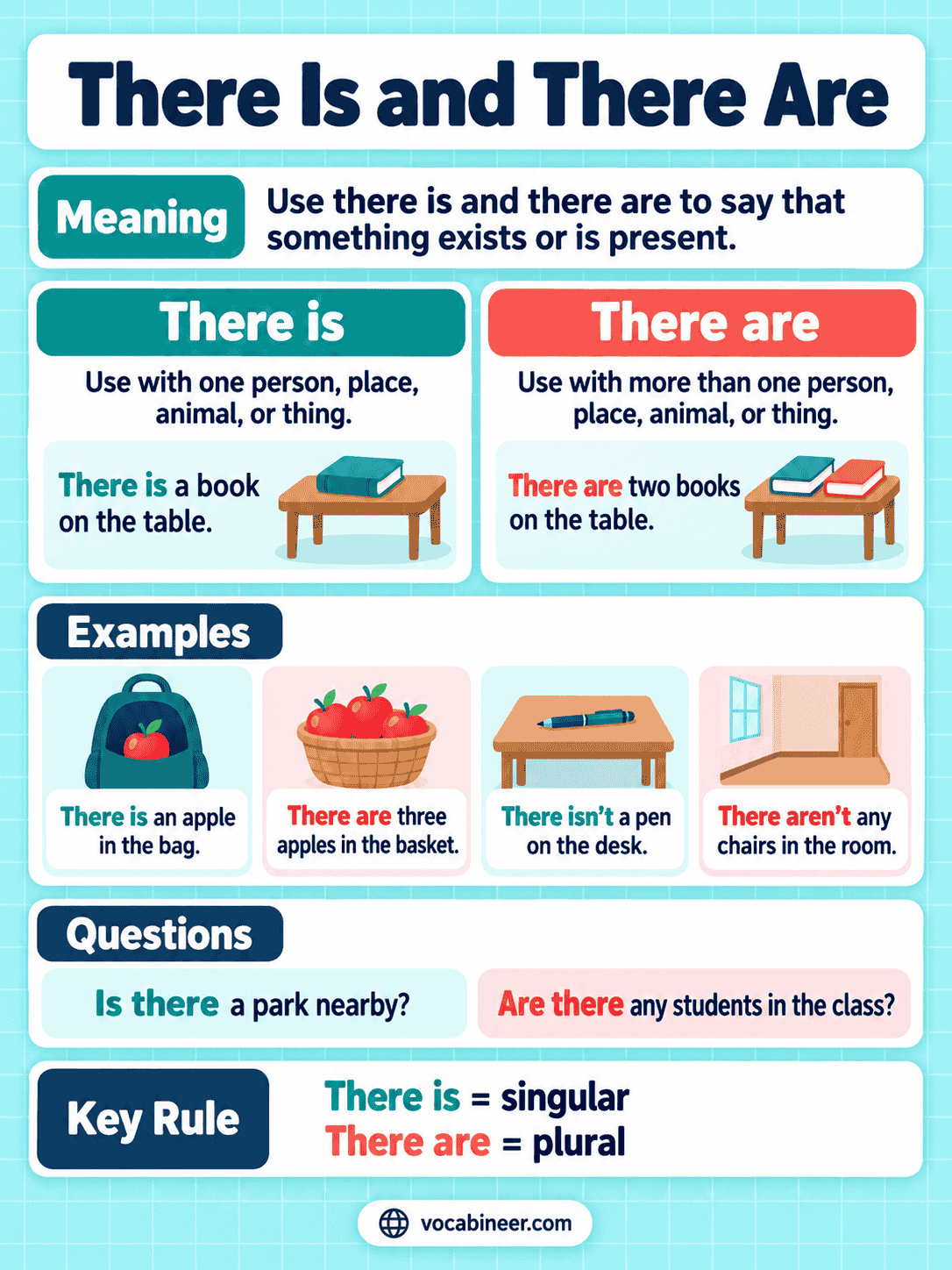
There is and there are are common English structures used to say that someone or something exists, is present, or can be found in a place or situation. They are especially useful when describing rooms, houses, classrooms, pictures, towns, objects, and quantities.
Learning the correct use of there is and there are helps beginners build clear descriptive sentences. Use there is with singular and uncountable nouns, while there are goes with plural nouns.
In This Page
Quick Rule for There Is and There Are
| Noun Type | Correct Form | Example |
|---|---|---|
| singular countable noun | there is | There is a book on the desk. |
| uncountable noun | there is | There is some milk in the fridge. |
| plural noun | there are | There are three books on the desk. |
A simple memory rule is:
One thing → there is
Uncountable noun → there is
Two or more things → there are
What Do There Is and There Are Mean?
There is and there are introduce the existence or presence of people, things, or features.
Examples:
- There is a café near my house.
- There are two parks in the area.
- There is some water in the bottle.
- There are many students in the classroom.
The noun that follows is or are determines which form is correct.
Use of There Is
Use there is with one person or thing and with singular countable nouns.
Examples:
- There is a book on the table.
- There is a cat outside.
- There is a problem.
- There is a shop near the school.
- There is one chair in the room.
- There is a student at the door.
- There is a park near my house.
A common pattern is:
There is + a/an + singular noun
Examples:
- There is a car outside.
- There is an apple in the bag.
Use of There Are
Use there are with plural nouns.
Examples:
- There are two books on the desk.
- There are several shops nearby.
- There are many students in the hall.
- There are three chairs in the room.
- There are some apples in the basket.
- There are many trees in the park.
- There are two windows beside the door.
The difference is simple: singular takes is, while plural takes are.
There Is with Uncountable Nouns
Use there is with uncountable nouns.
Examples:
- There is some milk in the fridge.
- There is water on the floor.
- There is rice in the bowl.
- There is traffic on the road.
- There is information on the website.
- There is sugar in the jar.
- There is enough time.
These nouns do not normally use there are because they are not counted as separate individual units in this context.
There Is with A and An
Use a or an with a singular countable noun after there is.
Examples:
- There is a dog outside.
- There is a park near the school.
- There is an orange on the table.
- There is an interesting book on the shelf.
Do not use a/an before plural or uncountable nouns.
There Are with Numbers
Numbers commonly follow there are.
Examples:
- There are two windows in the room.
- There are five students outside.
- There are ten apples in the box.
- There are three cars on the street.
- There are six chairs around the table.
This pattern is especially useful when describing quantities.
There Is and There Are with Some
Use some mainly in affirmative sentences with plural and uncountable nouns.
Examples:
- There are some books on the shelf.
- There are some children outside.
- There are some apples in the basket.
- There is some milk in the fridge.
- There is some bread on the table.
- There is some water in the bottle.
There Is and There Are with Any
Use any commonly in questions and negative sentences.
Examples:
- Is there any milk?
- Is there any water?
- Are there any books?
- Are there any students outside?
- There isn’t any bread.
- There aren’t any chairs.
This pattern is especially useful with countable and uncountable nouns.
Negative Sentences with There Is and There Are
Use there isn’t with singular and uncountable nouns. By contrast, use there aren’t with plural nouns.
| Positive | Negative |
|---|---|
| There is a bank nearby. | There isn’t a bank nearby. |
| There is some milk. | There isn’t any milk. |
| There are some shops. | There aren’t any shops. |
| There are many students. | There aren’t many students. |
Examples:
- There isn’t a bank near here.
- There isn’t any milk left.
- There isn’t enough time.
- There aren’t any students outside.
- There aren’t many shops in the village.
- There aren’t any apples in the basket.
There Is No and There Are No
Another common negative pattern uses no.
Examples:
- There is no problem.
- There is no milk left.
- There is no information available.
- There are no chairs in the room.
- There are no buses today.
- There are no students outside.
This pattern often provides a concise alternative to isn’t any or aren’t any.
Questions with Is There and Are There
To form questions, place is or are before there.
Is There
Use Is there…? with singular or uncountable nouns.
- Is there a bank nearby?
- Is there a problem?
- Is there a café near here?
- Is there any milk?
- Is there any water?
- Is there enough time?
Are There
Use Are there…? with plural nouns.
- Are there any shops nearby?
- Are there two bathrooms?
- Are there many students?
- Are there any questions?
- Are there any books on the table?
The basic pattern is:
Is there + singular/uncountable noun?
Are there + plural noun?
Short Answers with There Is and There Are
Short answers repeat the correct form.
Examples:
- Is there a café nearby? — Yes, there is. / No, there isn’t.
- Is there any milk? — Yes, there is. / No, there isn’t.
- Are there any shops? — Yes, there are. / No, there aren’t.
- Are there any questions? — Yes, there are. / No, there aren’t.
In positive short answers, use the full form:
- Yes, there is.
- Yes, there are.
The Contraction There’s
There’s is the common contraction of there is.
Examples:
- There’s a book on the table.
- There’s a café near here.
- There’s some milk in the fridge.
- There’s a problem.
- There’s a park near the school.
For beginner writing, keep there are in its full form.
There’s with Plural Nouns
In informal speech, people sometimes use there’s before a plural noun.
For example:
- There’s three people outside.
However, standard learner writing should use:
- There are three people outside.
Likewise:
Incorrect in careful writing:
- There’s lots of cars here.
Better:
- There are lots of cars here.
There Is/Are vs It Is/They Are
These forms serve different purposes.
Use there is/are to introduce something:
- There is a cat outside.
- There are two books on the desk.
Then use it is / they are when referring back to the thing already mentioned:
- There is a cat outside. It is black.
- There are two books on the desk. They are mine.
Therefore, there is/are introduces existence, while it is/they are identifies or describes known subjects.
Existential There vs Location There
The word there can have different functions.
Compare:
- There is a shop near my house. → introduces existence
- The shop is there. → shows location
In the first sentence, there helps introduce something. In the second, it refers to a place.
There Is/Are with Countable and Uncountable Nouns
The main pattern can be summarized clearly:
| Noun Type | Example |
|---|---|
| singular countable | There is a chair. |
| plural countable | There are two chairs. |
| uncountable | There is some water. |
This distinction is especially important when choosing between is and are.
Some and Any with There Is/Are
A simple comparison shows the pattern clearly:
| Sentence Type | Uncountable | Plural |
|---|---|---|
| affirmative | There is some water. | There are some books. |
| negative | There isn’t any water. | There aren’t any books. |
| question | Is there any water? | Are there any books? |
This pattern is common in everyday English.
There Is and There Are for Describing Rooms
These structures are especially useful when describing rooms.
Examples:
- There is a bed in the room.
- There is a lamp beside the bed.
- There are two windows.
- There are three pictures on the wall.
- There is a wardrobe near the door.
Such sentences are common in speaking, writing, and classroom activities.
There Is and There Are for Describing Houses
Examples:
- There is a kitchen downstairs.
- There is a garden behind the house.
- There are three bedrooms upstairs.
- There are two bathrooms.
- There is a garage beside the house.
This makes the structure useful for everyday descriptions.
There Is and There Are for Describing Classrooms
Examples:
- There is a board on the wall.
- There is a teacher at the front.
- There are twenty desks in the classroom.
- There are several books on the shelf.
- There are two windows beside the door.
These examples are especially suitable for beginners and children.
There Is and There Are for Describing Places
There is and there are also work well when describing towns, cities, parks, and neighborhoods.
Examples:
- There is a park near the station.
- There is a hospital in the town.
- There are several shops on this street.
- There are many trees in the park.
- There are two cafés near the school.
There Is and There Are for Describing Pictures
These structures are also useful when talking about what appears in a picture.
Examples:
- There is a tree in the picture.
- There is a dog beside the house.
- There is a bird in the sky.
- There are two children in the garden.
- There are clouds above the mountains.
This pattern is common in kids’ activities and beginner English lessons.
There Was and There Were
There was and there were are the common past forms.
Use:
There was + singular or uncountable noun
There were + plural noun
Examples:
- There was a problem yesterday.
- There was a shop here before.
- There was some food left.
- There were three people outside.
- There were many cars on the road.
- There were several houses here years ago.
The same singular/plural logic continues in the past.
There Will Be
Use there will be to talk about future existence or presence.
Examples:
- There will be a meeting tomorrow.
- There will be a new shop here.
- There will be many people at the event.
- There will be more opportunities next year.
- There will be two classes tomorrow.
Unlike there is/are, the form will be stays the same before both singular and plural nouns.
There Is/Are vs Have/Has
These structures can express similar information from different perspectives.
Use there is/are to introduce existence:
- There is a library in the school.
- There are two bedrooms in the house.
Use have/has when a subject possesses or contains something:
- The school has a library.
- The house has two bedrooms.
The meaning may overlap, but the sentence focus differs.
Common Mistakes with There Is and There Are
Using There Is with a Plural Noun
Incorrect: There is three books on the desk.
Correct: There are three books on the desk.
Using There Are with a Singular Noun
Incorrect: There are a cat outside.
Correct: There is a cat outside.
Using Are There with an Uncountable Noun
Incorrect: Are there any milk?
Correct: Is there any milk?
Using There Are with an Uncountable Noun
Incorrect: There are some information.
Correct: There is some information.
Using the Wrong Question Order
Incorrect: There is a shop?
Correct: Is there a shop?
Using a Contracted Positive Short Answer
Less suitable: Yes, there’s.
Correct: Yes, there is.
Confusing There, Their, and They’re
- there → existence or place
- their → possession
- they’re → they are
Easy There Is and There Are Sentences for Kids
These simple examples are useful for children and beginners:
- There is a cat outside.
- There is a ball on the floor.
- There is an apple in the bag.
- There is some water in the glass.
- There are two dogs in the park.
- There are three books on the desk.
- There are flowers in the garden.
- There isn’t any milk.
- Is there a toy in the box?
- Are there any birds in the tree?
- There are five pencils on the table.
- There is a teacher in the classroom.
FAQs
Use there is with singular and uncountable nouns. Use there are with plural nouns. For example, There is a book on the table but There are three books on the table.
Yes. Use there is with uncountable nouns, as in There is some water in the bottle and There is information on the website.
Move is or are before there. Use Is there…? with singular and uncountable nouns and Are there…? with plural nouns.
There is/are introduces the existence or presence of something. It is/they are refers to something already identified.
Use there was with singular and uncountable nouns and there were with plural nouns.
Read More
- 12 English Tenses Chart
- All Tenses Rules and Formula
- English Tenses with Examples
- Present Tenses in English
- Past Tenses in English
- Future Tenses in English
- Be Going To in English