

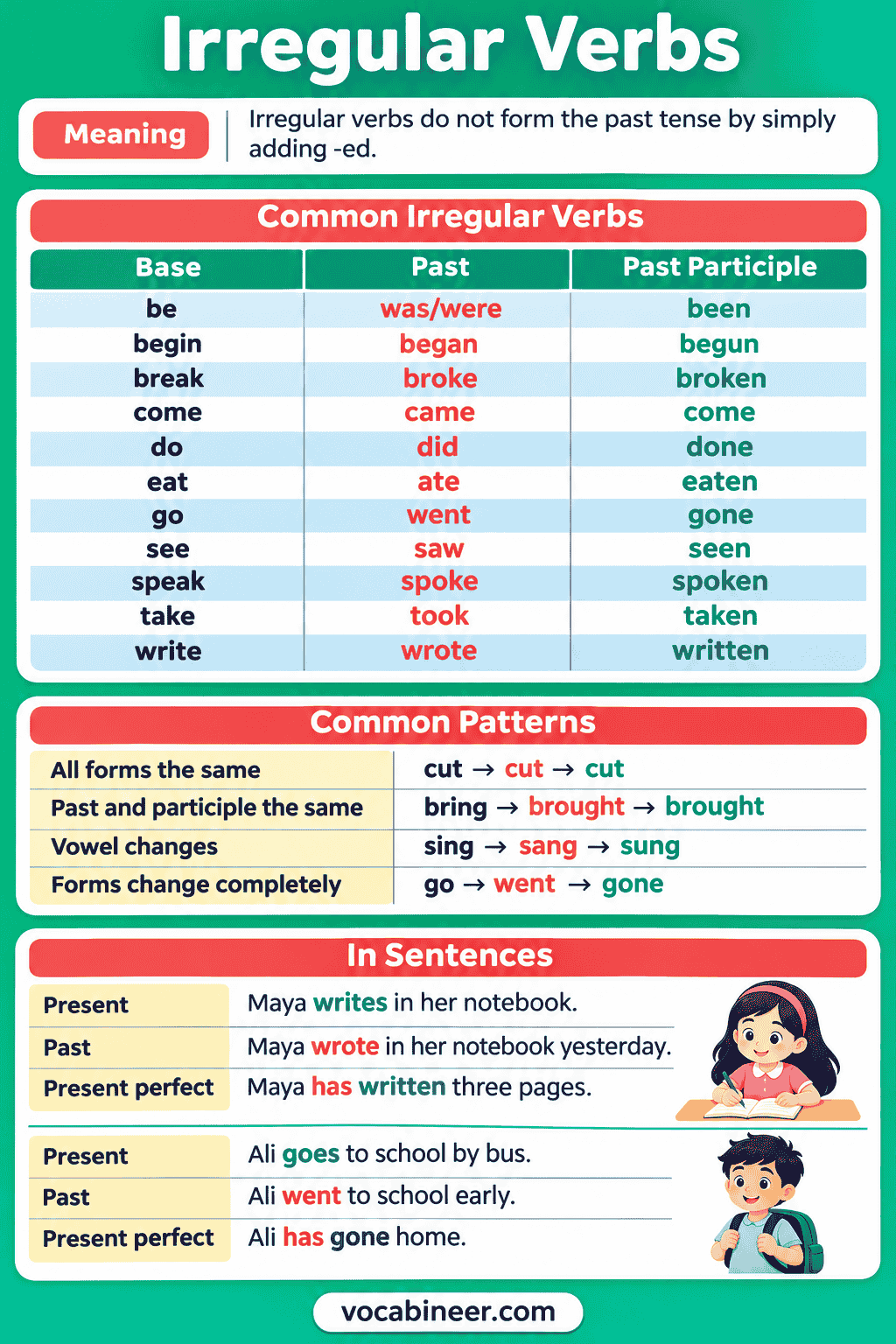
Most English verbs form their simple past and past participle by adding -ed. However, irregular verbs follow different patterns. For example, go becomes went and gone, while write becomes wrote and written. Because these forms appear frequently in everyday English, learning them improves both speaking and writing.
Irregular verbs do not follow one universal formation rule, but many belong to recognizable families. This guide explains their five forms, major change patterns, tense structures, accepted variants, and commonly confused forms. It also provides 100 modern irregular verbs with practical sentence examples.
In This Page
Understanding Irregular Verbs
An irregular verb does not form its simple past or past participle through the standard -ed pattern. Instead, it may change a vowel, replace part of the word, keep the same form, or use a completely different form.
| Base Form | Simple Past | Past Participle |
|---|---|---|
| go | went | gone |
| write | wrote | written |
| buy | bought | bought |
| cut | cut | cut |
Irregularity usually affects the simple past and past participle. Nevertheless, a few verbs, especially be, have, do, and say, also have unusual present forms.
Moreover, irregular describes conjugation rather than meaning. An irregular verb can also be an action, linking, stative, transitive, or intransitive verb.
| Classification | Irregular Verb Example |
|---|---|
| Action verb | She wrote a letter. |
| Stative verb | He knew the answer. |
| Linking verb | She became a doctor. |
| Transitive verb | They built a house. |
| Intransitive verb | The children slept. |
Five Forms of Irregular Verbs
Although teaching lists often show only V1, V2, and V3, English main verbs generally have five forms.
| Verb Form | Example with write | Main Use |
|---|---|---|
| Base form | write | Present forms, infinitives, and commands |
| Third-person singular | writes | Simple present with he, she, or it |
| Simple past | wrote | Completed past action |
| Past participle | written | Perfect tenses and passive voice |
| Present participle | writing | Continuous tenses and other -ing uses |
V1, V2, and V3 are convenient classroom labels. However, the grammatical names are more precise.
| Teaching Label | Grammatical Term | Example |
|---|---|---|
| V1 | Base form | write |
| V2 | Simple past | wrote |
| V3 | Past participle | written |
The third-person and -ing forms usually follow ordinary spelling rules, even when V2 and V3 are irregular.
Main Irregular Verb Patterns
Irregular verbs do not follow the productive -ed rule. However, grouping them by shared forms makes them easier to understand.
All Three Forms Remain the Same
| Base | Past | Past Participle |
|---|---|---|
| cut | cut | cut |
| put | put | put |
| hit | hit | hit |
| let | let | let |
| hurt | hurt | hurt |
Past and Past Participle Remain the Same
| Base | Past | Past Participle |
|---|---|---|
| build | built | built |
| feel | felt | felt |
| find | found | found |
| keep | kept | kept |
| send | sent | sent |
Base and Past Participle Remain the Same
| Base | Past | Past Participle |
|---|---|---|
| come | came | come |
| become | became | become |
| run | ran | run |
| overcome | overcame | overcome |
Base and Past Forms Remain the Same
This AAB pattern is uncommon.
| Base | Past | Past Participle |
|---|---|---|
| beat | beat | beaten |
All Three Forms Change
| Base | Past | Past Participle |
|---|---|---|
| begin | began | begun |
| drink | drank | drunk |
| speak | spoke | spoken |
| write | wrote | written |
| take | took | taken |
Common Vowel-Change Families
Many irregular verbs share vowel or ending changes. These families help learners notice similarities, although they are not universal rules.
| Pattern | Examples |
|---|---|
| i–a–u | sing–sang–sung, ring–rang–rung, drink–drank–drunk |
| ow–ew–own | blow–blew–blown, grow–grew–grown, know–knew–known |
| i–o–en | drive–drove–driven, rise–rose–risen, write–wrote–written |
| ea–o–en | break–broke–broken, speak–spoke–spoken |
| ought | buy–bought–bought, bring–brought–brought, think–thought–thought |
| aught | catch–caught–caught, teach–taught–taught |
| ee–e–e | keep–kept–kept, sleep–slept–slept, feel–felt–felt |
Mixed Regular and Irregular Forms
Some verbs form their simple past with -ed but use an irregular or alternative past participle.
| Base | Simple Past | Past Participle |
|---|---|---|
| show | showed | shown |
| prove | proved | proved or proven |
| sew | sewed | sewn or sewed |
| sow | sowed | sown or sowed |
| swell | swelled | swollen or swelled |
| mow | mowed | mown or mowed |
These mixed patterns explain why a verb cannot always be classified by looking only at its simple-past form.
Regular and Irregular Verbs
| Feature | Regular Verbs | Irregular Verbs |
|---|---|---|
| Past formation | Usually add -ed | Change in different ways |
| Past participle | Usually matches the past | May match or differ from the past |
| Predictability | Generally predictable | Learned individually or by pattern |
| Example | walk–walked–walked | write–wrote–written |
| Additional example | clean–cleaned–cleaned | go–went–gone |
Most English verbs are regular. However, many of the most frequently used verbs are irregular.
Simple Past and Past Participle Uses
The simple past and past participle are forms, not interchangeable tenses. V2 expresses a completed past event by itself, whereas V3 normally works with one or more helping verbs.
| Form or Structure | Pattern | Example |
|---|---|---|
| Simple past | Subject + V2 | She wrote a letter. |
| Present perfect | Subject + has/have + V3 | She has written a letter. |
| Past perfect | Subject + had + V3 | She had written a letter. |
| Future perfect | Subject + will have + V3 | She will have written the letter. |
| Passive voice | Subject + form of be + V3 | The letter was written yesterday. |
| Modal perfect | Modal + have + V3 | She may have written the letter. |
Past participles also appear in conditional structures:
- If I had known, I would have helped.
- If they had left earlier, they would have arrived on time.
Irregular Verbs in Different Tenses
The verb write remains irregular even when a tense uses its base or -ing form.
| Tense | Example |
|---|---|
| Simple present | She writes every day. |
| Present continuous | She is writing now. |
| Simple past | She wrote yesterday. |
| Past continuous | She was writing at noon. |
| Present perfect | She has written three pages. |
| Past perfect | She had written before dinner. |
| Simple future | She will write tomorrow. |
| Future perfect | She will have written the report. |
Irregular Verbs in Questions and Negatives
The helping verb did already marks past time. Therefore, the main verb returns to its base form in simple-past questions and negatives.
| Sentence Type | Structure | Example |
|---|---|---|
| Past statement | Subject + V2 | She went home. |
| Past question | Did + subject + V1 | Did she go home? |
| Past negative | Subject + did not + V1 | She did not go home. |
Contracted forms are common:
- She didn’t go home.
- He didn’t write the email.
- We haven’t seen the film.
- She hasn’t eaten lunch.
| Incorrect | Correct |
|---|---|
| Did she went home? | Did she go home? |
| He did not wrote. | He did not write. |
| They have went home. | They have gone home. |
| She has ate lunch. | She has eaten lunch. |
Special Forms of BE
The verb be has more irregular forms than any other English verb.
| Subject | Present Form | Past Form |
|---|---|---|
| I | am | was |
| he, she, it | is | was |
| you, we, they | are | were |
| Form | BE Form |
|---|---|
| Base form | be |
| Present forms | am, is, are |
| Past forms | was, were |
| Past participle | been |
| Present participle | being |
Unlike most verbs, be does not use do, does, or did to form questions and negatives.
| Ordinary Verb | BE |
|---|---|
| Did she go home? | Was she at home? |
| She did not go home. | She was not at home. |
| Does he work here? | Is he here? |
Other Irregular Present Forms
Most irregular verbs have ordinary present forms. However, have, do, and say change spelling or pronunciation in the third-person singular.
| Base | Third-Person Form | Example |
|---|---|---|
| have | has | She has a car. |
| do | does | He does his work. |
| say | says | She says hello. |
The forms does and says also have unexpected pronunciations.
Main-Verb and Helping-Verb Uses
The highly frequent verbs be, have, and do can function as main verbs or helping verbs.
| Verb | Main-Verb Use | Helping-Verb Use |
|---|---|---|
| be | She is a teacher. | She is working. |
| have | They have a car. | They have finished. |
| do | He did the work. | Did he leave? |
Their function depends on whether they carry the main meaning or support another verb.
Modal and Defective Verbs
Modal verbs do not have normal five-form paradigms. Therefore, they should not appear in a standard V1–V2–V3 irregular-verb list.
| Modal | Related Past Form | Missing Forms |
|---|---|---|
| can | could | No infinitive, participle, or -ing form |
| may | might | No normal participle or -ing form |
| shall | should | No normal participle or -ing form |
| will | would | No normal participle or -ing form |
| must | — | No separate past or participle |
When another tense or form is needed, English often uses an alternative expression, such as be able to instead of can.
Irregular Verbs in Passive Structures
Passive constructions use a form of be followed by V3.
| Passive Structure | Example |
|---|---|
| Simple present passive | The letters are written by hand. |
| Simple past passive | The window was broken yesterday. |
| Present perfect passive | The work has been done. |
| Modal passive | The form must be signed. |
The auxiliary changes according to tense and number, while the past participle carries the main lexical meaning.
Past-Participial Adjectives
An irregular past participle can also describe a noun or subject.
| Past Participle | Adjectival Use |
|---|---|
| broken | a broken window |
| written | a written report |
| hidden | a hidden door |
| frozen | frozen food |
| stolen | a stolen bicycle |
In these examples, the participles function like adjectives rather than forming a perfect tense.
25 Essential Irregular Verbs
The following verbs appear extremely often in everyday English and deserve priority.
| Base | Past | Past Participle |
|---|---|---|
| be | was/were | been |
| become | became | become |
| begin | began | begun |
| bring | brought | brought |
| buy | bought | bought |
| come | came | come |
| do | did | done |
| eat | ate | eaten |
| find | found | found |
| get | got | got/gotten |
| give | gave | given |
| go | went | gone |
| have | had | had |
| know | knew | known |
| make | made | made |
| read | read | read |
| run | ran | run |
| say | said | said |
| see | saw | seen |
| take | took | taken |
| tell | told | told |
| think | thought | thought |
| understand | understood | understood |
| wear | wore | worn |
| write | wrote | written |
100 Common Irregular Verbs with Examples
The following alphabetical list contains 100 unique, standard modern irregular verbs. Alternative forms appear only where they are common and useful.
| Base Form | Simple Past | Past Participle | Example Sentence |
|---|---|---|---|
| arise | arose | arisen | A problem arose during the meeting. |
| awake | awoke | awoken | She awoke before sunrise. |
| be | was/were | been | They were ready. |
| bear | bore | borne/born | She was born in May. |
| beat | beat | beaten | Our team beat the champions. |
| become | became | become | He became a doctor. |
| begin | began | begun | The lesson began at nine. |
| bend | bent | bent | She bent the wire. |
| bet | bet | bet | He bet ten dollars. |
| bite | bit | bitten | The dog has bitten the toy. |
| bleed | bled | bled | His finger bled slightly. |
| blow | blew | blown | The wind blew all night. |
| break | broke | broken | Someone has broken the glass. |
| bring | brought | brought | She brought her notebook. |
| build | built | built | They built a bridge. |
| buy | bought | bought | I bought fresh bread. |
| catch | caught | caught | He caught the ball. |
| choose | chose | chosen | We have chosen a winner. |
| come | came | come | They came early. |
| cost | cost | cost | The repairs cost too much. |
| cut | cut | cut | She cut the paper. |
| deal | dealt | dealt | He dealt with the complaint. |
| dig | dug | dug | We dug a small hole. |
| do | did | done | She did her homework. |
| draw | drew | drawn | The child drew a house. |
| drink | drank | drunk | He drank some water. |
| drive | drove | driven | We drove to the coast. |
| eat | ate | eaten | They ate dinner early. |
| fall | fell | fallen | A branch fell from the tree. |
| feed | fed | fed | She fed the cat. |
| feel | felt | felt | I felt much better. |
| fight | fought | fought | The soldiers fought bravely. |
| find | found | found | He found his keys. |
| fly | flew | flown | The birds flew south. |
| forget | forgot | forgotten | I forgot the appointment. |
| forgive | forgave | forgiven | She forgave the mistake. |
| freeze | froze | frozen | The lake froze overnight. |
| get | got | got/gotten | We got good news. |
| give | gave | given | She gave me a book. |
| go | went | gone | They went home. |
| grow | grew | grown | The plant grew quickly. |
| hang | hung | hung | He hung the picture. |
| have | had | had | We had enough time. |
| hear | heard | heard | I heard a strange noise. |
| hide | hid | hidden | She hid the gift. |
| hit | hit | hit | The ball hit the wall. |
| hold | held | held | He held the door open. |
| hurt | hurt | hurt | She hurt her ankle. |
| keep | kept | kept | We kept the receipt. |
| know | knew | known | I knew the answer. |
| lead | led | led | She led the discussion. |
| leave | left | left | They left before noon. |
| lend | lent | lent | He lent me his pen. |
| let | let | let | She let us enter. |
| lie | lay | lain | He lay on the sofa. |
| lose | lost | lost | I lost my wallet. |
| make | made | made | She made a cake. |
| mean | meant | meant | I meant every word. |
| meet | met | met | We met at the station. |
| pay | paid | paid | He paid the bill. |
| put | put | put | She put the keys away. |
| read | read | read | I read the article yesterday. |
| ride | rode | ridden | They rode their bicycles. |
| ring | rang | rung | The phone rang twice. |
| rise | rose | risen | Prices rose last month. |
| run | ran | run | She ran five miles. |
| say | said | said | He said goodbye. |
| see | saw | seen | We saw a rainbow. |
| sell | sold | sold | They sold their house. |
| send | sent | sent | I sent the email. |
| set | set | set | She set the table. |
| shake | shook | shaken | He shook the bottle. |
| shoot | shot | shot | The player shot the ball. |
| show | showed | shown | She showed us the room. |
| shut | shut | shut | He shut the window. |
| sing | sang | sung | They sang beautifully. |
| sink | sank | sunk | The boat sank quickly. |
| sit | sat | sat | We sat near the door. |
| sleep | slept | slept | The baby slept peacefully. |
| speak | spoke | spoken | She spoke clearly. |
| spend | spent | spent | We spent the afternoon outside. |
| stand | stood | stood | He stood beside me. |
| steal | stole | stolen | Someone stole my bicycle. |
| stick | stuck | stuck | The note stuck to the wall. |
| sting | stung | stung | A bee stung his hand. |
| strike | struck | struck/stricken | Lightning struck the tree. |
| sweep | swept | swept | She swept the floor. |
| swim | swam | swum | They swam across the pool. |
| take | took | taken | He took the last seat. |
| teach | taught | taught | She taught mathematics. |
| tear | tore | torn | I tore the paper. |
| tell | told | told | He told the truth. |
| think | thought | thought | We thought about the problem. |
| throw | threw | thrown | She threw the ball. |
| understand | understood | understood | I understood the instructions. |
| wake | woke | woken | He woke at six. |
| wear | wore | worn | She wore a blue coat. |
| win | won | won | Our team won the match. |
| withdraw | withdrew | withdrawn | She withdrew some money. |
| write | wrote | written | He wrote a short story. |
Verbs with Two Accepted Forms
Some verbs have both regular and irregular variants. Preferences often differ between American and British English.
| Base | Regular Variant | Irregular Variant |
|---|---|---|
| burn | burned | burnt |
| dream | dreamed | dreamt |
| learn | learned | learnt |
| smell | smelled | smelt |
| spell | spelled | spelt |
| spoil | spoiled | spoilt |
American English generally favors burned, dreamed, learned, smelled, spelled, and spoiled. British English uses both sets more freely.
Got and Gotten
Get requires special attention because its past participle differs across varieties and meanings.
| Variety or Use | Preferred Form | Example |
|---|---|---|
| American English for become or obtain | gotten | She has gotten better. |
| British English general participle | got | She has got better. |
| Possession with have got | got | She has got a new car. |
| Simple past in both varieties | got | She got a new car. |
Forms That Change According to Meaning
Hang
| Meaning | Past and Participle | Example |
|---|---|---|
| Suspend an object | hung | She hung the picture. |
| Execute a person | hanged | The prisoner was hanged. |
Bear
| Meaning | Past Participle | Example |
|---|---|---|
| Give birth | born | She was born in May. |
| Carry, support, or endure | borne | The cost was borne by the company. |
Shine
| Meaning | Past and Participle | Example |
|---|---|---|
| Produce light | shone | The moon shone brightly. |
| Polish something | shined | He shined his shoes. |
Lie
| Meaning | Base | Past | Past Participle |
|---|---|---|---|
| Recline | lie | lay | lain |
| Say something untrue | lie | lied | lied |
Find and Found
| Verb | Meaning | Forms |
|---|---|---|
| find | discover | find–found–found |
| found | establish | found–founded–founded |
Easily Confused Verbs
| Verb | Meaning | Past | Past Participle |
|---|---|---|---|
| lie | recline | lay | lain |
| lay | place something | laid | laid |
| rise | move upward independently | rose | risen |
| raise | lift something | raised | raised |
| sit | take a seated position | sat | sat |
| set | place something | set | set |
| fall | move downward | fell | fallen |
| fell | cut down | felled | felled |
Transitive verbs such as lay, raise, set, and fell normally take an object. In contrast, lie, rise, sit, and fall do not require one.
Compound Irregular Verbs
Many compounds inherit the irregular pattern of their base verbs.
| Base Verb | Compound Verb | Forms |
|---|---|---|
| take | overtake | overtake–overtook–overtaken |
| stand | understand | understand–understood–understood |
| come | overcome | overcome–overcame–overcome |
| do | redo | redo–redid–redone |
| write | rewrite | rewrite–rewrote–rewritten |
| see | foresee | foresee–foresaw–foreseen |
Nevertheless, uncommon compounds should be checked in a reliable dictionary because usage can vary.
Pronunciation Changes in Irregular Verbs
Some irregular forms have spellings that may mislead learners.
| Forms | Pronunciation Note |
|---|---|
| read–read–read | Base /riːd/, past and participle /rɛd/ |
| lead–led–led | Base /liːd/, past and participle /lɛd/ |
| say–said–said | Said is pronounced /sɛd/ |
| buy–bought–bought | The vowel changes completely |
| think–thought–thought | The vowel and final consonant cluster change |
Identifying Irregular Verbs
Use this process to identify an irregular verb:
- Find the verb’s base form.
- Check its simple-past form.
- Check its past-participle form.
- Determine whether both forms follow the standard -ed pattern.
- Notice pronunciation changes and accepted variants.
- Check a reliable dictionary when uncertain.
| Forms | Classification | Reason |
|---|---|---|
| walk–walked–walked | Regular | Follows the -ed pattern |
| study–studied–studied | Regular | Follows a standard spelling rule |
| write–wrote–written | Irregular | Changes in two different ways |
| put–put–put | Irregular | Does not use the -ed pattern |
| read–read–read | Irregular | Changes pronunciation |
Common Mistakes with Irregular Verbs
Adding ED to an Irregular Verb
| Incorrect | Correct |
|---|---|
| goed | went |
| writed | wrote |
| buyed | bought |
| catched | caught |
Using V2 After Did
Because did already marks the past, use V1 after it.
| Incorrect | Correct |
|---|---|
| Did she went? | Did she go? |
| He didn’t wrote. | He didn’t write. |
Using V2 Instead of V3
| Incorrect | Correct |
|---|---|
| They have went. | They have gone. |
| I have saw it. | I have seen it. |
| She had wrote the note. | She had written the note. |
Omitting a Helping Verb Before V3
In standard perfect structures, V3 requires have, has, or had.
| Incorrect | Correct |
|---|---|
| She gone home. | She has gone home. |
| We seen the film. | We have seen the film. |
Confusing Went and Gone
| Went | Gone |
|---|---|
| Simple past | Past participle |
| She went home. | She has gone home. |
Confusing Saw and Seen
| Saw | Seen |
|---|---|
| Simple past | Past participle |
| I saw the movie. | I have seen the movie. |
Confusing Lay and Lain
Lay is the simple past of lie when it means recline. Lain is its past participle.
- Yesterday, he lay on the sofa.
- He has lain there for an hour.
Do not confuse these forms with lay–laid–laid, which means to place something.
Assuming Unchanged Forms Are Regular
Verbs such as cut, put, hit, and set are irregular. They remain unchanged instead of following the productive -ed pattern.
Mixing American and British Forms
Both learned and learnt are standard, but consistent regional usage makes writing clearer. This article uses American English as its main style.
FAQs
An irregular verb does not form its simple past or past participle through the standard -ed pattern. It may change its vowel, use a different ending, remain unchanged, or adopt a completely different form.
V1 is the base form, V2 is the simple-past form, and V3 is the past participle. For example, the three forms of write are write, wrote, and written.
Irregular verbs do not follow one universal rule, but many form useful families. For example, sing–sang–sung and ring–rang–rung share the same vowel pattern.
Went is the simple-past form of go and can stand alone as the main verb. Gone is the past participle and normally follows a helping verb, as in “She has gone home.”
Learn the most frequent verbs first, group them by pattern, and study all three principal forms in short sentences. Regular exposure through reading and listening also makes the forms more familiar.
Conclusion
Irregular verbs form their simple past and past participle in ways that differ from the standard -ed pattern. Some remain unchanged, some share two forms, and others change completely. Nevertheless, many belong to recognizable families that make them easier to organize and remember.
To use irregular verbs accurately, distinguish V2 from V3, return to the base form after did, and use the correct helping verb before a past participle. Once these patterns become familiar, past, perfect, passive, and conditional structures become much easier to form.
Read More
- Parts of Speech in English
- Nouns in English with Examples
- Common and Proper Nouns
- Countable and uncountable nouns
- Collective nouns
- Abstract and concrete nouns
- Gender nouns
- Compound nouns
- Possessive nouns
- Singular and plural nouns
- Plural noun rules