

Verbs carry the main action or state in a sentence. When a verb expresses that meaning clearly, readers can understand the sentence quickly. However, a vague or indirect verb may force other words to carry the meaning, making the sentence less precise and more difficult to read.
In writing advice, these vague or indirect choices are often called weak verbs. The term also has a traditional grammatical meaning related to past-tense formation. This guide explains both meanings, compares weak and strong verbs, and shows how to improve weak sentences without replacing simple verbs unnecessarily.
In This Page
What Are Weak Verbs?
In writing, a weak verb is a verb that communicates less information than the context requires. It may be vague, repetitive, or hidden inside a long phrase. Common verbs such as be, have, do, make, and get often become weak when a more direct verb could express the same idea.
Consider this sentence:
The committee made a decision to postpone the meeting.
The verb made contributes little meaning because the noun decision contains the real action. Using a direct verb produces a clearer sentence:
The committee decided to postpone the meeting.
Weak verbs are not necessarily grammatically incorrect. In many sentences, a simple verb is the most accurate and natural choice. A verb becomes weak when it makes the intended meaning vague, repetitive, wordy, or unnecessarily indirect.
Two Meanings of Weak Verbs
The expression weak verb has different meanings in writing instruction and traditional grammar.
| Meaning | Explanation | Example |
|---|---|---|
| Weak verb in writing | A vague, overused, or indirect verb that carries little precise meaning | She made a suggestion. |
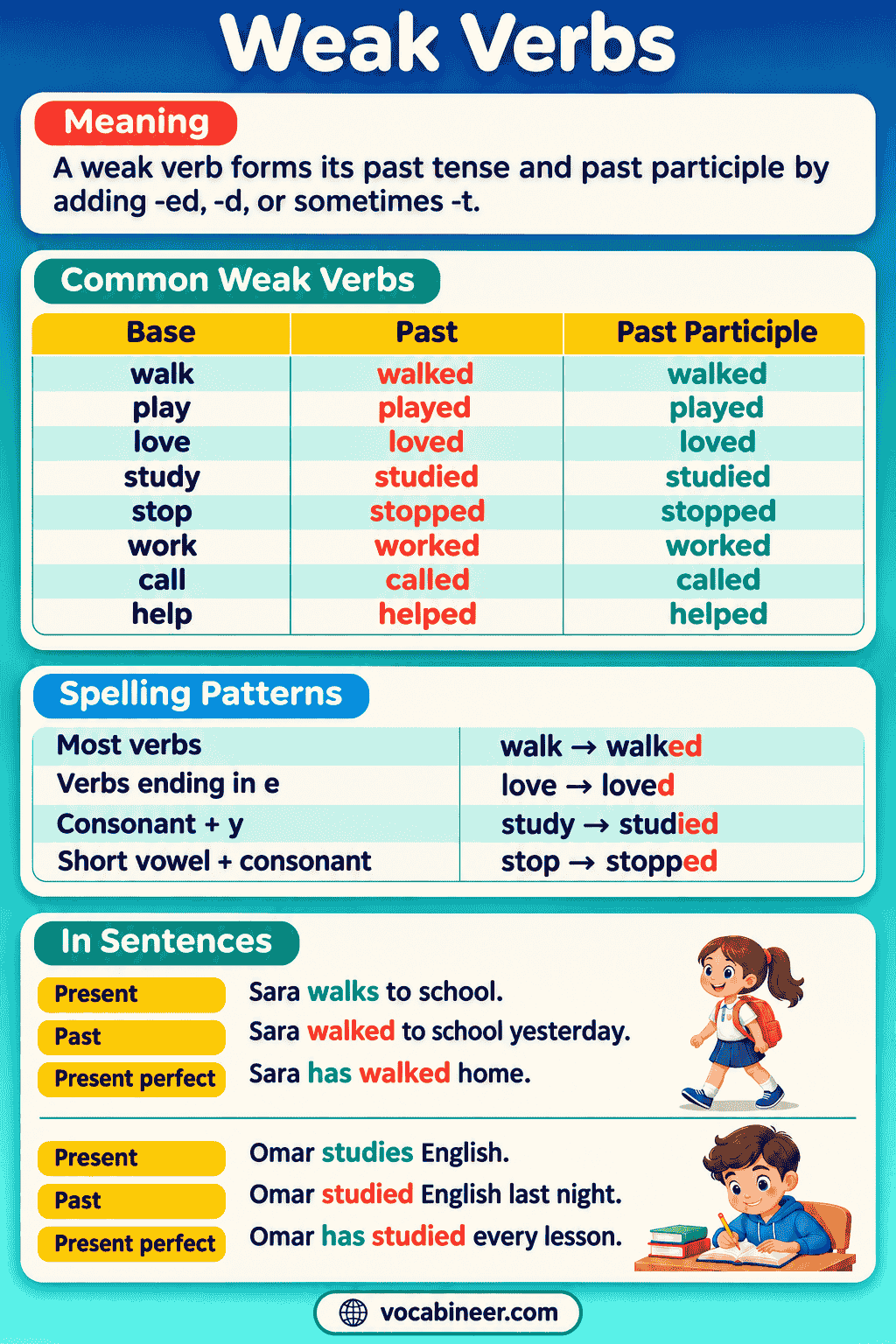
| Weak verb in traditional grammar | A verb that forms its past tense with a dental ending such as -d, -ed, or -t | walk–walked; keep–kept |
This article mainly discusses weak verbs as a writing issue. However, it also explains their traditional grammatical meaning.
Common Weak Verbs in Writing
Several familiar verbs can weaken writing when they are overused or chosen instead of more precise verbs.
| Common Verb | Why It May Sound Weak | Possible Alternatives |
|---|---|---|
| be | Describes a state without showing a specific action | Depends on context |
| have | May hide the action inside a noun | own, contain, experience, possess |
| do | Provides little information about the action | complete, perform, prepare, investigate |
| make | Often appears with an abstract noun | create, build, decide, improve |
| get | Can express many unrelated meanings | obtain, receive, become, understand |
| go | Does not explain how something moves | travel, rush, enter, leave |
| say | May omit the speaker’s purpose or manner | explain, whisper, announce, argue |
| see | Can refer to several kinds of perception | notice, observe, examine, understand |
| look | May not identify the purpose of seeing | inspect, glance, stare, examine |
| take | Often needs extra words to reveal its meaning | accept, carry, require, choose |
| give | May create an indirect verb phrase | provide, offer, explain, describe |
| put | Does not always identify the exact action | place, insert, arrange, install |
| use | Can be less precise than the action performed | apply, operate, employ |
| happen | May hide the cause or responsible subject | occur, develop, trigger, cause |
These alternatives are not interchangeable in every sentence. Therefore, always check the meaning, tone, tense, and grammatical pattern before replacing a verb.
Weak Verbs vs Strong Verbs
A strong verb communicates a clear and specific action without depending heavily on modifiers or abstract nouns. Strong verbs often make writing shorter, but their main advantage is precision.
| Weak Verbs | Strong Verbs |
|---|---|
| Often express a broad or general meaning | Express a more exact action |
| May require an abstract noun to carry the meaning | Usually carry the main meaning themselves |
| Can make a sentence longer | Often make a sentence more concise |
| May create static or indirect wording | Usually create direct and energetic wording |
| Can become repetitive | Add variety when chosen carefully |
The goal is not to make every sentence dramatic. Instead, choose the simplest verb that accurately expresses the intended action.
Weak Verbs and Stronger Alternatives
Many weak constructions combine a general verb with an abstract noun. Converting the noun into a verb often improves the sentence.
| Weak Expression | Stronger Alternative |
|---|---|
| make a decision | decide |
| make an improvement | improve |
| make an announcement | announce |
| make a comparison | compare |
| have a discussion | discuss |
| have an influence on | influence |
| have an effect on | affect |
| give an explanation | explain |
| give a description | describe |
| give assistance | assist |
| do an investigation | investigate |
| do an analysis | analyze |
| do a review | review |
| take into consideration | consider |
| come to a conclusion | conclude |
| provide an indication of | indicate |
| conduct an examination of | examine |
| perform an evaluation of | evaluate |
| is responsible for managing | manages |
| is able to solve | can solve |
The direct versions usually contain fewer words and place the action where readers expect it—in the verb.
Weak and Strong Verb Examples
The following comparisons show how stronger verbs can improve clarity and flow.
| Weak Sentence | Improved Sentence |
|---|---|
| The committee made a decision to change the policy. | The committee decided to change the policy. |
| The scientist did an analysis of the results. | The scientist analyzed the results. |
| The teacher gave an explanation of the rule. | The teacher explained the rule. |
| There was an increase in fuel prices. | Fuel prices increased. |
| The team conducted an investigation into the complaint. | The team investigated the complaint. |
| The new schedule had an effect on attendance. | The new schedule affected attendance. |
| Sara walked quickly toward the exit. | Sara hurried toward the exit. |
| The dog made a loud sound at the stranger. | The dog barked at the stranger. |
| The editor did a review of the article. | The editor reviewed the article. |
| The company is responsible for maintaining the system. | The company maintains the system. |
An improved sentence must preserve the original meaning. For example, hurried may replace walked quickly, but sprinted would suggest a faster and more intense action.
Forms of Be as Weak Verbs
Forms of be include am, is, are, was, were, be, being, and been. Writers sometimes call them weak because they describe conditions rather than visible actions. Nevertheless, they perform essential functions as linking and helping verbs.
| Use of Be | Example | Should It Be Replaced? |
|---|---|---|
| Links a subject to its identity | Maya is the team leader. | Usually no |
| Links a subject to a condition | The room is quiet. | Not unless a different meaning is intended |
| Helps form a continuous tense | They are studying. | No |
| Helps form the passive voice | The bridge was built in 1920. | Only if active voice suits the context |
| Creates an indirect sentence | There was an increase in sales. | Often: Sales increased. |
| Delays the main action | The manager is responsible for approving requests. | Often: The manager approves requests. |
Do not remove forms of be mechanically. Replace them only when a direct verb improves the sentence without changing its meaning.
Weak Verb Phrases and Nominalizations
A nominalization is a noun formed from a verb or adjective. Examples include decision from decide, investigation from investigate, and improvement from improve.
Nominalizations are useful when the concept itself matters. However, too many nominalizations can hide actions and make sentences unnecessarily heavy.
| Indirect Phrase | Direct Verb |
|---|---|
| make a suggestion | suggest |
| reach an agreement | agree |
| provide a response | respond |
| conduct a measurement | measure |
| carry out an assessment | assess |
| give confirmation | confirm |
| perform a calculation | calculate |
| offer protection to | protect |
Not every verb-and-noun combination needs revision. For example, make a cake and have a car express ordinary meanings naturally. Revise the phrase only when the noun contains an action that a direct verb could communicate more effectively.
Weak Verbs and Passive Voice
Weak verbs and passive voice are separate issues. A sentence uses passive voice when the subject receives the action instead of performing it.
Passive sentences often use a form of be followed by a past participle, so they may sound less direct. However, passive voice remains useful when the performer is unknown, unimportant, or already understood.
| Passive Sentence | Active Sentence |
|---|---|
| The report was written by Elena. | Elena wrote the report. |
| The files were reviewed by the manager. | The manager reviewed the files. |
| The window was broken during the storm. | The storm broke the window. |
| The medicine was approved in May. | The agency approved the medicine in May. |
The passive version may be better when the action or result matters more than the performer. Therefore, revise passive voice according to the sentence’s purpose rather than treating it as an automatic error.
How to Find Weak Verbs
Weak verbs become easier to identify when you examine which words carry the meaning in each sentence.
- Underline the main verb in each sentence.
- Look for repeated forms of be, have, do, make, and get.
- Find general verbs followed by abstract nouns.
- Check whether an adverb carries meaning that a precise verb could express.
- Notice sentences beginning with there is, there are, there was, or there were.
- Identify passive sentences that unnecessarily hide the performer.
- Ask whether the verb names the exact action.
- Check whether several words could become one clear verb.
For example, She spoke in a quiet voice can become She whispered. However, She spoke to the manager may already be the most natural choice if the manner of speaking does not matter.
How to Replace Weak Verbs
Use a careful revision process instead of choosing the first synonym in a thesaurus.
- Identify the real action. Determine what the subject actually does.
- Find the word carrying the meaning. The main action may appear inside a noun or modifier.
- Convert the idea into a direct verb. For example, change made an observation to observed.
- Remove unnecessary words. Delete words that the new verb makes redundant.
- Check the grammar and tense. Make sure the replacement agrees with the subject and fits the time reference.
- Check the meaning and tone. Confirm that the new verb is neither too weak nor too dramatic.
- Read the sentence naturally. Keep the original wording if the revision sounds awkward or less accessible.
A precise verb may require restructuring the entire sentence. This approach usually works better than substituting one word without adjusting the surrounding grammar.
When Simple Verbs Are Appropriate
Strong writing does not require unusual verbs in every sentence. General verbs remain useful when:
- The exact manner of the action does not matter.
- A familiar word is clearer for the intended audience.
- Instructions require simple and consistent terminology.
- A linking verb connects the subject to essential information.
- A helping verb forms the required tense or voice.
- A stronger alternative would exaggerate the action.
- Repetition improves clarity in technical or legal writing.
For example, Press the button to start the machine is clearer than a sentence that replaces press or start with less familiar words. Precision matters more than novelty.
Weak Verbs in Traditional Grammar
In traditional Germanic grammar, weak verbs form the past tense and past participle by adding a dental sound, usually written as -d, -ed, or -t. Most modern English regular verbs belong to this historical class.
| Base Form | Past Tense | Past Participle |
|---|---|---|
| walk | walked | walked |
| love | loved | loved |
| paint | painted | painted |
| call | called | called |
| keep | kept | kept |
| send | sent | sent |
By contrast, traditional strong verbs form the past tense by changing a vowel inside the verb, as in sing–sang–sung and write–wrote–written.
This historical distinction differs from the modern writing distinction between vague and precise verbs.
Weak Verbs vs Weak Forms
Weak verbs should not be confused with weak forms in pronunciation. Weak forms are unstressed pronunciations of common grammatical words in connected speech.
| Weak Verbs | Weak Forms |
|---|---|
| Concern writing style or verb history | Concern pronunciation |
| May describe vague verbs in writing | Describe reduced, unstressed word forms |
| May describe verbs with dental past-tense endings | Commonly occur in auxiliaries, pronouns, prepositions, and articles |
| Example: make a decision instead of decide | Example: unstressed can pronounced /kən/ |
An auxiliary verb may have a weak pronunciation, but that does not automatically make it a weak verb in writing.
Common Mistakes with Weak Verbs
Treating Every Form of Be as Wrong
Forms of be are necessary as linking and helping verbs. Replace them only when another construction communicates the intended meaning more clearly.
Choosing an Inaccurate Synonym
Words listed together in a thesaurus may differ in intensity, tone, grammar, or context. For example, walk, stroll, march, and stagger describe different kinds of movement.
Making Every Sentence Dramatic
Strong verbs should add precision rather than unnecessary intensity. A character who looked at a clock did not necessarily glare at it.
Ignoring the Surrounding Sentence
Replacing one verb may require changes to objects, prepositions, or sentence structure. Revise the complete sentence instead of substituting words mechanically.
Confusing Passive Voice with Weak Verbs
Passive voice describes a grammatical relationship, while a weak verb describes an imprecise or indirect word choice. The two may occur together, but they are not identical.
Removing Useful Nominalizations
Nominalizations are not always wordy. They can name important concepts, connect ideas, and create an appropriate academic tone. Revise them only when they hide a clearer action.
Final Thoughts
Weak verbs are not a list of forbidden words. Their strength depends on context, purpose, and the amount of meaning they carry. A form of be may express an idea perfectly, while a phrase such as make an improvement may sound clearer and shorter as improve.
During revision, focus on precision rather than decoration. Choose direct verbs when they clarify the action, retain simple verbs when they already work, and avoid replacements that distort the meaning. This balanced approach produces writing that is concise, natural, and easy to understand.
FAQs
In writing, a weak verb is a vague, overused, or indirect verb that communicates less precise meaning than the context requires. In traditional grammar, the term describes a verb that forms its past tense with -d, -ed, or -t.
Common examples include be, have, do, make, get, go, say, see, and take. These verbs are not always weak; their effectiveness depends on how they function in a particular sentence.
No. Forms of be work correctly as linking verbs and as helping verbs in continuous tenses and passive constructions. They need revision only when they create unnecessary wordiness or hide a clearer action.
Identify the sentence’s real action, convert an action-carrying noun or modifier into a direct verb, remove redundant words, and confirm that the revision preserves the intended meaning and tone.
In writing, a weak verb communicates a broad or indirect meaning, while a strong verb expresses a more precise action. In traditional grammar, weak and strong verbs differ in how they form the past tense.
Read More
- Parts of Speech in English
- Nouns in English with Examples
- Common and Proper Nouns
- Countable and uncountable nouns
- Collective nouns
- Abstract and concrete nouns
- Gender nouns
- Compound nouns
- Possessive nouns
- Singular and plural nouns
- Plural noun rules