

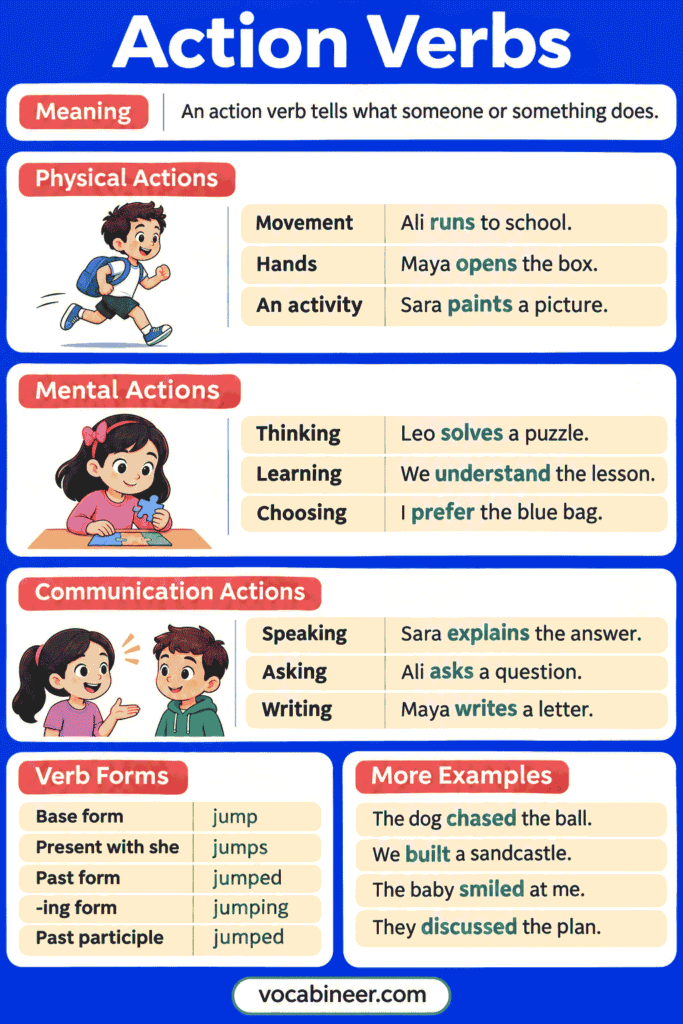
Action verbs tell us what a person, animal, object, or force does. In the sentence “Lina opened the window,” the verb opened expresses a visible action. However, actions are not always physical. Verbs such as consider, calculate, and investigate describe mental activities that we cannot see.
Understanding action verbs helps you build clearer sentences, choose accurate verb forms, and distinguish actions from states or descriptions. This guide explains the main types of action verbs, shows how they work in sentences, and provides categorized lists, comparison tables, and practical examples.
In This Page
Understanding Action Verbs
An action verb expresses an action, event, or process connected to the subject of a sentence. It may describe an intentional activity, an automatic movement, a natural event, or a gradual change.
- The athlete jumped over the barrier.
- Mariam considered the offer.
- The baby sneezed twice.
- The temperature dropped overnight.
- The flowers grew quickly.
Action verbs are often called dynamic verbs because they describe something happening or changing. However, the term dynamic verb is slightly broader. It includes deliberate actions as well as events and processes that do not involve a conscious doer.
Physical and Mental Action Verbs
Action verbs commonly describe physical or mental activities. Physical actions are usually observable, whereas mental actions occur in the mind.
| Type | Meaning | Common Examples | Example Sentence |
|---|---|---|---|
| Physical action verbs | Describe visible movements or activities | run, lift, write, cook, throw | Sana lifted the box. |
| Mental action verbs | Describe active mental processes | consider, examine, calculate, imagine, study | We considered every option. |
Not every verb related to the mind is an action verb. For example, know, believe, and understand usually describe states rather than active mental processes. Therefore, context and meaning determine the verb type.
Main Types of Action Verbs
Action verbs cover more than intentional physical movement. They can describe several kinds of activity, events, and change.
| Type | What It Describes | Examples | Example Sentence |
|---|---|---|---|
| Deliberate action | An activity performed intentionally | write, carry, open, repair | Ahmed repaired the bicycle. |
| Automatic action | A physical response that may happen naturally | blink, breathe, cough, sneeze | The child blinked in the bright light. |
| Mental activity | An active process of the mind | analyze, calculate, consider, imagine | The team analyzed the results. |
| Event | Something that happens | occur, fall, break, explode | A branch fell during the storm. |
| Process | A gradual development or change | grow, develop, improve, decrease | The small business grew rapidly. |
Action Verbs in Sentences
An action verb can serve as the main verb by itself or appear inside a longer verb phrase. In either case, the main verb carries the central meaning.
- Birds fly.
- The children played outside.
- Ayesha is preparing dinner.
- The workers have completed the bridge.
- We will discuss the proposal tomorrow.
In is preparing, is helps form the present continuous, while preparing expresses the action. Similarly, in have completed, have is the helping verb and completed is the main action verb.
Common Action Verbs by Category
The following lists group common action verbs by meaning. As a result, they make it easier to learn related vocabulary and choose a precise verb for each sentence.
| Category | Action Verbs |
|---|---|
| Movement | walk, run, jump, climb, crawl, swim, march, slide, travel, enter |
| Body actions | blink, breathe, cough, sneeze, smile, wave, kick, stretch, bend, chew |
| Communication | speak, ask, answer, explain, announce, whisper, shout, discuss, describe, report |
| Creation | build, draw, design, write, paint, produce, compose, develop, invent, construct |
| Mental activity | analyze, calculate, consider, examine, imagine, investigate, plan, study, compare, solve |
| Daily activities | eat, drink, cook, clean, wash, dress, carry, open, close, sleep |
| Work and study | read, prepare, organize, manage, complete, deliver, research, practice, review, revise |
| Change and process | grow, change, improve, expand, decrease, rise, fall, melt, develop, recover |
This table contains 80 action verbs. Some verbs can belong to more than one category because their meanings overlap. For example, write can describe communication, creation, work, or study.
Transitive and Intransitive Action Verbs
Action verbs can be transitive or intransitive. A transitive verb requires a direct object, while an intransitive verb does not.
| Feature | Transitive Action Verbs | Intransitive Action Verbs |
|---|---|---|
| Direct object | Required to complete the meaning | Not required |
| Question to ask | What or whom did the subject act on? | No object question is necessary |
| Example | Hina opened the door. | The baby slept. |
| Additional example | Ali kicked the ball. | Everyone laughed. |
Some action verbs can work in both ways. Their use depends on whether the sentence includes a direct object.
| Intransitive Use | Transitive Use |
|---|---|
| The children played. | The children played a game. |
| The bell rang. | The teacher rang the bell. |
| The car stopped. | The driver stopped the car. |
Action Verbs and Stative Verbs
Action verbs describe activities, events, and changing processes. In contrast, stative verbs describe conditions, possession, thoughts, emotions, relationships, or perceptions that remain relatively stable.
| Feature | Action Verbs | Stative Verbs |
|---|---|---|
| Main meaning | Action, event, or process | State or condition |
| Continuous forms | Commonly used | Usually avoided |
| Common examples | run, write, discuss, build | know, own, prefer, belong |
| Example | She is writing a letter. | She knows the answer. |
Because action verbs describe something in progress, they often work naturally in continuous tenses. Stative verbs usually appear in simple forms instead.
| Incorrect | Correct |
|---|---|
| I am knowing the answer. | I know the answer. |
| She is owning two apartments. | She owns two apartments. |
| We are believing your story. | We believe your story. |
However, a normally stative verb may become dynamic when its meaning changes. Therefore, learners should examine the idea expressed in the complete sentence rather than classify the word by itself.
Action Verbs and Linking Verbs
An action verb shows what the subject does or what happens. By contrast, a linking verb connects the subject to a noun, pronoun, or adjective that identifies or describes it.
| Feature | Action Verbs | Linking Verbs |
|---|---|---|
| Purpose | Express an action, event, or process | Connect the subject to a description or identity |
| Word after the verb | May be a direct object | Usually a subject complement |
| Example | Sara tasted the soup. | The soup tasted delicious. |
| Identification | Shows an activity | Can often be replaced with a form of be |
Some verbs, including look, feel, smell, taste, grow, and turn, can act as action or linking verbs. Their function depends on their meaning and the words that follow them.
Verbs That Change Meaning and Function
Several common verbs describe an action in one context but a state or description in another.
| Verb | Action Use | Stative or Linking Use |
|---|---|---|
| think | I am thinking about the problem. | I think you are correct. |
| have | We are having lunch. | We have a new car. |
| taste | She tasted the sauce. | The sauce tastes spicy. |
| look | He looked through the window. | He looks tired. |
| feel | She felt the fabric. | She feels happy. |
| smell | The chef smelled the soup. | The soup smells delicious. |
| grow | Farmers grow wheat here. | The sky grew dark. |
For instance, tasted describes an action when someone samples food. However, it functions as a linking verb when it connects the sauce with the description spicy.
Action Verbs and Helping Verbs
A helping verb works with a main verb to express tense, aspect, voice, possibility, ability, or another grammatical meaning. The action verb remains the main source of meaning.
| Feature | Action Verb | Helping Verb |
|---|---|---|
| Function | Expresses the main action, event, or process | Supports the main verb |
| Common examples | run, write, build, study | be, have, do, will, can |
| Sentence | Sara writes stories. | Sara is writing a story. |
| Role in a verb phrase | Acts as the main verb | Appears before the main verb |
A verb phrase may contain more than one helping verb:
- They have finished the work.
- The report will be completed tomorrow.
- She may have forgotten the appointment.
In each example, the final main verb expresses the central action or event.
Action Verbs and Active Voice
An action verb is not the same as active voice. Action verb describes the verb’s meaning, whereas voice describes the relationship between the action and the sentence’s subject.
| Feature | Action Verb | Active Voice |
|---|---|---|
| What it describes | The meaning of a verb | The structure of a clause |
| Main focus | An action, event, or process | A subject that performs an action |
| Can occur in passive voice | Yes | No |
| Example | The door was opened. | Mariam opened the door. |
An action verb can therefore appear in both active and passive sentences.
| Active Voice | Passive Voice |
|---|---|
| The mechanic repaired the car. | The car was repaired by the mechanic. |
| The students completed the project. | The project was completed by the students. |
Action Verbs in Different Tenses
Action verbs change form or combine with helping verbs to express time and aspect.
| Tense or Form | Example | Main Use |
|---|---|---|
| Simple present | She writes every day. | Habit or repeated action |
| Present continuous | She is writing now. | Action in progress |
| Simple past | She wrote yesterday. | Completed past action |
| Past continuous | She was writing at noon. | Past action in progress |
| Present perfect | She has written three pages. | Past action connected to the present |
| Past perfect | She had written before class began. | Action completed before another past event |
| Simple future | She will write tomorrow. | Future action |
| Future continuous | She will be writing at noon. | Future action in progress |
The tense changes the time or perspective, but write remains the main action throughout these examples.
Regular and Irregular Action Verbs
Regular action verbs form the past tense and past participle by adding -d or -ed. Irregular action verbs change in other ways and must usually be learned individually.
| Type | Base Form | Past Form | Past Participle |
|---|---|---|---|
| Regular | walk | walked | walked |
| Regular | open | opened | opened |
| Regular | study | studied | studied |
| Irregular | write | wrote | written |
| Irregular | take | took | taken |
| Irregular | build | built | built |
| Irregular | go | went | gone |
| Irregular | speak | spoke | spoken |
Consequently, choosing the correct form matters, especially in perfect tenses.
| Incorrect | Correct |
|---|---|
| She writed a letter. | She wrote a letter. |
| He taked the keys. | He took the keys. |
| They have went home. | They have gone home. |
Phrasal Action Verbs
A phrasal verb combines a verb with an adverb, a preposition, or both. Together, the words create a meaning that may differ from the meaning of the main verb alone.
| Phrasal Verb | Meaning | Example Sentence |
|---|---|---|
| pick up | lift or collect | She picked up the bag. |
| turn off | stop a device | Please turn off the light. |
| carry out | perform or complete | They carried out the plan. |
| sit down | take a seat | We sat down quietly. |
| wake up | stop sleeping | I woke up early. |
| look for | try to find | He looked for his keys. |
| set up | arrange or establish | We set up the equipment. |
| clean up | make a place clean | The children cleaned up the room. |
Some phrasal action verbs are separable. For example, both “turn off the light” and “turn the light off” are correct. However, an object pronoun must appear between the two parts, as in “turn it off.”
Action Verbs in Commands
Commands, also called imperatives, usually begin with the base form of an action verb. The subject you is understood, so speakers normally leave it unstated.
- Open the door.
- Write your name at the top.
- Turn off the computer.
- Carry the boxes carefully.
- Consider both options.
To form a negative command, place do not or don’t before the base verb.
- Do not touch the wet paint.
- Don’t open that window.
Subject-Verb Agreement with Action Verbs
In the simple present tense, most action verbs take -s or -es when the subject is he, she, it, or a singular noun. Other subjects use the base form.
| Subject | Verb Form | Example |
|---|---|---|
| I, you, we, they | Base form | They walk to school. |
| He, she, it | Base form + -s or -es | She walks to school. |
| Singular noun | Base form + -s or -es | The bus arrives at eight. |
| Plural noun | Base form | The buses arrive at eight. |
Some verbs require spelling changes. For example, study becomes studies, go becomes goes, and have becomes has.
Action Verbs in Questions and Negatives
Simple-present and simple-past questions usually require do, does, or did. The main action verb then remains in its base form.
| Sentence Type | Structure | Example |
|---|---|---|
| Present question | Do/Does + subject + base verb | Does he work here? |
| Past question | Did + subject + base verb | Did they leave early? |
| Present negative | Subject + do/does not + base verb | She does not drive. |
| Past negative | Subject + did not + base verb | We did not finish. |
Do not add a second past or third-person ending after did or does.
| Incorrect | Correct |
|---|---|
| Did she walked home? | Did she walk home? |
| He does not works here. | He does not work here. |
However, subject questions do not use do, does, or did when the question word itself acts as the subject.
- Who opened the door?
- What caused the noise?
Identifying Action Verbs
Use the following process to identify an action verb accurately:
- Find the subject of the sentence.
- Locate the main verb or complete verb phrase.
- Determine whether the verb describes an action, event, or process.
- Check whether a following word functions as an object or a subject complement.
- Examine the context because the same verb may perform different functions.
Consider this sentence:
The mechanic repaired the engine.
The mechanic is the subject, and repaired tells what the mechanic did. In addition, the engine receives the action, so repaired is a transitive action verb.
The common question “What is the subject doing?” is helpful, but it does not solve every case. Events such as fall and processes such as grow may not involve deliberate action. Therefore, meaning and sentence structure provide a more reliable answer.
Strong Action Verbs for Clearer Writing
A strong verb is not a separate grammatical type. Instead, it is a precise word that communicates an action more clearly than a vague verb or a long verb-noun expression.
| Vague Expression | Stronger Action Verb |
|---|---|
| made a decision | decided |
| gave an explanation | explained |
| did an examination | examined |
| made an improvement | improved |
| went quickly | rushed |
| looked carefully | inspected |
| made a suggestion | suggested |
| gave a response | responded |
For example, “The technician inspected the machine” is more precise than “The technician looked carefully at the machine.” Nevertheless, the best verb always depends on the intended meaning and tone.
Common Mistakes with Action Verbs
Treating Every Verb as an Action Verb
Some verbs link the subject to a description, while others help form a verb phrase. For example, seems is a linking verb in “The plan seems practical,” and has is a helping verb in “She has finished.”
Assuming Every Action Is Physical
Mental activities can also be dynamic. Verbs such as analyze, calculate, investigate, and consider express active processes of the mind.
Treating Every Mental Verb as Dynamic
In contrast, know, believe, prefer, and understand usually describe states. Therefore, they generally do not appear in continuous forms.
Omitting an Object After a Transitive Verb
| Incomplete | Complete |
|---|---|
| She carried. | She carried the bags. |
| He discussed. | He discussed the problem. |
| They built. | They built a shelter. |
An incomplete example may become acceptable when the context makes the object obvious. However, learners should include the object when the verb’s meaning requires it.
Confusing Action Verbs with Active Voice
An action verb can appear in active or passive voice. Therefore, the presence of an action verb does not automatically make a sentence active.
Using Vague Verbs Repeatedly
Words such as do, make, get, and go are useful, but repeated use can weaken writing. When precision matters, replace them with clearer choices such as complete, create, obtain, or travel.
Frequently Asked Questions
An action verb expresses an action, event, or process connected to the subject. It can describe a visible activity, such as run, or an invisible mental process, such as consider.
Some mental verbs express active processes and function as action verbs. Examples include calculate, analyze, and investigate. However, verbs such as know, believe, and understand usually describe states.
The same word can function as an action verb or a linking verb in different sentences. For example, tasted shows an action in “She tasted the soup,” but it links the subject to a description in “The soup tasted salty.”
No. Transitive action verbs take direct objects, while intransitive action verbs do not. For example, opened takes an object in “She opened the door,” but laughed needs no object in “Everyone laughed.”
Yes. Most action verbs work naturally in continuous tenses when an action is in progress, as in “They are building a house.” However, the continuous form is not required when the speaker describes habits, completed actions, or other time relationships.
Conclusion
Action verbs express physical activities, mental processes, events, and changes. They may be transitive or intransitive, regular or irregular, and simple or phrasal. Moreover, they can appear in different tenses, commands, questions, negatives, and both active and passive sentences.
To identify an action verb, examine its meaning and function in the complete sentence. Pay particular attention to helping verbs, objects, complements, and context. Once you understand these patterns, you can recognize action verbs accurately and use stronger, clearer verbs in your own writing.
Read More
- Parts of Speech in English
- Nouns in English with Examples
- Common and Proper Nouns
- Countable and uncountable nouns
- Collective nouns
- Abstract and concrete nouns
- Gender nouns
- Compound nouns
- Possessive nouns
- Singular and plural nouns
- Plural noun rules