

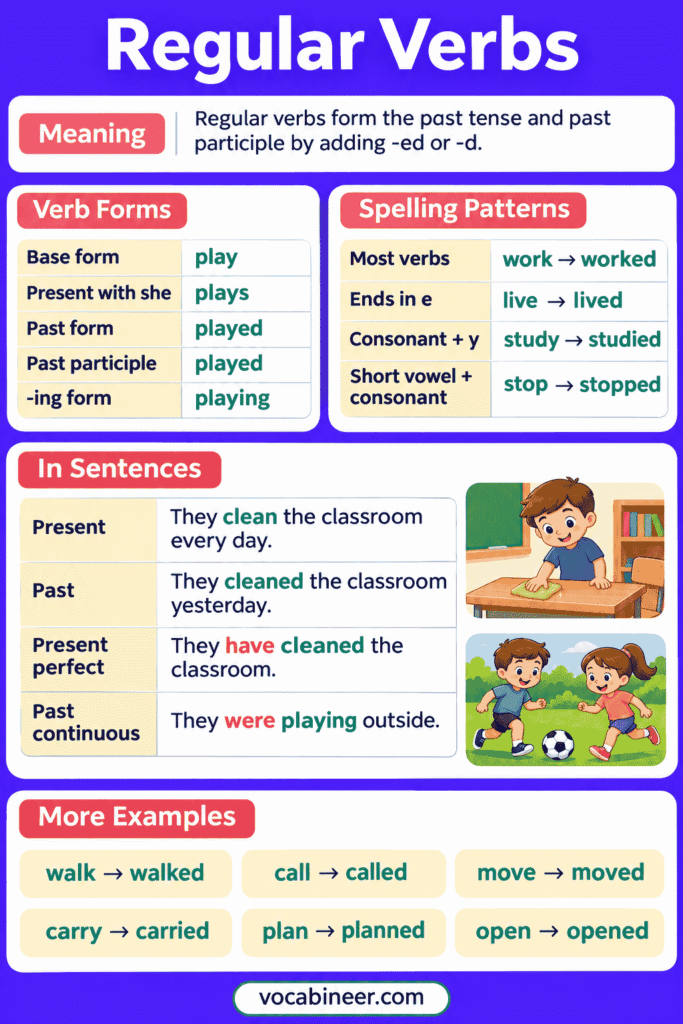
English verbs change form to express time and grammatical function. Many verbs follow a predictable pattern: they form both the simple past and past participle by adding -ed or a related ending. These verbs are called regular verbs. For example, walk becomes walked, and study becomes studied.
Although the basic pattern is simple, spelling and pronunciation can cause confusion. Therefore, this guide explains the five verb forms, every major -ed spelling rule, the three pronunciations of -ed, and the difference between regular and irregular verbs. It also provides 100 common regular verbs with sentence examples.
In This Page
Understanding Regular Verbs
A regular verb forms its simple past and past participle according to the standard English conjugation pattern. In most cases, this means adding -ed to the base form.
| Base Form | Simple Past | Past Participle |
|---|---|---|
| walk | walked | walked |
| clean | cleaned | cleaned |
| study | studied | studied |
| stop | stopped | stopped |
Regularity mainly concerns the past and past-participle forms. Consequently, a verb remains regular even when spelling rules require a small change, as in study–studied or stop–stopped.
Moreover, regular describes a verb’s conjugation, not its meaning or sentence function. A regular verb can belong to several other categories.
| Classification | Regular Verb Example |
|---|---|
| Action verb | She walked home. |
| Stative verb | He preferred tea. |
| Linking verb | The room appeared empty. |
| Transitive verb | She opened the door. |
| Intransitive verb | Everyone laughed. |
| Phrasal verb | They looked after the child. |
Five Forms of Regular Verbs
Regular verbs have the same five main forms as other English verbs. However, their simple-past and past-participle forms follow the regular -ed pattern.
| Verb Form | Example with walk | Main Use |
|---|---|---|
| Base form | walk | Present forms, infinitives, and commands |
| Third-person singular | walks | Simple present with he, she, or it |
| Simple past | walked | Completed past action |
| Past participle | walked | Perfect tenses and passive voice |
| Present participle | walking | Continuous tenses and other -ing uses |
Some regular verbs require spelling changes in one or more forms.
| Base Form | Third-Person Form | Past and Participle | ING Form |
|---|---|---|---|
| study | studies | studied | studying |
| stop | stops | stopped | stopping |
| live | lives | lived | living |
| panic | panics | panicked | panicking |
These changes follow standard spelling rules, so they do not make the verbs irregular.
Forming the Past and Past Participle
For most regular verbs, add -ed to form both the simple past and past participle.
| Base Form | Simple Past | Past Participle |
|---|---|---|
| work | worked | worked |
| help | helped | helped |
| open | opened | opened |
| visit | visited | visited |
Although the two forms look identical, they perform different jobs. The simple past can serve as the main verb by itself, while a past participle usually works with a helping verb.
| Form | Structure | Example |
|---|---|---|
| Simple past | Subject + past form | She cleaned the room. |
| Present perfect | Subject + has/have + past participle | She has cleaned the room. |
| Past perfect | Subject + had + past participle | She had cleaned the room. |
| Passive voice | Subject + form of be + past participle | The room was cleaned. |
Spelling Rules for Adding ED
The regular past pattern remains predictable, but its spelling depends on the ending of the base verb.
Adding ED to Most Regular Verbs
Most verbs simply take -ed.
| Base Form | Past Form |
|---|---|
| work | worked |
| clean | cleaned |
| help | helped |
| answer | answered |
Adding D to Verbs Ending in E
When a verb already ends in silent e, add only -d.
| Base Form | Past Form |
|---|---|
| live | lived |
| love | loved |
| move | moved |
| change | changed |
Therefore, forms such as liveed and moveed are incorrect.
Changing Consonant and Y to IED
When a verb ends in a consonant followed by y, change y to i and add -ed.
| Base Form | Past Form |
|---|---|
| study | studied |
| carry | carried |
| try | tried |
| reply | replied |
Keeping Y After a Vowel
When a vowel comes before the final y, keep the y and add -ed.
| Base Form | Past Form |
|---|---|
| play | played |
| enjoy | enjoyed |
| stay | stayed |
| employ | employed |
Doubling the Final Consonant
One-syllable verbs that end in one vowel followed by one consonant usually double the final consonant before -ed.
| Base Form | Past Form |
|---|---|
| stop | stopped |
| plan | planned |
| rob | robbed |
| hug | hugged |
However, final w, x, and y are normally not doubled.
| Base Form | Correct Past Form |
|---|---|
| snow | snowed |
| fix | fixed |
| play | played |
With multisyllable verbs, stress matters. The final consonant usually doubles when the last syllable carries the main stress.
| Stress Pattern | Base Form | Past Form |
|---|---|---|
| Stressed final syllable | admit | admitted |
| Stressed final syllable | prefer | preferred |
| Unstressed final syllable | visit | visited |
| Unstressed final syllable | open | opened |
| Unstressed final syllable | offer | offered |
Adding K to Verbs Ending in C
Verbs ending in c generally add k before -ed.
| Base Form | Past Form |
|---|---|
| panic | panicked |
| picnic | picnicked |
| mimic | mimicked |
| traffic | trafficked |
Spelling the Third-Person Singular
Regular and irregular verbs follow the same general spelling rules in the third-person singular present.
| Base Form | Rule | Third-Person Form |
|---|---|---|
| work | Add -s | works |
| watch | Add -es after -ch | watches |
| fix | Add -es after -x | fixes |
| study | Change consonant + y to -ies | studies |
| play | Keep vowel + y | plays |
These forms appear with he, she, it, and singular noun subjects.
- I work at home.
- She works at home.
- The student studies every evening.
Spelling the ING Form
The -ing form does not determine whether a verb is regular. Nevertheless, its spelling forms an important part of the five-form system.
| Base Form | Rule | ING Form |
|---|---|---|
| work | Add -ing | working |
| make | Remove final e | making |
| stop | Double the final consonant | stopping |
| lie | Change ie to y | lying |
| study | Keep y | studying |
Pronouncing ED Endings
The -ed ending has three pronunciations: /t/, /d/, and /ɪd/. The correct pronunciation depends on the final sound of the base verb, not simply its last written letter.
| Pronunciation | Used After | Examples |
|---|---|---|
| /t/ | Voiceless sounds except /t/ | worked, watched, laughed |
| /d/ | Vowels and voiced sounds except /d/ | played, cleaned, called |
| /ɪd/ | /t/ and /d/ sounds | wanted, needed, started |
ED Pronounced as T
After a voiceless sound other than /t/, pronounce -ed as /t/. This ending does not add another syllable.
- helped
- washed
- kissed
- watched
- laughed
ED Pronounced as D
After a vowel or voiced sound other than /d/, pronounce -ed as /d/. This ending also does not add another syllable.
- played
- opened
- cleaned
- called
- loved
ED Pronounced as ID
After /t/ or /d/, pronounce -ed as /ɪd/. This pronunciation adds an extra syllable.
- wanted
- needed
- visited
- started
- decided
Therefore, worked has one syllable, while wanted has two.
Regular and Irregular Verbs
Regular and irregular verbs differ in the way they form the simple past and past participle.
| Feature | Regular Verbs | Irregular Verbs |
|---|---|---|
| Past formation | Follow the standard -ed pattern | Follow other patterns |
| Past participle | Usually identical to the simple past | May differ from the simple past |
| Predictability | Generally predictable | Usually learned individually |
| Example | walk–walked–walked | write–wrote–written |
| Additional example | play–played–played | go–went–gone |
Most English verbs are regular. However, many frequently used verbs, including be, have, go, make, and take, are irregular.
Some irregular verbs can be misleading because their forms remain unchanged in writing.
| Base | Past | Past Participle | Classification |
|---|---|---|---|
| walk | walked | walked | Regular |
| study | studied | studied | Regular |
| put | put | put | Irregular |
| cut | cut | cut | Irregular |
| read /riːd/ | read /rɛd/ | read /rɛd/ | Irregular |
| write | wrote | written | Irregular |
For example, read changes pronunciation rather than spelling. Meanwhile, put and cut do not take the normal -ed ending. Therefore, all three verbs are irregular.
Regular Verbs in Different Tenses
The verb work remains regular even when helping verbs and different verb forms express various tenses.
| Tense | Example |
|---|---|
| Simple present | She works every day. |
| Present continuous | She is working now. |
| Simple past | She worked yesterday. |
| Past continuous | She was working at noon. |
| Present perfect | She has worked here for a year. |
| Past perfect | She had worked before she moved. |
| Simple future | She will work tomorrow. |
| Future perfect | She will have worked for ten hours. |
Regularity does not refer to tense. Instead, it describes the predictable relationship among the base, past, and past-participle forms.
Regular Verbs in Questions and Negatives
Simple-present questions and negatives use do or does. Simple-past questions and negatives use did. After these helping verbs, the main verb stays in its base form.
| Sentence Type | Structure | Example |
|---|---|---|
| Present question | Do/Does + subject + base verb | Does she work here? |
| Past question | Did + subject + base verb | Did she work yesterday? |
| Present negative | Subject + do/does not + base verb | She does not work here. |
| Past negative | Subject + did not + base verb | She did not work yesterday. |
Contracted forms are also common:
- She doesn’t work here.
- They didn’t play outside.
- He hasn’t finished the report.
Do not add an -ed or third-person ending after did or does.
| Incorrect | Correct |
|---|---|
| Did she worked yesterday? | Did she work yesterday? |
| They did not played outside. | They did not play outside. |
| Does he walks to school? | Does he walk to school? |
Subject-Verb Agreement with Regular Verbs
In the simple present, most verbs take -s or -es with he, she, it, or a singular noun. Other subjects use the base form.
| Subject | Verb Form | Example |
|---|---|---|
| I, you, we, they | Base form | They work here. |
| He, she, it | Base form + -s or -es | She works here. |
| Singular noun | Base form + -s or -es | The machine works well. |
| Plural noun | Base form | The machines work well. |
By contrast, the simple-past form stays the same with every subject.
- I worked yesterday.
- She worked yesterday.
- They worked yesterday.
Regular Verbs in Passive Structures
Passive constructions use a form of be followed by a past participle. Because regular past participles end in -ed, they often appear in passive sentences.
| Passive Structure | Example |
|---|---|
| Simple present passive | The rooms are cleaned daily. |
| Simple past passive | The rooms were cleaned yesterday. |
| Present perfect passive | The rooms have been cleaned. |
| Modal passive | The rooms must be cleaned. |
The helping verbs change according to tense and number, while the past participle remains cleaned.
ED Verbs and ED Adjectives
A word ending in -ed does not always function as a past-tense verb. It may serve as a past participle or a participial adjective.
| Use | Example | Function |
|---|---|---|
| Past-tense verb | The news surprised us. | Expresses a past action |
| Past participle | The news has surprised us. | Forms the present perfect |
| Passive participle | We were surprised by the news. | Forms the passive voice |
| Participial adjective | We felt surprised. | Describes a condition |
In a few established adjectives, -ed may be pronounced /ɪd/ even when the related verb has a different pronunciation. Examples include a learned professor, an aged tree, and a blessed event. These are vocabulary exceptions rather than general verb rules.
100 Common Regular Verbs with Examples
The following lists contain 100 unique regular verbs. Each table shows the base form, simple past, past participle, and a practical sentence.
Regular Verbs for Daily Activities
| Base | Past | Past Participle | Example Sentence |
|---|---|---|---|
| clean | cleaned | cleaned | We cleaned the kitchen. |
| cook | cooked | cooked | Sara cooked dinner. |
| dress | dressed | dressed | The child dressed quickly. |
| help | helped | helped | Ali helped his neighbor. |
| listen | listened | listened | We listened carefully. |
| open | opened | opened | She opened the window. |
| start | started | started | The class started early. |
| wash | washed | washed | He washed the car. |
| work | worked | worked | They worked all morning. |
| relax | relaxed | relaxed | I relaxed after dinner. |
Regular Verbs for Communication
| Base | Past | Past Participle | Example Sentence |
|---|---|---|---|
| answer | answered | answered | He answered the question. |
| ask | asked | asked | Maya asked for directions. |
| call | called | called | I called my friend. |
| explain | explained | explained | The teacher explained the rule. |
| mention | mentioned | mentioned | She mentioned the delay. |
| report | reported | reported | They reported the problem. |
| talk | talked | talked | We talked for an hour. |
| thank | thanked | thanked | He thanked the driver. |
| emailed | emailed | I emailed the document. | |
| text | texted | texted | She texted her brother. |
Regular Verbs for Work and Study
| Base | Past | Past Participle | Example Sentence |
|---|---|---|---|
| complete | completed | completed | We completed the project. |
| organize | organized | organized | Sana organized the files. |
| practice | practiced | practiced | He practiced every day. |
| prepare | prepared | prepared | They prepared the presentation. |
| research | researched | researched | I researched the topic. |
| study | studied | studied | Amina studied English. |
| review | reviewed | reviewed | The editor reviewed the article. |
| revise | revised | revised | She revised her notes. |
| calculate | calculated | calculated | We calculated the total. |
| compare | compared | compared | The students compared the results. |
Regular Verbs for Movement
| Base | Past | Past Participle | Example Sentence |
|---|---|---|---|
| climb | climbed | climbed | They climbed the hill. |
| cross | crossed | crossed | We crossed the road. |
| follow | followed | followed | The dog followed us. |
| jump | jumped | jumped | He jumped over the puddle. |
| travel | traveled | traveled | She traveled by train. |
| turn | turned | turned | The car turned left. |
| walk | walked | walked | I walked home. |
| march | marched | marched | The band marched forward. |
| skate | skated | skated | The children skated outside. |
| dance | danced | danced | Everyone danced at the celebration. |
Regular Verbs for Thoughts and Decisions
| Base | Past | Past Participle | Example Sentence |
|---|---|---|---|
| consider | considered | considered | We considered every option. |
| decide | decided | decided | She decided to stay. |
| imagine | imagined | imagined | He imagined a better future. |
| remember | remembered | remembered | I remembered the address. |
| plan | planned | planned | They planned the trip. |
| expect | expected | expected | We expected better weather. |
| notice | noticed | noticed | She noticed the mistake. |
| prefer | preferred | preferred | He preferred the blue shirt. |
| suppose | supposed | supposed | I supposed they were busy. |
| wonder | wondered | wondered | She wondered about the result. |
Regular Verbs for Creation and Change
| Base | Past | Past Participle | Example Sentence |
|---|---|---|---|
| change | changed | changed | The weather changed suddenly. |
| create | created | created | The artist created a mural. |
| design | designed | designed | They designed a new logo. |
| develop | developed | developed | The team developed an app. |
| improve | improved | improved | His writing improved quickly. |
| produce | produced | produced | The factory produced new parts. |
| repair | repaired | repaired | The mechanic repaired the engine. |
| decorate | decorated | decorated | We decorated the room. |
| paint | painted | painted | She painted the wall. |
| printed | printed | I printed the report. |
Regular Verbs for Social Activities and Emotions
| Base | Past | Past Participle | Example Sentence |
|---|---|---|---|
| agree | agreed | agreed | They agreed with the proposal. |
| enjoy | enjoyed | enjoyed | We enjoyed the concert. |
| invite | invited | invited | She invited her friends. |
| like | liked | liked | He liked the movie. |
| love | loved | loved | The children loved the story. |
| smile | smiled | smiled | She smiled warmly. |
| support | supported | supported | The community supported the project. |
| surprise | surprised | surprised | The gift surprised me. |
| trust | trusted | trusted | I trusted his judgment. |
| welcome | welcomed | welcomed | They welcomed the visitors. |
Regular Verbs for Home and Practical Tasks
| Base | Past | Past Participle | Example Sentence |
|---|---|---|---|
| bake | baked | baked | She baked fresh bread. |
| brush | brushed | brushed | He brushed his shoes. |
| close | closed | closed | I closed the gate. |
| dry | dried | dried | The clothes dried quickly. |
| fill | filled | filled | We filled the bottles. |
| fold | folded | folded | She folded the towels. |
| lock | locked | locked | He locked the door. |
| move | moved | moved | They moved the table. |
| plant | planted | planted | We planted tomatoes. |
| water | watered | watered | She watered the flowers. |
Regular Verbs for Business and Services
| Base | Past | Past Participle | Example Sentence |
|---|---|---|---|
| accept | accepted | accepted | He accepted the offer. |
| advertise | advertised | advertised | The company advertised the position. |
| arrange | arranged | arranged | We arranged a meeting. |
| book | booked | booked | She booked a hotel room. |
| deliver | delivered | delivered | They delivered the package. |
| employ | employed | employed | The firm employed twenty workers. |
| manage | managed | managed | She managed the department. |
| order | ordered | ordered | We ordered lunch. |
| promise | promised | promised | He promised to return. |
| serve | served | served | The café served breakfast. |
Regular Verbs for Events and Results
| Base | Past | Past Participle | Example Sentence |
|---|---|---|---|
| arrive | arrived | arrived | The train arrived on time. |
| continue | continued | continued | The rain continued all night. |
| end | ended | ended | The meeting ended at noon. |
| happen | happened | happened | The accident happened yesterday. |
| increase | increased | increased | Prices increased slightly. |
| rain | rained | rained | It rained in the afternoon. |
| recover | recovered | recovered | She recovered quickly. |
| remain | remained | remained | The door remained closed. |
| stop | stopped | stopped | The bus stopped suddenly. |
| wait | waited | waited | We waited outside. |
Regular Verbs with Alternative Forms
Some verbs have both regular and irregular past forms. The preferred form may depend on dialect, style, or context.
| Regular Form | Irregular Variant |
|---|---|
| learned | learnt |
| dreamed | dreamt |
| burned | burnt |
| spelled | spelt |
| smelled | smelt |
| spoiled | spoilt |
American English generally favors the regular forms in this table. British English accepts both forms, although the irregular variants often occur more frequently. In addition, certain forms have specialized adjectival uses, such as burnt toast or a learned scholar.
American and British Spelling Differences
American and British English sometimes apply different doubling conventions, particularly with verbs ending in unstressed -l.
| American English | British English |
|---|---|
| traveled | travelled |
| canceled | cancelled |
| labeled | labelled |
| modeled | modelled |
| signaled | signalled |
Both spellings remain regular because they follow accepted regional conventions. This article uses American English consistently.
New Verbs Usually Follow the Regular Pattern
English often creates verbs from nouns, brands, and new technologies. These newer verbs generally adopt the regular -ed pattern.
- email → emailed
- text → texted
- message → messaged
- livestream → livestreamed
- google → googled
This tendency shows why the regular pattern remains productive in modern English.
Identifying Regular Verbs
Use the following process to identify a regular verb:
- Find the verb’s base form.
- Check its simple-past form.
- Check its past-participle form.
- Determine whether both forms follow the standard -ed pattern.
- Account for predictable spelling changes such as studied, stopped, or panicked.
| Forms | Classification | Reason |
|---|---|---|
| work–worked–worked | Regular | Adds -ed |
| study–studied–studied | Regular | Follows the consonant + y rule |
| stop–stopped–stopped | Regular | Follows the final-consonant rule |
| write–wrote–written | Irregular | Does not follow the -ed pattern |
| go–went–gone | Irregular | Uses unpredictable past forms |
Common Mistakes with Regular Verbs
Adding ED After Did
The helping verb did already expresses past time. Therefore, the main verb must remain in its base form.
| Incorrect | Correct |
|---|---|
| Did she worked yesterday? | Did she work yesterday? |
| They did not played. | They did not play. |
Adding ED to a Verb That Already Ends in E
Add only -d when the base verb ends in e.
| Incorrect | Correct |
|---|---|
| liveed | lived |
| moveed | moved |
Keeping Y After a Consonant
Change consonant + y to i before adding -ed.
| Incorrect | Correct |
|---|---|
| studyed | studied |
| carryed | carried |
Forgetting to Double the Final Consonant
Apply the final-consonant rule when the spelling and stress pattern require it.
| Incorrect | Correct |
|---|---|
| stoped | stopped |
| planed | planned |
| prefered | preferred |
Doubling a Final Consonant Unnecessarily
Do not normally double w, x, or y. Also, do not double the final consonant of a multisyllable verb when its last syllable is unstressed.
| Incorrect | Correct |
|---|---|
| fixxed | fixed |
| playyed | played |
| openned | opened |
Pronouncing Every ED Ending as ID
Only verbs ending in /t/ or /d/ take the /ɪd/ pronunciation. For example, wanted ends with /ɪd/, but worked ends with /t/ and played ends with /d/.
Confusing the Past Tense with the Past Participle
The simple past can stand alone as the main verb. In contrast, a past participle usually follows a helping verb in a perfect or passive construction.
| Simple Past | Past Participle |
|---|---|
| She cleaned the room. | She has cleaned the room. |
| They completed the work. | The work was completed. |
Assuming Every Unchanged Verb Is Regular
Verbs such as put, cut, and hit are irregular. Their past forms remain unchanged because they do not follow the productive -ed pattern.
FAQs
A regular verb forms its simple past and past participle through the standard -ed pattern. Predictable spelling changes, such as study–studied and stop–stopped, still produce regular forms.
Most regular verbs add -ed. Verbs ending in e add only -d, verbs ending in consonant + y change y to i, and some verbs double their final consonant.
The -ed ending is pronounced /t/ after most voiceless sounds, /d/ after vowels and most voiced sounds, and /ɪd/ after /t/ or /d/. The final sound of the base verb determines the pronunciation.
Yes, regular verbs normally use the same form for both. However, the simple past stands alone as a main verb, while the past participle appears in perfect tenses and passive constructions.
Yes. Verbs such as learn, dream, burn, and spell have both regular and irregular variants. American English generally favors forms such as learned and dreamed, while British English also commonly uses learnt and dreamt.
Conclusion
Regular verbs form their simple past and past participle through predictable -ed patterns. Although these patterns require several spelling rules, the resulting forms remain systematic. In addition, the ending has three possible pronunciations: /t/, /d/, and /ɪd/.
To use regular verbs accurately, pay attention to spelling, syllable stress, pronunciation, helping verbs, and sentence structure. Once these patterns become familiar, forming verb tenses, questions, negatives, perfect constructions, and passive sentences becomes much easier.
Read More
- Parts of Speech in English
- Nouns in English with Examples
- Common and Proper Nouns
- Countable and uncountable nouns
- Collective nouns
- Abstract and concrete nouns
- Gender nouns
- Compound nouns
- Possessive nouns
- Singular and plural nouns
- Plural noun rules