

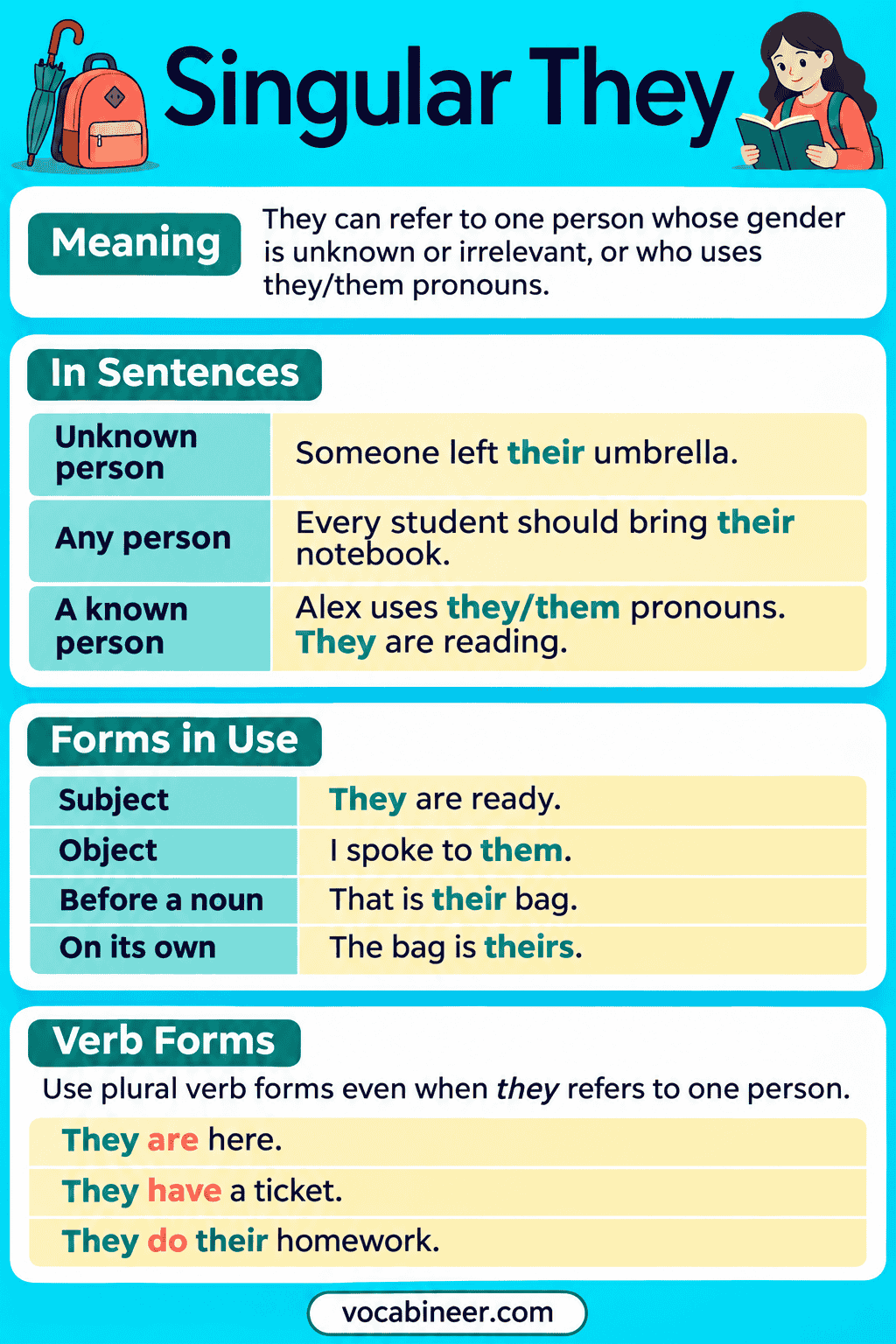
Singular they refers to one person using the pronoun they and its related forms, including them, their, and theirs. It is useful when someone’s gender is unknown or irrelevant. For example, “Someone left their umbrella” refers to one person without specifying their gender.
Singular they also refers to a specific person who uses they/them pronouns. Although it describes one person, it keeps familiar verb forms such as they are, they have, and they do. Understanding these forms helps you write clear sentences about people in everyday and formal contexts.
In This Page
Understanding Singular They
The word they can refer to one person or several people. The surrounding words help readers identify who you mean.
| Use | Example | Meaning |
|---|---|---|
| An unspecified person | Someone called, but they left no message. | One person called. Their identity is unknown. |
| A person whose gender is irrelevant | Each applicant should check their email. | The instruction applies to each applicant individually. |
| A specific person | Jordan uses they/them pronouns. They work at the library. | They refers to Jordan. |
| Several people | Jordan and Maya arrived. They brought lunch. | They refers to both people. |
When you use singular they, the reference remains singular. However, the pronoun follows the same verb patterns it uses when referring to several people.
The Forms of Singular They
Choose the form according to its job in the sentence. For example, they can be the subject, while them can be the object of a verb or preposition.
In the examples below, Jordan uses they/them pronouns.
| Form | Grammatical role | Example |
|---|---|---|
| They | Subject | They arrived early. |
| Them | Object | I thanked them. |
| Their | Possessive form before a noun | Their notebook is blue. |
| Theirs | Possessive pronoun standing alone | The blue notebook is theirs. |
| Themselves / themself | Reflexive form | They introduced themselves to the group. |
Their and Theirs
Use their before the thing someone owns. Use theirs when the noun is already clear from the sentence or context. Neither form takes an apostrophe.
| Form | Example | Explanation |
|---|---|---|
| Their | This is their bag. | Their comes before the noun bag. |
| Theirs | This bag is theirs. | Theirs expresses possession without a following noun. |
Contractions With They
Contractions also work when they refers to one person. For example, if Jordan plans to arrive tomorrow, you can write “They’ll arrive tomorrow.”
| Contraction | Full form | Example |
|---|---|---|
| They’re | They are | They’re ready to leave. |
| They’ve | They have | They’ve finished the report. |
| They’ll | They will | They’ll call this evening. |
Because their and they’re sound alike, check their meaning when you write.
| Word | Meaning | Example |
|---|---|---|
| Their | Shows possession | Their coat is here. |
| They’re | Means they are | They’re looking for a coat. |
If you can replace the word with they are, use they’re.
Verb Agreement With Singular They
Singular they takes are, were, have, and do. With most present-tense action verbs, it takes the form without the third-person singular -s.
A person’s name still takes a singular verb. Therefore, changing the subject from a name to they can change the verb form.
| With a singular name | With singular they |
|---|---|
| Jordan is ready. | They are ready. |
| Jordan was tired. | They were tired. |
| Jordan has a bicycle. | They have a bicycle. |
| Jordan does the shopping. | They do the shopping. |
| Jordan works nearby. | They work nearby. |
Both columns describe the same person. The verb agrees with the grammatical form of the subject in each sentence.
Questions and Negative Sentences
The same agreement pattern applies when you ask a question or make a negative statement.
| Statement | Question | Negative sentence |
|---|---|---|
| They are ready. | Are they ready? | They aren’t ready. |
| They work here. | Do they work here? | They don’t work here. |
| They have a ticket. | Do they have a ticket? | They don’t have a ticket. |
| They were at home. | Were they at home? | They weren’t at home. |
After do or don’t, use the base form of the main verb. For example, “Do they work here?” uses work.
Singular They With Someone, Everyone, and Each Person
Words such as someone, everyone, and each person take singular verbs. However, when you refer back to them with they, use the usual they verb forms.
| Initial subject | Sentence with singular they |
|---|---|
| Someone | Someone has a question. They are waiting to ask it. |
| Everyone | Everyone is welcome. They can bring a guest. |
| Each student | Each student has a notebook. They use it during class. |
| Every applicant | Every applicant needs an account before they submit a form. |
Each subject controls its own verb. As a result, “Every applicant needs” and “they submit” can appear together correctly.
Singular they also works naturally in general instructions.
- Anyone. If anyone needs help, they can ask the teacher.
- A customer. A customer can return an item if they have the receipt.
- Each participant. Each participant should bring their identification.
Using They and Them for a Specific Person
When someone uses they/them pronouns, use the appropriate forms consistently. Their name can establish the reference, and the pronouns can carry it through the following sentences.
Jordan joined our team this week. They work at the front desk, and I helped them learn the booking system. Their first shift went well. The notebook beside the computer is theirs.
Here, they, them, their, and theirs all refer to Jordan. Each form has a different grammatical role.
A pronoun alone does not establish someone’s gender identity. For a specific person, use the pronouns that person uses. If you do not know their pronouns, singular they can help you refer to them without assuming.
Choosing Themself or Themselves
Both themself and themselves occur with singular they. APA Style accepts both as singular reflexive forms, although themselves is more common.
| Form | Example referring to one person |
|---|---|
| Themselves | The new student introduced themselves. |
| Themself | The new student introduced themself. |
A reflexive pronoun refers back to the person named by the subject. In these examples, the student makes the introduction and is also the person they introduce.
When referring to an individual, follow the form they use. For a general statement, follow your publication’s style guidance and use the chosen form consistently.
Keeping Pronoun References Clear
Readers should be able to identify who they refers to. Usually, a nearby name or noun provides enough information.
However, when a sentence mentions two people, the reference can become unclear.
| Sentence | Clarity |
|---|---|
| Jordan spoke to Maya after they finished the report. | They could refer to Jordan, Maya, or both. |
| After Jordan finished the report, Jordan spoke to Maya. | Jordan finished the report. |
| After Maya finished the report, Jordan spoke to Maya. | Maya finished the report. |
| After Jordan and Maya finished the report, they spoke about it. | Both people finished the report. |
Repeat a name when it helps the reader understand the intended meaning.
For general statements, you can also choose between singular and plural wording.
| General statement about one person | General statement about a group |
|---|---|
| Each student should bring their notebook. | Students should bring their notebooks. |
Both versions work, but the emphasis changes slightly. The first addresses each student individually. The second describes students collectively. When writing about a specific person, preserve that individual reference and use their pronouns.
Common Mistakes With Singular They
Most errors involve verb agreement or choosing the wrong pronoun form. Check the subject, the verb, and whether the sentence expresses possession.
| Incorrect form in standard writing | Correct form | Reason |
|---|---|---|
| They is ready. | They are ready. | They takes are. |
| They has a ticket. | They have a ticket. | They takes have. |
| They was late. | They were late. | They takes were. |
| Them works here. | They work here. | Use they as the subject and work as its verb. |
| This is theirs notebook. | This is their notebook. | Their comes before a noun. |
| The notebook is their’s. | The notebook is theirs. | Theirs takes no apostrophe. |
| Their ready to leave. | They’re ready to leave. | The intended meaning is they are. |
FAQs About Singular They
Yes. Singular they is an established English usage. It can refer to an unspecified person or a specific person who uses they/them pronouns.
Yes. APA Style endorses singular they, and MLA also accepts it. Follow any specific requirements from your instructor, journal, or publisher.
The pronoun keeps its usual verb forms even when it refers to one person. English also uses “you are” when speaking to a single person.
No. It also refers to people whose gender is unknown or irrelevant, as in “Someone forgot their keys.” For a known individual, use the pronouns that person uses.
No. English speakers and writers have used singular they for unspecified people for centuries. Its use for specific people who use they/them pronouns has gained wider recognition more recently.
Read More
- Parts of Speech in English
- Nouns in English with Examples
- Common and Proper Nouns
- Countable and uncountable nouns
- Collective nouns
- Abstract and concrete nouns
- Gender nouns
- Compound nouns
- Possessive nouns
- Singular and plural nouns
- Plural noun rules