

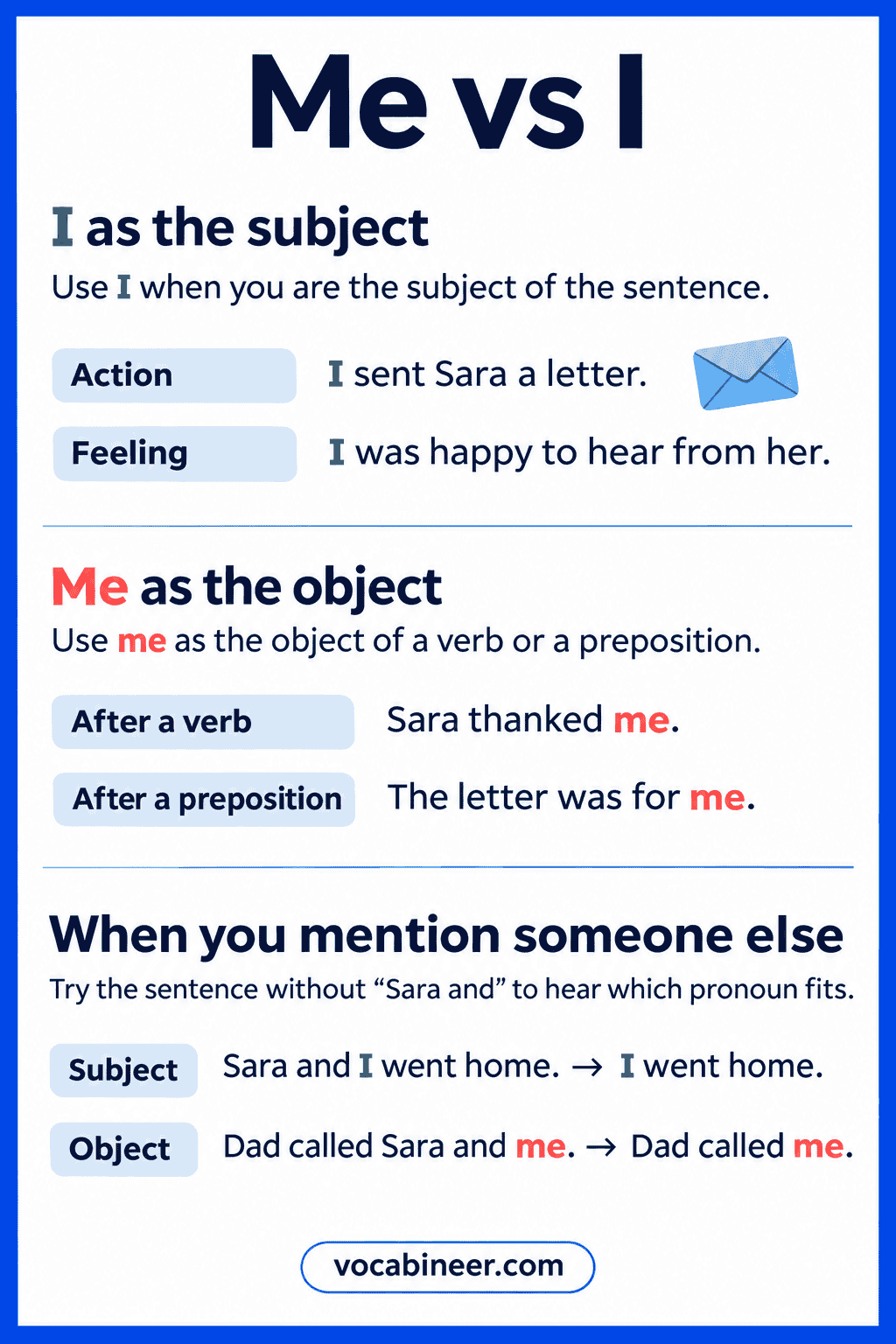
I and me both refer to the person speaking or writing. Use I as the subject of a verb and me as the object of a verb or a preposition. In “I called Maya, and she called me back,” the speaker makes the first call and receives the second.
The choice can feel less obvious when you mention yourself and someone else. If you’re writing a thank-you note and pause at “Thank you for inviting Maya and me,” try leaving out Maya’s name. “Thank you for inviting me” shows why me belongs in the original sentence.
In This Page
The Difference Between I and Me
First, look for the verb or preposition that connects to the pronoun. Even when two sentences describe the same event, the speaker can have a different role in each one.
| Role | Example | Why the pronoun fits |
|---|---|---|
| Subject of a verb | I thanked the coach. | I is the subject of thanked. The speaker gives the thanks. |
| Object of a verb | The coach thanked me. | Me is the object of thanked. The speaker receives the thanks. |
| Object of a preposition | The coach saved a seat for me. | Me is the object of for. It tells us who the seat was for. |
A subject can also receive an action. For example, in “I was chosen for the team,” the coach makes the choice. The speaker still uses I because it is the subject of was chosen.
Choosing I or Me When You Name Two People
When you join a name and a pronoun with and, the two words share a role. For example, if you and Maya both thank the coach, the whole phrase Maya and I is the subject. Two quick checks can help when you’re unsure.
- Leave out the other person. Remove the name and and, then read the sentence with just your pronoun.
- Replace the pair. Try we or us in place of both people. This check is especially handy with a plural verb such as are.
| Full sentence | Leave out the other person | Replace the pair |
|---|---|---|
| Maya and I thanked the coach. | I thanked the coach. | We thanked the coach. |
| The coach thanked Maya and me. | The coach thanked me. | The coach thanked us. |
| You and I are ready. | I am ready. | We are ready. |
In the last example, removing the other person changes the verb to am. Using we lets you keep are and check the subject in one step.
Using Me After a Preposition
Use me when you refer to yourself after a preposition such as to, for, with, or between. If removing a name makes the phrase sound incomplete, replace both people with us. This works particularly well with between, since us keeps both people in the picture.
| Preposition | Example | Check with us |
|---|---|---|
| To | Send the address to Maya and me. | Send the address to us. |
| For | These seats are for you and me. | These seats are for us. |
| With | Ben walked home with Maya and me. | Ben walked home with us. |
| Between | Let’s keep this between you and me. | Let’s keep this between us. |
Common Mistakes With I and Me
It’s easy to reach for and I when you want an email or invitation to sound polite. Instead, check the job the pronoun does in that particular sentence.
| Common mistake in standard writing | Correct form | Quick check |
|---|---|---|
| My brother and me will bring dessert. | My brother and I will bring dessert. | I will bring dessert. |
| Please email Sara and I. | Please email Sara and me. | Please email me. |
| This card is from Dad and I. | This card is from Dad and me. | This card is from us. |
FAQs About I and Me
Yes. “It’s me” is a natural way to identify yourself when someone asks who’s at the door or on the phone.
Yes. Leave out Maya and, and the request becomes “Please let me know.” Keep me when you put Maya’s name back.
“Me too” is a common short reply when you share someone’s feeling or experience. If a friend says “I love mangoes,” your reply means “I love mangoes too.”
Both are correct. In “My sister is taller than me,” me is the object of than. In “My sister is taller than I am,” I is the subject of am.
No. It’s customary to mention the other person first. In “The host welcomed Maya and me,” the host welcomed both of you, so me is the correct form.
Read More
- Parts of Speech in English
- Nouns in English with Examples
- Common and Proper Nouns
- Countable and uncountable nouns
- Collective nouns
- Abstract and concrete nouns
- Gender nouns
- Compound nouns
- Possessive nouns
- Singular and plural nouns
- Plural noun rules