

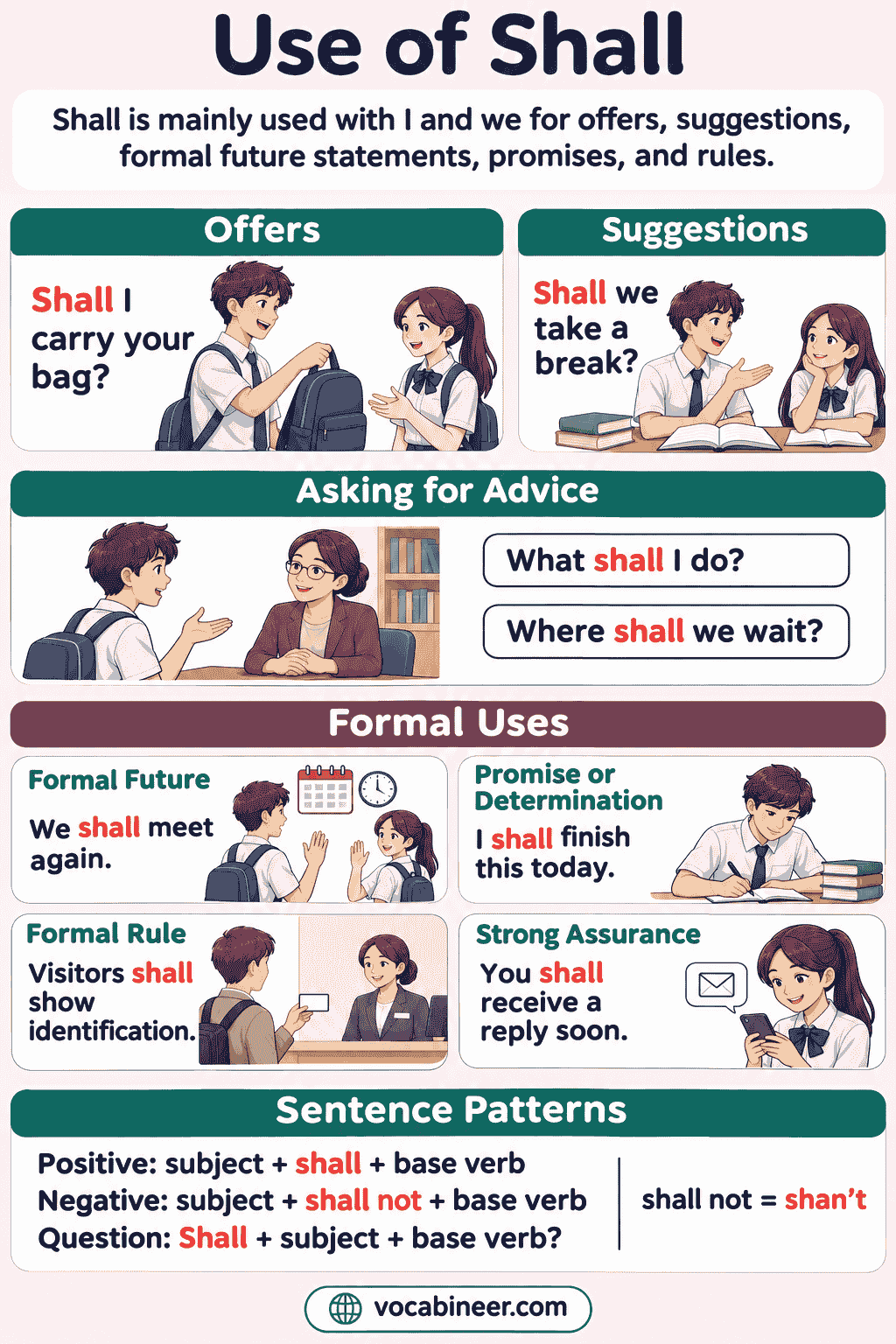
The modal verb shall appears most naturally in questions such as “Shall I help?” and “Shall we begin?” These patterns let speakers offer help, suggest a shared action, or ask for guidance. Shall can also express a formal future intention, determination, a promise, an authoritative command, or a requirement in certain legal and technical documents.
However, modern English uses shall less often than older grammar rules suggest. Will now expresses ordinary future meaning with every subject, especially in American English. Therefore, learning shall means understanding not only its grammar but also its formality, regional use, and purpose in a specific sentence or document.
In This Page
Shall in Modern English
Shall is a modal auxiliary verb. It comes before the base form of another verb and keeps the same form with every subject. Although speakers can use it with different subjects in formal or specialized contexts, its most common everyday patterns are shall I and shall we.
| Use | Example | Modern Status |
|---|---|---|
| Offer | Shall I carry your bag? | Current, especially in British English |
| Shared suggestion | Shall we take a break? | Current, especially in British English |
| Request for guidance | What shall I do? | Current but less common in American English |
| Fixed question tag | Let’s begin, shall we? | Standard |
| Formal future | We shall contact you soon. | Correct but formal |
| Determination | We shall succeed. | Emphatic or rhetorical |
| Promise | You shall receive a reply. | Formal or literary |
| Command | You shall remain here. | Authoritative or old-fashioned |
| Legal requirement | The tenant shall pay the fee. | Specialized and convention-dependent |
The everyday value of shall lies mainly in decision-seeking questions. In contrast, statements with shall often sound formal, ceremonial, forceful, legalistic, or old-fashioned.
Grammar Rules for Shall
Like other central modal verbs, shall takes a bare infinitive. It does not take to, does not add -s for the third person, and does not need do, does, or did in questions and negatives.
| Feature | Rule | Example |
|---|---|---|
| Main verb form | Use the base form | We shall return. |
| Third-person form | Do not add -s | The winner shall receive a prize. |
| Negative | Put not after shall | We shall not surrender. |
| Question | Put shall before the subject | Shall we begin? |
| Other modals | Do not combine two central modals | Use shall have to, not shall must. |
Affirmative Sentences
Structure: Subject + shall + base verb
- I shall contact you tomorrow.
- We shall discuss the matter later.
- You shall receive a full explanation.
- The committee shall meet every month.
Negative Sentences
Structure: Subject + shall not + base verb
- I shall not forget your kindness.
- We shall not accept the proposal.
- Visitors shall not enter this area.
- The company shall not disclose personal data.
The contraction shan’t appears mainly in British English:
- I shan’t be long.
- We shan’t know the result until Monday.
However, won’t is much more common in modern conversation.
Questions with Shall
Structure: Shall + subject + base verb?
- Shall I open the window?
- Shall we invite Nadia?
- Where shall we meet?
- What shall I tell them?
Questions normally use I or we because the speaker asks another person to help decide the speaker’s or group’s action.
Short Answers
Replies usually answer the proposed action rather than repeat shall mechanically.
- “Shall we begin?” “Yes, let’s.”
- “Shall I call a taxi?” “Yes, please.”
- “Shall I close the door?” “No, thanks.”
- “Where shall we wait?” “Outside the main entrance.”
Offers with Shall I
Use shall I…? when the speaker offers to perform an action or asks whether an intended action is suitable.
- Shall I carry your bag?
- Shall I make some tea?
- Shall I send you the report?
- Shall I turn on the light?
The speaker controls the proposed action. Therefore, shall I differs from a request that asks the listener to act.
| Purpose | Natural Form | Example |
|---|---|---|
| Speaker offers to act | Shall I…? | Shall I open the door? |
| Speaker asks listener to act | Will you…? / Could you…? | Could you open the door? |
| Speaker asks whether an action is advisable | Should I…? | Should I open the door? |
In American English, speakers may prefer “Would you like me to…?” or “Should I…?” depending on the meaning.
Suggestions with Shall We
Use shall we…? to suggest an action that includes both the speaker and the listener.
- Shall we take a break?
- Shall we order dinner?
- Shall we meet at six?
- Shall we discuss the next section?
The question invites agreement instead of simply predicting the future.
Shall We and Let’s
Both forms propose a shared action, but they differ slightly in force.
| Shall We…? | Let’s… |
|---|---|
| Shall we leave now? | Let’s leave now. |
| Asks whether the listener agrees | Directly proposes the action |
| More consultative | Slightly more decisive |
The standard tag after let’s is shall we?
- Let’s begin, shall we?
- Let’s take a taxi, shall we?
- Let’s not argue, shall we?
Requests for Advice and Instructions
Questions with shall can ask another person to decide what the speaker or group should do.
- What shall I wear?
- Where shall we wait?
- Who shall I contact?
- How shall we proceed?
- Shall I include the final paragraph?
These questions often seek a specific decision or instruction rather than general advice.
| Question | Main Purpose |
|---|---|
| What shall I do with these files? | Request for instructions |
| Where shall we meet? | Decision about an arrangement |
| Who shall I invite? | Request for guidance |
| How shall we solve this problem? | Shared deliberation |
Shall I vs Will I
These forms are not interchangeable.
| Shall I…? | Will I…? |
|---|---|
| Shall I open the window? | Will I receive the results today? |
| Offers an action or asks for guidance | Asks about a future event affecting the speaker |
| The speaker can perform the proposed action | The speaker seeks a prediction or information |
Therefore, use shall I to consult someone about an action and will I to ask what is likely to happen.
Shall We vs Will We
| Shall We…? | Will We…? |
|---|---|
| Shall we leave now? | Will we arrive before noon? |
| Proposes a shared action | Asks about a future outcome |
| Invites agreement | Requests information or a prediction |
“Shall we win?” can sound like a formal speculation about the future, but “Will we win?” is the normal modern question.
Shall We vs Should We
| Shall We…? | Should We…? |
|---|---|
| Shall we call her now? | Should we call her now? |
| Proposes calling her | Asks whether calling her is advisable |
| Seeks agreement on a plan | Seeks judgment or advice |
Similarly, shall I asks for a decision or offers an action, whereas should I asks whether an action is wise or appropriate.
Question Tags with Shall
The most familiar tag is shall we? after let’s.
- Let’s leave, shall we?
- Let’s review the figures, shall we?
Speakers can also attach shall I? or shall we? to a first-person proposal:
- I’ll close the window, shall I?
- We’ll meet outside, shall we?
These tags seek confirmation. They do not simply ask about the future.
Negative questions are possible but often sound formal:
- Shall we not wait for them?
- Shan’t we need more time?
Modern speakers commonly prefer “Shouldn’t we wait?” or “Won’t we need more time?”
Formal Questions About the Future
Not every question with shall makes an offer or suggestion. Formal or literary questions can express speculation, concern, or selection.
- Where shall we be this time next year?
- How shall we manage without her?
- Who shall lead the organization?
- What shall become of the building?
In everyday English, will often replaces shall in straightforward future questions.
Formal Future Statements
Shall can replace will with I and we in formal statements about future intentions, decisions, predictions, or arrangements.
- I shall contact you tomorrow.
- We shall review your application.
- I shall be available after noon.
- We shall need more information.
Modern conversation normally uses will or ’ll:
| Formal | Neutral Modern Alternative |
|---|---|
| I shall call tomorrow. | I will call tomorrow. |
| We shall respond shortly. | We will respond shortly. |
| I shall not attend. | I will not attend. |
| We shan’t be late. | We won’t be late. |
After I and we, the contraction ’ll does not reveal whether the theoretical full form is will or shall. In modern speech, that distinction rarely matters.
Continuous and Perfect Forms with Shall
More complex forms are grammatically correct, although equivalent forms with will sound more natural in most modern contexts.
| Form | Structure | Example |
|---|---|---|
| Future continuous | shall be + verb-ing | We shall be waiting for you. |
| Future perfect | shall have + past participle | We shall have finished by noon. |
| Future perfect continuous | shall have been + verb-ing | We shall have been working for six hours. |
| Future passive | shall be + past participle | The matter shall be reviewed. |
| Perfect passive | shall have been + past participle | The work shall have been completed. |
Promises and Assurances
With second- or third-person subjects, shall can express a promise, assurance, guarantee, reward, or authority-controlled result.
- You shall receive a full refund.
- You shall have all the help you need.
- The winner shall receive a medal.
- Every applicant shall receive a response.
Speaker control helps explain this meaning.
| Sentence | Meaning |
|---|---|
| You will receive a reply tomorrow. | Neutral prediction or statement of future fact |
| You shall receive a reply tomorrow. | Promise or authoritative guarantee |
| The winner will receive a prize. | Future information |
| The winner shall receive a prize. | Officially prescribed reward |
This use sounds formal, literary, ceremonial, or authoritative rather than conversational.
Determination and Declarations
Stressed shall can show strong determination.
- We shall succeed.
- I shall finish this work today.
- We shall overcome these difficulties.
- We shall not surrender.
Speeches, slogans, declarations, and ceremonial statements often use this form because it sounds weightier than ordinary will. The strong pronunciation /ʃæl/ can reinforce that determination.
Commands, Threats, and Prohibitions
With second- and third-person subjects, shall can express authority over another person’s action or outcome.
Formal Commands
- You shall remain here.
- Each candidate shall sign the form.
- The door shall remain closed.
Threats and Warnings
- You shall regret this.
- He shall pay for what he has done.
- No one shall escape punishment.
Prohibitions
- Visitors shall not enter this area.
- Candidates shall not use mobile phones.
- Employees shall not disclose confidential information.
These sentences sound official, dramatic, legal, literary, or old-fashioned. In everyday instructions, must and must not usually communicate the rule more clearly.
Shall with Have To, Need To, and Be Able To
Although shall cannot combine directly with another central modal, it can precede semi-modal expressions.
- We shall have to wait.
- I shall need to speak with the manager.
- We shall be able to finish tomorrow.
| Incorrect | Correct |
|---|---|
| We shall must wait. | We shall have to wait. |
| I shall can attend. | I shall be able to attend. |
| She shall should apply. | She should apply. |
Traditional and Modern Usage
Traditional grammar taught a person-based distinction between shall and will.
| Traditional Meaning | First Person | Second and Third Persons |
|---|---|---|
| Neutral future | shall | will |
| Determination or command | will | shall |
Under that system, “I shall return” expressed neutral future time, whereas “I will return” expressed determination. Conversely, “You will return” predicted the future, while “You shall return” issued a command.
Modern English does not consistently follow this rule. Instead, speakers use will with every subject for ordinary future meaning. Learners should understand the traditional system when reading older, literary, ceremonial, or highly formal texts, but they do not need to reproduce it in everyday communication.
British and American Usage
| Context | British English | American English |
|---|---|---|
| Shall I…? | Natural for offers and guidance | Formal; often replaced |
| Shall we…? | Natural for suggestions | Less common but understood |
| What shall I do? | Current | Often What should I do? |
| Formal future shall | Correct but formal | Rare |
| Shan’t | Possible but declining | Very rare |
| Let’s …, shall we? | Standard | Understood, sometimes formal |
| Legal shall | Still encountered | Still encountered but often avoided in new drafting |
Useful alternatives include:
- Would you like me to open the window?
- Should I send the file now?
- Do you want to leave?
- How about taking a break?
Shall in Conditional Clauses
Older, formal, or legalistic English may place shall in an if-clause.
- If you shall require assistance, contact the office.
- If any dispute shall arise, the parties will negotiate.
Modern English usually prefers the present simple:
| Formal or Old-Fashioned | Natural Modern Form |
|---|---|
| If you shall require assistance… | If you require assistance… |
| If a dispute shall arise… | If a dispute arises… |
Therefore, learners should recognize conditional shall but avoid it in ordinary writing.
Shall in Reported Speech
Traditional or formal English may backshift shall to should after a past reporting verb.
| Direct Speech | Traditional Reported Form |
|---|---|
| I said, “I shall return.” | I said that I should return. |
| We said, “We shall help.” | We said that we should help. |
Modern English commonly uses would:
- I said that I would return.
- We promised that we would help.
Reported should in these examples does not necessarily give advice. However, because it can sound dated or ambiguous, would is generally clearer for future-in-the-past meaning.
Ellipsis and Agreement with Shall
In formal or emphatic language, shall can stand without a repeated verb phrase.
- “Will you return?” “I shall.”
- I shall attend if necessary.
- Some may object, but we shall not.
Formal agreement structures also occur:
- “I shall attend.” “So shall I.”
- “I shall not surrender.” “Neither shall we.”
Modern conversation usually prefers will in these patterns.
Shall in Contracts and Legal Documents
Contracts and older legal texts often use shall for duties, prohibitions, entitlements, and prescribed legal consequences. However, legal meaning depends on the complete clause and its drafting context.
| Legal Function | Example |
|---|---|
| Duty | The buyer shall pay the fee. |
| Prohibition | The buyer shall not disclose the data. |
| Entitlement | The employee shall be entitled to paid leave. |
| Legal effect | The agreement shall terminate on 30 June. |
| Constitution | The committee shall consist of five members. |
| Deeming provision | The notice shall be deemed received. |
Legal Shall and Ordinary Future Shall
| Sentence | Likely Function |
|---|---|
| We shall contact you tomorrow. | Formal future intention |
| The tenant shall pay the rent. | Contractual duty |
| No visitor shall enter. | Prohibition |
| The winner shall receive a prize. | Entitlement or prescribed result |
Shall vs Must in Legal Drafting
Modern drafting practices differ. Some drafters use must for obligations because it communicates necessity directly. Others retain shall in contracts or documents that define it as mandatory.
| Shall | Must |
|---|---|
| Traditional formal or contractual wording | Clear modern expression of obligation |
| Can express duty, futurity, entitlement, or legal effect | Usually signals necessity or obligation |
| Meaning may depend on drafting convention | Often clearer to general readers |
Therefore, writers should follow the relevant jurisdiction, institutional style guide, and document convention rather than apply one universal rule.
Passive Legal Wording
Official documents often use shall in passive constructions:
- The fee shall be paid in advance.
- The application shall be reviewed.
- No personal information shall be disclosed.
However, passive wording can hide responsibility. A named actor often makes the rule clearer.
| Less Direct | Clearer Alternative |
|---|---|
| The report shall be submitted by Friday. | The manager must submit the report by Friday. |
| The equipment shall be inspected annually. | A qualified technician must inspect the equipment annually. |
This grammar discussion explains common usage only. It does not determine the legal effect of a clause or replace advice from a qualified legal professional.
Shall in Technical Standards
Some technical standards assign precise meanings to modal terms.
| Term | Common Standards Meaning |
|---|---|
| shall | Mandatory requirement |
| shall not | Prohibition |
| should | Recommendation |
| should not | Discouraged choice |
| may | Permission |
| can | Capability or possibility |
For example, “The device shall withstand the stated temperature” can establish a mandatory compliance requirement. Nevertheless, these meanings apply only when the standard or its governing framework follows that convention.
Shall Compared with Related Modals
Shall vs Will
| Use | Shall | Will |
|---|---|---|
| Neutral future | Formal with I/we | Normal with every subject |
| Offer by speaker | Shall I help? | I will help. |
| Shared suggestion | Shall we begin? | Not the normal form |
| Prediction | Formal and limited | Common |
| Determination | Formal or rhetorical | Common and direct |
| Legal requirement | Possible in specialized drafting | Usually expresses future or commitment |
Shall vs Should
| Shall | Should |
|---|---|
| Shall we begin? | We should begin soon. |
| Suggests a shared action | Recommends an action |
| What shall I do? | What should I do? |
| Asks for a decision or instruction | Asks for advice |
| May impose a specialized requirement | Usually expresses advice, expectation, or weaker obligation |
Shall vs Must
| Shall | Must |
|---|---|
| Can express formal future, promise, command, or requirement | Expresses necessity or strong obligation |
| Meaning depends heavily on context | Meaning is usually more direct |
| Common in some contracts and standards | Common in modern rules and instructions |
Shall Not vs May Not
| Shall Not | May Not |
|---|---|
| Candidates shall not use phones. | Candidates may not use phones. |
| Usually creates a formal prohibition | Can deny permission or express negative possibility |
| Requirement-oriented wording | Potentially ambiguous without context |
Pronunciation and Contractions
Shall has a weak pronunciation /ʃəl/ and a strong pronunciation /ʃæl/. Speakers often use the weak form in an unstressed question:
- Shall we go?
The strong form can emphasize determination or authority:
- We shall succeed.
- You shall not enter.
British speakers commonly pronounce shan’t as /ʃɑːnt/. The word is rare in American English. Meanwhile, ’ll remains the most common spoken contraction in future statements:
- I’ll call tomorrow.
- We’ll see you later.
Common Mistakes with Shall
Using To After Shall
| Incorrect | Correct |
|---|---|
| We shall to return. | We shall return. |
| I shall to call later. | I shall call later. |
Adding S to the Main Verb
| Incorrect | Correct |
|---|---|
| The winner shall receives a prize. | The winner shall receive a prize. |
| She shall reports directly to the manager. | She shall report directly to the manager. |
Using Do, Does, or Did
| Incorrect | Correct |
|---|---|
| Do we shall begin? | Shall we begin? |
| We do not shall surrender. | We shall not surrender. |
Combining Shall with Another Modal
| Incorrect | Correct |
|---|---|
| We shall must wait. | We shall have to wait. |
| I shall can attend. | I shall be able to attend. |
Using Shall for Ordinary Advice
| Incorrect or Unnatural | Natural |
|---|---|
| You shall rest more. | You should rest more. |
| In my opinion, we shall wait. | In my opinion, we should wait. |
Confusing Shall I with Should I
- Shall I carry the bag?
The speaker offers to carry it. - Should I carry the bag?
The speaker asks whether carrying it is advisable.
Overusing Shall for Future Time
Although “We shall arrive tomorrow” is correct, “We will arrive tomorrow” sounds more natural in most modern contexts.
Restricting Shall to I and We in Every Context
Ordinary future shall mainly takes I and we, but formal promises, commands, rules, and requirements can use other subjects:
- You shall receive a reply.
- The tenant shall pay the fee.
Treating Legal Shall as Universally Mandatory
Not every legal shall creates the same type of duty, and not every modern drafting system prefers it. Always interpret the complete provision within its document and jurisdiction.
Practical Guide to Choosing Shall
| Intended Meaning | Recommended Form | Example |
|---|---|---|
| Offer to act | Shall I…? | Shall I help? |
| Shared suggestion | Shall we…? | Shall we begin? |
| Request for instructions | What shall I…? | What shall I send? |
| Neutral future | will / ’ll | We’ll call tomorrow. |
| Formal first-person future | shall | We shall respond shortly. |
| Determination | stressed shall | We shall succeed. |
| Promise or assurance | shall in formal style | You shall receive an answer. |
| Everyday command | must / imperative | You must wait. |
| General advice | should | You should rest. |
| Contractual or technical requirement | follow the governing convention | The supplier shall/must deliver the goods. |
FAQs
The most common uses are offers with shall I, shared suggestions with shall we, and questions that ask for a decision or instruction. Future statements with shall remain correct but usually sound formal.
Will is the normal modern choice for neutral future meaning with every subject. Shall is most useful in first-person offers and suggestions, formal future statements, emphatic declarations, and specialized documents.
Shall I…? offers an action or asks another person to decide what the speaker should do. Should I…? asks whether an action is advisable or appropriate.
Everyday offers, suggestions, and formal future statements usually use I or we. However, promises, commands, rules, contracts, and technical standards can use shall with second- or third-person subjects.
No. In formal documents, shall may express a duty, prohibition, entitlement, legal effect, or prescribed result. Its exact effect depends on the clause, document, jurisdiction, and drafting convention.
Final Summary
Shall remains useful, but its role has narrowed in modern English. Speakers mainly use shall I for offers, shall we for shared suggestions, and question-word patterns for guidance or decisions. Formal writers may also use it with I and we for future intentions, while speeches and literary language use it for determination, promises, commands, and dramatic effects.
In contracts, legislation, and technical standards, shall can carry specialized meanings, but no single drafting rule applies everywhere. Therefore, choose it according to context, register, regional variety, and document convention. For ordinary future statements, will is usually more natural; for advice, use should; and for clear general obligations, must is often the better choice.
Read More
- Verbs in English
- Action Verbs
- Regular Verbs
- Irregular Verbs
- Transitive and Intransitive verbs
- Finite and Non-finite verbs
- Principal Parts of Verbs
- Forms of Verbs