

Verbs give sentences movement, purpose, and direction. A carefully chosen verb can show exactly what a person does, how an event unfolds, or how one idea affects another. When the verb carries clear meaning, the sentence usually becomes more direct and needs fewer supporting words.
In writing, these precise choices are often called strong verbs. However, the term also has a traditional grammatical meaning connected with past-tense formation. This guide explains both meanings, compares strong and weak verbs, and shows how to choose effective verbs for academic, creative, and professional writing without making every sentence unnecessarily dramatic.
In This Page
What Are Strong Verbs?
In writing, a strong verb expresses an action or state with precision. It carries enough meaning to reduce vague nouns, unnecessary adverbs, and wordy phrases.
Consider this sentence:
The child ran quickly across the road.
The verb ran gives the basic action, while quickly adds the manner. A more precise verb can communicate both ideas:
The child sprinted across the road.
The second sentence creates a clearer image with fewer words. Still, sprinted is suitable only if the child ran at full speed. If the child simply moved faster than usual, hurried may fit better.
A strong verb does not need to be long, unusual, or emotional. Short verbs such as grab, solve, cut, build, and prove can be strong because they express exact actions.
Two Meanings of Strong Verbs
The expression strong verb has one meaning in writing instruction and another in traditional grammar.
| Meaning | Explanation | Example |
|---|---|---|
| Strong verb in writing | A precise verb that communicates a clear action or state | The child sprinted. |
| Strong verb in traditional grammar | A verb that forms its past tense through an internal vowel change | sing–sang–sung |
These meanings should not be mixed. A verb may be strong in writing even if it is grammatically regular. For example, analyze is precise in “Researchers analyzed the results,” although its past tense follows the regular pattern analyzed.
Strong Verbs vs Weak Verbs
A weak verb usually expresses a broad meaning or places the real action inside another word. A strong verb communicates the action more directly.
| Strong Verbs | Weak Verbs |
|---|---|
| Express precise actions or states | Express broad or vague meanings |
| Often work without extra modifiers | May rely on adverbs or abstract nouns |
| Usually make sentences more concise | Can create wordy constructions |
| Help readers picture or understand the action | May provide limited detail |
| Must match the intended context | May be suitable when detail is unnecessary |
For example, The manager made a decision is not incorrect. However, The manager decided expresses the same action more directly.
Common Strong Verbs by Meaning
Grouping strong verbs by purpose makes them easier to choose. Words within the same category are not exact synonyms, so context still matters.
| Category | Strong Verbs |
|---|---|
| Movement | dash, creep, march, sprint, stagger, stroll, wander |
| Speech | admit, announce, argue, demand, explain, whisper |
| Observation | detect, discover, examine, inspect, notice, recognize |
| Thought | analyze, consider, conclude, evaluate, predict, question |
| Emotion | admire, cherish, fear, regret, resent, value |
| Change | expand, improve, reduce, strengthen, transform, weaken |
| Creation | assemble, build, compose, design, develop, produce |
| Damage or destruction | crush, damage, demolish, eliminate, erase, shatter |
| Support | confirm, defend, justify, reinforce, substantiate, uphold |
| Opposition | challenge, contradict, deny, dispute, reject, resist |
For instance, stroll, march, and stagger all describe walking, but each one creates a different image. A person strolls casually, marches purposefully, and staggers unsteadily.
Strong Verbs in Sentences
The following examples show how precise verbs work in different contexts.
| Strong Verb | Example Sentence |
|---|---|
| sprint | The athlete sprinted toward the finish line. |
| whisper | Maya whispered the answer to her friend. |
| examine | The doctor examined the patient. |
| construct | Workers constructed a bridge across the river. |
| reject | The committee rejected the proposal. |
| transform | The renovation transformed the empty building. |
| detect | The sensor detected smoke in the hallway. |
| negotiate | The companies negotiated a new agreement. |
| demonstrate | The experiment demonstrated the effect of heat. |
| coordinate | Aisha coordinated the entire event. |
The verb should communicate the intended action without forcing readers to guess. Therefore, examined is stronger than looked at carefully, while negotiated is more informative than talked about.
Replacing Weak Expressions
Weak constructions often combine a general verb with an abstract noun. Converting that noun into a direct verb can make the sentence shorter and clearer.
| Weak Expression | Stronger Alternative |
|---|---|
| make a decision | decide |
| give an explanation | explain |
| conduct an investigation | investigate |
| have an effect on | affect |
| make an improvement | improve |
| give a description | describe |
| do an analysis | analyze |
| come to a conclusion | conclude |
| provide an indication | indicate |
| carry out an assessment | assess |
| perform an evaluation | evaluate |
| is responsible for managing | manages |
For example:
The team conducted an investigation into the complaint.
The noun investigation carries the real action. A direct verb improves the sentence:
The team investigated the complaint.
Not every verb-and-noun combination needs revision. Phrases such as make a cake, have a car, and give a gift express natural meanings and do not hide actions.
Replacing Verbs and Adverbs
One precise verb can sometimes replace a general verb and an adverb. However, each alternative adds a particular meaning.
| General Verb and Adverb | Possible Strong Verb |
|---|---|
| walked slowly | strolled, crept, or trudged |
| ran quickly | sprinted or dashed |
| said quietly | whispered |
| looked angrily | glared |
| cried loudly | wailed |
| ate quickly | devoured or gulped |
| held tightly | gripped or clutched |
| smiled broadly | beamed |
| listened secretly | eavesdropped |
| wrote carelessly | scrawled |
These choices are not interchangeable. Strolled suggests relaxed movement, crept suggests quiet or cautious movement, and trudged suggests effort or tiredness. The correct verb depends on the scene.
Adverbs are not automatically weak. Sometimes an adverb adds information that no single familiar verb expresses naturally. The goal is to remove unnecessary modifiers, not to ban an entire word class.
Necessary Uses of Be, Have, and Do
Writers often overuse be, have, and do, but these verbs also perform essential grammatical functions.
| Verb | Necessary Use | Example |
|---|---|---|
| be | Links a subject to an identity or description | Lina is the captain. |
| be | Helps form continuous tenses and passive voice | They are studying. |
| have | Expresses possession or experience | We have enough time. |
| have | Helps form perfect tenses | She has finished. |
| do | Forms questions and negatives | Do you agree? |
| do | Adds emphasis | I do understand. |
These verbs become candidates for revision only when they create unnecessary wordiness or hide a more direct action.
| Less Direct | More Direct |
|---|---|
| She is responsible for supervising the staff. | She supervises the staff. |
| He has a strong dislike of delays. | He dislikes delays. |
| They did an examination of the records. | They examined the records. |
Do not remove helping or linking verbs when they are grammatically necessary.
Strong Verbs and Active Voice
Strong verbs and active voice can work together, but they describe different features of writing.
| Strong Verbs | Active Voice |
|---|---|
| Concern precise word choice | Concerns sentence structure |
| Can appear in active or passive sentences | Places the performer before the action |
| May describe an action or a state | Shows the subject performing the action |
| Example: The storm destroyed the roof. | Example: Workers repaired the roof. |
A passive sentence can contain a precise verb:
The proposal was rejected by the committee.
The verb reject remains precise, although the sentence uses passive voice. The active version, The committee rejected the proposal, sounds more direct because it names the performer first.
Passive voice remains useful when the performer is unknown, unimportant, or intentionally omitted. Therefore, writers should choose voice according to purpose rather than treating every passive sentence as weak.
Strong Reporting Verbs
Academic writers use reporting verbs to describe another writer’s ideas, evidence, or conclusions. The verb also shows how strongly the writer interprets the source.
| Purpose | Reporting Verbs |
|---|---|
| Neutral reporting | describes, explains, reports, states |
| Agreement or support | accepts, confirms, endorses, supports |
| Disagreement | challenges, denies, disputes, rejects |
| Evidence | demonstrates, establishes, indicates, reveals |
| Cautious interpretation | implies, proposes, suggests, predicts |
| Argument | argues, claims, contends, maintains |
Choose reporting verbs carefully because they express different levels of certainty. Demonstrates makes a stronger claim than suggests, while argues describes a position rather than established proof.
Compare:
The study proves that the method works.
The study suggests that the method may work.
The first sentence expresses certainty. The second presents a cautious interpretation. The available evidence should determine the verb.
Strong Verbs for Academic Writing
Academic verbs should communicate the relationship between ideas accurately.
| Purpose | Useful Verbs |
|---|---|
| Analyzing | analyze, assess, evaluate, examine |
| Comparing | compare, contrast, differentiate, distinguish |
| Explaining | clarify, define, demonstrate, illustrate |
| Supporting | confirm, justify, reinforce, substantiate |
| Challenging | challenge, contradict, dispute, question |
| Showing causes | cause, generate, produce, trigger |
| Showing results | affect, improve, reduce, transform |
| Organizing ideas | categorize, classify, connect, summarize |
Avoid choosing a formal verb merely because it sounds academic. A familiar verb that accurately represents the evidence is stronger than an impressive word used incorrectly.
Strong Verbs for Creative Writing
Creative writing benefits from verbs that create clear images, sounds, and physical reactions.
| General Verb | Context-Specific Alternatives |
|---|---|
| walk | creep, march, stroll, stagger, trudge |
| look | examine, gaze, glance, glare, scan |
| run | bolt, charge, dash, flee, sprint |
| hold | clutch, cradle, grasp, grip, seize |
| break | crack, crush, shatter, snap, split |
| move | drift, glide, lunge, slide, sway |
| touch | brush, pat, press, stroke, tap |
| shine | beam, flicker, gleam, glow, sparkle |
Sensory verbs can also make descriptions more immediate.
| Sense | Strong Verbs |
|---|---|
| Sight | glimpse, inspect, observe, scan |
| Sound | crackle, echo, roar, whisper |
| Touch | brush, grip, squeeze, stroke |
| Smell | detect, inhale, reek, sniff |
| Taste | devour, nibble, sample, savor |
Should Writers Replace Said?
The verb said is not automatically weak. It works as a neutral dialogue tag and often remains nearly invisible to readers. Replace it only when another verb communicates necessary information.
| General Dialogue Tag | Context-Specific Alternative |
|---|---|
| said quietly | whispered |
| said loudly | shouted |
| said angrily | snapped |
| said officially | announced |
| said unwillingly | admitted |
Avoid distracting dialogue tags when the words or surrounding action already reveal the speaker’s tone.
Strong Verbs for Résumés and Professional Writing
Professional writing uses strong verbs to show responsibilities, skills, and results.
| Skill Area | Strong Verbs |
|---|---|
| Leadership | directed, led, managed, supervised |
| Communication | explained, negotiated, persuaded, presented |
| Organization | arranged, coordinated, scheduled, streamlined |
| Creation | built, designed, developed, launched |
| Improvement | increased, reduced, strengthened, transformed |
| Problem-solving | analyzed, corrected, resolved, simplified |
| Achievement | completed, delivered, exceeded, generated |
A strong résumé statement should connect the verb to a specific responsibility or result.
Weak: Responsible for managing customer records.
Strong: Managed customer records for three regional offices.
When possible, add an accurate outcome:
Streamlined the filing process, reducing retrieval time by 30 percent.
Keep tense consistent. Use present tense for current duties and past tense for completed roles or achievements.
Strong Verbs and Phrasal Verbs
A phrasal verb combines a verb with a particle, as in find out or turn down. Phrasal verbs are natural and useful in everyday English. However, a single-word alternative may sound more concise or formal in academic and professional contexts.
| Phrasal Verb | Formal Alternative |
|---|---|
| find out | discover |
| look into | investigate |
| put off | postpone |
| bring about | cause |
| turn down | reject |
| cut down on | reduce |
| think over | consider |
| set up | establish |
Do not replace phrasal verbs mechanically. Put out a fire is natural and clear, while extinguish a fire sounds more formal. The audience and context should guide the choice.
Collocations and Natural Verb Choice
A collocation is a group of words that commonly appear together. Some expressions may contain broad verbs but still sound natural and correct.
| Natural Collocation | Meaning |
|---|---|
| make a decision | choose after consideration |
| reach a conclusion | form a final judgment |
| draw attention | cause someone to notice |
| conduct research | carry out systematic study |
| pose a question | present a question |
| raise an issue | introduce a subject for discussion |
In some contexts, a direct verb improves the expression: decide may replace make a decision. In others, the collocation carries a useful meaning that no shorter verb expresses as naturally. Effective revision respects both precision and normal English usage.
Choosing the Right Strong Verb
Use the following process when revising:
- Identify the exact action. Determine what the subject actually does.
- Decide which details matter. Consider speed, direction, emotion, purpose, and result.
- Check the context. Match the verb to the subject, audience, and level of formality.
- Choose the correct intensity. Do not use destroyed when damaged expresses the facts.
- Check the verb pattern. Confirm whether the verb needs an object, preposition, or complement.
- Remove redundant words. Delete modifiers that the new verb already includes.
- Confirm the meaning. Check a dictionary when the verb is unfamiliar.
- Read the complete sentence. Make sure the revision sounds natural and preserves the original idea.
Tone and Intensity
Related verbs can communicate very different attitudes.
| Verb | Typical Meaning or Tone |
|---|---|
| walk | neutral movement |
| stroll | relaxed movement |
| march | purposeful movement |
| trudge | slow, difficult movement |
| stagger | unsteady movement |
Similarly, question, challenge, criticize, and condemn express increasing levels of opposition. Choosing the strongest word without considering intensity may distort the message.
Transitive and Intransitive Verbs
Some strong verbs require direct objects, while others can stand alone.
| Verb Type | Example |
|---|---|
| Transitive | The storm destroyed the roof. |
| Transitive | She examined the evidence. |
| Intransitive | The audience applauded. |
| Intransitive | The children laughed. |
A precise verb still produces an incomplete sentence if its required object is missing.
Strong Verbs in Different Tenses
Verb strength depends on meaning rather than tense.
- She analyzes the results every week.
- She analyzed the results yesterday.
- She will analyze the results tomorrow.
- She has analyzed the results already.
Helping verbs may be necessary to express time, completion, possibility, or voice. Their presence does not weaken the main verb.
When Simple Verbs Are Better
Strong writing does not require dramatic or unusual verbs in every sentence. A simple verb may be the best choice when:
- The exact manner of the action does not matter.
- The audience includes beginner English learners.
- Instructions require familiar and consistent language.
- Technical writing uses established terminology.
- A more vivid verb would exaggerate the facts.
- The simple verb already expresses the meaning accurately.
- Repetition helps readers follow a procedure.
For example, Press the button to start the machine is clearer than a version filled with uncommon or overly formal alternatives. Precision matters more than novelty.
A Complete Paragraph Revision
Strong verbs improve more than individual sentences. They can also make an entire paragraph clearer.
Before revision
The project team had a meeting about the delivery problem. They did an analysis of the schedule and made a decision to change the shipping process. The manager gave instructions to the staff, and the new process had a positive effect on delivery times.
After revision
The project team met to discuss the delivery problem. They analyzed the schedule and changed the shipping process. The manager instructed the staff, and the new process shortened delivery times.
The revision replaces broad verbs and abstract nouns with met, analyzed, changed, instructed, and shortened. As a result, the paragraph becomes shorter and more direct without sounding exaggerated.
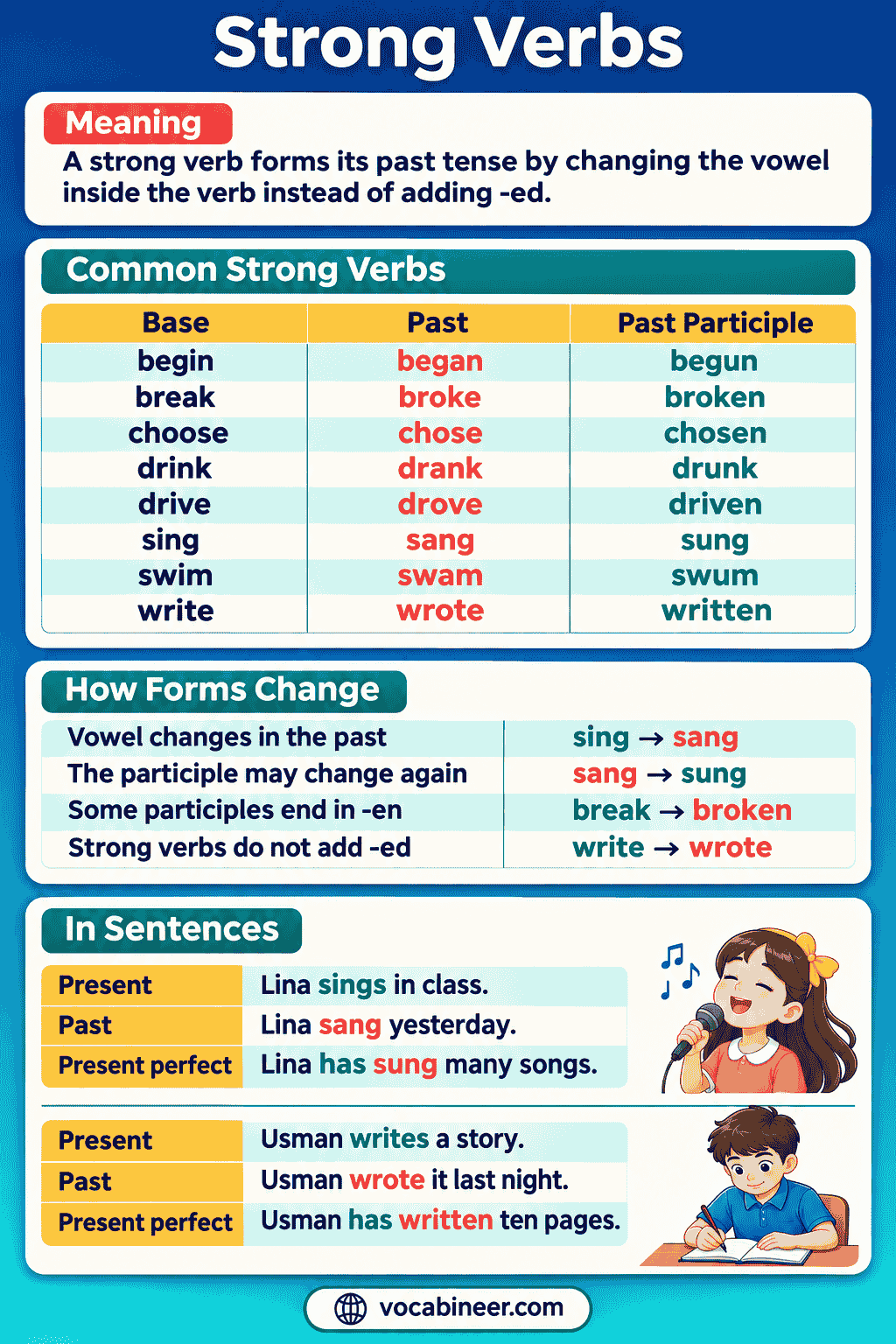
Strong Verbs in Traditional Grammar
In traditional Germanic grammar, strong verbs form the past tense and past participle through an internal vowel change.
| Base Form | Past Tense | Past Participle |
|---|---|---|
| begin | began | begun |
| choose | chose | chosen |
| drink | drank | drunk |
| drive | drove | driven |
| sing | sang | sung |
| speak | spoke | spoken |
| swim | swam | swum |
| write | wrote | written |
Weak verbs traditionally form the past tense with a dental ending such as -d, -ed, or -t. For example, walk becomes walked, while keep becomes kept.
This historical classification does not measure writing quality. The verb walked can be a precise choice, while the grammatical strong verb went can sound vague in a particular sentence.
Strong Verbs vs Irregular Verbs
Many traditional strong verbs are irregular in modern English, but the two categories are not identical.
| Strong Verbs | Irregular Verbs |
|---|---|
| Form the past through an internal vowel change | Do not follow the standard -ed pattern |
| Represent one historical group of irregular verbs | Include several formation patterns |
| Usually show vowel alternation | May change vowels, endings, both, or nothing |
| Example: sing–sang–sung | Examples: go–went, bring–brought, cut–cut |
Therefore, every traditional strong verb is irregular in modern English, but not every irregular verb is historically strong.
Common Mistakes with Strong Verbs
Replacing Every Simple Verb
Simple verbs are not automatically weak. Replace a verb only when another choice communicates the meaning more accurately.
Choosing an Inaccurate Synonym
Thesaurus entries may differ in tone, intensity, grammar, and collocation. Confirm the exact meaning before using an unfamiliar alternative.
Making Ordinary Actions Dramatic
A character who looked at a clock did not necessarily glare at it. Strong verbs should clarify the action rather than exaggerate it.
Removing Necessary Helping Verbs
Helping verbs form tenses, questions, negatives, and passive constructions. Removing them can make a sentence ungrammatical or change its meaning.
Treating Every Adverb as Unnecessary
A precise verb can replace some verb-and-adverb combinations, but useful adverbs add information that the verb does not contain.
Replacing Every Phrasal Verb
Phrasal verbs are natural in everyday English. Replace them only when a single-word verb better suits the audience and context.
Ignoring Collocations
A possible synonym may sound unnatural with a particular noun. Check how the verb normally combines with other words.
Confusing Writing Strength with Grammar
A strong verb in writing expresses precise meaning. A traditional strong verb changes its vowel to form the past tense. These classifications serve different purposes.
FAQs
In writing, a strong verb is a precise verb that communicates a clear action or state. In traditional grammar, it is a verb that forms its past tense through an internal vowel change.
Examples include analyze, construct, detect, examine, negotiate, sprint, transform, and whisper. A verb is strong only when it accurately fits the context.
Strong verbs reduce vague wording, unnecessary modifiers, and wordy phrases. They also help readers understand or imagine the action more clearly.
No. Action verbs express physical or mental actions, while strong verbs describe the precision of word choice. An action verb may be broad or specific depending on the sentence.
In traditional grammar, strong verbs form the past through vowel changes. Irregular verbs include all verbs that do not follow the standard -ed pattern, so the irregular category is broader.
Final Thoughts
Strong verbs improve writing by communicating actions and ideas with accuracy. They can replace vague expressions, unnecessary adverbs, and abstract noun phrases, but they should never distort the intended meaning.
During revision, focus on context, tone, intensity, grammar, and audience. Keep simple verbs when they already work, choose precise alternatives when they add clarity, and verify unfamiliar words before using them. Effective verb choice makes writing direct, natural, and engaging.
Read More
- Parts of Speech in English
- Nouns in English with Examples
- Common and Proper Nouns
- Countable and uncountable nouns
- Collective nouns
- Abstract and concrete nouns
- Gender nouns
- Compound nouns
- Possessive nouns
- Singular and plural nouns
- Plural noun rules