

Phrasal verbs appear throughout everyday English. Expressions such as wake up, find out, turn down, and look after combine a verb with one or more small words to create a complete meaning. Because the final meaning may differ from the meanings of the individual words, learners often find these expressions challenging.
However, vocabulary is only one part of the topic. You also need to know whether a phrasal verb takes an object, whether its parts can separate, where to place a pronoun, and how the expression changes for tense. This guide explains those rules clearly and presents common phrasal verbs in natural contexts.
In This Page
What Are Phrasal Verbs?
A phrasal verb combines a main verb with an adverb particle such as up, down, out, off, or away. Together, the words function as a single unit of meaning.
- Wake means to stop sleeping, while wake up expresses the complete action of becoming awake.
- Give means to provide something, while give up can mean to stop trying.
- Turn describes movement, while turn down can mean to reject an offer or reduce volume.
Some phrasal verbs have transparent meanings, while others are highly idiomatic. Therefore, learners must study both their meaning and their grammatical behavior.
Verbs and Particles
The main verb carries tense and agreement. The particle remains unchanged but helps create the expression’s meaning.
| Part | Function | Example |
|---|---|---|
| Main verb | Changes for tense, person, and number | give, gives, gave, given |
| Particle | Combines with the verb and remains unchanged | up |
| Complete phrasal verb | Functions as one meaning unit | give up |
For example:
- I give up.
- She gives up too easily.
- They gave up yesterday.
- We have given up waiting.
Although the form of give changes, up stays the same.
How Particles Affect Meaning
One verb can combine with different particles to create several meanings.
| Phrasal verb | Meaning | Example |
|---|---|---|
| Take off | Remove or leave the ground | Take off your shoes. |
| Take on | Accept work or responsibility | She took on a new project. |
| Take over | Gain control | A new company took over the business. |
| Take up | Begin an activity | He took up painting. |
| Take back | Return something or withdraw a statement | I take back what I said. |
Consequently, learning only the main verb does not reveal the meaning of every combination.
How to Identify a Phrasal Verb
Not every verb followed by a short word forms a phrasal verb. Sometimes the short word belongs to an ordinary phrase that describes place or direction.
| Phrasal verb | Ordinary verb combination |
|---|---|
| She looked up the word. | She looked up the street. |
| Please take off your shoes. | The bird flew over the house. |
| They turned down the offer. | They walked down the road. |
Several tests can help identify a phrasal verb:
- The verb and particle create one recognized meaning.
- Replacing one part may change the meaning completely.
- A separable particle can move after a noun object: look up the word → look the word up.
- The particle may receive stress in speech.
- A dictionary lists the complete combination as a separate expression.
No single test works for every expression. Therefore, a reliable learner’s dictionary remains the best guide.
Phrasal Verbs and Other Multi-Word Verbs
The term multi-word verb covers several related structures. In strict grammatical descriptions, these structures are not identical. However, many teaching materials use phrasal verb as a broad label for all of them.
| Category | Structure | Example | Main feature |
|---|---|---|---|
| Phrasal verb | verb + adverb particle | turn down | The particle forms part of the verb’s meaning. |
| Prepositional verb | verb + preposition | rely on | The preposition introduces its object. |
| Phrasal-prepositional verb | verb + particle + preposition | put up with | Two small words follow the verb. |
Particles and Prepositions Compared
Particles and prepositions may look identical, but they perform different jobs.
| Particle | Preposition |
|---|---|
| Forms part of a phrasal verb | Introduces a noun, pronoun, or gerund |
| May move in a separable construction | Normally stays before its object |
| Can receive strong stress | Usually receives less stress than the following noun |
| Turn the light off. | Look at the picture. |
| Turn it off. | Look at it. |
Compare “She looked up the answer” with “She looked up the chimney.” In the first sentence, up forms the phrasal verb look up, meaning to search for information. In the second, up introduces the direction of her gaze.
Literal and Idiomatic Phrasal Verbs
Phrasal verbs vary in how easily readers can understand their meanings.
| Meaning type | Phrasal verb | Explanation |
|---|---|---|
| Literal | sit down | Both words keep clear physical meanings. |
| Semi-transparent | clean up | The meaning remains fairly easy to infer. |
| Idiomatic | give up | The combined meaning cannot be predicted reliably. |
Therefore, it is inaccurate to say that every phrasal verb has a completely unpredictable meaning. Nevertheless, strongly idiomatic expressions usually need to be learned as complete vocabulary items.
Phrasal Verbs and Idioms
A phrasal verb is identified by its grammatical structure, while an idiom is identified mainly by its fixed, nonliteral meaning.
| Phrasal verb | Idiom |
|---|---|
| Contains a verb and one or more particles | Can use many different grammatical structures |
| May have a literal or idiomatic meaning | Usually has a figurative meaning |
| Example: turn off | Example: break the ice |
Some phrasal verbs are idiomatic, but not every phrasal verb is an idiom, and not every idiom is a phrasal verb.
Main Types of Phrasal Verbs
Phrasal verbs can be classified according to whether they take an object and whether their parts can separate.
| Type | Object | Separation | Example |
|---|---|---|---|
| Transitive and separable | Required | Usually possible | Turn the light off. |
| Transitive and inseparable | Required | Not possible | Look after the child. |
| Intransitive | Not used | Not applicable | The car broke down. |
Transitive Phrasal Verbs
A transitive phrasal verb takes an object.
- She turned down the offer.
- Please write down the address.
- We need to sort out this problem.
The object answers what? or whom? For example, “She turned down what?” The answer is “the offer.”
Intransitive Phrasal Verbs
An intransitive phrasal verb does not take a direct object.
- The car broke down.
- He showed up late.
- The children grew up quickly.
Because these expressions do not take objects, there is nothing to place between the verb and particle.
Separable Phrasal Verbs
With a separable phrasal verb, a noun object may appear after the particle or between the verb and particle.
- Please turn off the light.
- Please turn the light off.
- She called off the meeting.
- She called the meeting off.
Both positions are normally correct with a short noun object.
Inseparable Phrasal Verbs
An inseparable expression must remain together. Its object follows the complete expression.
- She looks after her grandmother.
- We came across an old photograph.
- He is getting over the illness.
Do not say “She looks her grandmother after” or “We came an old photograph across.”
When One Phrasal Verb Has Different Patterns
The grammar of an expression may change with its meaning.
| Meaning of take off | Type | Example |
|---|---|---|
| Remove clothing | Transitive and separable | Take your jacket off. |
| Leave the ground | Intransitive | The plane took off. |
| Become successful quickly | Intransitive | Her career took off. |
Similarly, work out can take an object in “We worked out the answer,” but it is intransitive in “Everything worked out.” Learners should therefore check the specific meaning, not just the expression itself.
Separable and Inseparable Phrasal Verbs Compared
| Feature | Separable | Inseparable |
|---|---|---|
| Can a noun divide the expression? | Usually yes | No |
| Can a pronoun divide it? | It must when used as the object | No |
| Noun example | Pick up the parcel. / Pick the parcel up. | Look after the child. |
| Pronoun example | Pick it up. | Look after her. |
Separability cannot always be predicted from meaning. Therefore, learn it as part of the phrasal verb and confirm it in a dictionary.
Word Order with Phrasal Verbs
Correct word order depends on the phrasal verb’s type and the kind of object used.
Position of Noun Objects
A short noun object can usually occupy either position with a separable phrasal verb:
- Put on your coat.
- Put your coat on.
However, an inseparable phrasal verb must remain together:
- She ran into an old friend.
- Not: She ran an old friend into.
Position of Personal Pronouns
When a separable phrasal verb takes a personal pronoun, place the pronoun between the verb and particle.
- Turn it off.
- Pick me up at eight.
- Write them down.
- Hand it in tomorrow.
Do not say “turn off it” or “pick up me.” By contrast, a pronoun follows an inseparable expression: “Look after her” and “Get over it.”
Position of Long Objects
Long or complex objects usually sound more natural after the particle.
- Natural: She sorted out the problems affecting the entire payment system.
- Awkward: She sorted the problems affecting the entire payment system out.
Keeping the verb and particle together makes a long sentence easier to understand.
Two-Word and Three-Word Phrasal Verbs
Two-word phrasal verbs contain a verb and one particle. Three-word expressions contain a verb followed by a particle and a preposition.
| Type | Structure | Examples |
|---|---|---|
| Two-word | verb + particle | wake up, turn off, give away |
| Three-word | verb + particle + preposition | put up with, run out of, look forward to |
Three-word expressions normally remain together:
- We ran out of milk.
- She came up with a practical solution.
- I cannot put up with the noise.
- He looks up to his older brother.
Gerunds After Three-Word Expressions
When the final word is a preposition, it can introduce a noun, pronoun, or gerund. It does not take an infinitive merely because it is written as to.
- I look forward to the holiday.
- I look forward to seeing you.
- She finally got around to answering the email.
“I look forward to see you” is incorrect because to functions as a preposition in look forward to.
Phrasal Verbs with Multiple Meanings
Many phrasal verbs have several common meanings. Context shows which meaning the speaker intends.
| Phrasal verb | Meaning | Example |
|---|---|---|
| Take off | Remove clothing | Take your shoes off. |
| Take off | Leave the ground | The plane took off. |
| Take off | Become successful | The product quickly took off. |
| Pick up | Collect someone | I will pick you up at six. |
| Pick up | Learn informally | She picked up some Arabic. |
| Pick up | Improve | Business is picking up. |
| Turn down | Reject | He turned down the offer. |
| Turn down | Reduce | Please turn down the music. |
| Bring up | Mention a topic | She brought up the budget. |
| Bring up | Raise a child | He was brought up by his grandparents. |
For accurate learning, treat each sense as a separate vocabulary item and study it in a complete sentence.
How Phrasal Verbs Change Form and Tense
Only the main verb changes for tense, agreement, or grammatical form. The particle stays unchanged.
| Form | Example |
|---|---|
| Base form | give up |
| Third-person singular | gives up |
| Past form | gave up |
| Present participle | giving up |
| Past participle | given up |
Phrasal verbs can appear in different tenses:
| Tense | Example |
|---|---|
| Present simple | She looks after her nephew. |
| Past simple | She looked after him yesterday. |
| Future simple | She will look after him tomorrow. |
| Present continuous | She is looking after him today. |
| Present perfect | She has looked after him before. |
| Past perfect | She had looked after him before we arrived. |
| Modal construction | She can look after him tonight. |
If the main verb is irregular, use its correct irregular forms: take off, took off, taken off and give up, gave up, given up.
Negative Sentences and Questions
Form negatives and questions with the auxiliary required by the tense.
Negative examples:
- I do not get along with him.
- She did not turn down the offer.
- They have not sorted the problem out.
- We cannot put up with the noise.
Question examples:
- What time did you wake up?
- Why did she turn the job down?
- Have they called the meeting off?
- Who looks after the children?
The particle remains attached to the phrasal verb’s meaning even when other sentence elements change.
Phrasal Verbs in the Passive Voice
Many transitive phrasal verbs can form passive sentences. The particle or preposition remains with the verb.
| Active | Passive |
|---|---|
| They called off the meeting. | The meeting was called off. |
| The committee turned down the proposal. | The proposal was turned down. |
| Someone broke into the office. | The office was broken into. |
| Maria looked after the children. | The children were looked after by Maria. |
Intransitive expressions cannot form passives because they do not take objects:
- The car broke down.
- He showed up late.
- The children grew up abroad.
Therefore, constructions such as “The accident was happened” are incorrect.
Phrasal Verbs and Compound Nouns
A phrasal verb is normally written as separate words. However, a related noun may appear as one word or with a hyphen.
| Phrasal verb | Compound noun | Examples |
|---|---|---|
| work out | workout | I work out daily. / That was a hard workout. |
| take off | takeoff | The plane took off. / The takeoff was smooth. |
| check in | check-in | Please check in online. / Online check-in is open. |
| back up | backup | Back up your files. / Keep a backup. |
| log in | login | Log in here. / Enter your login details. |
| break down | breakdown | The machine broke down. / A breakdown stopped production. |
Spelling can vary by style and region, so check a current dictionary when editing formal work.
Formality and One-Word Alternatives
Phrasal verbs are frequent in conversation, but they are not automatically informal. Some work naturally in both speech and formal writing, while others have more formal one-word alternatives.
| Phrasal verb | One-word alternative | Typical difference |
|---|---|---|
| Put off | Postpone | Put off sounds more conversational. |
| Find out | Discover | Discover may sound more formal. |
| Look into | Investigate | Investigate suits formal reports. |
| Turn down | Reject | Reject is concise and formal. |
| Put up with | Tolerate | Tolerate is more formal. |
| Carry on | Continue | Continue is neutral or formal. |
| Point out | Indicate | Both can suit formal contexts. |
| Set up | Establish | Establish often suits professional writing. |
Choose the expression that fits the audience, purpose, and tone rather than replacing every phrasal verb automatically.
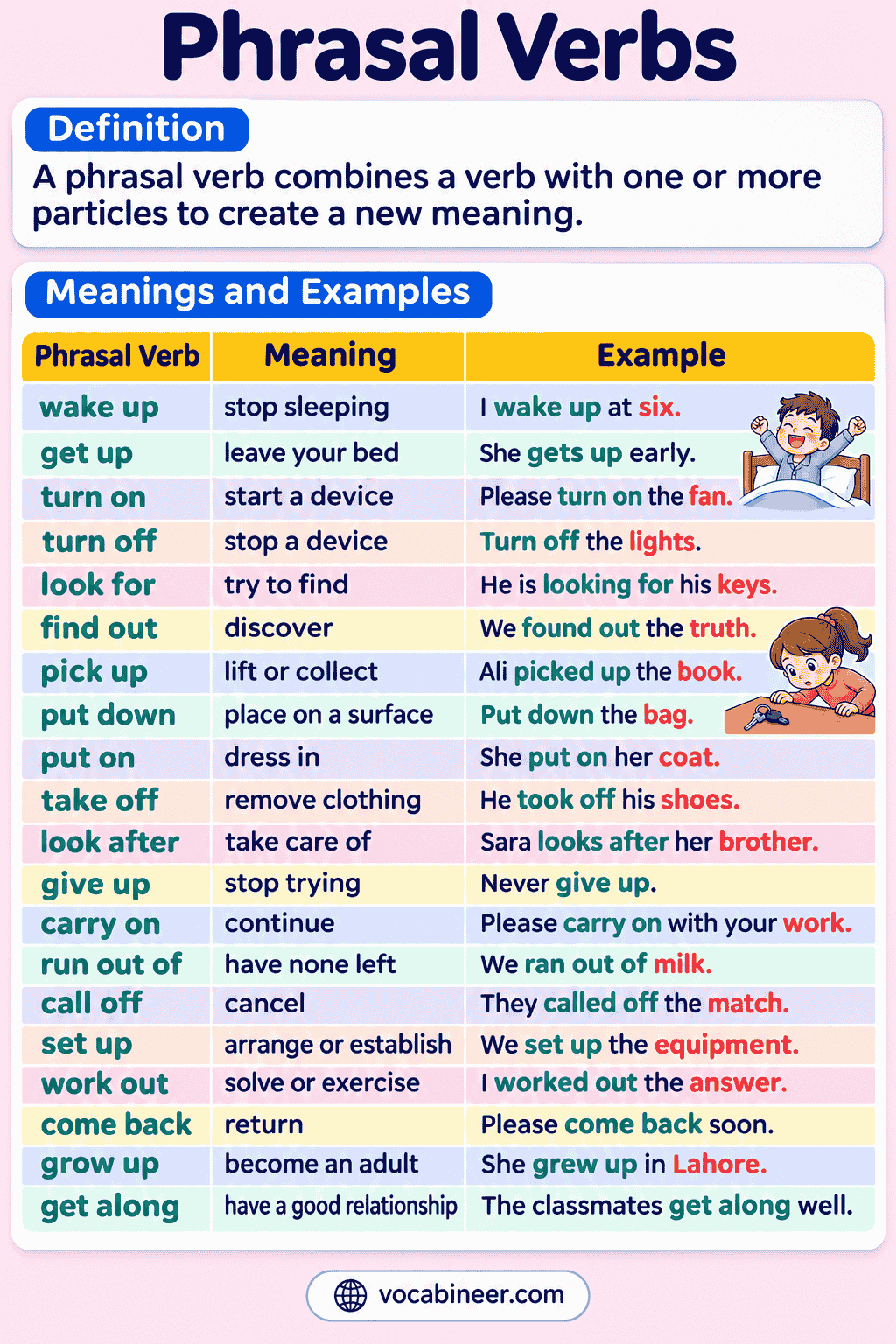
Common Phrasal Verbs with Meanings and Examples
The following groups present useful expressions for everyday communication. The type refers to the grammatical behavior shown in the listed meaning.
Daily Routines
| Phrasal verb | Meaning | Type | Example |
|---|---|---|---|
| Wake up | Stop sleeping | Intransitive | I wake up at six. |
| Get up | Leave your bed | Intransitive | She got up early. |
| Put on | Dress yourself in something | Transitive, separable | Put your jacket on. |
| Take off | Remove clothing | Transitive, separable | Take off your shoes. |
| Clean up | Make a place clean | Transitive, separable | We cleaned the kitchen up. |
| Go out | Leave home for a social activity | Intransitive | They went out after dinner. |
Work and Study
| Phrasal verb | Meaning | Type | Example |
|---|---|---|---|
| Hand in | Submit work | Transitive, separable | Hand your assignment in tomorrow. |
| Look up | Search for information | Transitive, separable | Look the word up online. |
| Write down | Record in writing | Transitive, separable | Write the address down. |
| Carry out | Perform a task | Transitive, separable | The team carried out the research. |
| Catch up | Reach the required level | Intransitive | I need to catch up before the exam. |
| Figure out | Understand or solve | Transitive, separable | We figured the answer out. |
Communication
| Phrasal verb | Meaning | Type | Example |
|---|---|---|---|
| Bring up | Mention a subject | Transitive, separable | She brought the issue up. |
| Point out | Draw attention to something | Transitive, separable | He pointed out the error. |
| Speak up | Speak more loudly | Intransitive | Please speak up. |
| Call back | Return a telephone call | Transitive, separable | I will call you back. |
| Hang up | End a telephone call | Intransitive | Do not hang up. |
| Cut off | Interrupt or disconnect | Transitive, separable | The bad signal cut us off. |
Travel and Movement
| Phrasal verb | Meaning | Type | Example |
|---|---|---|---|
| Set off | Begin a journey | Intransitive | We set off before sunrise. |
| Check in | Register on arrival | Intransitive | Please check in at the desk. |
| Pick up | Collect someone | Transitive, separable | I will pick you up at the airport. |
| Drop off | Take someone somewhere and leave them | Transitive, separable | She dropped me off at work. |
| Get in | Enter a car or arrive | Intransitive | Get in the car. |
| Get out | Leave a vehicle or place | Intransitive | We got out near the station. |
Problems and Solutions
| Phrasal verb | Meaning | Type | Example |
|---|---|---|---|
| Deal with | Handle a situation | Inseparable | We need to deal with this complaint. |
| Sort out | Resolve or organize | Transitive, separable | They sorted the problem out. |
| Work out | Find a solution | Transitive, separable | Can you work this puzzle out? |
| Look into | Investigate | Inseparable | The police will look into the matter. |
| Break down | Stop functioning | Intransitive | Our car broke down. |
| Run out of | Use all of something | Three-word, inseparable | We ran out of fuel. |
Relationships and Emotions
| Phrasal verb | Meaning | Type | Example |
|---|---|---|---|
| Get along | Have a friendly relationship | Intransitive | The two brothers get along well. |
| Fall out | Have an argument and stop being friendly | Intransitive | They fell out over money. |
| Cheer up | Become or make someone happier | Transitive or intransitive | The good news cheered her up. |
| Calm down | Become or make someone calmer | Transitive or intransitive | Take a breath and calm down. |
| Look after | Take care of | Inseparable | She looks after her grandfather. |
| Get over | Recover from an experience or illness | Inseparable | He soon got over the cold. |
Common Particles and Their Meaning Tendencies
Particles sometimes suggest recurring ideas. However, these tendencies are not fixed definitions.
| Particle | Common tendency | Examples |
|---|---|---|
| Up | Completion, increase, or approach | eat up, speed up, come up |
| Down | Reduction, stopping, or recording | slow down, shut down, write down |
| Out | Removal, discovery, or completion | take out, find out, run out |
| Off | Separation, departure, or cancellation | cut off, set off, call off |
| On | Continuation or activation | carry on, turn on |
| Away | Distance, disappearance, or continuous action | go away, throw away |
| Back | Return or response | come back, call back |
| Over | Review, transfer, or recovery | think over, take over, get over |
These patterns can support memory, but context and dictionary definitions must determine the actual meaning.
Stress and Pronunciation
In many phrasal verbs, speakers stress the particle, especially when emphasizing a contrast or direction.
- Turn the television OFF, not ON.
- Write the number DOWN.
- When did the plane take OFF?
Prepositions usually receive less stress than the nouns that follow them. However, pronunciation varies with sentence rhythm and emphasis, so stress provides a useful clue rather than a perfect identification test.
Common Mistakes with Phrasal Verbs
| Incorrect | Correct | Explanation |
|---|---|---|
| Turn off it. | Turn it off. | A pronoun separates a separable phrasal verb. |
| She looked the child after. | She looked after the child. | Look after is inseparable. |
| We ran milk out of. | We ran out of milk. | A three-word expression remains together. |
| He give up yesterday. | He gave up yesterday. | The main verb must show past tense. |
| I picked up them. | I picked them up. | The pronoun goes between the verb and particle. |
| I look forward to see you. | I look forward to seeing you. | The final to is a preposition. |
| The accident was happened. | The accident happened. | An intransitive verb cannot form a passive. |
| She looked up it. | She looked it up. | A pronoun must separate look up. |
Another common mistake is assuming that every transitive expression is separable. For instance, look after takes an object but cannot be divided. Therefore, learners should record separability whenever they learn a new phrasal verb.
How to Learn Phrasal Verbs Effectively
Learning long alphabetical lists rarely produces confident usage. Instead, combine meaning, grammar, and context.
- Learn complete sentences. Record “She turned the offer down” rather than only “turn down.”
- Group expressions by topic. Study travel, work, relationships, and daily routines separately.
- Record grammatical behavior. Mark each expression as transitive, intransitive, separable, or inseparable.
- Include pronoun examples. Write “turn it down” to remember the correct position.
- Separate different meanings. Treat each meaning of take off as its own vocabulary item.
- Notice expressions while reading and listening. Context makes meaning and register clearer.
- Use new expressions repeatedly. Create original examples instead of memorizing definitions alone.
Reading Phrasal Verbs in a Dictionary
A learner’s dictionary shows meaning, grammar, register, and example sentences. Common labels include:
| Label | Meaning |
|---|---|
| sb | somebody |
| sth | something |
| transitive | Takes an object |
| intransitive | Does not take a direct object |
| separable | Allows an object between the verb and particle |
| informal | Used mainly in relaxed contexts |
| British English | Used mainly in Britain |
| American English | Used mainly in the United States |
Also check which meaning each label belongs to because one phrasal verb may follow different patterns in different senses.
Quick Reference to Phrasal Verb Patterns
| Pattern | Rule | Example |
|---|---|---|
| Intransitive | No direct object | The car broke down. |
| Transitive and separable with a noun | Noun before or after particle | Turn off the light. / Turn the light off. |
| Transitive and separable with a pronoun | Pronoun between verb and particle | Turn it off. |
| Inseparable | Object after complete expression | Look after the child. |
| Three-word expression | Keep all parts together | We ran out of milk. |
| Final word as a preposition | Use a noun, pronoun, or gerund | I look forward to meeting you. |
| Passive form | Keep the particle with the verb | The meeting was called off. |
| Tense change | Change only the main verb | give up → gave up |
Frequently Asked Questions
What is a phrasal verb?
A phrasal verb combines a main verb with an adverb particle to create a complete unit of meaning. Examples include wake up, turn down, and give away. Many teaching resources also use the term broadly for related multi-word verbs.
What are the main types of phrasal verbs?
The main practical types are transitive, intransitive, separable, and inseparable phrasal verbs. Some expressions belong to more than one category, such as transitive and separable.
What is the difference between separable and inseparable phrasal verbs?
A separable phrasal verb can place a noun object between the verb and particle, as in “turn the light off.” An inseparable expression stays together, as in “look after the child.”
Where does a pronoun go in a phrasal verb?
With a separable phrasal verb, place the pronoun between the verb and particle: “pick it up.” With an inseparable expression, place it afterward: “look after her.”
Can phrasal verbs appear in passive sentences?
Many transitive phrasal verbs can form passives, as in “The meeting was called off.” Intransitive expressions cannot form passives because they do not take objects.
Read More
- Parts of Speech in English
- Nouns in English with Examples
- Common and Proper Nouns
- Countable and uncountable nouns
- Collective nouns
- Abstract and concrete nouns
- Gender nouns
- Compound nouns
- Possessive nouns
- Singular and plural nouns
- Plural noun rules