

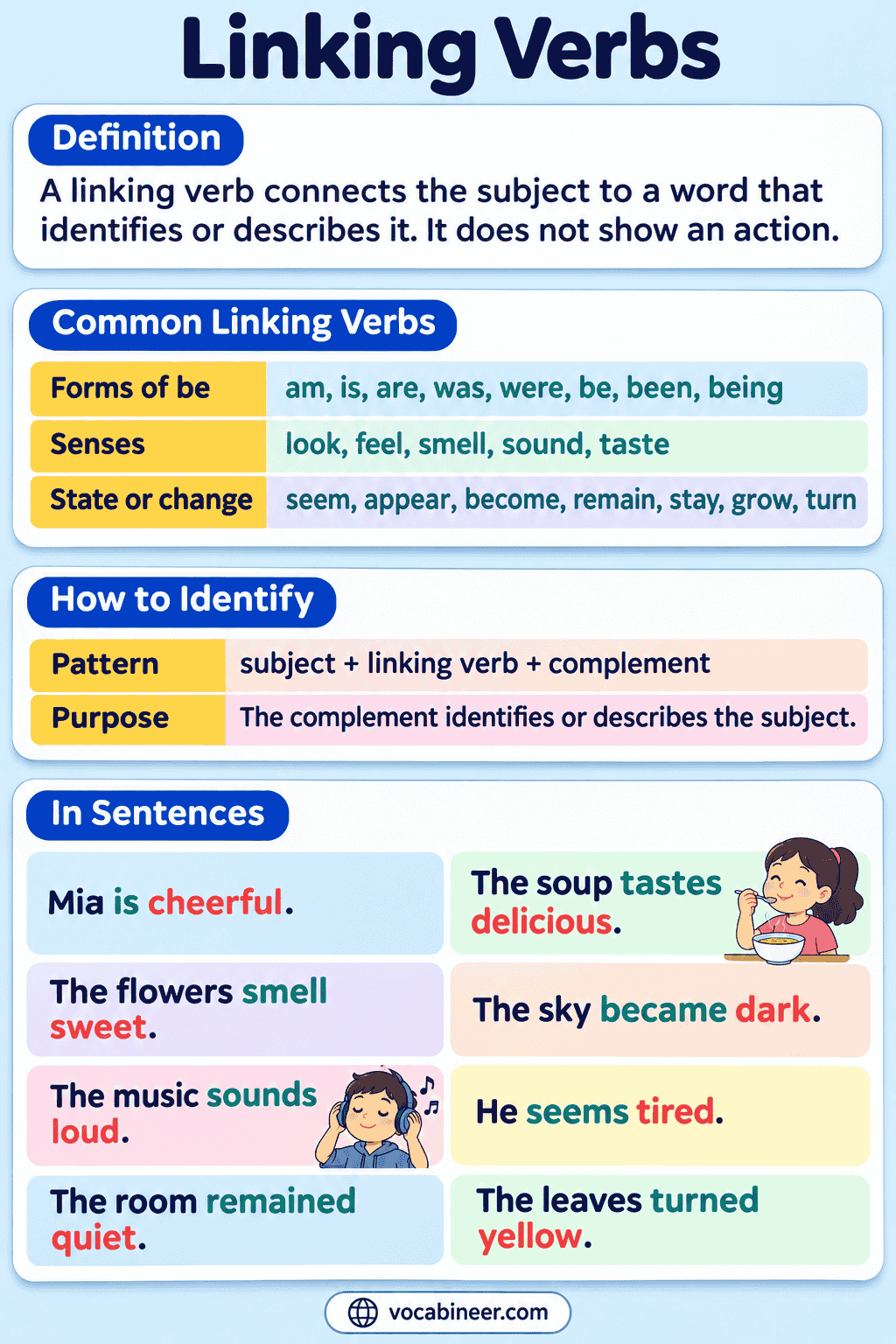
Linking verbs connect the subject of a sentence to information that identifies, describes, or explains it. In The sky is blue, the verb is links the sky to the adjective blue. Unlike an action verb, a linking verb does not show the subject performing an action on an object.
However, recognizing linking verbs requires more than memorizing a list. Words such as look, feel, smell, and grow can function as linking verbs in one sentence and action verbs in another. This guide explains common linking verbs, subject complements, sentence patterns, identification tests, verb phrases, grammar rules, common mistakes, and clear examples.
In This Page
Common Linking Verbs and How They Work
The most common linking verb is be, including its forms am, is, are, was, were, be, being, and been. Other common linking verbs describe appearance, perception, change, continuation, or a resulting condition.
The basic pattern is:
Subject + linking verb + subject complement
In The children seem tired, the sentence has the following parts:
| Sentence Part | Example | Function |
|---|---|---|
| Subject | the children | Names the people being described |
| Linking verb | seem | Connects the subject to its description |
| Subject complement | tired | Describes the subject |
The following table provides a quick overview of common linking verbs.
| Category | Common Linking Verbs | Example |
|---|---|---|
| Forms of be | am, is, are, was, were, be, being, been | The windows are clean. |
| Identity or condition | become, seem | Noor became a pilot. |
| Appearance | appear, look | The road looks narrow. |
| Sensory perception | feel, smell, sound, taste | The bread smells fresh. |
| Change | come, fall, get, go, grow, turn | The leaves turned yellow. |
| Continuing state | keep, remain, stay | Please remain calm. |
| Result | prove | The method proved effective. |
What Is a Linking Verb?
A linking verb connects a subject with a word or phrase that refers back to that subject. Grammarians also call a linking verb a copular verb or copula. Instead of transferring an action to an object, it establishes a relationship between two parts of the sentence.
Consider these examples:
- The garden is beautiful.
- Bilal became an architect.
- Your suggestion sounds reasonable.
- The milk smells sour.
In each sentence, the expression after the bold verb describes or identifies the subject. Beautiful describes the garden, an architect identifies Bilal, reasonable describes your suggestion, and sour describes the milk.
Linking verbs commonly express:
- Identity: She is the manager.
- Condition: The patient seems stable.
- Appearance: The fabric looks expensive.
- Sensory quality: The soup tastes salty.
- Change: The weather became colder.
- Continuing state: The door remained open.
- Result: The task proved difficult.
Linking Verb Sentence Patterns
A linking verb can connect the subject to several kinds of information. The two principal subject complements in traditional school grammar are predicate adjectives and predicate nouns.
| Pattern | Example | Information After the Verb |
|---|---|---|
| Subject + linking verb + adjective | The water feels cold. | Describes the subject |
| Subject + linking verb + adjective phrase | The students seem extremely confident. | Describes the subject in greater detail |
| Subject + linking verb + noun | Sara is captain. | Renames the subject |
| Subject + linking verb + noun phrase | Omar became a skilled engineer. | Identifies the subject |
Forms of be can also connect a subject to expressions of place or time:
- The keys are on the table.
- The guests are outside.
- The meeting is at noon.
Grammar frameworks classify these expressions in different ways. Some classroom grammars treat them broadly as complements after a linking verb, while other approaches call them locative or temporal complements. In either case, they complete the meaning of the clause rather than receive an action.
Types of Linking Verbs
Forms of Be
Forms of be are the most frequent linking verbs. They connect the subject to its identity, description, condition, location, or other information.
| Form | Example |
|---|---|
| am | I am ready. |
| is | The answer is correct. |
| are | The children are cheerful. |
| was | The street was quiet. |
| were | The boxes were heavy. |
| be | Try to be patient. |
| being | He is being careless. |
| been | The journey has been difficult. |
Nevertheless, a form of be is not always a linking verb. In The children are playing, are helps the main verb playing. Therefore, it functions as an auxiliary verb.
Verbs of Appearance and Perception
The verbs appear, look, and seem often connect the subject to an apparent quality or condition.
- The solution appears simple.
- You look tired.
- Her explanation seems accurate.
Context still matters. In The actor appeared on stage, appeared means “arrived” or “became visible” and does not connect the actor to a subject complement.
Sensory Linking Verbs
The verbs feel, smell, sound, and taste function as linking verbs when they describe a quality perceived through the senses.
- The blanket feels soft.
- The flowers smell sweet.
- The engine sounds noisy.
- The sauce tastes spicy.
However, these same words can describe actions. In The chef tasted the sauce, the chef performs the action, and the sauce functions as a direct object.
Verbs That Express Change
Several linking verbs connect the subject to a new condition. Common examples include become, come, fall, get, go, grow, and turn.
- Her dream came true.
- The room fell silent.
- The evenings get colder in November.
- The fruit went bad.
- Everyone grew impatient.
- His face turned red.
These verbs do not always function as linking verbs. For example, The farmer grew wheat contains an action verb and a direct object.
Verbs That Express a Continuing State
The verbs keep, remain, and stay can show that a condition continues.
- Keep quiet during the presentation.
- The cause remains unknown.
- The children stayed calm.
Again, meaning determines function. She kept the receipt uses kept as a transitive action verb, while She kept calm uses it as a linking verb.
Verbs That Express a Result
The verb prove functions as a linking verb when it connects the subject to a resulting judgment or condition.
- The advice proved useful.
- The assignment proved challenging.
By contrast, The evidence proved his innocence uses proved transitively because his innocence receives the action of proving.
Complete List of Common Linking Verbs
No list can determine a verb’s function without context. Still, the following table covers the forms that most often appear as linking verbs.
| Verb | Common Linking Meaning | Example |
|---|---|---|
| be | Exist in an identity or condition | The sky is clear. |
| become | Change into a new state or identity | She became confident. |
| seem | Give an impression | The test seems easy. |
| appear | Seem to have a quality | He appears nervous. |
| look | Have a particular appearance | The room looks spacious. |
| feel | Have a physical or emotional quality | I feel hopeful. |
| smell | Have a particular odor | The soap smells pleasant. |
| sound | Give a particular auditory impression | That plan sounds sensible. |
| taste | Have a particular flavor | The tea tastes bitter. |
| come | Enter a condition | The knot came loose. |
| fall | Enter a condition | The child fell asleep. |
| get | Become | The sky got darker. |
| go | Become, often negatively | The bread went stale. |
| grow | Gradually become | The crowd grew restless. |
| turn | Change into a condition or color | The leaves turned brown. |
| keep | Continue in a condition | Keep safe during the storm. |
| remain | Continue to be | The shop remained closed. |
| stay | Continue in a condition | The food stayed fresh. |
| prove | Turn out to have a quality | The rumor proved false. |
Subject Complements After Linking Verbs
A subject complement completes the meaning of a linking verb by describing or identifying the subject. It refers to the subject rather than to a separate receiver of an action.
Predicate Adjectives
A predicate adjective describes the subject.
- The sand feels warm.
- Your answer is correct.
- The audience grew restless.
Predicate Nouns
A predicate noun, also called a predicate nominative, renames or identifies the subject.
- Hina is a scientist.
- Faisal became the class representative.
- That building was a hospital.
| Complement | Purpose | Example |
|---|---|---|
| Predicate adjective | Describes the subject | The fabric feels smooth. |
| Predicate noun | Renames or identifies the subject | Sana is a teacher. |
How to Identify a Linking Verb
Use the following process instead of relying on a memorized list alone:
- Find the subject of the sentence.
- Locate the verb or complete verb phrase.
- Examine the words after the verb.
- Ask whether those words describe, rename, or identify the subject.
- Check whether the sentence contains a direct object receiving an action.
- Replace the possible linking verb with a suitable form of be.
- Confirm that the original verb expresses a state, condition, identity, appearance, change, or result.
For example, consider The soup smells delicious. The adjective delicious describes the soup, and The soup is delicious keeps the central relationship. Therefore, smells functions as a linking verb.
Now consider Rida smelled the soup. The noun phrase the soup receives the action of smelling. Moreover, Rida is the soup does not preserve the meaning. Therefore, smelled functions as an action verb.
The replacement test provides a useful clue, but it is not an absolute rule. Always confirm the sentence structure and meaning.
Linking Verb Phrases
A linking verb can appear with one or more auxiliary verbs. The entire group forms a verb phrase, but one word functions as the main linking verb.
| Sentence | Complete Verb Phrase | Main Linking Verb |
|---|---|---|
| The plan might become expensive. | might become | become |
| The children have been quiet. | have been | been |
| Her explanation will seem reasonable. | will seem | seem |
| The task could prove difficult. | could prove | prove |
This distinction matters because auxiliary verbs add tense, mood, or other grammatical meaning, while the main linking verb connects the subject to its complement.
Linking Verbs Versus Action Verbs
An action verb tells what the subject does. A linking verb connects the subject to a description or identity. Many sensory and change-of-state verbs can perform either role.
| Linking Verb | Action Verb |
|---|---|
| The soup tastes spicy. | Amina tasted the soup. |
| The flowers smell fresh. | I smelled the flowers. |
| Hamza looks worried. | Hamza looks through the window. |
| The child grew tired. | The farmer grew wheat. |
| The plan proved successful. | The evidence proved his claim. |
Linking Verbs Versus Helping Verbs
A linking verb acts as the main verb and connects the subject to a complement. A helping verb supports another main verb to express tense, voice, mood, or aspect.
| Linking Verb | Helping Verb |
|---|---|
| Mariam is confident. | Mariam is speaking. |
| The rooms were quiet. | The rooms were cleaned. |
| The journey has been difficult. | Ali has been traveling. |
| The door was open. | The door was opened by the guard. |
Linking Verbs Versus Stative Verbs
The term linking verb describes a grammatical function, whereas stative verb describes meaning. Stative verbs express states, thoughts, possession, emotions, or perception. Many linking verbs are stative, but not every stative verb links the subject to a complement.
| Linking Verb | Stative Verb That Is Not Linking |
|---|---|
| Connects a subject to a complement | Expresses a state but may take an object |
| The plan seems reasonable. | I understand the plan. |
| The child feels tired. | The child knows the answer. |
| Reasonable describes the plan. | The plan receives the meaning of understand. |
Linking Verbs Versus Ordinary Intransitive Verbs
Linking verbs do not take direct objects, so they resemble intransitive verbs. However, an ordinary intransitive verb can complete a predicate without linking the subject to a subject complement.
| Linking Verb | Ordinary Intransitive Verb |
|---|---|
| Connects the subject to descriptive or identifying information | Describes an event without a direct object |
| The baby seems tired. | The baby slept. |
| The crowd grew silent. | The crowd laughed. |
Subject Complements, Direct Objects, and Object Complements
These sentence elements can look similar, but they perform different jobs.
| Element | Function | Example |
|---|---|---|
| Subject complement | Describes or renames the subject | Maya became a teacher. |
| Direct object | Receives the action | Maya called the teacher. |
| Object complement | Describes or renames the direct object | They elected Maya captain. |
In Maya became a teacher, Maya and a teacher refer to the same person. In Maya called the teacher, the teacher is a separate participant who receives the action. Finally, in They elected Maya captain, Maya is the direct object, while captain renames that object.
Rules for Using Linking Verbs
Use an Adjective to Describe the Subject
When the word after a linking verb describes the subject, use an adjective rather than an adverb.
| Incorrect | Correct | Reason |
|---|---|---|
| The soup tastes badly. | The soup tastes bad. | Bad describes the soup. |
| The flowers smell sweetly. | The flowers smell sweet. | Sweet describes the flowers. |
| He looks nervously. | He looks nervous. | Nervous describes him. |
An adverb remains appropriate when it modifies an action. For example, He looked nervously at the door uses looked as an action verb, so nervously explains how he looked.
Recognize Well as an Adjective or Adverb
The word well usually functions as an adverb, but it can also serve as an adjective meaning “healthy.”
| Sentence | Function and Meaning |
|---|---|
| I feel good. | Good describes a positive feeling or emotional state. |
| I feel well. | Well is an adjective meaning healthy. |
| She sings well. | Well is an adverb modifying the action sings. |
Make the Verb Agree with the Subject
The linking verb agrees with the subject, not with the predicate noun that follows it.
| Subject | Correct Sentence |
|---|---|
| Singular | Her greatest strength is her communication skills. |
| Plural | Her communication skills are her greatest strength. |
| Singular | The main problem is the delays. |
| Plural | The delays are the main problem. |
If a grammatically correct sentence sounds awkward, rewrite it for clarity: Her greatest strength is her ability to communicate.
Use Continuous Forms Carefully
Many linking verbs describe stable conditions and therefore appear most naturally in simple forms. Still, continuous forms can emphasize a temporary condition, changing appearance, present feeling, or temporary behavior.
| Simple Form | Continuous Form and Its Emphasis |
|---|---|
| You look tired. | You are looking better today. |
| I feel nervous. | I am feeling better now. |
| He is rude. | He is being rude at the moment. |
The continuous form may change the meaning. He is rude presents rudeness as a general characteristic, while He is being rude describes temporary behavior.
Linking Verbs in Different Tenses
Linking verbs change form to express time. Auxiliary verbs may join the main linking verb in perfect, future, or modal constructions.
| Tense or Construction | Example |
|---|---|
| Present | The room is quiet. |
| Past | The room was quiet. |
| Future | The room will be quiet. |
| Present perfect | The room has remained quiet. |
| Past perfect | The room had become quiet. |
| Future perfect | The room will have been empty for a week. |
| Modal | The task may prove difficult. |
| Continuous | The weather is getting colder. |
Affirmative, Negative, and Question Forms
Forms of be create negatives by adding not and form questions by moving before the subject. Most other linking verbs use do, does, or did in simple-tense negatives and questions.
| Sentence Type | Form of Be | Other Linking Verb |
|---|---|---|
| Affirmative | The room is warm. | The plan seems practical. |
| Negative | The room is not warm. | The plan does not seem practical. |
| Question | Is the room warm? | Does the plan seem practical? |
| Past negative | The room was not warm. | The plan did not seem practical. |
| Past question | Was the room warm? | Did the plan seem practical? |
Special Uses of Be
Contractions
Contractions occur frequently in conversation and informal writing.
| Full Form | Contraction | Full Form | Contraction |
|---|---|---|---|
| I am | I’m | is not | isn’t |
| he is | he’s | are not | aren’t |
| she is | she’s | was not | wasn’t |
| it is | it’s | were not | weren’t |
| we are | we’re | I am not | I’m not |
| they are | they’re | they are not | they aren’t |
Dummy-Subject Constructions
Not every sentence containing be follows a simple subject–linking verb–subject complement pattern.
| Sentence | Explanation |
|---|---|
| There is a problem. | There introduces an existential construction; a problem names what exists. |
| It is raining. | It is a dummy weather subject, and is helps form the continuous verb is raining. |
| It is five o’clock. | It functions as a dummy subject in an expression of time. |
Therefore, readers should analyze the whole clause instead of labeling every form of be as a linking verb automatically.
Pronouns After Be
Traditional formal grammar often favors a subject-form pronoun after a linking form of be. Everyday English, however, commonly uses an object-form pronoun in this position.
| Formal Style | Natural Conversational Style |
|---|---|
| It is I. | It is me. |
| The caller was she. | The caller was her. |
| The winners were they. | The winners were them. |
Both patterns appear in modern English, but the conversational versions sound more natural in most ordinary situations. Writers can choose according to tone and context.
Common Mistakes with Linking Verbs
Treating Every Verb on the List as Linking
| Incorrect Assumption | Correct Analysis |
|---|---|
| Smell is always a linking verb. | It links in The rose smells sweet but shows action in She smelled the rose. |
| Grow is always an action verb. | It shows action in They grow rice but links in They grew tired. |
Assuming Every Form of Be Is Linking
| Sentence | Function of Be |
|---|---|
| The child is sleepy. | Linking verb |
| The child is sleeping. | Auxiliary verb |
| The window was broken by the ball. | Auxiliary in a passive construction |
Using an Adverb as a Subject Description
| Incorrect | Correct |
|---|---|
| The music sounds beautifully. | The music sounds beautiful. |
| She appears calmly. | She appears calm. |
Mistaking a Complement for a Direct Object
| Incorrect Interpretation | Correct Interpretation |
|---|---|
| A doctor is the object in Hamid became a doctor. | A doctor is a subject complement that identifies Hamid. |
| Cold is the object in The water feels cold. | Cold is a predicate adjective that describes the water. |
Relying Only on the Replacement Test
| Weak Method | Better Method |
|---|---|
| Replace the verb with is and stop. | Check meaning, sentence structure, the complement, and the presence or absence of a direct object. |
Linking Verb Examples in Sentences
| Category | Example Sentence |
|---|---|
| Form of be | The classroom is bright. |
| Form of be | My aunt was a nurse. |
| Identity | Farah became the director. |
| Condition | The patient seems comfortable. |
| Appearance | Your garden looks beautiful. |
| Appearance | The instructions appear clear. |
| Touch | The metal feels cold. |
| Smell | The coffee smells strong. |
| Sound | Your idea sounds promising. |
| Taste | The mango tastes sweet. |
| Change | The nights grew longer. |
| Change | The traffic light turned green. |
| Change | The bread went stale. |
| Change | Everyone fell silent. |
| Continuing state | The door remained locked. |
| Continuing state | The children stayed cheerful. |
| Result | The journey proved exhausting. |
| Verb phrase | The decision might seem unfair. |
| Perfect form | The weather has remained pleasant. |
| Continuous change | The situation is getting serious. |
FAQs
A linking verb connects the subject of a sentence to information that describes, identifies, or explains it. For example, is links the sky to blue in “The sky is blue.”
The most common linking verbs include forms of be, along with become, seem, appear, feel, look, smell, sound, and taste. Verbs such as grow, turn, remain, and prove can also function as linking verbs in particular contexts.
No. A form of be functions as a linking verb when it connects the subject to a complement, as in “The room is quiet.” It functions as an auxiliary verb when it helps another verb, as in “The children are playing.”
Find the subject and determine whether the verb connects it to a word or phrase that describes or renames it. The be replacement test can help, but context, sentence structure, and the absence of a direct object provide stronger evidence.
Yes. Many verbs change function according to context. Tastes is linking in “The soup tastes salty,” but it expresses an action in “The chef tastes the soup.”
Conclusion
Linking verbs connect a subject to information about its identity, description, condition, appearance, or change. Forms of be perform this role most often, although sensory verbs and several change-of-state verbs can also act as links. Because many of these words perform other functions, analyze the complete sentence, locate the complement, and use meaning—not memorization alone—to identify the verb correctly.
Read More
- Parts of Speech in English
- Nouns in English with Examples
- Common and Proper Nouns
- Countable and uncountable nouns
- Collective nouns
- Abstract and concrete nouns
- Gender nouns
- Compound nouns
- Possessive nouns
- Singular and plural nouns
- Plural noun rules